Comparisons
Martial Arts Gym Software: Compare Features and Costs
Compare martial arts gym software, pricing models, billing, rank tracking, and automation. Use the vendor table and scorecard to choose with confidence.
 Watch · 20s
Martial arts gym software has to manage more than class bookings. A school may need family billing, rank restrictions, belt testing, recurring memberships, intro appointments, attendance alerts, waivers, and communication with both students and guardians. The best choice is not necessarily the platform with the most features; it is the one that handles your school’s real workflows without creating extra front-desk work.
This guide compares established options, explains common pricing models, and provides a scorecard you can copy into a spreadsheet. Product features and pricing change, so confirm every critical requirement in a live demo and written proposal before signing.
Martial arts gym software comparison
The platforms below represent different approaches: martial-arts-specific systems, broader fitness platforms, and automation-focused operating systems. This is a starting shortlist, not a ranking.
| Platform | Best initial fit | Notable areas to evaluate | Potential limitation or buying question | Pricing consideration |
|---|---|---|---|---|
| Kicksite | Schools wanting martial-arts-specific administration | Student management, rank tracking, attendance, billing and communication | Test family-account exceptions, reporting depth and required integrations | Confirm plan limits, messaging charges, onboarding and payment processing terms |
| Spark Membership | Martial arts schools emphasizing sales and member communication | Lead management, memberships, billing, marketing and school operations | Verify that rank, testing and reporting workflows match your curriculum | Request current plan, processing, communication and implementation costs |
| Zen Planner | Schools needing membership, attendance and belt or skill tracking | Scheduling, billing, attendance, member records and progression features | Review staff usability, customer booking flow and customization needs | Confirm subscription scope, setup services, payment terms and add-ons |
| Gymdesk | Independent schools seeking a streamlined management platform | Memberships, billing, attendance, scheduling, website tools and martial arts features | Test advanced automation, multi-location controls and complex reporting | Check current plan thresholds, processing choices and messaging usage |
| WellnessLiving | Schools also operating broader fitness or wellness programs | Scheduling, memberships, marketing, customer apps and multi-service operations | The breadth may add configuration work for a straightforward dojo | Ask which modules, apps, setup services and communication features cost extra |
| Mindbody | Larger or multi-service businesses needing a broad marketplace and business platform | Scheduling, payments, marketing, reporting and multi-location capabilities | Evaluate complexity, martial-arts-specific progression needs and contract terms | Obtain a complete quote for locations, modules, processing and implementation |
| WTF Go with Fitty | Operators prioritizing lead response, booking, follow-up and dues conversations | Unified operations plus an AI receptionist for routine prospect and member interactions | Confirm martial arts progression depth, channel coverage, integrations and human escalation rules | Request pricing based on locations, communication volume, payments and required modules |
Do not infer that a checked feature name means identical functionality. For example, two platforms may both offer “family accounts,” while only one supports separate memberships, payment methods, guardians and billing dates within the same household.
Which type of platform fits your school?
Martial-arts-specific software
A specialized system is often the first place to look when belt progression, testing eligibility and rank-restricted classes are central to operations. The tradeoff may be less depth in broader marketing, advanced automation or services outside martial arts.
Ask the vendor to demonstrate your progression rules rather than showing a generic belt list. Confirm whether instructors can record evaluations, whether eligibility is calculated or manually filtered, and how promotion history is exported.
General fitness or wellness software
A broader platform can fit businesses combining martial arts with fitness classes, personal training, camps, recovery services or wellness appointments. These systems may offer wider scheduling and marketing capabilities, but rank progression can require custom fields or a separate process.
Map those workarounds before buying. A feature that depends on repeated manual exports is not truly integrated.
Automation-first operating systems
An automation-focused platform can help when leads arrive after hours, staff miss follow-ups, or routine payment conversations consume front-desk time. Fitty, WTF Go’s AI receptionist, is designed to answer routine inquiries, book classes, follow up and assist with dues collection workflows around the clock.
That does not mean an AI agent should operate without controls. Its results depend on accurate schedules, pricing rules, approved responses, connected systems and escalation design. It should hand off sensitive disputes, unusual account changes, emergencies and conversations requiring staff judgment. During evaluation, verify supported communication channels, integration behavior, conversation records, consent controls and what happens when the agent cannot answer confidently.
Features that deserve a live workflow test
Leads, intros and follow-up
Submit a test inquiry from your own phone. Evaluate whether the system can:
- Identify the requested program and student age
- Offer an appropriate intro class
- respect class capacity and eligibility rules
- Send confirmations and reminders
- Recognize replies rather than continuing a fixed message sequence
- Follow up after a no-show
- Transfer the conversation to a staff member with context
- Attribute the lead to the correct source
Also verify how staff stop automation when a prospect objects, enrolls or asks not to receive messages.
Family accounts
Create a household with two children in different programs and one adult payer. Then freeze one membership, change the other student’s schedule and update the family’s payment method. Check whether the system preserves separate attendance, rank and membership records without duplicating the guardian.
Billing and collections
Ask vendors to demonstrate enrollment, proration, failed payments, refunds, freezes, future changes and cancellations. Review who controls retry timing and whether staff can see the full transaction trail.
Payment-data portability requires careful wording. Stored card or bank details are usually represented by secure tokens rather than exposed account numbers. Whether tokens can move to a new system depends on the current and future payment processors, tokenization arrangements, merchant contracts, vendor cooperation and applicable security requirements. A processor-assisted migration may be possible, but it is never safe to assume that saved methods will transfer. Obtain the process and responsibilities in writing.
Attendance and retention signals
Attendance should produce action, not merely a historical report. Test whether staff can identify students whose attendance has declined, contact the correct guardian and record the intervention. For multi-location schools, confirm whether attendance and eligibility follow a student across approved locations.
Rank and testing management
Use a real upcoming test as the scenario. Determine whether the software can filter eligibility by rank, time, attendance, instructor approval or your own criteria. Test registration, testing fees, result recording and promotion history.
What martial arts software actually costs
There is no responsible universal price range. Vendors change plans, bundle different modules and price according to factors such as locations, active members, staff users, communication volume or payment processing. A low subscription can also carry higher usage or implementation costs.
Common pricing components include:
- Monthly or annual platform subscription
- Per-location, per-user or member-based charges
- Card and ACH processing costs
- Text, voice or email usage
- Branded app or website modules
- Setup, data migration and training
- Check-in hardware
- Premium reporting, marketing or automation
- Integration fees
- Contract termination or data-export charges
Request a written quote using the same operating assumptions for every vendor. Include your number of locations, staff accounts, active records, expected messages, payment mix and required modules.
A worked total-cost comparison template
Use this formula rather than comparing headline subscriptions:
Annual total cost = subscription + location fees + user fees + communication usage + payment costs + add-ons + implementation + hardware + migration + expected internal labor
For a side-by-side comparison, create these three scenarios:
| Cost item | Vendor A | Vendor B | Vendor C |
|---|---|---|---|
| Annual subscription and required modules | Enter quote | Enter quote | Enter quote |
| Processing under your actual payment mix | Calculate | Calculate | Calculate |
| Expected messaging and voice usage | Calculate | Calculate | Calculate |
| First-year setup, migration and hardware | Enter quote | Enter quote | Enter quote |
| Internal setup and reconciliation hours | Estimate | Estimate | Estimate |
| Tools the platform would replace | Subtract | Subtract | Subtract |
| First-year total | Sum | Sum | Sum |
| Ongoing annual total | Exclude one-time costs | Exclude one-time costs | Exclude one-time costs |
For payment costs, apply each vendor’s written terms to the same recent month of transactions, then annualize that result. Do not use a vendor’s generic “typical business” example; your card mix, ACH usage, transaction sizes and chargeback activity may differ.
Copyable weighted scorecard
Copy this table into a spreadsheet. Score each platform from 0 to 5:
- 0: Not available
- 1: Requires an impractical workaround
- 2: Partially meets the requirement
- 3: Meets the requirement
- 4: Meets it well with minor advantages
- 5: Excellent fit proven in your test
Calculate each result as score ÷ 5 × weight. The maximum weighted total is 100.
| Criterion | Weight | Vendor score, 0–5 | Weighted result |
|---|---|---|---|
| Membership billing and exception handling | 15 | ||
| Family and guardian accounts | 10 | ||
| Scheduling, eligibility and attendance | 10 | ||
| Rank progression and belt testing | 10 | ||
| Lead capture, intro booking and follow-up | 10 | ||
| Communication and human handoff | 8 | ||
| Reporting and actionable retention signals | 8 | ||
| Staff permissions, security and audit history | 8 | ||
| Data export and migration terms | 6 | ||
| Integrations and API capabilities | 5 | ||
| Staff and customer usability | 5 | ||
| Support and implementation quality | 3 | ||
| Total cost and contract flexibility | 2 | ||
| Total | 100 |
Adjust the weights before seeing vendor scores. If rank tracking is essential, make it a pass/fail requirement as well as a weighted criterion. A high total should not rescue a platform that fails a non-negotiable workflow.
Run demos with the same script
Give every shortlisted vendor these tasks:
- Capture a web lead and book an age-appropriate intro.
- Follow up after the prospect misses the appointment.
- Enroll two siblings with separate programs under one payer.
- Restrict a class by age or rank.
- Freeze one membership and future-date another change.
- Recover a failed payment while preserving an audit trail.
- Find students with declining attendance.
- Produce a belt-testing eligibility list.
- Limit an instructor to attendance and progression access.
- Export student, membership, attendance and transaction data.
Mark each task as native, integration-dependent, manual workaround or unavailable. Ask to see current functionality; roadmap commitments should not receive points.
Make the decision on evidence
Choose martial arts gym software based on demonstrated workflows, full costs and contract terms—not a polished dashboard. Speak with support during the trial, inspect the mobile customer experience and request documentation for data exports, processor transitions and cancellation.
The right system should give staff fewer places to check, make billing records easier to trust and turn lead and attendance information into clear next actions. If a platform cannot handle your most common exceptions in a controlled demo, those exceptions will become your team’s daily workload.
Frequently asked questions
What is the best martial arts gym software?
There is no single best platform for every school. Kicksite, Spark Membership, Zen Planner, Gymdesk, WellnessLiving, Mindbody and WTF Go serve different needs; compare them using your billing, family, rank, lead and multi-location workflows.
How much does martial arts gym software cost?
Cost depends on the subscription model, locations, users, payment processing, messaging, modules, migration and support. Request itemized quotes and compare both first-year and ongoing total cost using identical assumptions.
Can saved payment methods transfer to new martial arts software?
Sometimes, but portability depends on processors, tokenization arrangements, contracts, vendor cooperation and security requirements. Get written confirmation from both the current and future providers before planning a migration.
Does martial arts software track belts and testing eligibility?
Many martial-arts-specific platforms track rank and promotion history, but eligibility rules and testing workflows vary. Ask the vendor to demonstrate your actual attendance, time-in-rank and instructor-approval requirements.
Should a martial arts school use AI for lead follow-up?
AI can handle routine replies, booking and follow-up when schedules, rules and escalation paths are configured correctly. Staff should retain control over sensitive disputes, unusual account changes, emergencies and conversations requiring judgment.
Keep reading
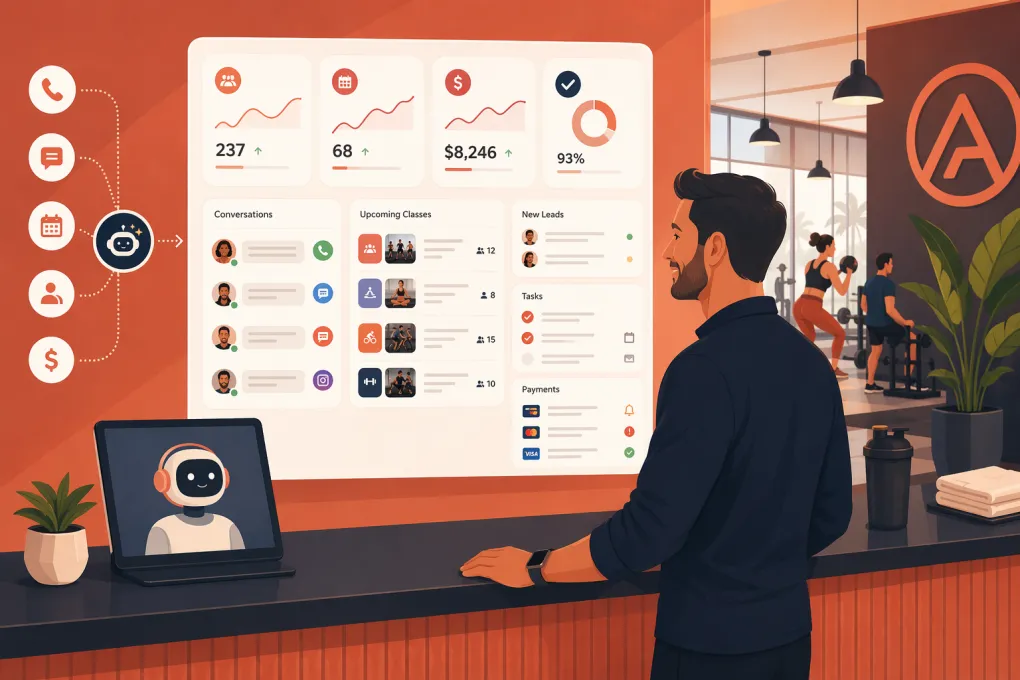


Run your gym on autopilot with WTF Go
Fitty — your AI receptionist — answers calls and DMs, fills classes, follows up with every lead, and collects dues while you coach.