Comparisons
Glofox Alternative Guide: Compare 7 Gym Software Platforms
Compare each Glofox alternative across CRM, booking, payments, automation, pricing visibility, contracts, support, and migration before you switch platforms.
 Watch · 20s
A search for a Glofox alternative usually starts with a specific operational problem—not a desire for more features. Perhaps leads wait too long for replies, appointment scheduling requires another tool, payment follow-up consumes staff time, or management cannot get a clean view across locations.
This comparison uses publicly available vendor product pages, help centers and pricing pages linked throughout. It is not presented as a hands-on lab test, and vendor claims should be verified in a live demo using your own workflows. Pricing, packaging, processor arrangements and contract terms can change, so obtain them in writing before making a decision.
Glofox alternatives at a glance
Use Glofox as the baseline. Its published platform covers lead management, memberships, class scheduling, booking, payments, communications, reporting and branded member apps. The question is where another platform offers a more decisive fit for your operating model.
| Platform | CRM and automation | Classes and appointments | Multi-location | Payments and integrations | Pricing and migration visibility |
|---|---|---|---|---|---|
| Glofox | Lead capture, sales workflows and member communications | Strong class and membership focus; verify complex service-resource scheduling | Available for multi-location operators | Integrated payments and third-party connections; confirm processor terms | Pricing is sales-led; request contract length, implementation scope and export terms |
| WTF Go | CRM plus Fitty, an AI agent positioned to answer, follow up, book and pursue dues | Built for gyms, studios, spas and mixed wellness services | Verify hierarchy, consolidated reporting and location-specific AI knowledge | Payment and operational workflows are integrated; request the current integration list | Request a quote, implementation plan, data map and AI usage terms |
| Mindbody | Marketing, lead management and automated communications across a broad ecosystem | Supports fitness classes and wellness appointments | Established multi-location capabilities; test central versus local permissions | Integrated payment services and a large partner ecosystem | Pricing is plan-based but requires careful confirmation of add-ons, implementation and contract terms |
| Mariana Tek | Boutique-fitness sales and member-engagement workflows | Strong class-based boutique experience; appointment-heavy businesses should verify fit | Designed with multi-location boutique brands in mind | Integrated commerce and selected partner connections | Sales-led pricing and implementation; likely more process than a small single site needs |
| PushPress | Gym-oriented lead and member workflows, with automation varying by product and plan | Strong fit for recurring gym memberships and classes; verify spa-style appointments | Multi-location functionality is available; test consolidated controls | PushPress Payments and published integrations | A public pricing page improves initial comparison; confirm processing, setup and migration costs |
| TeamUp | Member communications and integrations rather than a broad, all-in-one sales stack | Clear class, course and membership administration; appointments should be tested | Supports multiple venues; verify requirements for separately managed locations | Connects with payment and integration partners | Public pricing is based on active customers; confirm migration assistance and message costs |
| Gymdesk | Lead management, automations and member administration for independent facilities | Good gym and martial-arts fit; test complex provider, room and treatment scheduling | Supports multi-location operations; confirm reporting depth | Payment processing and integrations are documented publicly | Public pricing makes budgeting easier; confirm data-import scope and any processor differences |
| Vagaro | Marketing, messaging and client-management tools | Strong appointment, provider and resource scheduling, plus classes | Supports multiple locations and service providers | Vagaro Merchant Services and an app marketplace | Public base pricing is available, but add-ons and payment terms require a full quote |
“Available” does not mean “equivalent.” For example, two products may both support appointments while only one can automatically assign a room, observe a cleanup buffer and prevent a provider conflict. Make every finalist demonstrate your actual rules.
Where each alternative is meaningfully different
WTF Go: when unattended conversations are the bottleneck
WTF Go’s key distinction is Fitty. According to WTF Go’s product information, Fitty is an AI receptionist and agent designed to answer leads, book classes, conduct follow-up and collect dues around the clock. That could reduce the number of conversations waiting for a staffed front desk, but it should be evaluated as rigorously as any competitor’s automation.
In a demo, test Fitty with:
- A new lead asking about price, childcare and beginner suitability
- A prospect who stops replying after asking for a trial
- A member trying to book an ineligible class
- A past-due member who disputes the balance
- A question that requires escalation to a person
- An opt-out request or sensitive account issue
Ask where responses get their information, how location-specific rules are maintained, what the human handoff looks like, and whether conversations remain visible in the member record. Also confirm which actions require staff approval. Fitty is most relevant when lead response and repetitive front-desk work are the central problems—not merely because “AI” appears on a feature list.
Mindbody: when ecosystem breadth matters
Mindbody’s decisive advantage is breadth. Its business platform spans fitness and wellness scheduling, client management, marketing, payments and consumer discovery. That makes it a serious option for businesses combining classes, appointments and multiple service providers.
The tradeoff is that broad platforms require careful package comparison. Determine which marketing, branded-app, reporting and communication capabilities are included versus sold separately. Ask support to demonstrate a failed-payment resolution, cross-location client record and refund—not only the consumer booking flow.
Mindbody is a stronger candidate than Glofox when appointment-led wellness services or ecosystem reach are major requirements. It may be excessive if the business wants a narrowly focused class and membership system.
Mariana Tek: when boutique class experience is the priority
Mariana Tek focuses on boutique fitness brands, particularly class-led and multi-location operations. Its positioning emphasizes consumer experience, flexible configurations and centralized brand operations.
That focus can be an advantage for established boutique concepts with demanding class-pack, waitlist and location requirements. It is less obviously suited to a small open-access gym or an appointment-led spa. Pricing is not presented as simple self-service purchasing, so operators should expect a sales and implementation process and ask for a complete recurring-cost schedule.
Compared with Glofox, the decisive question is not whether both can schedule classes. It is whether Mariana Tek better supports the brand’s specific cross-location purchase, booking and member-experience rules.
PushPress: when conventional gym workflows should stay simple
PushPress is oriented toward gyms and fitness businesses managing leads, recurring memberships, classes, check-ins and payments. Its public product and pricing information makes it easier to establish an initial shortlist than platforms that disclose little before a sales call.
It is a practical candidate for strength, functional-fitness and community-based gyms. Appointment-heavy spa workflows, complicated treatment resources or extensive enterprise permissions require closer testing. Compare PushPress with Glofox by timing routine tasks such as adding a membership, pausing an account, checking in a member and resolving a failed payment.
TeamUp: when focused class administration matters more than a large suite
TeamUp concentrates on memberships, classes, courses, customer administration and related integrations. Its pricing page ties cost to active-customer volume, giving operators a visible basis for estimating software expense.
The focused approach can suit independent studios that want understandable administration without a large marketplace ecosystem. Businesses needing sophisticated native sales automation, spa-resource scheduling or enterprise-style location controls should test those areas closely.
TeamUp may be a better Glofox alternative when administrative simplicity and transparent pricing logic outweigh the need for a broader built-in growth stack.
Gymdesk: when an independent gym wants visible pricing
Gymdesk publishes pricing and describes features for gyms, martial-arts schools and related membership businesses. Its scope includes member management, billing, attendance, scheduling, marketing functions and website integrations.
The decisive advantage is straightforward evaluation for smaller operators: product scope and subscription structure can be reviewed before a sales conversation. The limitation is fit rather than an obvious missing checkbox. A spa, a complex franchise hierarchy or a business with intricate provider compensation should run deeper workflow tests.
Vagaro: when appointments drive the schedule
Vagaro is the clearest alternative in this group for appointment-led spas and wellness businesses. Provider calendars, services, rooms, resources and appointment commerce are more central to its model than they are in class-first gym platforms.
Vagaro also supports classes and memberships, but a gym should verify recurring billing rules, access control, class packs, attendance and freezes. Add-ons can affect the final software cost, and payment processing should be reviewed alongside subscription pricing.
Choose it over Glofox when appointment and provider utilization are more important than a boutique class experience—not simply because the business happens to offer one bookable service.
Compare pricing, contracts, support and payments correctly
A monthly software price is not the total commercial agreement. Request a written cost sheet from Glofox and every alternative covering:
- Base subscription by location
- Required onboarding or implementation
- Branded app, marketing, messaging and AI charges
- Payment-processing rates and fixed transaction charges
- Hardware, access-control and integration costs
- Data migration and staff training
- Contract length, renewal and cancellation notice
- Data export format and post-termination access
For support, ask which channels are included, their staffed hours, and how payment outages or launch-blocking problems are escalated. “Support included” is not enough. Submit a technical scenario during the sales process and assess the specificity of the response.
Processor terms deserve separate review. Confirm whether you can retain your current processor, whether stored payment credentials can be transferred, who handles chargebacks, and how quickly deposits are reconciled. Never assume saved cards will migrate with ordinary member data.
Use the same proof-based demo for every finalist
Give each vendor the same anonymized test script:
- Capture an after-hours lead and book a trial.
- Sell a recurring membership with a future start date.
- Move a member from a waitlist after a cancellation.
- Freeze an account and show the billing effect.
- Recover a failed payment without duplicate staff outreach.
- Schedule an appointment requiring both a provider and room.
- Produce location-level sales, attendance and unpaid-balance reports.
- Export the resulting member record and communication history.
Have a front-desk employee and a manager score the number of manual steps, system handoffs and unresolved questions. Request documentation for capabilities that cannot be shown live.
The right Glofox alternative is the platform that handles your frequent and expensive workflows most reliably. A shorter feature list with clean execution is usually more useful than broad functionality that depends on workarounds.
Frequently asked questions
What is the best Glofox alternative for an independent gym?
PushPress, Gymdesk, TeamUp and WTF Go are reasonable candidates, depending on whether your priority is simple gym administration, visible pricing, class management or AI-led follow-up. Test each one with your billing and booking rules.
Which Glofox alternative is best for a spa or appointment-led studio?
Vagaro and Mindbody deserve consideration when providers, rooms and appointment services drive the schedule. Verify recurring memberships and class rules if fitness remains a substantial part of the business.
Which alternative offers AI lead follow-up?
WTF Go positions Fitty as an AI receptionist that answers leads, books classes, follows up and collects dues. Require a live test of real questions, escalation, consent handling and staff visibility before deciding.
Are Glofox alternatives cheaper?
Not necessarily. Compare subscription fees together with add-ons, implementation, messaging, payment processing, hardware and contract obligations. Public base pricing rarely captures the entire operating cost.
Can payment details and member data be migrated from Glofox?
Member records can generally be exported, but the available fields and cleanup work must be confirmed. Stored payment credentials depend on processor and token-transfer rules, so obtain written confirmation before choosing a cutover date.
Keep reading
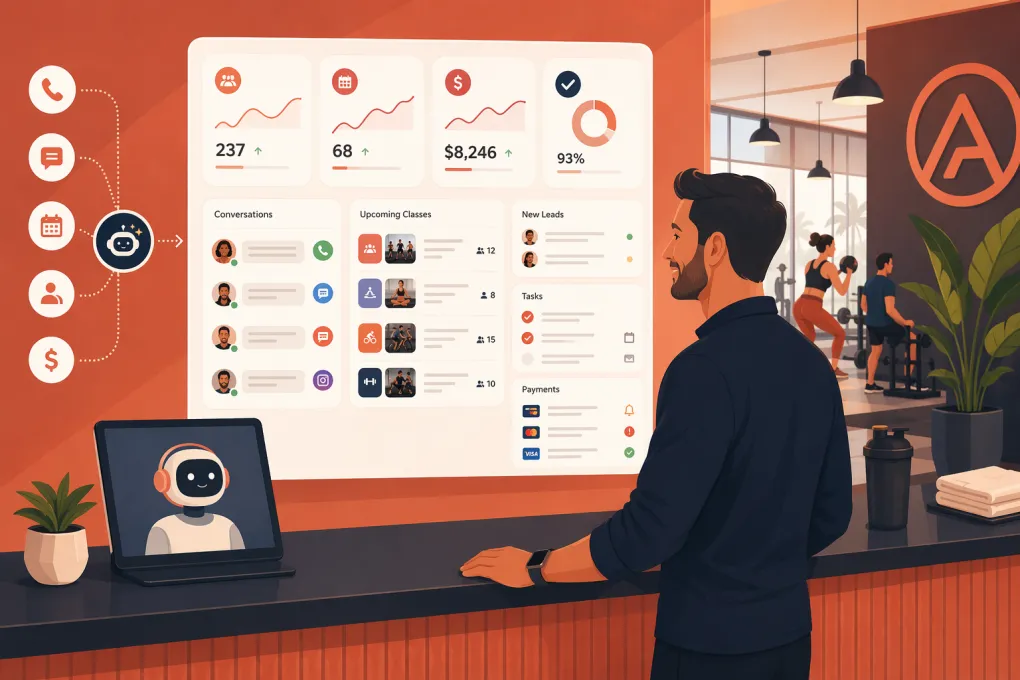


Run your gym on autopilot with WTF Go
Fitty — your AI receptionist — answers calls and DMs, fills classes, follows up with every lead, and collects dues while you coach.