Comparisons
Yoga Studio Software: Compare the Best Options for 2026
Compare yoga studio software for booking, memberships, payments, integrations, migration, and AI follow-up using a practical buyer-focused framework.

Yoga studio software should reduce front-desk work, not relocate it into a different dashboard. If staff still answer every pricing question, manually chase introductory-offer buyers, reconcile class packs, and track failed payments in spreadsheets, the platform is only solving part of the job.
A serious comparison must go beyond whether each product has “booking” or “automation.” You need to know how it handles your actual memberships, what costs extra, whether it connects to the rest of your stack, and what happens when an automated conversation needs a person.
This guide compares representative options using an operator-focused evaluation framework—and clearly identifies where public information is incomplete.
How these platforms were evaluated
This is an editorial desk-research comparison, not a claim of hands-on laboratory testing. WTF Go did not receive controlled trial accounts for every competing platform, so we are not presenting invented screenshots, test results, or mystery-shopper findings.
The comparison uses publicly described product capabilities and vendor documentation across seven criteria:
- Class, appointment, and waitlist workflows
- Memberships, class packs, and payments
- Lead capture, follow-up, and automation
- Multi-location operations and permissions
- Integrations and API availability
- Onboarding, support, and migration assistance
- Public pricing structure and likely add-on exposure
Pricing and packaging can change. Exact contract pricing should come from a written vendor quote that includes implementation, messaging, payment processing, add-ons, and every location. Links below point to vendor pages so buyers can check the current source of truth.
What yoga studio software must handle
A scheduler publishes classes. A studio operating system connects the entire customer journey:
- Inquiry and lead capture
- Introductory offer purchase
- First class booking
- Waiver and payment collection
- Attendance and no-show management
- Membership conversion
- Failed-payment recovery
- Retention communication
- Cancellation, freeze, and reactivation
The gaps between those steps create work. A website form sends an email, someone copies the lead into a CRM, another tool handles texts, and the booking platform never records the conversation. That makes it difficult to see which leads were answered, which intro buyers attended, and which members need intervention.
If lead response and payment follow-up are falling between systems, see how Fitty connects yoga inquiries, bookings, follow-up, and dues workflows.
Yoga studio software comparison
| Platform | Booking and core operations | Lead handling and automation | Integrations and multi-location | Support and migration | Pricing structure | Best fit and limitations |
|---|---|---|---|---|---|---|
| WTF Go | Combines studio operations, booking, customer records, payments, and front-desk workflows | Fitty is an AI receptionist and agent for answering leads, booking eligible classes, following up, and supporting dues collection | Intended for gyms, studios, spas, and wellness operators, including businesses needing connected workflows; confirm required third-party integrations and location permissions during discovery | Implementation and migration scope should be documented in the proposal, including imported records and payment-data handling | No stable public self-service price list; request a quote based on locations and required workflows | Strong candidate when unattended inquiries and repetitive front-desk work are primary problems. Buyers needing a particular accounting, access-control, or legacy integration should require a technical confirmation before signing. |
| Mindbody | Broad class and appointment scheduling, memberships, payments, staff management, reporting, and consumer marketplace exposure | Marketing and lead-management capabilities are available, but access and depth depend on package and purchased services | Supports integrations through its partner ecosystem and developer platform; commonly used by multi-location fitness and wellness businesses | Offers onboarding and support, with service levels and implementation scope dependent on the agreement; migration details should be written into the order | Quote-based packaging. Higher packages and optional services can affect total cost; use the current Mindbody business pricing page | Best for operators wanting a mature wellness platform and marketplace presence. Breadth can mean more configuration, package complexity, and staff training. |
| WellnessLiving | Classes, appointments, memberships, payments, client profiles, staff management, rewards, and marketing functions | Automated communication and marketing tools are available, with advanced functionality varying by package or add-on | Supports multi-location businesses and offers integrations; buyers should map every required system against the vendor’s current integration directory | Promotes onboarding and migration assistance, but the exact records transferred, cleanup responsibilities, and timeline belong in the contract | Tiered or quote-led packaging depending on requirements; consult the live WellnessLiving pricing page | Suitable for studios wanting a broad management suite. Carefully compare which marketing, branded-app, reporting, and enterprise functions are included versus added. |
| Momence | Scheduling, memberships, events, courses, payments, waivers, and customer communication for fitness and wellness businesses | Supports campaigns and customer communication; test whether lead ownership, missed-call response, and multi-step follow-up match your sales process | Offers external connections and tools for expanding businesses; confirm API or connector access at the plan being quoted | Migration and onboarding assistance may depend on package and sales scope; request a field-level migration map | Packaging and transaction economics can vary by product configuration; review current details on the Momence pricing page | Worth considering for studios running classes, workshops, teacher training, or events. Operators with complex cross-location memberships should demo those rules live. |
| Vagaro | Supports classes and appointments, memberships, packages, forms, payments, staff calendars, and marketplace discovery | Marketing, messaging, forms, and related business tools are available, with several capabilities sold as add-ons | Particularly relevant to mixed-service businesses spanning yoga, massage, beauty, or wellness; supports multiple staff and locations | Vagaro advertises customer support and setup resources; data conversion eligibility and scope should be confirmed for the source system | Base pricing is structured around bookable calendars, with additional features and services affecting the total. Check the live Vagaro pricing page for current US rates | Good for businesses combining classes with appointment-based services. Add every calendar, location, marketing feature, hardware item, and payment cost before comparing totals. |
| Acuity Scheduling | Strong self-service appointment scheduling, packages, subscriptions, forms, reminders, and calendar coordination | Supports reminders and intake workflows but is not positioned as a full fitness sales CRM or autonomous receptionist | Connects with common calendars, payment tools, video platforms, and other business applications; multi-location studio controls are less central than in dedicated fitness suites | Primarily a self-service SaaS product with online support resources; migration is generally lighter and more operator-led | Public tiered subscription pricing is available on the Acuity pricing page | Best for private yoga, consultations, and appointment-led businesses. A class-heavy studio may need separate CRM, attendance, membership, and retention tools. |
Why other platforms are not in the main table
The market is larger than six products. The shortlist intentionally represents different operating models rather than claiming to rank every vendor.
Zen Planner is another established fitness-management option worth reviewing, particularly for membership-based studios. Mariana Tek is frequently evaluated by larger boutique fitness brands. OfferingTree, Arketa, Punchpass, TeamUp, and similar products may fit independent studios seeking different balances of simplicity, content delivery, marketing, or class management.
They were omitted to keep the table usable—not because they are automatically weaker. Add them to your shortlist if they match your size, geography, service mix, or required workflow. The same seven evaluation criteria should apply to all of them.
Understanding pricing without inventing a number
A vendor’s advertised subscription is not a reliable total-cost comparison. Some providers publish entry pricing; others use quote-based packages. Even a public price can exclude messaging, branded apps, extra staff calendars, payment processing, migration, hardware, or premium support.
Build a three-year comparison using written quotes and include:
- Base subscription for every location
- Required plan level
- Additional staff or bookable calendars
- SMS, phone, and email usage
- Marketing and CRM add-ons
- Branded member app
- Payment processing and payout terms
- Data migration and onboarding
- Door-access or point-of-sale hardware
- Support tier and training
- Contract term, renewal, and cancellation provisions
Do not assign a dollar value to “time saved” unless you can support it with your own payroll and workload data. Instead, list the tasks each system removes, reduces, or leaves manual.
What to make vendors demonstrate
Send the same script to every vendor. Do not accept a tour that only shows ideal screens.
1. An after-hours beginner inquiry
Ask the system to handle: “I have never done yoga. Which class should I take tomorrow, and what does it cost?”
Observe whether it can identify an eligible class, explain approved pricing, create the lead, complete the booking, and preserve the conversation for staff.
2. A full class and waitlist cancellation
Have a booked member cancel inside your policy window. Ask who receives the opening, how long it is held, and what happens if nobody accepts.
3. A failed recurring payment
Require the vendor to show the failed charge, member notification, secure payment-update path, staff visibility, retry logic, and account-access rules.
4. An introductory offer that does not convert
Ask how the platform distinguishes someone who purchased, booked, attended, no-showed, or completed the offer without buying a membership.
5. A multi-location membership
Test where the member can book, which price applies, how revenue is attributed, what managers can see, and whether duplicate profiles are prevented.
These observations are more useful than counting feature-list checkmarks.
Fitty’s boundaries and human escalation
“AI receptionist” should not mean unrestricted autonomy. Fitty is designed to answer leads, book classes, follow up, and support dues collection, but each workflow needs business rules and an escalation path.
For implementation, define:
- Which classes, offers, and prices Fitty may present
- Capacity, eligibility, cancellation, and booking restrictions
- Questions that must go to a manager
- When a lead requests a person
- Medical, injury, complaint, refund, and emergency language that requires escalation
- Contact windows and message-frequency limits
- What “collecting dues” includes in your process
Dues collection should mean approved outreach and a secure path to resolve an outstanding balance—not legal collections advice, aggressive negotiation, or exposing payment credentials. Fitty should hand off exceptions such as disputed charges, hardship requests, refunds, and unusual account adjustments to authorized staff.
Likewise, it should not provide medical guidance or decide whether a person is physically suited for a class. Those situations belong with qualified staff.
Ask any AI vendor to demonstrate the handoff, show what staff sees, explain how knowledge is approved, and identify which actions require confirmation.
See how WTF Go can map Fitty to your studio’s booking, escalation, and dues rules.
How to choose your shortlist
Choose based on the source of operational friction:
- Prioritize WTF Go when fast lead response, conversational booking, follow-up, and dues workflows are central requirements.
- Prioritize Mindbody when marketplace reach and a broad, established wellness ecosystem matter.
- Prioritize WellnessLiving when you want a wide studio-management suite and are prepared to compare package boundaries carefully.
- Prioritize Momence when classes, events, workshops, and customer communication are important parts of the model.
- Prioritize Vagaro when yoga operates alongside massage, beauty, or other appointment-led services.
- Prioritize Acuity when private sessions and straightforward appointment scheduling matter more than full membership operations.
Before signing, obtain a complete quote, migration map, support commitment, integration list, sample data export, and live demonstration of your five hardest workflows. The best yoga studio software is the one that completes those workflows cleanly while giving staff control over exceptions.
Frequently asked questions
How much does yoga studio software cost?
Pricing varies by locations, staff calendars, plan level, messaging, payment processing, apps, and add-ons. Compare written total-cost quotes rather than advertised base subscriptions.
What integrations should yoga studio software support?
Common requirements include accounting, payment processing, email marketing, calendars, video platforms, access control, websites, analytics, and automation tools. Require written confirmation for each specific integration and plan level.
Can an AI receptionist safely book yoga classes?
Yes, when it follows approved schedules, prices, eligibility rules, and capacity limits. Medical questions, complaints, disputed payments, refunds, and unusual requests should escalate to authorized staff.
Will a new provider migrate existing member data?
Many vendors offer some migration help, but scope varies. Get a field-level list covering profiles, memberships, class-pack balances, bookings, waivers, notes, payment tokens, and historical transactions.
Which yoga studio platform is best for multiple locations?
Choose one that demonstrates cross-location memberships, permissions, consolidated reporting, revenue attribution, shared profiles, and local pricing using your actual operating rules.
Keep reading

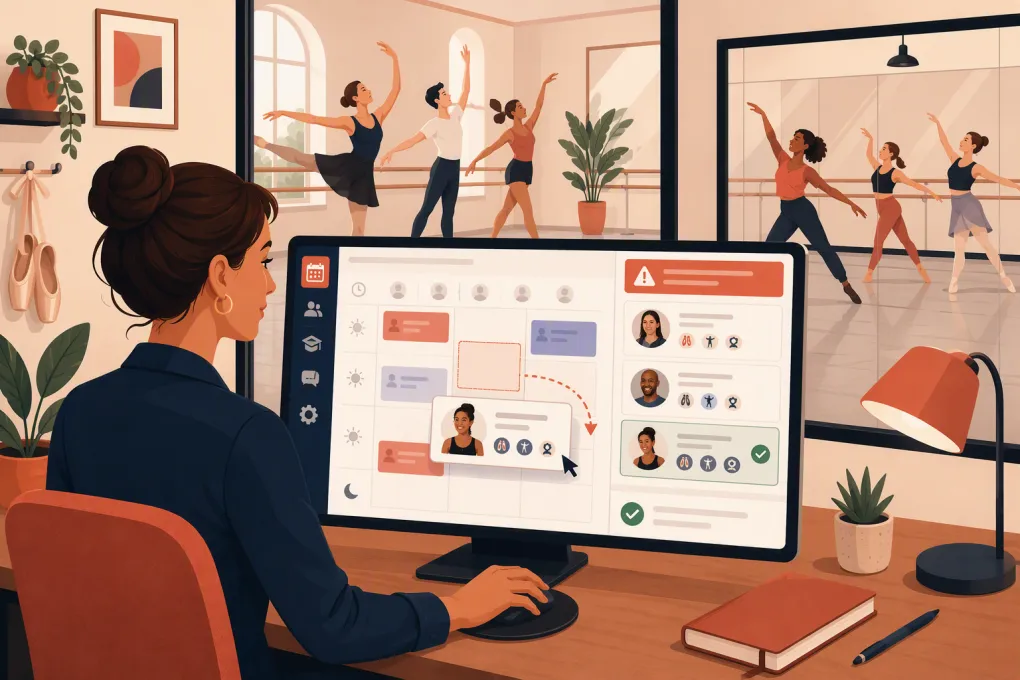

Run your gym on autopilot with WTF Go
Fitty — your AI receptionist — answers calls and DMs, fills classes, follows up with every lead, and collects dues while you coach.