Comparisons
Best Yoga Studio Management Software: 2026 Buyer’s Guide
Compare yoga studio management software on pricing, booking, billing, workshops, support, migration, and AI with a practical vendor evaluation checklist.
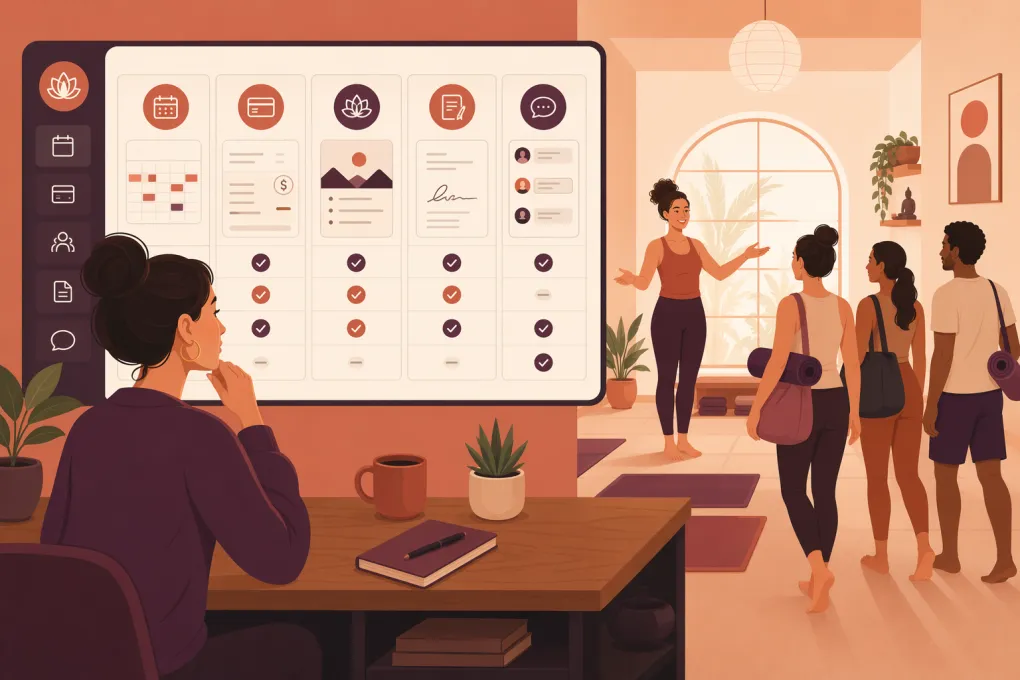 Watch · 20s
Yoga studio management software should reduce front-desk work, not relocate it to a different screen. Booking is only the starting point. The real test is how a platform handles intro offers, waitlists, workshops, waivers, instructor pay, failed payments, and prospects who contact the studio after closing.
This comparison uses public vendor information and a workflow-based evaluation framework. It is not presented as a controlled, hands-on product benchmark, and we have not assigned performance scores without testing every product under identical conditions. Features, packages, and prices change, so use the linked vendor pages to verify current terms and make each vendor demonstrate your workflows live.
Start with the operational bottleneck
Before requesting demos, identify the three problems worth fixing first. Common examples include:
- Leads waiting until the next staffed shift for an answer
- Staff manually reconciling memberships and class credits
- Workshop purchases becoming disconnected from member records
- Failed payments sitting unresolved
- Waitlists requiring manual calls or texts
- Teachers submitting hours in spreadsheets
- Owners lacking consolidated location-level reporting
A long feature list can hide weak execution. A platform may technically offer waitlists, payroll, or automation while still requiring several manual steps.
If delayed inquiry response is one of your primary problems, see how Fitty is configured to answer yoga leads and move eligible prospects toward booking →. Booking and payment actions depend on the studio’s connected systems, operating rules, permissions, and payment setup; exceptions still need a staff escalation path.
Yoga studio management software comparison
Public prices are rarely apples-to-apples. Monthly software fees may exclude payment processing, messaging, branded apps, website services, hardware, migration, or premium support. Some vendors also price by location, staff member, or bookable calendar.
The pricing notes below reflect how vendors publicly present pricing rather than a guaranteed quote. Confirm the current amount, term, cancellation provisions, implementation charges, and processing agreement directly with the vendor.
| Platform | Operational strengths | Automation and AI | Plans and public pricing | Important limitations to verify | Best fit |
|---|---|---|---|---|---|
| WTF Go | Connected lead, booking, follow-up, billing, and operating workflows, with Fitty as an AI receptionist/agent | Fitty can handle configured conversations and actions around the clock, subject to integrations, permissions, payment authorization, confidence rules, and human escalation | Public self-service tiers are not listed on the WTF Go website; request a quote covering software, onboarding, messaging, payments, and locations | Verify workshop depth, waivers, instructor payroll, member-facing app experience, integrations, migration scope, support hours, and contractual service terms | Operators whose main gap is lead response and follow-through, and who want AI tied to operating workflows |
| Mindbody | Mature scheduling, memberships, payments, reporting, staff management, and consumer discovery marketplace | Marketing and communication functions vary by package; confirm what is native versus an add-on | The official pricing page presents Starter, Accelerate, Ultimate, and Ultimate Plus packages and a public starting price; higher-package pricing generally requires vendor confirmation | Confirm total cost for branded apps, marketing, messaging, processing, implementation, support level, and multi-location administration | Established studios that value a broad ecosystem and marketplace exposure |
| WellnessLiving | Scheduling, memberships, payments, client management, marketing, rewards, and business reporting | Client communication and automation capabilities vary by package and configuration | The official pricing page lists multiple package levels; verify current monthly pricing, included features, setup terms, and processing costs | Test report usability, app branding, data exports, workshop workflows, payroll rules, and the support included with the selected plan | Studios seeking a wide suite of fitness and wellness management features |
| Momence | Modern customer-facing booking, memberships, events, video, and communications | Marketing and workflow tools are available, but triggers, messaging allowances, and plan access should be tested | The official pricing page should be used for current plan charges and transaction-related fees because package structures can change | Confirm accounting needs, instructor compensation, complex recurring series, multi-location permissions, app options, and export completeness | Independent and growing studios focused on events, workshops, and a streamlined customer journey |
| Vagaro | Classes and appointment scheduling across fitness, beauty, and wellness, plus marketplace and point-of-sale options | Marketing and communication functions are available through included features or add-ons, depending on configuration | Vagaro’s US pricing page publishes calendar-based pricing, beginning with one bookable calendar; costs increase with calendars and optional features | Add-ons can materially affect total cost. Test class-first workflows, workshop registration, family accounts, payroll, reports, and multi-location control | Studios combining yoga classes with massage, private sessions, retail, or other appointment services |
WTF Go should receive the same scrutiny as every other option. Ask for a live demonstration, written integration scope, implementation owner, support commitments, data-export details, and a complete quote. Do not select it—or any vendor—based solely on an AI demonstration or sales conversation.
What to evaluate beyond class booking
Workshops, series, and special events
A normal weekly class and a six-week beginner series are not the same product. Ask the vendor to create each of these during the demo:
- A one-time workshop with a separate price
- A recurring series sold only as a complete program
- An event that accepts members but is not included in membership
- A workshop with an instructor revenue split
- An event requiring a separate waiver or intake form
- A limited-capacity event with a waitlist and refund deadline
Check whether students can transfer registrations, whether attendance appears in the main member record, and how revenue is recognized in reports. If staff need a spreadsheet to calculate instructor compensation or track series attendance, include that labor in your cost comparison.
Waivers and intake forms
Confirm whether waivers are native, integrated, or merely uploaded as documents. A useful waiver workflow should show:
- Which version the member signed
- The signature and timestamp
- Whether a guardian must sign for a minor
- When a new signature is required
- Whether staff can block check-in until completion
- How records are exported and retained
Software does not determine whether a waiver is legally adequate. Have your attorney review the language, renewal process, and electronic signature practice for your state and services.
Instructor scheduling and payroll
“Payroll” may mean a full payroll integration, a compensation report, or only tracked teaching hours. Test the rules your studio actually uses: flat class rates, attendance-based bonuses, private-session splits, workshop percentages, substitute teachers, and minimum guarantees.
Ask whether approved compensation data flows to a payroll or accounting system or must be exported. Confirm who can edit rates and whether changes leave an audit trail.
Mobile app quality
Evaluate both sides of the mobile experience. Members should be able to buy, book, cancel, join a waitlist, update a payment method, and understand their remaining credits. Teachers may need to view rosters, check in students, contact the studio, or request substitutions.
Test on both major mobile operating systems. Review recent public app-store feedback for recurring issues, but do not treat individual reviews as proof of overall reliability. Ask whether the app is vendor-branded, custom-branded, or an extra-cost product.
Support and contract terms deserve their own review
Support is easy to overlook during a smooth sales demo. Ask what happens when check-in fails ten minutes before a full Saturday class.
Get written answers covering:
- Support hours and time zone
- Phone, chat, email, and emergency channels
- Weekend and holiday availability
- Expected response targets by issue severity
- Whether premium support costs extra
- Who handles payment-processing problems
- Whether implementation includes a named contact
Read the order form and payment agreement, not only the product page. Look for the initial term, automatic renewal, cancellation deadline, price-change rights, early termination provisions, data retrieval window, and obligations tied to payment processing or hardware.
Ask for a sample contract before the final sales call. If the salesperson describes an exception, require it in the signed agreement.
Payment portability can determine migration difficulty
Saved cards are generally represented by processor-controlled tokens rather than reusable card details visible to the studio. Whether credentials can move depends on the current processor, destination processor, card-network requirements, and secure migration procedures.
Before switching, ask both vendors:
- Who currently controls the payment tokens?
- Is a secure processor-to-processor transfer supported?
- What approvals, fees, and timelines apply?
- Which payment methods cannot transfer?
- Will members need to re-enter payment details?
- How will recurring billing continue during the cutover?
Do not assume that exporting member records includes exporting saved payment methods. Build a reauthorization campaign before migration if portability cannot be confirmed in writing.
Test AI as an operating system component, not a chatbot
An AI agent should be evaluated against controlled business rules. It needs an approved knowledge source for schedules, offers, policies, and frequently asked questions. Actions such as booking or collecting an authorized balance require the relevant integration and clearly defined permissions.
During a Fitty demo—or any AI vendor demo—test:
- A beginner asking which class is appropriate
- A member requesting an exception to the cancellation policy
- A caller with an injury or medical question
- A failed booking caused by an integration error
- A disputed balance or refund request
- A parent asking about a minor
- A prospect using ambiguous or hostile language
The desired result is not for AI to answer everything. It should complete low-risk, authorized tasks and hand off sensitive, uncertain, or policy-exception cases with context. Staff need access to conversation history, action logs, escalation status, and a way to correct the underlying information.
Privacy review matters as well. Ask what data the AI accesses, where conversations are retained, which vendors process the data, how access is controlled, and how records can be deleted or exported.
Run a workflow-based demo
A credible evaluation requires more than watching a polished presentation. Give every vendor the same script and require live execution rather than slides or statements that a feature is “supported.”
Use this sequence:
- A new student asks a question after the desk closes.
- The student buys an intro offer and attempts to book a full class.
- A space opens and the waitlist advances.
- The student signs the correct waiver and checks in.
- Staff follow up after attendance or a no-show.
- The student buys a recurring membership.
- The next payment fails.
- A manager reviews the messages, booking, waiver, attendance, and billing history.
- The owner exports the record and relevant financial report.
Record the number of staff steps, screens, add-ons, and outside tools required. Have a front-desk employee and studio manager participate; owners often prioritize dashboards while missing daily workflow friction.
Build the migration plan before signing
Migration problems usually come from mismatched fields and undocumented exceptions, not from the basic contact import. Inventory active memberships, credits, freezes, future bookings, waitlists, waivers, notes, household relationships, outstanding balances, and special pricing arrangements.
Request a field-level migration document specifying what will be imported, transformed, omitted, or stored as a static file. Reconcile active recurring revenue and account balances before and after cutover. Keep the old system accessible long enough to validate records, subject to your contract and data-retention obligations.
The strongest yoga studio management software is the platform that handles your highest-value workflows with the fewest fragile handoffs. Compare complete cost, contract flexibility, support, data access, and exception handling—not just the booking calendar.
Frequently asked questions
How much does yoga studio management software cost?
Costs may include a monthly platform fee, payment processing, messaging, branded apps, add-ons, hardware, onboarding, and migration. Use vendor pricing pages as a starting point, then request a written all-in quote based on locations, staff, and required workflows.
Can saved member cards move to new studio software?
Not always. Payment credentials are typically tokenized, and transfer depends on the current and destination processors, security requirements, and vendor cooperation; confirm portability in writing before setting a cutover date.
Can AI safely manage yoga studio bookings and payments?
AI can handle configured, low-risk tasks when it has reliable system access and explicit permissions. Integration failures, disputes, refunds, medical questions, policy exceptions, and uncertain requests should trigger a documented staff handoff, with conversation logs and privacy controls available for review.
Should yoga studio software include instructor payroll?
It should at least calculate or export compensation using your actual rules. Confirm whether the product processes payroll, integrates with a payroll provider, or only produces reports for flat rates, attendance bonuses, substitutions, and workshop splits.
What should be included in a yoga studio software migration?
Plan for member profiles, memberships, credits, future bookings, waitlists, waivers, notes, attendance, balances, household links, and financial history. Treat saved payment methods as a separate workstream because they may not be portable.
Keep reading


Run your gym on autopilot with WTF Go
Fitty — your AI receptionist — answers calls and DMs, fills classes, follows up with every lead, and collects dues while you coach.