Comparisons
Best Wellness Center Room Rental Booking Software 2026
Compare wellness center room rental booking software by scheduling, billing, permissions, integrations, setup, and fit to choose the right platform faster.
 Watch · 20s
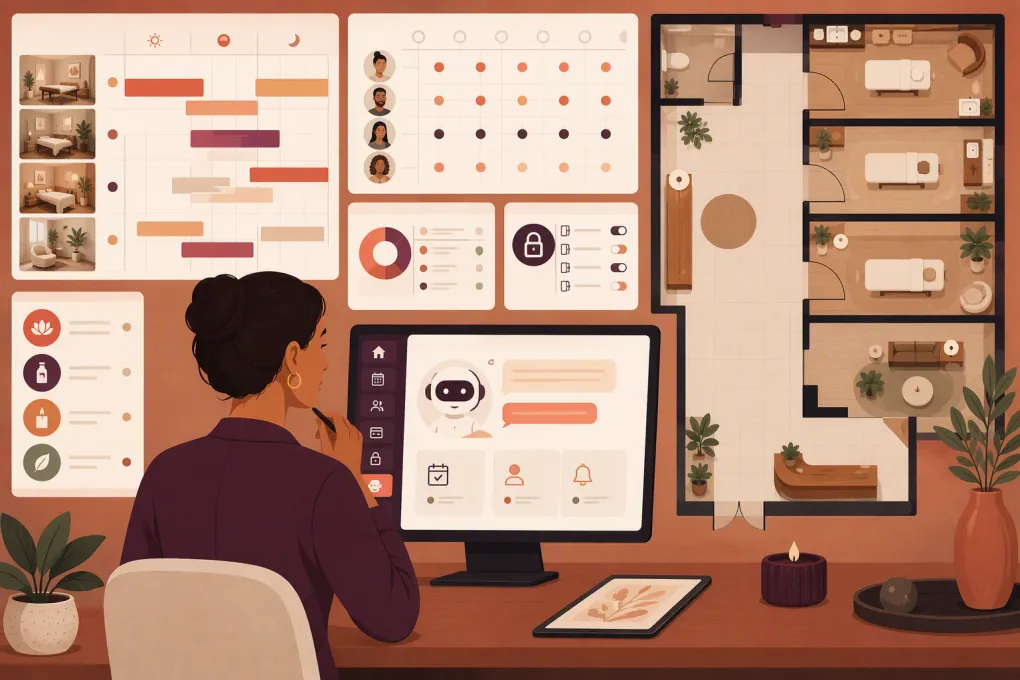
Room rental software has to manage more than an availability calendar. A wellness center may need to reserve treatment rooms for independent practitioners, prevent client appointments from creating conflicts, collect recurring rent, control building access, and protect each provider’s data.
No single product is best for every version of that business. A center operating like a coworking space needs different controls from a spa that occasionally rents unused rooms. This comparison identifies the strongest option by operating model—and the capabilities you must verify before signing a contract.
How we evaluated the software
This is a desk-based buyer’s guide, not a claim of hands-on testing. The evaluation uses capabilities described on vendors’ official product, feature, help, integration, and pricing pages. Product packaging changes, and some functions depend on the selected plan, payment processor, integration, or account configuration.
We assessed each platform against eight practical criteria:
- Room and resource scheduling
- Recurring practitioner reservations
- Rental billing and payment collection
- Client appointment workflows
- Roles, permissions, and access control
- Integrations and data portability
- Implementation effort and support model
- Pricing structure and ideal business type
Where a capability is not clearly positioned as standard, it is marked for validation rather than assumed. Operators should require a live demonstration using their own rental, booking, and billing scenarios before buying.
The core problem is that room rental usually creates two connected bookings: a practitioner reserves space, and a client reserves time with that practitioner. Many systems handle one side well but not both.
See how WTF Go connects wellness lead response, booking, follow-up, and payment workflows →
Best room rental booking software by business type
These are category winners, not a forced overall ranking:
- Best dedicated room scheduler: Skedda
- Best for a multi-location wellness coworking model: Nexudus
- Best for smaller coworking-style collectives: Cobot
- Best for client-facing spa and wellness appointments: Mindbody
- Best to evaluate for AI-assisted front-desk workflows: WTF Go with Fitty
WTF Go should not automatically be treated as the room-rental winner. Its fit depends on whether its configured room, practitioner, billing, and integration workflows match your rental model. Fitty is most relevant when missed inquiries, follow-up, booking assistance, and dues collection are major operational problems.
Side-by-side comparison
| Platform | Verified or publicly described strengths | Recurring rental and payments | Permissions, access, and integrations | Implementation and pricing structure | Best fit and limitation |
|---|---|---|---|---|---|
| Skedda | Space and resource booking, availability rules, booking conditions, user management, and repeat bookings are central to the product | Supports online booking rules and payments in supported configurations. It is not primarily a lease-accounting or practitioner revenue-share platform | Offers user permissions and integrations; advanced identity, security, or workplace features may depend on plan. Confirm physical door-access requirements | Usually a focused implementation because space scheduling is the core use case. Public tiered pricing is available on the Skedda pricing page | Winner for dedicated scheduling. Strong when preventing room conflicts is the main job; weaker when you also need a wellness CRM and client-service sales system |
| Nexudus | Resource booking sits within a broader coworking platform covering members, locations, invoicing, and operational workflows | Designed for recurring memberships, invoices, payments, and bookable resources. Ask how hourly room rent, credits, deposits, and exceptions map to your model | Broad integration and API orientation, with access-control options available through supported connections. Granular configuration can increase setup work | Likely the heaviest implementation in this group because of its breadth. Pricing is generally configured around the deployment; consult Nexudus for current terms | Winner for wellness coworking and multi-location rental. Powerful for flex-space operations, but potentially excessive for a small center with a few rooms |
| Cobot | Coworking administration, member management, resource booking, invoicing, and payment workflows | Suitable for membership-style billing and shared-resource use. Have Cobot demonstrate recurring room series, cancellation charges, packages, and mixed rental rates | Provides administrative and member access plus integrations. Confirm the exact door-access provider, accounting connection, and export fields required | Generally narrower than a large flex-space suite, which can make adoption more manageable. Cobot publishes its pricing structure on its pricing page | Winner for smaller coworking-style collectives. Practical for member and space administration; less focused on wellness leads and treatment-client journeys |
| Mindbody | Established client-facing workflows for appointments, classes, staff schedules, service sales, and payments | Stronger for selling services than for collecting practitioner rent. Do not assume tenant invoices, room-hour packages, or lease-style billing are native | Staff permissions and a broad partner ecosystem are available, but integration availability and API access can vary. Confirm resource assignment and export needs | Implementation can involve service setup, staff schedules, payments, and data migration. Pricing is package- and quote-based through Mindbody’s business pricing page | Winner for appointment-led spas and wellness centers. A weaker fit when room rental—not client service booking—is the primary business model |
| WTF Go with Fitty | Wellness-focused operating workflows plus an AI receptionist/agent for answering leads, booking assistance, follow-up, and dues collection | Fitty’s ability to complete a booking or collect dues depends on the booking, payment, account, and integration configuration enabled for that business. Complex room-rental billing must be demonstrated | Exact room permissions, door access, external integrations, and export scope should be confirmed during a requirements review rather than assumed | Scope depends on locations, workflows, migration, and enabled automation. Request a tailored implementation and pricing review from WTF Go | Winner to evaluate for AI front-desk coverage. Strongest relevance when response and follow-up gaps are costing bookings; specialized rental controls require validation |
What each category winner does best
Skedda: best when the room is the primary inventory
Skedda is the clearest shortlist candidate when the main requirement is allowing approved users to reserve spaces under defined rules. Its public positioning centers on space management rather than spa CRM or treatment sales.
That focus is useful if you need different booking windows, room eligibility rules, buffers, or repeat reservations. The tradeoff is that you may still need another system for wellness leads, client histories, treatment packages, and practitioner marketing.
During the demo, test whether payment collection works for your rental model. Charging for a reservation is not the same as generating recurring tenant invoices, applying prepaid room credits, or calculating revenue share.
Nexudus: best for wellness coworking at scale
Nexudus is the strongest category fit when practitioners behave like members of a flexible workspace. It combines resource reservations with broader member, billing, location, and operational management.
That breadth also creates implementation work. Someone must define membership plans, resources, taxes, credits, invoice rules, permissions, and integrations. Ask who owns configuration after launch and what support is included when a workflow breaks.
Cobot: best for a smaller practitioner collective
Cobot deserves consideration when you want coworking administration without starting with a broader enterprise-style workspace platform. Its public feature set covers member administration, bookings, invoicing, and payment-related workflows.
Do not stop at the standard booking demonstration. Ask the vendor to show a recurring treatment-room reservation with one excluded date, a late cancellation, an account credit, and an overdue invoice. That scenario will expose whether staff need manual workarounds.
Mindbody: best when clients book services, not rooms
Mindbody fits centers where client appointments and classes drive the operation. It is designed around consumer-facing wellness transactions, staff schedules, services, and payments.
That does not make it a dedicated room-rental platform. If independent practitioners pay rent, ask Mindbody to demonstrate the entire practitioner billing flow. A staff commission report or client payment is not the same as a recurring rental invoice.
WTF Go with Fitty: best when front-desk coverage is the gap
A room is only productive when practitioners and clients can book it. WTF Go is relevant when the center also needs to answer inquiries, follow up with prospects, book eligible services or classes, and pursue dues.
Fitty should not be described as universally able to complete every transaction in every setup. Direct booking and dues collection depend on the schedules, rules, payment methods, permissions, and integrations configured for the business. Ask for a demonstration using your actual booking destination and payment workflow.
Ask WTF Go to demonstrate Fitty with your wellness center’s real booking and dues workflow →
Capabilities to verify before you buy
Room rules and recurring reservations
Require the vendor to demonstrate all of the following:
- One-time and recurring room bookings
- Editing one occurrence without deleting the series
- Cleaning and turnover buffers
- Room restrictions by practitioner or service
- Blackout periods and maintenance blocks
- Waitlists or conflict handling
- Cancellation deadlines and charges
- Time-zone handling for multiple locations
Also test linked resources. A room may be open while a required table, device, assistant, or access credential is unavailable.
Billing, deposits, and failed payments
Write down every commercial model you use: hourly rent, day rate, fixed monthly rent, room packages, deposits, or revenue share. Then have the vendor build each model.
Verify tax handling, credits, refunds, automatic invoices, saved payment methods, failed-payment alerts, and financial exports. If accounting runs in another platform, determine which system owns the balance and how corrections synchronize.
Permissions and physical access
Independent providers should not automatically see other practitioners’ clients, revenue, notes, or schedules. Check permissions at the location, room, practitioner, and client-record levels.
If practitioners unlock doors without front-desk staff, confirm the named access-control integration, what triggers a credential, and what happens when a reservation is canceled. “Integrates with access control” is not enough.
Data portability and integrations
Request a sample export before signing. Confirm whether it includes:
- Clients and practitioner profiles
- Future and recurring reservations
- Invoices, payments, credits, and balances
- Notes, forms, and signed agreements
- Message history and consent status
- Resource rules and room assignments
Ask whether exports are self-service, whether API access costs extra, and who handles failures between connected systems.
Run this scenario in every demo
Ask each vendor to complete the same test:
- A practitioner reserves Room 3 every Tuesday for eight weeks.
- The room requires a 15-minute turnover buffer.
- One Tuesday is blocked for maintenance.
- The practitioner pays with a room-hour package.
- A client books an eligible service during a reserved period.
- The practitioner cancels one date after the deadline.
- The saved payment method fails.
- The practitioner’s building access is updated automatically.
- The operator exports the booking and payment history.
Score each step as native, integrated, manual, or unsupported. This creates a defensible comparison and prevents a polished generic demo from hiding workflow gaps.
The best wellness center room rental booking software is the product that handles your hardest exception—not merely the one with the cleanest calendar. Choose Skedda for dedicated space scheduling, Nexudus for a larger coworking model, Cobot for a smaller shared-space operation, Mindbody for appointment-led wellness, or evaluate WTF Go when AI-assisted response and front-desk execution are central to the problem.
Frequently asked questions
What is the best wellness center room rental booking software?
Skedda is a strong choice for dedicated room scheduling, Nexudus for larger wellness coworking operations, Cobot for smaller collectives, and Mindbody for client appointment-led businesses. WTF Go is worth evaluating when AI-assisted lead response, booking, follow-up, and dues workflows are also priorities.
Can Fitty directly book appointments and collect dues?
Fitty can support booking and dues collection, but direct completion depends on the schedules, payment methods, permissions, and integrations configured for the business. Request a demonstration using your actual booking and payment setup.
Does spa booking software usually support practitioner room rent?
Not necessarily. Spa software commonly handles client appointments and service payments, while recurring practitioner rent, room-hour packages, deposits, and lease-style invoices may require a workspace platform or separate configuration.
What should I ask a room booking software vendor to demonstrate?
Test a recurring reservation with an exception, a buffer, a cancellation fee, a failed payment, a linked client appointment, permission limits, and a complete data export. Use the same scenario with every vendor.
How much does wellness room rental software cost?
Pricing may be tiered, location-based, user-based, feature-based, or quote-based. Compare the complete cost of required plans, payment processing, messaging, integrations, migration, support, and access control rather than the entry price alone.
Keep reading

Run your gym on autopilot with WTF Go
Fitty — your AI receptionist — answers calls and DMs, fills classes, follows up with every lead, and collects dues while you coach.