Comparisons
Tennis Club Booking Software: An Operator’s Buying Guide
Evaluate tennis club booking software for courts, lessons, memberships, payments, migration, and automation with a practical vendor comparison guide.
 Watch · 20s
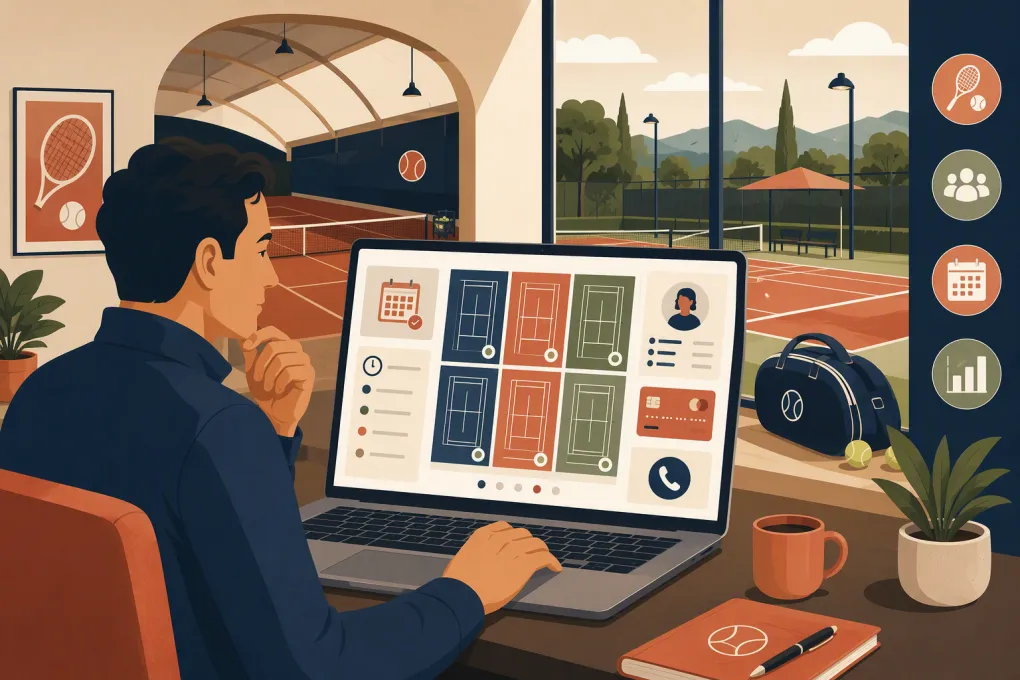
Tennis club booking software has one nonnegotiable job: control scarce court inventory without making members or staff fight the system. But a functioning club also has instructors, clinics, guest rules, memberships, weather closures, payments, and unanswered inquiries to manage.
That distinction matters when comparing software. A general booking platform is not automatically a tennis court management system. Likewise, a strong court reservation engine may not solve lead response, sales follow-up, or collections.
This guide separates those functions instead of pretending every product is interchangeable. It also gives you a repeatable way to test vendors against your actual operating rules.
Start with the court engine—not the feature list
Court scheduling is resource scheduling. Before considering CRM, marketing, or AI, establish whether a platform can natively represent your inventory and enforce your policies.
A serious evaluation should cover:
- Individual courts, locations, surfaces, and indoor or outdoor status
- Member-specific booking windows
- Advance-booking and duration limits
- Peak and off-peak restrictions
- Singles, doubles, guests, and participant requirements
- Member, nonmember, and guest pricing
- Recurring reservations
- Court closures and maintenance blocks
- Waitlists or open-court notifications
- Cancellation deadlines, credits, and no-show rules
- Instructor and court availability for private lessons
- Multi-court clinics, leagues, camps, and events
Do not infer these capabilities from a calendar screenshot. Ask the vendor to configure your rules in a live demonstration or trial account. A screenshot shows an interface; a workflow test shows whether the product can run your club.
WTF Go should not be treated as a proven substitute for a dedicated tennis court engine unless its team demonstrates your required court rules end to end. Its clearer role is handling the surrounding customer journey—answering inquiries, following up, supporting booking conversations, and collecting dues—either within a verified setup or alongside the club’s reservation system.
See how Fitty can cover after-hours inquiries around your existing booking process →
Comparison methodology and source notes
This comparison was reviewed on August 10, 2026 using publicly available vendor information. It is editorial desk research, not a claim that WTF Go operated a tennis facility on each platform. Features, packaging, integrations, and commercial terms can change.
The most reliable next step is a scripted demonstration using your own policies. Official vendor pages used for verification and further research include:
Vendor product pages are primary sources for advertised capabilities, but they do not establish implementation quality at your club. References, a sandbox, contract language, and an export sample remain necessary.
Tennis club booking software comparison
| Option | Court and program fit | CRM and automation | Pricing model and cost drivers | Migration considerations | Best use and principal limitation |
|---|---|---|---|---|---|
| CourtReserve | Purpose-built for racquet and court facilities; publicly presents court reservations, memberships, programming, events, and related club operations as core use cases | Includes club communication and management functions; clubs needing sophisticated lead qualification or conversational AI should test those separately | Plan-based software; confirm current plan limits, optional modules, payment processing, messaging, onboarding, and any app-related costs on the vendor’s current pricing materials | Ask specifically about future reservations, package balances, family relationships, waivers, payment tokens, and historical attendance. Payment credentials may require a processor-supported transfer | Strong shortlist candidate when court rules are central. Confirm the depth of sales automation and any non-racquet services you operate |
| Club Automation | Designed for broader health, athletic, and racquet club operations, including memberships, programs, and reservations | Broader member-management and sales capabilities than a court-only scheduler; implementation scope can be correspondingly larger | Generally evaluated through a sales-led proposal. Cost is likely to depend on club scope, modules, locations, implementation, payments, and integrations; require an itemized quote | Larger deployments need field mapping, permissions, accounting reconciliation, staff training, and a staged cutover plan. Ask for migration scope and acceptance criteria in writing | Suitable for full-service or multi-department clubs. It may be unnecessarily complex for a small facility that mainly needs court reservations |
| Playtomic | Focused on racquet-sports bookings and player discovery; suitability depends partly on the services and player network available in the club’s market | Customer acquisition through a player-facing marketplace can be a strength; test ownership of customer data and the club’s required CRM workflows | Commercial arrangements can vary by market and service. Ask about subscription charges, booking commissions or fees, payment handling, marketplace terms, and cancellation economics | Clarify whether existing members, memberships, credits, recurring bookings, and payment data can be imported. Also confirm what customer and booking data can be exported | Relevant when player discovery and marketplace demand matter. US clubs should verify regional adoption, support, and available functionality rather than assuming parity across markets |
| Mindbody | Established for classes, appointments, memberships, and wellness businesses; it is not primarily a tennis court-allocation product | Offers client management, marketing, marketplace exposure, and business automation | Package-based commercial structure. Obtain current costs for the required tier, payments, messaging, branded experiences, add-ons, onboarding, and locations | Well suited to client, class, and appointment records, but a tennis operator must test how courts are modeled. Avoid forcing courts into appointment calendars without proving conflict and rule enforcement | Worth considering for clubs with substantial fitness, spa, or appointment operations. Court-specific restrictions may require another system or a different choice |
| WTF Go + Fitty, paired with a verified court system | Do not assume native support for tennis-specific inventory rules. Require proof for courts, booking windows, waitlists, guest policies, instructors, and program resources | Fitty is positioned for continuous inquiry response, lead follow-up, booking assistance, and dues collection—the workflows that often sit before and after the reservation | Request current platform, usage, messaging, payment, onboarding, and integration costs. Compare the combined cost if a separate court system remains necessary | Migration should focus on CRM records, lead status, communication consent, membership data, balances, and the handoff to the booking system. Test duplicate-record prevention and source-of-truth rules | Best considered when response time and manual follow-up are major problems. It should complement—not be presented as—specialized court software until the required court workflows are demonstrated |
The table intentionally avoids exact prices because vendor packages and negotiated terms change. A decision-useful quote should still expose the same categories: base subscription, locations, users, modules, payment processing, messaging, marketplace fees, hardware, onboarding, data migration, support, and exit costs.
Use an acceptance test every vendor must pass
A generic product tour makes comparison nearly impossible. Send each vendor the same test script before the meeting and require the presenter to complete it live.
Court-policy tests
- Create separate booking windows for two membership types and nonmembers.
- Limit prime-time reservations without limiting off-peak reservations.
- Add a guest, apply the correct guest fee, and prevent an ineligible guest booking.
- Close three outdoor courts for weather without affecting indoor courts.
- Cancel a reservation and offer the opening to the correct waitlisted player.
- Prevent a recurring reservation from overriding a tournament block.
Instruction and program tests
- Schedule a private lesson that requires both a professional and a court.
- Attempt to double-book the professional on another court.
- Build a clinic using multiple courts, a skill restriction, a capacity limit, and a waitlist.
- Register two children from one household while preserving separate participant records.
- Issue a credit after a weather cancellation without incorrectly refunding a used package session.
Customer journey tests
- Submit an after-hours inquiry for beginner lessons.
- Measure whether the system captures the lead, answers approved questions, and creates a follow-up task or conversation.
- Move the prospect into the appropriate clinic or assessment booking.
- Trigger reminders and cancellation-policy messaging.
- Fail a recurring payment and show how the customer and staff are notified.
Record whether each task is native, configurable, dependent on an integration, manual, or unavailable. Also count staff clicks and note where information must be entered twice.
Configuration lessons that prevent avoidable problems
These are practical implementation controls, not claims about a specific vendor deployment.
Define inventory before importing customers
Document every court with a stable identifier, location, surface, operating hours, lighting constraints, and closure rules. Decide whether temporary training courts or pickleball conversions are separate resources or configurations of the same court.
Changing this structure after future reservations have been imported can create conflicts and reporting inconsistencies.
Separate eligibility from pricing
“Can this person book?” and “What should this person pay?” are different rules. A member may be eligible to reserve earlier but still owe a guest fee. Configure and test eligibility, booking windows, and pricing independently.
Assign one source of truth
If the court platform manages reservations while another system manages leads and communication, document which system owns:
- Customer contact information
- Membership status
- Booking records
- Package or credit balances
- Payment status
- Marketing and text consent
Without clear ownership, staff may update one platform while automation reads stale information from another.
Build exception queues
Automation should handle repeatable work, not conceal exceptions. Create staff queues for disputed charges, unusual refund requests, incomplete waivers, safeguarding concerns, and policy overrides.
This is where Fitty can be useful without pretending to be the court engine. It can handle approved routine conversations and follow-up while routing defined exceptions to staff.
Discuss a Fitty workflow that works with your club’s reservation rules →
Migration pitfalls to address in the contract
Migration is not complete when customer names appear in the new system. Before signing, request a written data map and acceptance process covering:
- Active and frozen memberships
- Household and dependent relationships
- Future and recurring reservations
- Unused lessons, packages, credits, and expiration dates
- Outstanding balances and account credits
- Waivers and communication consent records
- Instructor assignments and payroll-relevant records
- Notes that contain sensitive or unnecessary information
- Historical utilization and attendance data
- Stored payment methods
Payment tokens often cannot be moved through an ordinary spreadsheet export. Ask both the outgoing and incoming payment providers whether a secure token migration is supported, what authorization is required, and what happens if it fails.
Run at least one test import before the final cutover. Reconcile record counts and financial balances, then test a sample of households, packages, future bookings, and recurring payments. Keep the old system read-only for an agreed period if contract terms allow it.
Make the final decision on operating fit
Choose dedicated tennis club booking software when nuanced court control is the primary requirement. Consider a broader club platform when tennis is one department inside a larger fitness, aquatics, spa, or wellness operation. Consider a customer-communication layer when the reservation engine works but leads, follow-up, and collections still consume staff time.
Do not buy based on the longest feature list. Buy the system—or clearly defined combination of systems—that passes your acceptance test, preserves your data, exposes its full cost, and gives staff an obvious way to handle exceptions.
Frequently asked questions
What is the most important feature in tennis club booking software?
Reliable court-resource management is foundational. The software should enforce your actual booking windows, eligibility rules, duration limits, guest policies, closures, and instructor conflicts.
How should a tennis club compare software pricing?
Compare the full operating cost: subscription, locations, modules, payment processing, messaging, marketplace fees, onboarding, migration, support, hardware, and contract exit terms. Require an itemized quote using the same assumptions for every vendor.
Can WTF Go replace dedicated tennis court reservation software?
Do not assume that it can. A club should require a live demonstration of every tennis-specific workflow; Fitty may be better used alongside a verified court system to handle inquiries, follow-up, booking conversations, and dues collection.
What data should be migrated to a new tennis club platform?
Include members, households, future reservations, memberships, package balances, credits, waivers, consent records, outstanding balances, instructor assignments, and required history. Stored payment credentials may need a secure processor-to-processor migration.
How can a club verify vendor claims before signing?
Use a scripted demonstration or sandbox with real court rules and exceptions. Include the resulting requirements, migration scope, integrations, data-export rights, support commitments, and accepted costs in the contract.
Keep reading

Run your gym on autopilot with WTF Go
Fitty — your AI receptionist — answers calls and DMs, fills classes, follows up with every lead, and collects dues while you coach.