Comparisons
Tattoo Removal Clinic Management Software: Buyer’s Guide
Compare tattoo removal clinic management software for booking, lead follow-up, treatment records, payments, and multi-location operations—without guesswork.
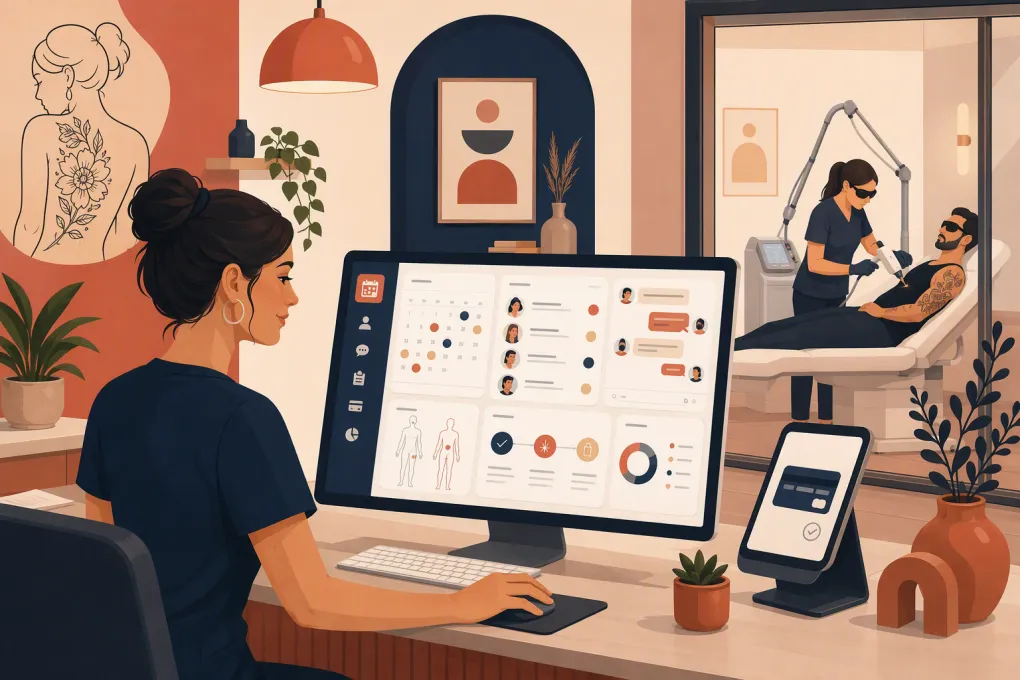 Watch · 20s
Tattoo removal is not a simple appointment business. A client may begin with an inquiry, complete a consultation, submit medical information and consent forms, purchase a treatment series, return for multiple sessions, and require documented photos and treatment details at every visit.
Generic calendars can schedule the first appointment. They usually struggle with everything surrounding it: fast lead response, consultation conversion, treatment-series tracking, clinical documentation, reminders, balances, and long-term follow-up.
The right tattoo removal clinic management software should reduce those gaps without forcing your team to maintain five disconnected systems. It should also separate administrative automation from clinical judgment. Software can organize workflows, but your licensed providers must still control candidacy, treatment protocols, contraindications, and escalation decisions.
See how Fitty handles tattoo-removal inquiries and follow-up around the clock →
What tattoo removal clinic software needs to handle
A useful platform should support the complete client journey, not just the treatment-room calendar.
Lead capture and rapid response
Tattoo removal prospects often contact several clinics while researching price, discomfort, treatment duration, and expected results. If an inquiry sits unanswered, the clinic may never get the consultation.
Look for software that can:
- Capture leads from forms, calls, text messages, social channels, or advertising campaigns
- Send an immediate acknowledgment outside business hours
- Ask basic operational questions without making medical claims
- Assign leads to staff members and track follow-up status
- Record the original lead source
- Escalate clinical questions to a qualified team member
- Move qualified prospects into a consultation workflow
An automated agent should not promise a number of sessions, guarantee clearance, diagnose a reaction, or determine whether someone is medically eligible. Build clear handoff rules for those conversations.
Consultation and appointment scheduling
Tattoo removal clinics may need different appointment types, durations, resources, and provider rules. A consultation should not necessarily consume the same room or equipment block as a treatment session.
Confirm that the system supports:
- Separate consultation, treatment, follow-up, and patch-test appointment types
- Provider, room, and equipment availability
- Online booking rules and approval requirements
- Deposits, cancellation policies, and rescheduling
- Automated confirmations and reminders
- Location-specific hours and services
- Waitlists or tools for filling canceled appointments
Test the booking flow on a phone. A polished back-office system does not compensate for a confusing client experience.
Clinical records, consent, and photography
Tattoo removal involves sensitive health and treatment information. Depending on your clinic structure and applicable law, you may need a medical-grade record system rather than a conventional spa CRM.
Your clinical workflow may require fields for medical history, informed consent, tattoo characteristics, provider notes, device settings, treatment endpoints, aftercare, adverse events, and progress photography. The software should let your clinical leadership define required fields based on approved protocols.
Evaluate:
- Customizable treatment notes and templates
- Versioned consent forms with signatures and timestamps
- Secure before-and-after photo storage
- Role-based access to clinical information
- Audit trails showing who accessed or changed a record
- Record-retention and export controls
- Secure client intake forms
- Business associate agreement availability when required
Do not accept a broad claim that a product is compliant without examining your responsibilities. HIPAA compliance, where applicable, is a shared operational obligation involving the vendor, your configurations, staff access, devices, policies, and training.
Tattoo removal software comparison
There is no universal winner. Some platforms are built around medical charting, while others are stronger at booking, client experience, marketing, or front-desk automation. A clinic may also pair a clinical record system with an operating platform that handles lead conversion and collections.
| Platform | Core strength | Booking and CRM | Clinical record fit | Automation and AI | Main limitation to verify | Pricing approach |
|---|---|---|---|---|---|---|
| WTF Go with Fitty | Unified business operations with an AI receptionist and agent | Lead response, scheduling workflows, follow-up, payments, and ongoing client communication | Confirm whether your clinical documentation requirements need a separate medical record platform | Fitty answers leads, follows up, supports booking workflows, and helps collect outstanding dues 24/7 | Verify the exact charting, consent, photography, and healthcare-compliance configuration your clinic needs | Contact WTF Go for current plans and scope |
| Aesthetic Record | Practice management and EMR functions for medical aesthetics | Scheduling, client management, transactions, and aesthetics-focused workflows | Stronger fit for clinics that need aesthetics-oriented charting and photography | Includes workflow and communication capabilities; confirm the current automation included in your plan | Evaluate lead-response depth, integrations, and how well it handles your specific tattoo removal protocols | Plan availability and features should be confirmed directly |
| PatientNow | Broad practice management for medical aesthetics and plastic surgery organizations | CRM, scheduling, patient engagement, and practice workflows | Designed for medical-aesthetic environments with clinical documentation needs | Offers patient communication and workflow tools; confirm current AI functionality | Breadth can mean a more involved implementation than a lightweight scheduler | Typically requires vendor consultation for an accurate quote |
| Pabau | Clinic management across healthcare and aesthetic practices | Scheduling, forms, client records, communications, and operational workflows | Supports clinical record workflows; validate templates and regulatory requirements for your location | Provides configurable automations and communication features | Confirm US-specific support, integrations, payment processing, and compliance needs | Review current plans and any feature-based add-ons |
| Boulevard | Client experience, booking, checkout, and marketing for appointment businesses | Strong online booking, front-desk workflows, messaging, and POS capabilities | Not primarily a medical EMR; a separate clinical system may be necessary | Marketing and communication automation are central strengths | Confirm whether clinical notes, consent, photos, and audit controls meet your requirements | Uses plan-based pricing; request current details |
| Mindbody | Established scheduling and business management for fitness, wellness, and appointment services | Booking, memberships, packages, payments, and marketing tools | Not purpose-built for tattoo removal clinical records | Includes automated marketing and client communication options | Medical charting and aesthetics-specific treatment tracking may require another system | Plans and add-ons vary; obtain a current quote |
The most important distinction is whether you want one system to be the legal clinical record, the operational front desk, or both. Do not assume that a strong scheduler is an EMR. Likewise, do not assume that an EMR will respond effectively to leads at night or persistently follow up with unbooked consultations.
Explore how WTF Go and Fitty can close the gap between a new inquiry and a booked consultation →
Build your requirements around actual workflows
Before booking demos, map five real workflows from your clinic. Use them as test scripts instead of letting vendors control the demonstration.
1. New tattoo removal inquiry
Ask the vendor to show what happens when a prospect submits a form after closing time. Can the system acknowledge the inquiry, collect basic information, answer approved nonclinical questions, notify staff, and create a follow-up task?
2. Consultation to treatment plan
Follow a prospect from consultation booking through intake, consent, provider assessment, proposed treatment series, payment, and first treatment appointment. Note every point where staff must re-enter information.
3. Multi-session treatment tracking
Create a package or treatment series. Complete one session, document it, schedule the next visit, and show the remaining sessions and balance. Check what the client sees in messages and receipts.
4. Cancellation and reactivation
Cancel an appointment and see whether the software applies your policy, opens the slot, contacts a waitlist, and starts a rebooking sequence. Then test a client who finishes one treatment but does not schedule the next.
5. Clinical escalation
Enter a message describing an unexpected post-treatment concern. The system should stop routine automation and escalate the conversation according to your written protocol. It should not improvise clinical advice.
Features that matter as the clinic grows
A single-location owner may tolerate manual work that becomes unmanageable across several clinics. If expansion is possible, assess multi-location controls before signing a long contract.
Important capabilities include:
- Central reporting with location-level views
- Staff permissions by role and clinic
- Shared clients without duplicate records
- Location-specific pricing, taxes, forms, and policies
- Provider access across approved locations
- Standardized treatment templates
- Central lead routing and call handling
- Equipment or room resource scheduling
- Consolidated payment and outstanding-balance reporting
Also ask how the system handles ownership of data. You should be able to export client profiles, appointments, transaction history, consent documents, clinical notes, and images in usable formats, subject to legal retention requirements.
Evaluate payments and revenue workflows carefully
Tattoo removal revenue can involve consultation fees, deposits, individual sessions, packages, financing arrangements, refunds, and outstanding balances. Demonstrate each transaction you use today.
Check whether the software can:
- Store payment methods through a compliant payment provider
- Collect deposits during online booking
- Track packages and remaining sessions
- Apply refund and cancellation permissions by staff role
- Send receipts and balance reminders
- Separate complimentary corrections from paid appointments
- Reconcile payments by provider and location
- Export information to your accounting workflow
Fitty is particularly relevant when the operational problem is not charting but follow-through. An AI agent can continue approved outreach, answer routine questions, and pursue outstanding dues without relying on the front desk to remember every next step.
See how Fitty supports follow-up and collections without adding another front-desk shift →
Plan migration before signing
Migration is where otherwise good software projects stall. Request a written inventory of what will and will not transfer.
Your migration plan should cover:
- Client contact information and communication consent
- Future and historical appointments
- Packages, credits, balances, and gift cards
- Treatment notes, consent forms, and photographs
- Saved payment tokens, which may not be portable
- User permissions and provider schedules
- Reporting history
- Integrations with accounting, marketing, phones, forms, and payment systems
Run a small validation batch before the full import. Compare record counts, balances, upcoming appointments, documents, and photos. Keep access to the previous system for the legally and operationally appropriate period rather than assuming every historical item migrated perfectly.
Red flags during a software demo
Be cautious if a vendor cannot clearly answer questions about:
- Data export and contract termination
- Audit logs and permission controls
- Secure photo storage
- Consent-form version history
- Clinical and emergency-message escalation
- Failed payment handling
- Duplicate client records across locations
- Implementation ownership and support response paths
- What its AI can say, what it cannot say, and when a human takes over
The right tattoo removal clinic management software should make the clinic easier to operate without weakening clinical controls. Start with the system of record you need, then make sure lead response, booking, follow-up, payments, and reporting work as one practical operating process.
Frequently asked questions
Does a tattoo removal clinic need an EMR or regular booking software?
If the clinic stores protected health information or maintains medical treatment records, it may need an EMR or another appropriately configured clinical system. Confirm the requirements with qualified legal and compliance advisers rather than relying on a scheduler’s marketing claims.
Can tattoo removal software track treatment packages and sessions?
Many platforms can track packages, remaining sessions, balances, and future appointments, but the workflow varies. Test partial use, refunds, complimentary sessions, expiration rules, and transfers during the demo.
What should AI handle in a tattoo removal clinic?
AI can handle approved FAQs, lead response, consultation follow-up, scheduling steps, reminders, and balance outreach. Clinical questions, candidacy decisions, complications, and treatment promises should be escalated to qualified staff.
Can WTF Go replace tattoo removal medical record software?
That depends on your charting, consent, photography, compliance, and retention requirements. WTF Go and Fitty can manage operational workflows and lead follow-up, while some clinics may still need a dedicated clinical record platform.
Keep reading


Run your gym on autopilot with WTF Go
Fitty — your AI receptionist — answers calls and DMs, fills classes, follows up with every lead, and collects dues while you coach.