Comparisons
Squash Club Management Software: A Practical Comparison
Compare squash club management software for court booking, memberships, payments, access and follow-up, with clear limits and selection criteria.
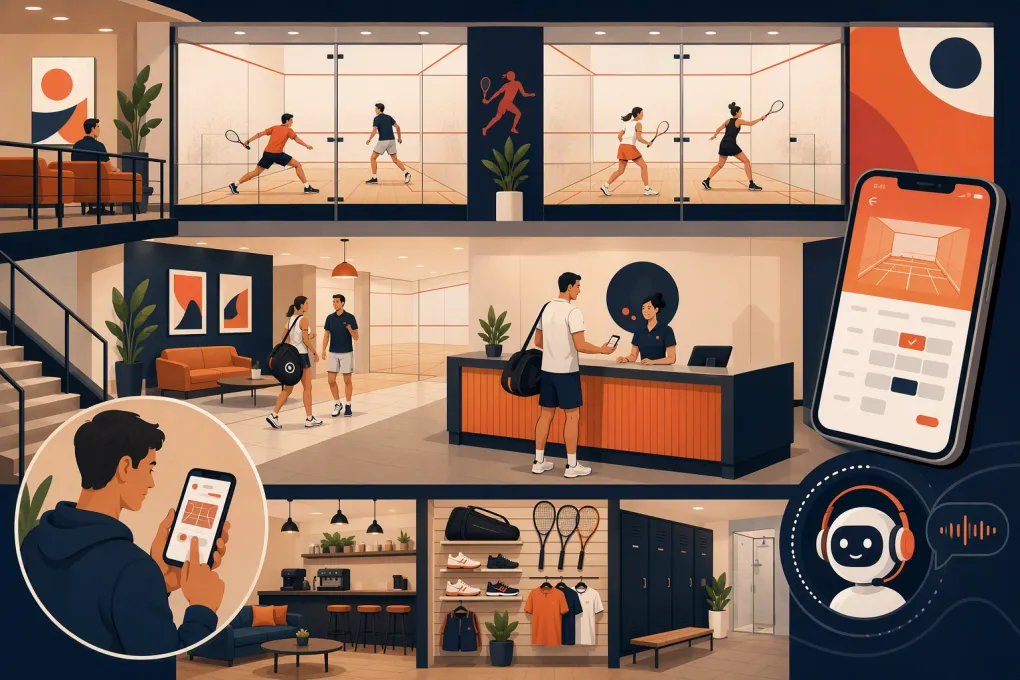 Watch · 20s
Squash club management software has to manage scarce court inventory—not just classes on a calendar. It also has to connect reservations with membership eligibility, guest policies, coaching, payments and front-desk communication.
That makes selection harder than comparing feature checklists. A platform may offer “booking” but lack native court rules. Another may handle courts well but require separate tools for sales follow-up, access control or overdue-account outreach.
This comparison is based on vendors’ publicly documented product positioning and help or product pages, not a hands-on benchmark of every platform. Public documentation can establish what a vendor markets as native; it cannot prove that a feature will support your club’s exact rules. Where capabilities depend on configuration, integrations or a sales consultation, that distinction is stated rather than assumed.
See how Fitty can cover squash-club inquiries while your court system manages inventory →
Define the job before comparing software
A squash club may need four different types of capability:
- Court operations: inventory, booking windows, peak-time rules, maintenance blocks and cancellations.
- Club administration: memberships, households, waivers, billing and reporting.
- Programming: lessons, clinics, camps, leagues and tournaments.
- Front-office automation: lead response, tour or trial booking, reminders and overdue-account follow-up.
Few systems are equally strong in all four. Decide which functions must be native and which can safely run through an integration.
A court rule should usually be native because a delayed sync could create a double booking. Accounting exports, marketing automation and business-intelligence reporting are more reasonable integration candidates. League brackets may remain in a specialist product if rosters and payments do not require repeated manual entry.
Squash club management software comparison
The table below separates documented native positioning from integrations and gaps. Pricing changes frequently, so it describes the published model rather than quoting an amount that may become inaccurate.
| Platform | Publicly documented native focus | Integrations or configuration | Not established as native | Pricing, access and migration considerations | Best fit |
|---|---|---|---|---|---|
| CourtReserve | Court reservations, memberships, events, programming and payments for tennis and pickleball clubs and other court-based facilities | Third-party connections and available add-ons depend on the club’s plan and implementation | Do not assume every squash league format, building-access system or sales CRM workflow is included | The vendor publishes plan information, but clubs should confirm current fees, payment costs, onboarding and data-import scope. Access control should be checked against the club’s exact hardware | Squash or multi-racket clubs where court inventory and reservation rules are the primary requirement |
| ClubSpark | Venue websites, membership, court booking, coaching and competition-related administration across supported sports and markets | Product availability and governing-body connections vary by country and sport | Universal US squash availability, every payment provider and native physical access control are not established across all markets | Availability is ecosystem- and region-dependent. Confirm whether a US squash club can purchase the required modules directly and what data can be imported | Community or association-linked clubs already operating in a supported ClubSpark ecosystem |
| Playbypoint | Racket-sports club management, including reservations, programming, membership-related workflows and member-facing tools | Payment, communication and other operational connections can depend on market and club setup | Do not assume support for every squash competition structure or existing door controller | Pricing is generally obtained through the vendor. Request written scope for onboarding, historical data, payment migration and regional support | Commercial racket clubs wanting a purpose-built member and reservation experience |
| Skedda | Rule-based scheduling for spaces and resources, including courts | Identity, workplace and automation connections are available in the broader platform; club billing may require another system | Recurring club dues, family memberships, coaching payroll, squash leagues and full member lifecycle management | Plans are published by the vendor, with capabilities varying by tier. Migration is more likely to center on users and bookings than a complete club-account history | Facilities primarily replacing spreadsheets, shared calendars or a basic court scheduler |
| Mindbody | Fitness and wellness scheduling, memberships, appointments, payments, staff management and marketing tools | Integrations are available through its ecosystem; court setup would require validation and configuration | Racket-specific court rules and squash league management are not its primary documented focus | Pricing is quote-based. Confirm implementation, data migration, payment processing, add-ons and any access-control partner requirements | Hybrid wellness clubs where fitness classes, appointments or spa services are more important than complex court operations |
| WTF Go with Fitty | Operating workflows for gyms, studios, spas and wellness businesses; Fitty handles configured lead conversations, follow-up and administrative outreach | Court booking requires a supported booking connection or a deliberately configured workflow. Fitty can only act on availability, policies and account data it can access | Native squash-court inventory, brackets, ladders and complex racket-specific reservation rules are not established here | Scope depends on the systems being connected and the workflows being implemented. Data access, payment permissions, escalation rules and migration responsibilities must be defined before launch | Clubs keeping a court-focused system but wanting stronger inquiry response, lead follow-up and front-office automation |
Official starting points for verification include CourtReserve’s platform pages, ClubSpark, Playbypoint, Skedda, Mindbody Business and WTF Go. Treat these as vendor documentation, not independent performance testing.
What “native” should mean in your evaluation
A native feature should use the same underlying member, eligibility, payment and booking records without an external sync. Ask the vendor to demonstrate each workflow from beginning to end.
For court reservations, test whether the system can enforce:
- Different advance-booking windows by membership type
- Peak and off-peak eligibility
- Maximum active reservations per member
- Guest permissions and fees
- Singles and doubles participation rules
- Court-specific closures and maintenance blocks
- Coaching reservations that consume court inventory
- Late-cancellation and no-show policies
- Staff overrides with a record of who changed what
If the vendor says a workflow is “configurable,” ask who configures it, whether custom development is required and whether the configuration survives product updates.
If it is an integration, ask four questions:
- Which system owns the record?
- Which fields move in each direction?
- How quickly does the sync occur?
- What happens when the connection fails?
If it is unsupported, document the manual workaround and its staffing cost. That answer may still be acceptable; it should not be hidden until implementation.
Court booking, leagues and coaching are separate requirements
Court booking software does not automatically include league management. A reservation engine allocates time and space. A league system may need divisions, standings, challenge rules, substitutions, results and playoff structures.
Write down which competition formats your club actually runs. Then classify each one:
- Must be native: The format drives regular court allocation or member billing.
- Integration is acceptable: A specialist competition tool can exchange clean rosters and schedules.
- Manual is acceptable: The event is occasional and has a capable administrator.
Apply the same logic to coaching. Private lessons require coach availability, court allocation, participant eligibility and payment. Group clinics add capacity, waitlists and attendance. A system that schedules the coach but not the court can still create conflicts.
The precise role of Fitty in a squash club
Fitty is WTF Go’s AI receptionist and agent. Its useful role is the communication and follow-up layer—not pretending to be a native squash competition engine.
With an appropriately connected or configured workflow, Fitty can:
- Answer approved questions about hours, membership options and club policies
- Capture caller and website-lead details
- Follow up according to configured sequences
- Book an eligible tour, trial, class or appointment when the relevant schedule is available to the system
- Contact members about overdue dues and direct them into an approved payment workflow
- Escalate exceptions to staff
“Books” does not mean Fitty should bypass court eligibility or invent availability. It needs access to the relevant schedule and approved booking actions. If the court platform is not supported or connected, the safe workflow is to capture the request or book a separate tour or sales appointment—not promise a court.
Likewise, “collects dues” should not be read as unrestricted authority to debit accounts, resolve disputes or change balances. The scope can include automated outreach, secure payment links and connected payment actions authorized by the business. Charge disputes, unusual account adjustments and policy exceptions should go to staff.
Fitty can respond around the clock when the service and connected systems are available, but clubs still need escalation rules, approved knowledge and human coverage for exceptions.
Ask WTF Go to map Fitty against your current court, CRM and payment systems →
Pricing and migration questions that require written answers
Software cost is more than the subscription. Request a written proposal covering:
- Base platform and required modules
- Payment-processing obligations and fees
- Text, email or voice usage charges
- Onboarding and configuration
- Data cleanup and import
- Staff training
- API or integration costs
- Access-control hardware or partner fees
- Support levels and contract terms
Migration scope is especially important. “Data migration included” may mean member names and email addresses, not stored payment tokens, waivers, future reservations, account credits or transaction history.
Ask each vendor to label every dataset as migrated, archived, manually recreated or not transferable. Payment credentials may be subject to processor rules and cannot always be moved like an ordinary spreadsheet.
Run a scenario-based selection process
Do not award points for a feature name alone. Give every shortlisted vendor the same scenarios and record whether the result is native, integrated, configured or unsupported.
Use examples such as:
- A family-plan dependent books a peak court with a guest.
- A coach reschedules a lesson after participants have paid.
- A suspended member tries to book and enter the building.
- A court closes after a league schedule has been published.
- A prospect calls after closing and wants a trial tomorrow.
- A recurring payment fails while the member holds future bookings.
- A member cancels and must lose door access at the correct time.
For access control, name your existing hardware during the demonstration. “Access-control integration available” is not enough. Confirm the supported vendor, credential type, sync timing and behavior during an internet outage.
For multi-location clubs, test cross-location membership rights, consolidated reporting and staff permissions. A platform may support multiple locations while still requiring separate member records or reports.
The best choice may be a court-native platform paired with a front-office automation layer. It may also be a broader club system if your reservation rules are simple. What matters is knowing where each workflow lives, which system owns the data and where staff must intervene.
See whether WTF Go can automate the gaps around your existing squash software →
Frequently asked questions
What features should squash club management software include?
Prioritize court inventory, membership eligibility, guest rules, payments, coaching schedules, cancellations and useful reporting. League management, access control and lead automation should be classified as native, integrated or unsupported.
Is court booking software the same as club management software?
No. Court booking software schedules resources, while club management software may also handle memberships, recurring dues, households, waivers, programs and communication.
Can Fitty directly book a squash court?
Only when the relevant schedule, rules and booking action are available through a supported connection or configured workflow. Without that access, Fitty should capture the request or book a separate tour or appointment rather than promise court availability.
Can squash software connect to door access systems?
Some platforms support access-control partners or integrations, but compatibility is hardware-specific. Confirm the controller, credential type, sync timing and rules for expired or suspended memberships.
What data may be difficult to migrate?
Stored payment credentials, signed waivers, historical transactions, account credits and complex future reservations may not transfer cleanly. Require a written field-by-field migration scope before signing.
Keep reading


Run your gym on autopilot with WTF Go
Fitty — your AI receptionist — answers calls and DMs, fills classes, follows up with every lead, and collects dues while you coach.