Comparisons
Small Group Personal Training Software: 2026 Buyer’s Guide
Compare small group personal training software for booking, billing, coaching, AI, integrations, and migration—plus clear picks for each business model.
 Watch · 20s
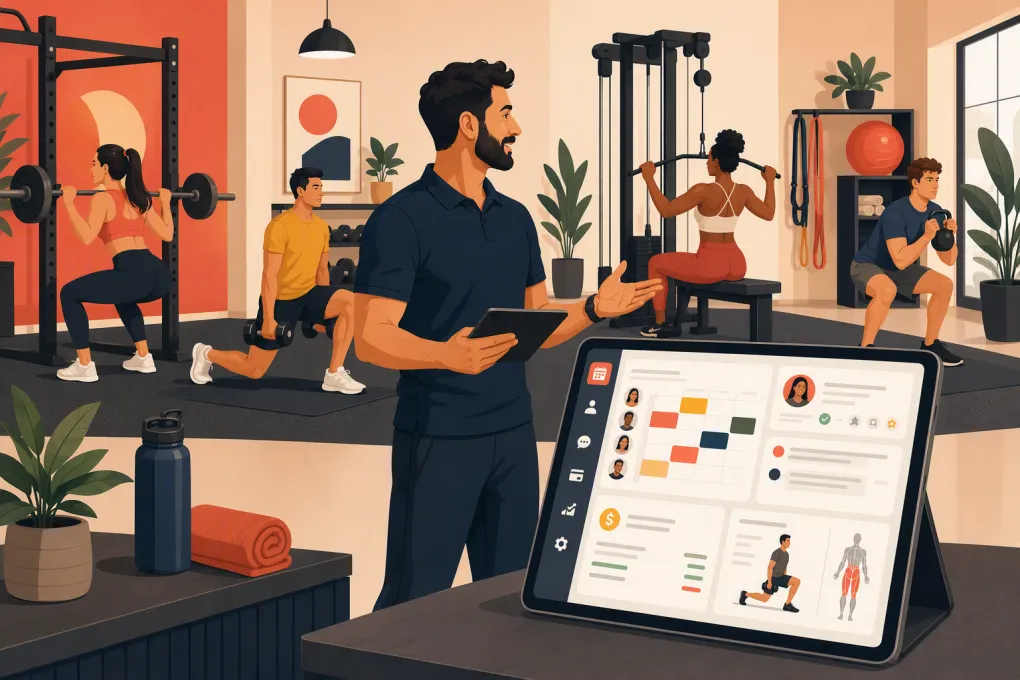
Small group personal training creates a software problem that standard class booking systems do not always solve. You need strict capacity controls and shared sessions, but you may also need individual programs, recurring reservations, session allowances, coach notes, lead follow-up, and recurring billing.
That combination explains why there is no automatic “best” platform. A semi-private strength gym, a hybrid online coach, and a wellness facility offering appointments all need different things from their software.
This guide compares five relevant options using the same criteria: lead management, scheduling, coaching delivery, automation, payments, integrations, multi-location administration, pricing transparency, and migration. It also gives you a demo script for verifying claims before signing.
Disclosure: WTF Go publishes this guide and is one of the products evaluated. We have identified its limitations alongside those of other platforms. The comparison is based on publicly documented product positioning and common operator workflows, not a claim that we conducted an independent laboratory test or interviewed every vendor’s customers. Features, packaging, and commercial terms change, so confirm them in a live demo and written proposal.
If front-desk workload is your primary constraint, review WTF Go’s current Fitty capabilities and request a workflow demo →. Fitty is positioned to answer inquiries, support booking, run follow-up, and assist with dues collection when those workflows are configured; exceptions, disputes, and transactions requiring member authorization still need an appropriate human or payment step.
What small group personal training software must handle
“Small group” can describe several operating models:
- Fixed cohorts sold as four-, six-, or eight-week programs
- Semi-private sessions with a different workout for each client
- Monthly memberships with a limited session allowance
- Unlimited memberships with controlled session capacity
- Open booking into recurring coach-led time slots
- Hybrid memberships combining in-person and remote coaching
Write down your model before looking at products. A platform can support ordinary classes yet fail when asked to preserve one member’s Tuesday-and-Thursday reservation, deduct the correct credits, and deliver an individual workout inside the same account.
Scheduling and capacity
Verify whether the system supports recurring member reservations—not merely recurring calendar events. Also test waitlists, cancellation windows, restored credits, coach substitutions, room capacity, and cross-location booking.
Products and billing
Build your real offers during the demo. Test autopay, session allowances, expiration rules, holds, proration, upgrades, failed payments, family billing, refunds, and scheduled cancellations.
Ask which payment processor is required and whether using it is optional. If you later switch platforms, stored cards may not transfer automatically; token portability depends on the processors, vendors, security requirements, and your agreement.
Coaching delivery
Semi-private operators may need exercise programming, workout history, assessments, progress photos, habits, coach notes, and client messaging. These are not core features in every gym management platform.
Decide whether you want one broad system or a management platform connected to a dedicated coaching app. Either approach can work, but define which system owns membership status, contact information, attendance, programming, and billing.
Sales and member communication
The system should capture leads, show their pipeline stage, schedule consultations, send reminders, and make missed follow-up visible. If automation matters, distinguish between software that drafts a message and software that can complete an action such as creating a booking.
Reporting and administration
At minimum, operators should be able to inspect leads by source, consultations booked and attended, membership changes, attendance, session utilization, no-shows, failed payments, and outstanding balances. Multi-location groups should also test consolidated reporting, location-level permissions, and member access across sites.
Small group personal training software comparison
The table focuses on concrete product differences. “Confirm” means the capability or commercial term should not be assumed from broad marketing language.
| Platform | Concrete strengths | Important limitations | Automation and integrations | Payments and contracts | Migration and best fit |
|---|---|---|---|---|---|
| WTF Go | Combines booking, member operations, communication, and Fitty, an AI receptionist/agent focused on inquiries, follow-up, booking, and dues workflows | Individualized workout programming is not the primary differentiator; operators needing a deep exercise library or detailed program builder should verify the coaching workflow or plan for another tool. A broad public integration directory is not clearly documented | Fitty can handle configured conversations and actions around leads and members. Confirm supported channels, escalation rules, booking permissions, knowledge controls, and available integrations in the demo | Current pricing and contract terms require direct confirmation. Ask which processor is used, whether processing is mandatory, and what member authorization is required for payment actions | Confirm import support for memberships, credits, bookings, payment tokens, waivers, and history. Best for operators whose main problem is front-desk coverage and disconnected operational work |
| Mindbody | Mature class and appointment scheduling, wellness-oriented business management, consumer marketplace exposure, payments, marketing options, and branded-app options | Broad scope can mean more configuration and add-on decisions. It is not primarily an individualized strength-programming platform, so semi-private workout delivery may require another product | Offers a substantial partner and integration ecosystem. Marketing and communication capabilities vary by package; verify what is native, an add-on, or supplied by a partner | Pricing is generally sales-led rather than fully self-checkout. Request the complete subscription, add-on, processing, implementation, and contract terms in writing | Ask how future bookings, packages, stored value, forms, and payment credentials move. Best for established fitness or wellness businesses combining classes, appointments, and marketplace discovery |
| PushPress | Gym-specific ecosystem for member management, scheduling, billing, lead management, and workout delivery. Its Core, Grow, and Train products make the separation between operations, CRM, and programming clearer than many all-in-one claims | Operators may need multiple products to cover management, sales automation, and programming. Confirm how data and staff workflows move among those products and which functions are included in each plan | Provides gym-focused CRM and communication capabilities, with integrations available through its ecosystem. Verify usage allowances, automation triggers, and whether a required connection is native or third-party | PushPress publishes plan information, but current totals depend on selected products and processing. Check commitment, cancellation, messaging, and implementation terms | Ask specifically about membership plans, credits, future reservations, waivers, and payment-token migration. Best for functional fitness and strength gyms wanting a gym-specific product family |
| Zen Planner | Established scheduling, membership, billing, attendance, and administrative tools for gyms, schools, and training businesses | Its center of gravity is traditional member management rather than sophisticated individualized workout delivery or an AI front desk. Interface and workflow fit should be judged in a live staff demo | Supports standard member communication and a set of integrations, but operators with complex automation requirements should map each trigger and action rather than assume CRM depth | Obtain current pricing, processing requirements, implementation fees, and contract terms directly. Confirm whether optional services are bundled or separately priced | Test imports for ranks or skills if relevant, as well as memberships, attendance, credits, and future bookings. Best for operators prioritizing conventional scheduling, billing, and member administration |
| Trainerize | Strong coaching layer: workout programming, exercise delivery, habits, progress tracking, messaging, groups, and integrations with selected nutrition, wearable, and business tools | It is coaching-first, not a complete replacement for every facility-management system. Complex class capacity, access control, front-desk sales, household billing, and multi-location administration require careful testing | Supports coaching automations and connections such as Zapier and selected fitness or nutrition services. It is not positioned as an AI receptionist that manages the full facility inquiry-to-collection workflow | Publishes tiered plan information, with costs affected by client capacity and selected services. Payment availability and terms can vary by setup or market, so verify your requirements | Client and program migration differs from membership-led migration; ask what can be imported in bulk. Best for hybrid or coaching-led businesses where workout delivery is the core product |
Directional shortlist by business type
These scores are use-case fit scores, not universal product-quality ratings. Five means the platform’s documented focus closely matches the named model. A lower score may simply mean another system or integration is likely to be required. We have not awarded undocumented features.
| Business model | WTF Go | Mindbody | PushPress | Zen Planner | Trainerize | Practical first choice |
|---|---|---|---|---|---|---|
| Semi-private gym prioritizing lead response and front-desk automation | 5 | 3 | 4 | 3 | 2 | WTF Go, then verify programming depth |
| Strength or functional fitness gym wanting gym operations plus programming | 3 | 3 | 5 | 3 | 4 | PushPress product ecosystem |
| Hybrid coach delivering individualized in-person and remote programs | 2 | 2 | 4 | 2 | 5 | Trainerize, potentially paired with facility software |
| Studio or wellness business mixing classes and appointments | 3 | 5 | 3 | 4 | 2 | Mindbody |
| Traditional membership business prioritizing scheduling and billing | 4 | 4 | 4 | 5 | 2 | Zen Planner, with automation requirements checked separately |
| Multi-location operator needing broad wellness administration | 3 | 5 | 3 | 3 | 2 | Mindbody, subject to a location-level workflow test |
Do not add the scores across rows. Choose your row, shortlist two platforms, and make both vendors perform the same tasks.
Run this demo instead of watching a feature tour
A polished feature tour does not prove that the system can run your program. Give each vendor a test account and ask them to complete these workflows live:
- Capture a website inquiry received after staffed hours.
- Answer questions about schedule, experience level, and program format.
- Escalate a medical question or billing dispute to a person.
- Book an assessment without exceeding coach or room capacity.
- Sell your most common recurring membership.
- Reserve the member into the same two weekly sessions for a full training block.
- Cancel one session and show whether the credit is restored.
- Move the member from one coach or location to another.
- Assign an individual workout and record coach notes, if required.
- Trigger a failed-payment workflow without charging a card outside the agreed authorization.
- Export member, attendance, booking, and transaction data.
Record the screen or take screenshots with the vendor’s permission. Note the number of systems, staff handoffs, and manual steps required. This creates documented findings tied to your operation instead of relying on review-site sentiment or sales claims.
Include a coach, a front-desk user, and whoever reconciles payments. Owners often notice reporting gaps; daily users notice extra clicks and ambiguous queues.
Questions to ask about integrations and AI
Is the integration native, API-based, or connected through middleware?
A logo on an integration page does not tell you what data moves or how often. Ask which records sync, which system is authoritative, whether updates are two-way, and what happens when the connection fails.
Can the AI take action or only suggest text?
Request a live demonstration of a new lead becoming a booked assessment. Then test an exception. Useful automation needs permissions, audit history, human escalation, and safeguards around account or payment actions.
Who maintains the answers?
Schedules, policies, introductory offers, age limits, and pricing change. Ask how staff update the AI’s source information, who approves changes, and whether previous conversation context remains available to a human.
WTF Go positions Fitty around these operational actions rather than workout generation. Ask WTF Go to demonstrate your actual after-hours inquiry, booking, escalation, and dues workflow →. Treat the demo—not the label “AI”—as the evidence.
Compare total cost and switching constraints
Do not compare only the base subscription. Request a written cost sheet covering:
- Required management, CRM, coaching, and marketing modules
- Per-location, per-user, or client-capacity charges
- Text, phone, email, or AI usage allowances
- Branded app fees
- Payment processing requirements and rates
- Setup, training, and data-import services
- Access control or hardware connections
- Contract length, renewal, cancellation, and price-change terms
- Data exports during the contract and after termination
Before signing, obtain a sample export and a migration responsibility matrix. It should identify who moves contact records, memberships, credits, future bookings, waivers, payment tokens, notes, and historical transactions. “Free migration” is not meaningful unless the included records and reconciliation work are defined.
The practical recommendation
Choose Trainerize when individualized program delivery is the product and facility administration is secondary. Choose PushPress when you want a gym-specific ecosystem spanning operations, CRM, and training. Choose Mindbody when classes, appointments, wellness services, and marketplace discovery matter most. Choose Zen Planner when conventional membership administration is the priority.
Choose WTF Go when lead response, booking, follow-up, collections workflows, and front-desk coverage are the main operating bottlenecks—but require the same live workflow proof, pricing disclosure, integration review, and migration plan you would request from any other vendor.
The best small group personal training software is not the platform with the longest feature page. It is the one that can run your recurring reservations, coaching model, payments, exceptions, and follow-up with the fewest undocumented workarounds.
Frequently asked questions
What is the best small group personal training software?
It depends on the operating model. Trainerize is strongest for coaching delivery, PushPress for a gym-focused product ecosystem, Mindbody for mixed classes and appointments, Zen Planner for traditional administration, and WTF Go for front-desk automation and lead follow-up.
Can small group training software manage recurring reservations?
Some platforms can, but a recurring calendar event is not necessarily a recurring member reservation. Ask the vendor to book one client into the same weekly slots for a full program and then test cancellations, credits, and transfers.
Do I need separate workout programming software?
Possibly. Coaching-first platforms provide deeper workout and progress tools, while gym management platforms usually focus on scheduling, memberships, and billing. Use separate systems only if ownership and synchronization of member data are clear.
Can stored payment cards be moved to new gym software?
Not automatically in every migration. Payment-token transfer depends on the old and new processors, vendor cooperation, security requirements, and contract terms; obtain written confirmation before choosing a cutover plan.
How should I verify an AI receptionist’s claims?
Have it complete a real inquiry-to-booking workflow, then test an exception such as a medical question, disputed balance, or request requiring payment authorization. Confirm escalation, permissions, supported channels, and audit history.
Keep reading

Run your gym on autopilot with WTF Go
Fitty — your AI receptionist — answers calls and DMs, fills classes, follows up with every lead, and collects dues while you coach.