Comparisons
Best Self-Defense School Management Software Options 2026
Compare self-defense school management software by booking, billing, rank tracking, AI, pricing model, onboarding, and fit for your school size.
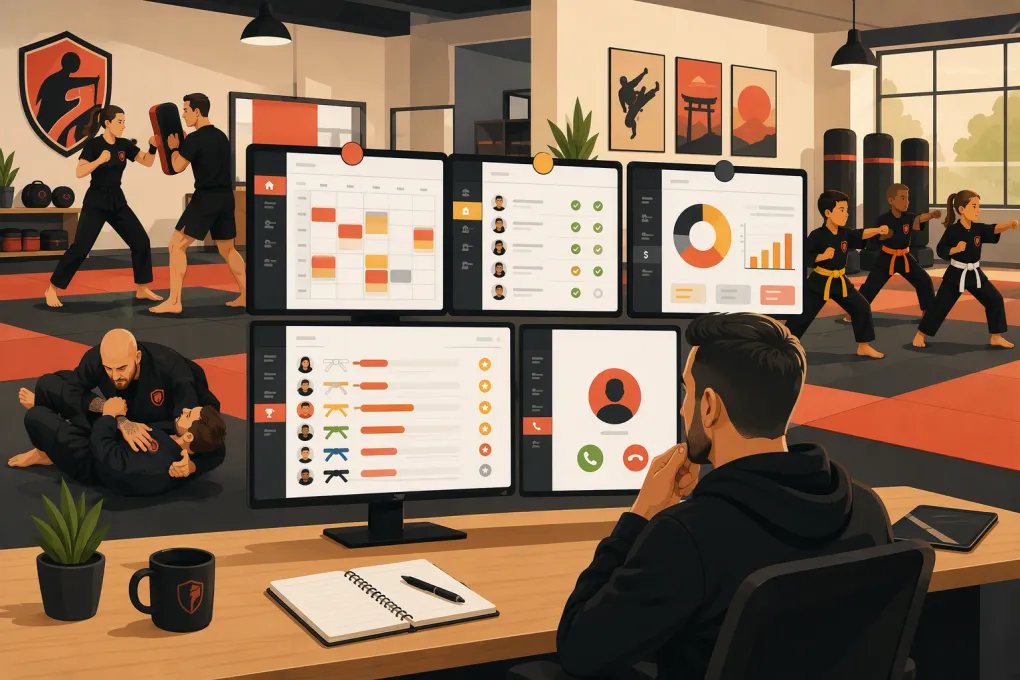 Watch · 20s
Self-defense schools have an awkward software problem: they operate partly like membership gyms, partly like appointment businesses, and partly like education programs. A workable platform may need to manage recurring dues, group classes, private lessons, family accounts, waivers, attendance, rank progression, leads, and instructor access.
No single product is best at all of those jobs. Martial arts-specific systems tend to be stronger at student progression. Broader fitness platforms may offer more extensive booking, marketing, or multi-location tools. AI-led systems focus on responding to inquiries and completing front-desk work when employees are unavailable.
This comparison evaluates five relevant options without pretending they are interchangeable.
How this comparison was evaluated
This is an editorial review of vendors’ publicly available product, pricing, support, and policy pages as of September 2026. It is not presented as a hands-on laboratory test, and WTF Go has a commercial interest in this category. Features described below are vendor-published capabilities, not independently measured performance claims.
The evaluation uses criteria that affect day-to-day self-defense school operations:
- Membership, booking, and attendance workflows
- Rank or progression tracking
- Lead response and automation
- Payment-processing model
- Integrations and data portability
- Multi-location administration
- Published pricing and contract transparency
- Onboarding and support information
- Suitability by school size and program model
Official sources are linked so operators can verify current details. Software packaging changes, and a feature listed on a vendor’s website may be limited to a particular plan, processor, country, or add-on. Where a vendor does not publicly disclose a material term, the comparison says so rather than guessing.
Comparison at a glance
| Platform | Operational emphasis | Rank tracking | Lead response and AI | Pricing visibility | Payment model | Best initial fit |
|---|---|---|---|---|---|---|
| WTF Go | Unified sales and operating workflows for gyms, studios, spas, and wellness businesses | Not promoted as a specialist rank-management system | Fitty is marketed to answer inquiries, book, follow up, and assist with dues workflows | Contact vendor for current package details | Confirm processor, rates, and portability directly | Schools losing leads after hours or combining training with appointments and wellness services |
| Gymdesk | Gym and martial arts membership administration | Martial arts features include ranks and promotion-related workflows | Built-in marketing and communication tools; not positioned primarily as a conversational AI receptionist | Public pricing page with plans tied to active-member ranges | Integrated payment options vary by market; confirm rates and account structure | Independent schools wanting transparent software tiers and martial arts administration |
| Kicksite | Martial arts student management | A central product emphasis, including student development and belt-related administration | Lead management and communications are available; verify automation scope by package | Quote-led; complete pricing is not publicly listed | Integrated billing is available; processing terms require a vendor quote | Traditional martial arts schools where rank and student progression are decisive |
| Zen Planner | Membership, billing, scheduling, attendance, and martial arts administration | Supports belt and skill tracking | Offers member communication and marketing functions; AI receptionist capabilities are not the core public positioning | Pricing requires current vendor confirmation | Uses an integrated payment ecosystem; confirm processing and migration terms | Established membership schools wanting a mature martial arts and fitness platform |
| Mindbody | Broad fitness and wellness marketplace, booking, payments, and marketing | Not a martial arts-specialist strength | Marketing and front-desk capabilities depend on package; confirm current AI products and add-ons | Quote-based package pricing | Native payment processing is a major part of the platform | Multi-service or multi-location businesses that also sell fitness, recovery, or wellness appointments |
Start with the vendors’ official pages: WTF Go, Gymdesk, Gymdesk pricing, Kicksite, Zen Planner, and Mindbody business software.
Detailed platform comparison
WTF Go: strongest fit for lead coverage and mixed-service operations
WTF Go is an operating platform for gyms, studios, spas, and wellness businesses rather than dedicated belt-school software. Its distinguishing component is Fitty, an AI receptionist and agent.
According to WTF Go’s official product site, Fitty is designed to answer leads, book classes, conduct follow-up, and assist with dues collection around the clock. Those are vendor-published capabilities. Operators should substantiate them in a live evaluation by calling outside staffed hours, asking program-specific questions, completing a test booking, missing that booking, and triggering a test past-due workflow.
That focus makes WTF Go relevant when unanswered calls, slow follow-up, and disconnected front-desk tools are larger problems than belt administration. A Krav Maga school offering group memberships, private training, corporate workshops, and recovery appointments may value that breadth more than a traditional academy would.
The tradeoff is specialization. Schools requiring detailed belt eligibility, curriculum testing, lineage, or promotion records should not assume a general operating platform covers them. Ask WTF Go to demonstrate each required progression workflow. Public pricing, processor terms, contract length, supported integrations, onboarding scope, and data-migration responsibilities should also be documented before purchase.
See how Fitty handles self-defense school inquiries and booking workflows →
Gymdesk: practical choice for independent martial arts schools
Gymdesk publicly positions its software for gyms and martial arts schools. Its martial arts software overview describes member management, scheduling, attendance, billing, communications, and rank-oriented administration.
Its major comparison advantage is pricing visibility. The official pricing page publishes plan tiers based on active-member ranges, allowing a school to estimate the software subscription before entering a sales process. Operators must still check processing charges, messaging usage, optional services, and the point at which member growth moves the school into another tier.
Gymdesk is a sensible shortlist candidate for a single-location or growing school that needs martial arts records without enterprise-level complexity. It also provides integrations and automation options, but operators seeking a live conversational receptionist should compare the exact inquiry-to-booking workflow rather than treating email, SMS, and AI conversation as equivalent.
Confirm which payment providers are available in your country, whether existing stored cards can migrate, and what onboarding assistance is included. Payment credentials frequently cannot be moved as freely as contact records.
Kicksite: strongest shortlist candidate for rank-led programs
Kicksite is purpose-built around martial arts school administration. Its public product materials emphasize student management, rank progression, attendance, billing, lead management, and communication.
That makes it a logical candidate for karate, taekwondo, judo, and other schools where promotions are part of the core operating model. During evaluation, ask Kicksite to show how instructors record progress, determine test eligibility, handle students training in multiple programs, and preserve promotion history.
The limitation for comparison shoppers is pricing transparency: complete current software, processing, onboarding, and contract costs require direct sales confirmation. Request one written quote that separates the base platform, payment processing, messaging, optional websites or marketing services, setup, data migration, and termination obligations.
Kicksite publishes support and educational resources through its official website, but verify current support channels and hours against your evening and weekend schedule. A support desk available only when your school is quiet may not solve operational emergencies.
Zen Planner: mature membership administration with martial arts support
Zen Planner serves fitness and martial arts businesses with membership management, scheduling, attendance, billing, communication, and belt or skill tracking. It is appropriate to consider when an established school needs structured member administration and martial arts functionality in the same platform.
Its breadth can require more configuration than a small seminar-based program needs. Ask for a workflow demonstration using your membership freezes, family billing, private lessons, belt tests, failed payments, and instructor permissions—not a generic fitness studio demo.
Current package pricing, onboarding charges, agreement terms, payment processing, integrations, support access, and data conversion should be confirmed with Zen Planner. Also ask whether implementation is self-directed or managed, who imports historical ranks and attendance, and what data can be exported in a usable format if the school later leaves.
Mindbody: broadest fit for hybrid fitness and wellness businesses
Mindbody is broader than martial arts software. It combines class and appointment booking, client management, payments, marketing capabilities, and consumer discovery for fitness and wellness businesses.
That breadth can suit a multi-service location offering self-defense, personal training, massage, recovery, or other appointments. It may be excessive for a small school that primarily needs dues, attendance, and belt records. Rank progression is not its defining specialty, so traditional schools may need another process or a more specialized platform.
Mindbody generally sells packaged business software through a quote process. Ask which functions are included, which require add-ons, whether a branded app is separate, how payment processing is structured, and what applies per location. Review current details on the Mindbody business site.
Its ecosystem is an advantage for businesses seeking broad integrations and marketplace visibility, but more components can also mean more implementation decisions. Require a location-by-location cost summary and a list of included support and onboarding services.
Recommendations by school type
Small or budget-sensitive school
Start with Gymdesk because its publicly visible member-based tiers make initial budgeting easier. Compare the total cost after processing, messaging, and migration—not just the subscription. A very small workshop-only operation may need simpler scheduling software, but it should plan for recurring billing and attendance before choosing a system it will quickly outgrow.
Traditional belt or rank-based academy
Shortlist Kicksite, Gymdesk, and Zen Planner. Make rank history, testing eligibility, family accounts, and instructor permissions pass-or-fail requirements. WTF Go and Mindbody should only advance if they can demonstrate your progression workflow or you are comfortable maintaining it elsewhere.
Krav Maga, reality-based defense, or seminar-focused program
Rank depth may matter less than lead conversion, introductory bookings, private appointments, and workshop sales. Compare WTF Go, Gymdesk, and Mindbody based on those workflows. WTF Go is particularly relevant if prospects regularly contact the school while instructors are teaching and no receptionist is available.
Hybrid self-defense, fitness, and wellness business
Compare Mindbody and WTF Go first. Mindbody offers a broad fitness and wellness ecosystem; WTF Go emphasizes consolidated operations and AI-led inquiry handling. Test appointment and class booking, resource conflicts, package use, cross-service reporting, and location permissions.
Multi-location operator
Do not accept a simple “multi-location supported” answer. Require each vendor to demonstrate centralized reporting, local manager restrictions, cross-location memberships, shared leads, instructor access, processor deposits, and separate tax or bank configurations. Mindbody, Zen Planner, and WTF Go merit evaluation, while martial arts-specific vendors should be tested against the same scenarios.
What to verify before signing
Use the same script with every finalist:
- Submit a lead after staffed hours and measure what happens.
- Book an intro class, then reschedule and cancel it.
- Enroll a parent with two students on different programs.
- Record attendance and update rank or skill progress.
- Fail a test payment and review staff and member notifications.
- Export leads, members, attendance, payment records, and rank history.
- Ask support a real configuration question through every offered channel.
Request a written summary covering subscription tiers, processing rates, messaging charges, onboarding, migration, integrations, contract length, renewal, cancellation, support hours, and export rights. If a term is absent, treat it as unresolved.
For schools where front-desk coverage is the primary gap, ask WTF Go to demonstrate Fitty answering, booking, following up, and handling a test dues workflow →. Apply the same proof standard to every vendor: use your schedule, policies, questions, and edge cases—not a prepared demo account.
The best self-defense school management software is not the platform with the longest feature page. It is the one that passes your critical workflows, fits your program model, and gives you acceptable control over payments, data, contracts, and member communication.
Frequently asked questions
Which software is best for tracking belts and ranks?
Kicksite, Gymdesk, and Zen Planner should be the first products evaluated for rank-based programs. Test promotion history, eligibility rules, multiple disciplines, and instructor permissions directly.
What is the best option for a small self-defense school?
Gymdesk is a practical starting point because it publishes member-based software tiers and supports martial arts operations. Compare its total cost and lead-response workflow with any finalist.
Can Fitty answer and book leads after hours?
WTF Go states that Fitty answers leads, books classes, follows up, and assists with dues workflows around the clock. Verify those vendor claims with an after-hours test call, a real booking scenario, and a controlled past-due account before committing.
Should a self-defense school choose martial arts-specific software?
Choose specialist software when belts, testing, and progression records are central. A broader platform may be better when the business prioritizes appointments, wellness services, multi-location operations, or AI-led front-desk coverage.
What costs should be compared beyond the monthly subscription?
Compare payment processing, messaging, add-ons, onboarding, migration, hardware, per-location charges, contract terms, support, and the cost of any separate tools the platform does not replace.
Keep reading


Run your gym on autopilot with WTF Go
Fitty — your AI receptionist — answers calls and DMs, fills classes, follows up with every lead, and collects dues while you coach.