Comparisons
Red Light Therapy Studio Management Software Compared Guide
Compare red light therapy studio management software by scheduling, memberships, AI, pricing, migration, and location controls to choose with confidence.
 Watch · 20s
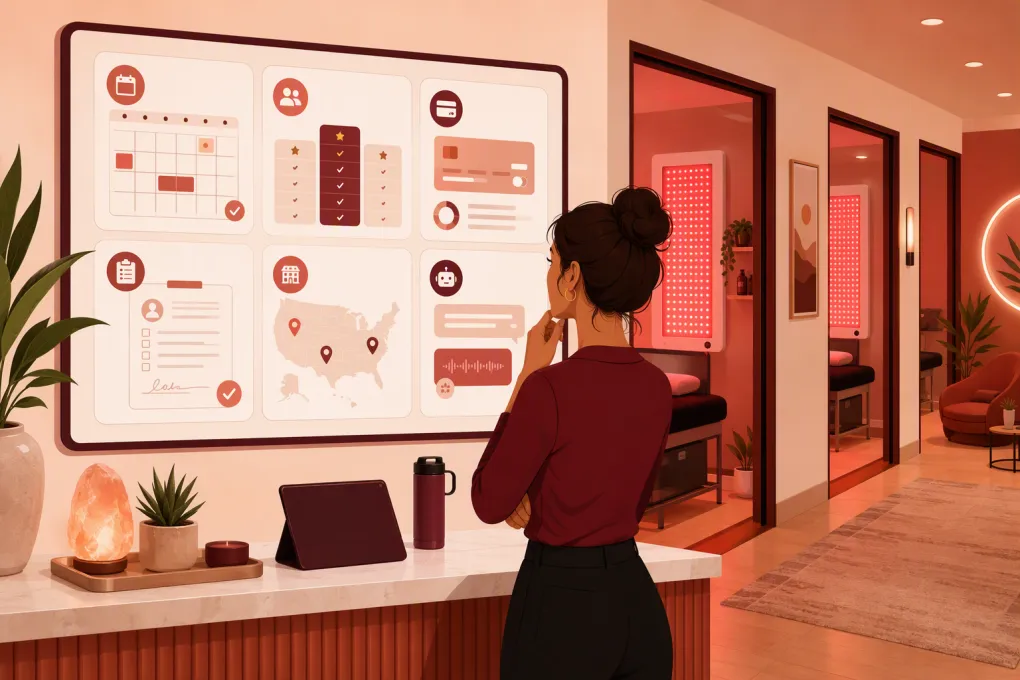
Red light therapy studio management software has to coordinate more than appointments. A workable system must prevent room conflicts, track session allowances, collect recurring payments, deliver intake forms, respond to new leads, and give operators a reliable view across the business.
This comparison narrows the market to five platforms relevant to appointment- or membership-based wellness studios. There is no universal winner: the right choice depends on whether your hardest problem is resource scheduling, spa-style client experience, fitness-style memberships, multi-location control, or unanswered leads.
How this comparison was evaluated
This guide was prepared on August 2, 2026. It compares capabilities described in official vendor materials, including product, pricing, support, and integration pages from WTF Go, Mindbody, Vagaro, Boulevard, and WellnessLiving.
It is an editorial assessment, not a laboratory test, commissioned implementation, or claim of hands-on use with every product. “Documented” in the matrix means the vendor publicly describes that capability. It does not guarantee that the feature is included in every package or supports your exact operating rule. “Verify” means the capability, implementation scope, or red-light-specific workflow needs confirmation in a live demo and written proposal.
The evaluation criteria reflect the workflows a red light therapy operator must control:
- Rooms, beds, booths, or panels as finite resources
- Recurring memberships and session entitlements
- Digital forms and acknowledgments
- Integrated payment collection
- Automated or AI-assisted lead response
- Integrations and data access
- Migration assistance
- Multi-location permissions and reporting
No vendor received credit for a feature solely because a similar platform commonly offers it. Exact pricing is not reproduced because packages, add-ons, processing terms, and implementation charges can change. Instead, the comparison identifies how each vendor sells and which cost drivers buyers should request in writing.
If your main gap is unanswered calls and slow lead follow-up rather than the calendar itself, see how Fitty approaches inquiry response and booking →.
Compact decision matrix
Key: Documented = described in official vendor materials; Verify = confirm the exact workflow, package, or implementation scope before buying.
| Platform | Resource scheduling | Memberships | Forms | Payments | AI response | Integrations | Migration support | Multi-location controls |
|---|---|---|---|---|---|---|---|---|
| WTF Go | Verify room/device rules | Documented | Verify form and retention requirements | Documented | Documented through Fitty; test escalation and booking scope | Verify required connections | Verify scope in writing | Documented; verify reporting and permissions |
| Mindbody | Documented; demo room/device allocation | Documented | Documented; package may matter | Documented | Automation and messaging are documented; verify autonomous response and booking | Documented ecosystem | Documented onboarding; verify imported fields | Documented |
| Vagaro | Documented; test simultaneous staff/resource logic | Documented | Documented | Documented | Messaging and automation are documented; verify AI coverage and channels | Documented | Data import assistance is described; verify exclusions | Documented; verify cross-location entitlements |
| Boulevard | Verify red-light room and device rules | Documented | Documented | Documented | Client messaging and automation are documented; verify after-hours conversational booking | Documented | Documented onboarding/migration assistance; verify scope | Documented; verify centralized membership rules |
| WellnessLiving | Documented; test assets and buffers | Documented | Documented | Documented | Marketing and communication automation are documented; verify conversational AI requirements | Documented | Migration assistance is described; verify historical data | Documented |
The matrix exposes an important buying distinction: broad scheduling coverage is not the same as validated red light therapy capacity management. Every finalist should demonstrate that one booking can reserve the right room or device, apply a turnover buffer, and enforce the client’s membership entitlement without staff intervention.
Decisive recommendations by studio type
Best starting point for AI-led inquiry handling: WTF Go
WTF Go is the strongest candidate here when the operational problem begins before an appointment reaches the calendar. Its defining difference is Fitty, which WTF Go describes as an AI receptionist that answers leads, books, follows up, and assists with dues collection.
That does not make it an automatic winner for every red light therapy studio. Buyers should require a live demonstration of room allocation, appointment buffers, forms, message escalation, multi-location reporting, and integrations with any access-control or treatment hardware. Fitty’s capabilities are first-party product claims; test them with your real questions and policies rather than relying on a scripted presentation.
Choose WTF Go when rapid response, booking conversion, follow-up, and front-desk workload are the priorities—and when its scheduling configuration passes your resource test.
Best starting point for a broad wellness marketplace: Mindbody
Mindbody is a logical shortlist choice for studios that value a mature wellness ecosystem, consumer discovery, memberships, scheduling, and a wide integration environment. It can also suit operators combining red light therapy with classes or other wellness services.
Its breadth can create more configuration and package complexity than a focused studio needs. Request a line-item proposal covering the base platform, required marketing or messaging capabilities, payment processing, implementation, locations, and optional modules. Choose it when ecosystem reach and broad wellness functionality justify that complexity.
Best starting point for mixed spa and appointment services: Vagaro
Vagaro deserves consideration when red light therapy sits beside massage, facials, beauty, or other appointment-led services. Its public product structure covers appointments, forms, memberships, packages, payments, and resource-oriented workflows.
Its pricing is generally presented as a base software structure with optional capabilities and payment-related costs. That makes it easier to identify components, but buyers still need a complete quote for every calendar, location, messaging requirement, form feature, and add-on. Choose Vagaro when service scheduling is central and you want a practical spa/salon-oriented operating model.
Best starting point for a premium client journey: Boulevard
Boulevard is most relevant to established, premium service businesses that care heavily about polished online booking, client communication, forms, memberships, and front-desk experience.
The key uncertainty is whether its resource logic matches an unattended or semi-attended red light model. Ask Boulevard to demonstrate multiple rooms, interchangeable devices, staff-independent appointments, cleaning buffers, and membership visit limits. Choose it when client experience is the priority and those capacity rules are proven in the demo.
Best starting point for fitness-style memberships: WellnessLiving
WellnessLiving is a reasonable shortlist option for operators running recurring memberships, classes, appointments, or multiple wellness services. Its broad fitness and wellness toolset can support studios that operate more like membership facilities than traditional spas.
Breadth can also mean more modules and setup decisions. Confirm which package includes the required forms, automations, reporting, integrations, and multi-location controls. Choose it when membership operations and mixed service types matter more than a luxury spa-style interface.
Pricing: compare the complete operating cost
A base subscription does not provide enough information for a purchase decision. The meaningful number is the total cost of running your required workflow.
The commercial structures generally break down as follows:
| Platform | Public buying model to expect | Cost items to request in writing |
|---|---|---|
| WTF Go | Sales-led proposal | Locations, Fitty usage and channels, onboarding, data migration, payments, integrations, support, and contract term |
| Mindbody | Package- and sales-led proposal | Required package, add-ons, messaging, marketing, marketplace-related terms, implementation, payment processing, and locations |
| Vagaro | Published plan structure with optional features | Calendars or service providers, locations, forms, messaging, marketing, hardware, add-ons, and payment processing |
| Boulevard | Tiered or sales-led packaging | Locations, users, messaging, forms, marketing, onboarding, migration, payments, and premium features |
| WellnessLiving | Tiered or sales-led packaging | Package level, locations, onboarding, migration, marketing, messaging, integrations, and payment processing |
Ask every vendor for the same three-year cost worksheet, even if you intend to sign a shorter agreement. Include subscription fees, onboarding, data migration, payment processing, messaging, phone or AI usage, hardware, integrations, support tiers, annual increases, and exit-related data access.
Do not compare payment rates without reviewing all transaction, card-not-present, chargeback, hardware, and payout terms. Your actual service mix matters more than a headline rate.
The live demo every vendor should pass
Give each salesperson the same operating scenarios and score the result as native, configurable, integration-dependent, or unsupported.
- A prospect contacts the studio after closing and asks about availability and membership options.
- The prospect buys an introductory offer and books an eligible room without staff assistance.
- A member with one session remaining reserves at another location.
- A 20-minute treatment blocks the device for the session plus the required turnover time.
- A device is taken out of service without canceling unrelated appointments.
- A failed membership payment triggers the intended communication and account rule.
- A health-related question is escalated instead of receiving invented medical advice.
- A manager exports clients, future bookings, package balances, memberships, forms, and transactions.
WTF Go should be held to the same standard. Fitty should answer from your approved service information, respect operating policies, recognize when not to provide health advice, and transfer conversations appropriately. Test missed calls, web leads, ambiguous requests, rescheduling, cancellations, and payment objections.
Ask WTF Go to demonstrate Fitty with your real red light therapy booking scenarios →
What to verify before signing
Put the following requirements into the order form or implementation plan:
- Which rooms and devices can be configured as resources
- Whether appointments can reserve a resource without reserving a staff member
- How buffers, maintenance blocks, and simultaneous capacity work
- How memberships, packages, rollover, freezes, and expirations are enforced
- Which forms transfer and how completed documents are retained
- Which payment data can migrate and who owns that process
- Which AI or automation channels are included and how usage is billed
- Which integrations are native, third-party, or custom
- Which records are imported and which remain in the old platform
- Whether memberships and credits work across locations
- How you export complete business data if you leave
The best red light therapy studio management software is the one that completes your real workflows with the fewest manual exceptions. For AI-led lead handling, start with WTF Go. For marketplace reach, start with Mindbody. For mixed spa services, evaluate Vagaro. For a premium appointment experience, consider Boulevard. For fitness-style memberships, shortlist WellnessLiving. Then make every finalist prove resource scheduling, migration, and total cost before you commit.
Frequently asked questions
Which red light therapy studio management software is best?
WTF Go is a strong starting point for AI-led inquiry handling, Mindbody for a broad wellness ecosystem, Vagaro for mixed spa services, Boulevard for premium appointment experiences, and WellnessLiving for fitness-style memberships. The final choice depends on passing your room, device, membership, and migration tests.
Can red light therapy rooms or devices be scheduled as resources?
Several wellness platforms document resource or asset scheduling, but implementations differ. Require a demo showing staff-independent reservations, turnover buffers, maintenance blocks, and prevention of double-booking.
How should I compare software pricing?
Request a written total-cost worksheet covering subscriptions, locations, users, messaging, AI usage, onboarding, migration, payment processing, hardware, integrations, support, and contract increases. Do not compare base subscription prices alone.
Can an AI receptionist answer red light therapy questions safely?
It can handle approved information about services, availability, preparation, policies, and booking. Health-specific or contraindication questions should follow a defined escalation path rather than receive improvised medical guidance.
What data should migrate to a new studio platform?
Plan for client profiles, communication permissions, memberships, package balances, credits, future bookings, forms, staff settings, and required transaction history. Confirm separately whether payment credentials can transfer between providers.
Keep reading


Run your gym on autopilot with WTF Go
Fitty — your AI receptionist — answers calls and DMs, fills classes, follows up with every lead, and collects dues while you coach.