Comparisons
Recovery Lounge Membership Management Software Compared
Compare recovery lounge membership management software by resources, entitlements, waivers, multi-location controls, automation, pricing, and operational fit.
 Watch · 20s
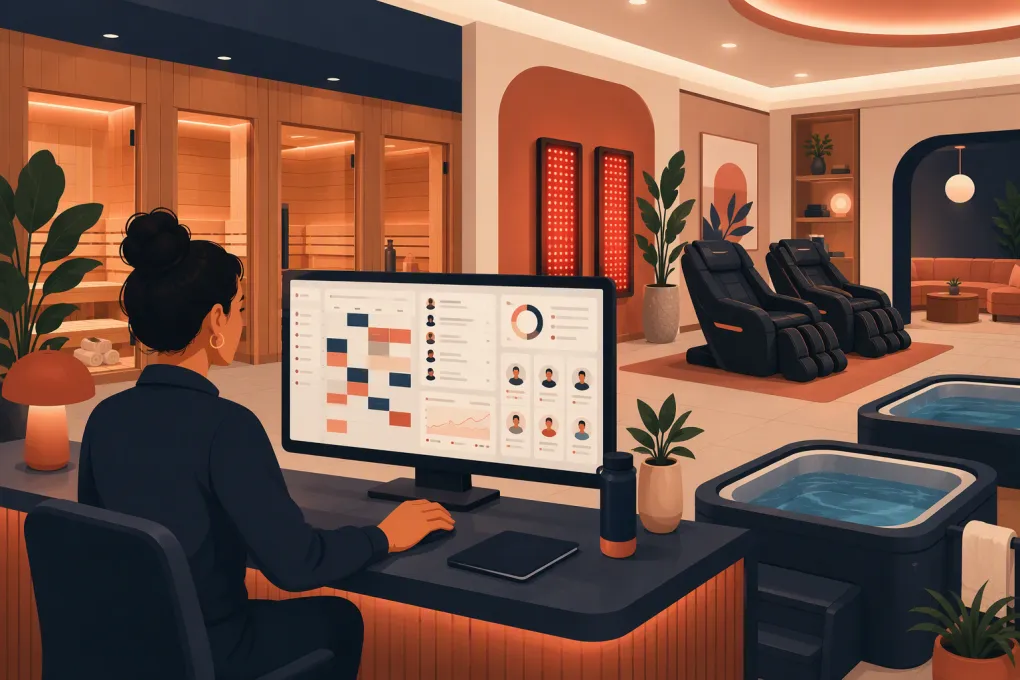
Recovery lounge membership management software must coordinate more than a calendar. It has to connect recurring memberships, session credits, rooms, equipment, waivers, payments and customer communication without making the front desk enforce every rule manually.
That is where general-purpose schedulers often fall short. A customer may be entitled to four red light sessions per month but not cold plunge access. A sauna booking may require a room, a cleanup buffer and a completed waiver. A failed payment may affect future reservations. If the software cannot connect those conditions, employees end up working from notes and spreadsheets.
This comparison uses six named evaluation criteria: resource scheduling, membership entitlements, forms and waivers, billing workflows, multi-location controls, and lead automation. It is based on capabilities vendors describe publicly, not undisclosed hands-on testing. Product packaging changes, so treat the table as a shortlist—not a substitute for a scripted demo using your own services and policies.
See how WTF Go approaches recovery lounge bookings, follow-up and dues workflows →
The six criteria that matter most
1. Resource-aware scheduling
Recovery services can require a provider, room, device or combination of resources. Your software should prevent the same sauna, compression unit or treatment room from being assigned twice.
Evaluate whether it can handle:
- Individual rooms and devices as separate resources
- Setup, transition and cleaning buffers
- Simultaneous capacity limits
- Services requiring both an employee and equipment
- Multi-step visits using more than one modality
- Maintenance blocks that remove equipment from availability
A vendor saying it supports “appointments” does not prove it can enforce these rules. Ask for a live demonstration of your most complicated visit.
2. Membership entitlements
An entitlement is the specific benefit a customer is allowed to redeem. Useful software should distinguish among recurring memberships, session packs, unlimited access, member discounts and modality-specific credits.
Test whether it supports:
- Monthly credits by service category
- Rollover and expiration policies
- Member pricing for extra sessions
- Booking limits and advance-booking windows
- Freezes, upgrades and cancellations
- Benefits shared across locations
- Restrictions on introductory offers
The critical question is not whether a platform sells memberships. It is whether the booking flow automatically recognizes and enforces what each membership includes.
3. Forms and waivers
Look for digital forms that can be assigned to a service, delivered before arrival and connected to the customer record. Ask whether the system records completion dates and allows updated versions to be issued.
A waiver feature does not make a platform a medical records system. Recovery lounges offering regulated medical services or storing protected health information should obtain qualified compliance advice and confirm the vendor’s security and contractual capabilities directly.
4. Billing and failed-payment workflows
Recurring billing should connect membership status to operational action. Employees need to see active, frozen, canceled and past-due accounts without reconciling separate systems.
Ask what happens after a payment fails:
- Is the customer notified?
- Can the payment method be updated through a secure flow?
- Are retries configurable?
- Does staff receive a task or alert?
- Can booking privileges be changed according to policy?
- Is each contact or collection attempt recorded?
5. Multi-location controls
Multi-location support should mean more than creating multiple calendars. Operators need centralized customer records, location-level permissions, cross-location redemption rules and consolidated reporting.
Confirm whether pricing, taxes, services and operating rules can differ by location. Also test whether a member can book at another lounge without creating a duplicate profile.
6. Lead response and automation
Recovery prospects frequently ask routine questions before booking: what to wear, what a membership includes, whether beginners are welcome and which times are open. Automation is valuable when it can answer approved questions, capture lead information and move the person into a valid booking workflow.
The boundaries matter. An automated agent should escalate medical, safety, refund and unusual policy questions rather than improvising an answer.
Recovery lounge software comparison
The distinctions below are intentionally operational. Vendor links point to official product or pricing pages where available. Confirm every requirement in writing because features may depend on package, payment processing arrangement, location count or configuration.
| Platform | Resource scheduling | Entitlements and waivers | Multi-location | Automation and follow-up | Best fit and material limitation |
|---|---|---|---|---|---|
| WTF Go | Supports booking workflows for gyms, studios, spas and wellness businesses. Recovery operators should require a configured demonstration of room, device, buffer and capacity rules. | Designed for membership-based operations and dues workflows. Confirm modality-specific credits, rollover rules and waiver versioning against your policies. | Intended for independent and multi-location operators; verify cross-location redemption, permissions and consolidated reporting during scoping. | Fitty can answer approved lead questions, book against connected availability, follow up and assist with configured dues outreach. Availability applies to automated workflows on enabled channels; clinical judgment, disputes and exceptions require staff escalation. | Strong candidate when reducing repetitive front-desk conversations is a priority. Specialized clinical documentation and unusually complex resource combinations require explicit validation. |
| Mindbody | Supports class and appointment scheduling, including resources used for services. Complex recovery sequences should still be tested live. | Offers memberships, packages, client profiles, forms and business policies, with availability varying by package and setup. | Built for businesses operating one or multiple locations, with broader ecosystem and consumer marketplace exposure. | Provides marketing and communication tools; exact automation, messaging and add-on availability depend on the selected package. | Broad fitness and wellness ecosystem. Operators should evaluate setup complexity, package dependencies and total cost rather than buying for marketplace visibility alone. |
| WellnessLiving | Supports classes, appointments and asset-style scheduling relevant to rooms or equipment. Test linked staff-and-device requirements. | Supports memberships, passes, client records and digital forms. Confirm granular modality restrictions and rollover behavior. | Offers multi-location business management, but permissions, reporting and shared-member rules should be demonstrated. | Includes client communication and marketing capabilities, with packaging varying by plan. | Broad option for hybrid class-and-appointment businesses. Recovery-specific resource and entitlement rules need validation rather than assumption. |
| Vagaro | Appointment-focused scheduling can account for service providers, rooms and equipment resources. Hybrid group workflows should be tested separately. | Supports memberships, packages, forms and online booking. Ask the vendor to demonstrate service-specific redemption and expiration rules. | Supports multiple locations and shared business management; confirm how memberships, gift certificates and reporting behave across locations. | Offers messaging, marketing and customer communication tools, some of which may affect subscription cost. | Practical for appointment-heavy recovery lounges and spas. Add-ons and the number of bookable employees or locations can materially affect cost. |
| Boulevard | Oriented toward appointment-based beauty and wellness operations, with calendar and service management tools. Confirm equipment-level scheduling for self-directed modalities. | Supports memberships, client profiles, checkout and forms-related workflows. Test credit rules and unattended-access use cases. | Supports multi-location brands with centralized operational capabilities; obtain a demonstration of cross-location benefits and permissions. | Provides client messaging and workflow automation, subject to package and configuration. | Strong consideration for hospitality-led, appointment-based concepts. It may be less natural for lounges centered on group classes, gym access or complex equipment rotations. |
These descriptions do not establish that one product will support every workflow out of the box. They identify what to test and where each platform’s general orientation may create a better or worse fit.
A defensible way to compare pricing
Exact subscription figures are often misleading. Vendors may change packaging, quote by location or user count, require particular payment arrangements, or price messaging and onboarding separately. Instead of comparing an advertised starting price with a negotiated quote, request written proposals on the same date using the same operating assumptions.
Create a 24-month cost worksheet with these rows:
| Cost category | What to request from each vendor |
|---|---|
| Base subscription | Monthly or annual platform fee for your actual location count |
| Required modules | Memberships, forms, marketing, reporting, branded app or automation not included in the base package |
| Users and resources | Charges tied to employees, calendars, rooms, devices or bookable resources |
| Communications | Included and overage costs for supported messaging channels |
| Payment processing | Card-present, card-not-present, recurring billing and dispute-related terms |
| Implementation | Setup, data import, configuration, training and launch support |
| Hardware | Terminals, card readers, kiosks or access-control equipment |
| Integrations | Setup and recurring fees for accounting, access control or other required systems |
| Multi-location expansion | Cost of adding the next location during the contract term |
| Exit and data export | Contract notice, early termination terms and fees for usable data exports |
Use the same membership count, transaction volume, employee count, location count and expected communication volume for every quote. Record the quote date and expiration date. This produces a comparable operating cost without publishing figures that may be outdated or irrelevant to your business.
How to run an evidence-based demo
Do not ask vendors to “show the booking system.” Send the same demo script to every finalist and score each workflow as native, configurable, third-party dependent, manual or unsupported.
Test one complicated booking
Use a real example: a member books 30 minutes of compression followed by a red light session. The visit requires two devices, a transition buffer and an active waiver. Ask the vendor to complete the booking online, reschedule it and cancel it.
Test an entitlement exception
Create a membership that includes four sauna sessions but only discounts cold plunge visits. Redeem all four credits, attempt a fifth booking and inspect what the customer and employee each see.
Test a failed payment
Trigger or simulate a failed recurring charge. Document the notification, retry process, staff visibility, booking consequences and account history.
Test location sharing
Have a member purchased at Location A book at Location B. Check duplicate prevention, benefit eligibility, revenue attribution and employee permissions.
Test automation boundaries
Ask routine and sensitive questions. A useful system should handle an approved hours or membership question, consult live availability where connected, and escalate a contraindication, refund dispute or policy exception.
Request screenshots or a recording of each completed test, plus written confirmation of any feature promised for future release. A roadmap is not a current capability.
Where Fitty fits—and where staff remain responsible
Fitty is WTF Go’s AI receptionist and agent. When the relevant channels, approved knowledge, booking rules and billing workflows are configured, it can respond outside staffed hours, answer permitted questions, offer available bookings, continue lead follow-up and assist with dues outreach.
“24/7” describes the availability of configured automation, not guaranteed resolution of every conversation. Fitty requires accurate business information, connected availability, escalation rules and regular review. It should not independently make clinical judgments, alter disputed balances or invent exceptions to membership policy.
For operators losing leads because employees are serving customers instead of monitoring inquiries, that distinction is still useful: automation handles repeatable work while staff retain control of sensitive decisions.
Explore how Fitty can be configured for recovery lounge inquiries and follow-up →
Make the decision from workflows, not feature counts
The best recovery lounge membership management software is the system that reliably enforces your actual operating model. Start with resource conflicts, entitlement rules, waivers, failed payments and cross-location visits. Then assess whether automation reduces repetitive work without creating compliance or customer-service risk.
Shortlist vendors from the comparison, issue the same demo script and request cost proposals using identical assumptions. A platform that passes those tests is more valuable than one with a longer feature page.
Frequently asked questions
What is recovery lounge membership management software?
It connects memberships, session entitlements, resource scheduling, payments, forms, customer records and follow-up for recovery and wellness businesses.
Can recovery lounge software prevent equipment double-booking?
Yes, if it supports resources such as rooms and devices—not only employee calendars. Test combined staff, equipment, capacity and cleanup-buffer rules before buying.
How should I compare recovery lounge software pricing?
Request written quotes on the same date using identical assumptions, then compare subscription, modules, communications, processing, implementation, hardware, integrations and expansion costs over a fixed period.
Does Fitty replace recovery lounge staff?
No. Fitty can handle configured questions, booking, follow-up and dues outreach on enabled workflows, while employees remain responsible for clinical questions, disputes, exceptions and escalations.
Should a recovery lounge choose gym software or spa software?
Choose by workflow rather than category. Appointment-heavy lounges may favor spa-oriented tools, while concepts combining memberships, classes and access need stronger entitlement and membership controls.
Keep reading
Run your gym on autopilot with WTF Go
Fitty — your AI receptionist — answers calls and DMs, fills classes, follows up with every lead, and collects dues while you coach.