Comparisons
Pilates Studio Equipment Reservation Software Compared
Compare Pilates studio equipment reservation software for reformer selection, conflict controls, pricing, payments, support, waitlists, and AI follow-up.
 Watch · 20s
A Pilates studio can be fully staffed and still lose revenue because its booking software treats equipment as an afterthought. Every reformer, tower, chair, treatment room, and private-session space is limited inventory. The system must prevent conflicts without making clients call the studio for every change.
The hard part is that “equipment reservation” can mean three different things:
- Capacity control: A class closes after all available reformers are reserved.
- Client-facing spot selection: A client chooses a particular reformer or floor position.
- Resource scheduling: Software prevents a room or apparatus from being assigned to overlapping sessions.
Many platforms handle the first. Fewer clearly support all three. Buying the wrong category leaves staff assigning stations manually, correcting conflicts, or maintaining a second calendar.
See how WTF Go connects Pilates booking with Fitty’s lead response and follow-up →
How this comparison was evaluated
This is a feature and buying-methodology comparison, not a claimed hands-on laboratory test. We did not create paid accounts, capture private product screenshots, or complete controlled implementation projects with every vendor listed. Presenting that as firsthand testing would be misleading.
Instead, the comparison separates capabilities vendors publicly position as product features from capabilities that require configuration or are not clearly established. We evaluated six operational questions:
- Can the platform cap a class at the number of usable reformers?
- Can a client select a specific spot rather than only reserve admission?
- Can it prevent a room or resource from being double-booked?
- Can staff remove equipment from availability for maintenance?
- How are payments, integrations, pricing, and support packaged?
- Does the platform cover lead response as well as scheduling?
“Not clearly established” does not mean a platform cannot be configured to do something. It means buyers should not treat that capability as confirmed until it appears in their agreement and is demonstrated using their workflow.
Pilates studio equipment reservation software comparison
| Platform | Capacity-based reformer classes | Client-facing spot selection | Resource conflict and maintenance controls | Automation and AI | Commercial model and best fit |
|---|---|---|---|---|---|
| WTF Go | Supports class booking and capacity-based studio operations | Exact reformer-map selection is not claimed here as a standard feature; require a demonstration if this is essential | Do not assume equipment-level conflict prevention or a dedicated maintenance state without seeing the intended configuration | Fitty is designed to answer leads, follow up, book within configured rules, and assist with dues workflows | Pricing and terms should be obtained directly; best fit when booking, lead handling, follow-up, and broader operations need to work together |
| Mindbody | Yes; class capacity, booking, waitlists, memberships, and payments are core workflows | Mindbody offers spot-picking functionality in supported booking experiences and configurations; availability can depend on the product setup | Resource scheduling is available for appointment-oriented workflows, but buyers should distinguish room or equipment resources from class spot layouts; a dedicated reformer-maintenance workflow is not clearly established as a universal feature | Offers marketing and communication tools; AI receptionist coverage may require specific products or another system | Typically sold through packaged plans and add-ons; suited to established fitness and wellness businesses that value a broad ecosystem and consumer marketplace |
| Mariana Tek | Yes; built around boutique fitness classes, memberships, waitlists, and branded booking | Yes; spot selection is a recognized part of its boutique class-booking experience when configured | Spot layouts can control sellable positions; confirm whether out-of-service equipment is represented as a blocked spot, schedule exception, or another administrative state | Strong digital sales and communication workflows; do not assume autonomous phone or AI reception without reviewing the current offering and integrations | Generally sales-led rather than simple self-service purchasing; best for premium and multi-location boutique fitness brands |
| WellnessLiving | Yes; supports class capacity, waitlists, memberships, and payments | Yes; its Book-a-Spot functionality is designed to let clients select a position from a configured layout | Spot layouts address station availability, but room and apparatus conflict rules should be evaluated separately; do not assume a complete maintenance-management module | Includes marketing and communication automation; the scope of AI functionality depends on the current product package | Uses plan-based commercial packaging with optional capabilities; broad fit for studios wanting scheduling, client management, and marketing under one vendor |
| Vagaro | Yes; classes, appointments, memberships, and payments are supported | A dedicated client-facing reformer map is not a capability buyers should assume; its resource model is more relevant to reserving facilities or equipment alongside services | Resource scheduling can associate equipment or rooms with services and reduce double-booking; ask the vendor to show how an unavailable reformer is blocked across every connected service | Provides messaging and marketing functions; AI phone or receptionist requirements should be evaluated separately | Publishes entry-level subscription information more openly than many enterprise-oriented vendors, with features and add-ons affecting total cost; useful for studios combining classes, appointments, and spa services |
The practical divide is clear. Mariana Tek and WellnessLiving are the most explicit options in this group for client-facing spot selection. Mindbody can support spot-picking in applicable configurations, but operators need to establish which booking surface and package provides it. Vagaro is more compelling when equipment functions as a service resource than when clients must choose reformer number seven from a studio map.
WTF Go should be evaluated differently. Its differentiator is not a claimed reformer-map feature; it is the connection between studio operations and Fitty’s lead-response, booking, follow-up, and dues workflows. A studio requiring exact visual station selection should make that a pass-or-fail demo requirement.
What Fitty does—and what it does not decide on its own
Fitty is WTF Go’s AI receptionist and agent. It is designed to operate around the clock, but “24/7” describes system availability, not a promise that every request can be completed without configuration or escalation.
Fitty can handle supported conversations and actions such as:
- Answering configured questions about classes, intro offers, and studio policies.
- Following up with leads according to established workflows.
- Booking when the requested service, schedule, and connected rules permit it.
- Assisting with dues collection workflows, such as reminders and directing clients through supported payment steps.
Fitty should not invent eligibility rules, override a full class, waive a cancellation policy, or make an unavailable reformer bookable. Booking accuracy depends on the schedule, capacity, membership rules, integrations, and escalation paths configured by the operator.
Likewise, “collects dues” should not be interpreted as Fitty becoming a payment processor, collections agency, or substitute for required payment compliance. Payment execution depends on the studio’s configured billing and processing setup. Operators should review processor responsibilities, authorization, card-data handling, failed-payment logic, and staff escalation during implementation.
Ask WTF Go to demonstrate an after-hours Pilates lead from first question to eligible booking →
Run these workflows during every software demo
A polished dashboard does not prove that a system can protect equipment inventory. Give each vendor the same test script and record the result.
Test 1: One reformer is out of service
Start with a recurring 10-reformer class. Remove one machine from tomorrow’s session without changing later classes.
Check whether the system:
- Reduces sellable capacity to nine.
- Preserves existing reservations safely.
- Stops staff and clients from creating a tenth booking.
- Shows why capacity changed and who changed it.
- Restores the reformer without rebuilding the class.
If the platform uses a visual map, confirm that the unavailable station cannot be selected.
Test 2: A client chooses a station
Ask the vendor to book a class from the client’s mobile view, not the administrative calendar. Have the client choose a particular reformer, change that selection, and cancel.
This exposes the difference between true client-facing spot selection and an internal staff note.
Test 3: A private session needs three resources
Book a private session that requires a client, instructor, room, and specific apparatus. Then attempt to use that same room or apparatus in an overlapping appointment.
A genuine resource system should prevent or clearly flag the conflict. Instructor-only scheduling is not enough.
Test 4: A waitlist opening appears after hours
Cancel a reservation and watch the entire promotion process. Verify eligibility checks, acceptance deadlines, messages, credits, and what happens if the first client does not respond.
For AI-assisted booking, ask what the agent can read and change. It should follow the source-of-truth booking rules rather than maintain a disconnected availability list.
Test 5: A membership payment fails
Attempt a booking using a membership with a failed renewal. Observe whether the client is blocked, warned, asked to update payment, or routed to staff. Review what messages are sent and whether successful payment automatically restores booking access.
Compare pricing, contracts, payments, and support in writing
Software cost cannot be compared from the base subscription alone. Request a written commercial worksheet from every finalist covering:
| Cost or contract area | Questions to ask |
|---|---|
| Subscription | Is pricing based on location, staff member, client count, feature tier, or another unit? |
| Spot selection and resources | Are floor maps, resource scheduling, or branded booking experiences included or sold separately? |
| Messaging and AI | Are phone, SMS, email, usage, or conversation charges separate? What limits apply? |
| Payment processing | Is a designated processor required? What transaction, card-update, dispute, refund, and chargeback terms apply? |
| Implementation | Are configuration, data migration, staff training, and launch support included? |
| Contract | What are the initial term, renewal process, cancellation window, and data-export rights? |
| Integrations | Is the integration native, API-based, or dependent on a third party? Who supports it when it fails? |
| Support | Which channels are available, during what hours, and with what escalation path for booking or payment outages? |
Mindbody, Mariana Tek, WellnessLiving, and WTF Go generally require a sales conversation to establish the applicable package and operating scope. Vagaro makes starting subscription information easier to find publicly, but add-ons, payment terms, messaging, locations, and required capabilities still determine the real total.
Do not rank support quality from sales claims or review averages alone. Submit a realistic technical question before signing. Ask who owns migration, how urgent incidents are escalated, and whether weekend support aligns with your busiest class schedule.
Make the buying decision around the hardest constraint
Choose capacity-based booking if clients only need admission to a reformer class and instructors assign stations on arrival.
Choose client-facing spot selection if clients expect to reserve a particular reformer. Mariana Tek and WellnessLiving deserve close evaluation for this workflow, while Mindbody’s applicable spot-picking setup should be demonstrated in the exact client experience you plan to deploy.
Choose resource scheduling if private sessions share rooms or specialized apparatus. Vagaro and appointment-capable platforms may fit, but the vendor must prove conflict prevention across every affected service.
Choose WTF Go with Fitty when the larger operational problem includes missed calls, slow lead response, inconsistent follow-up, booking questions, and dues workflows—not just a class grid. If exact reformer selection is mandatory, evaluate that requirement separately and document the approved configuration before signing.
See whether WTF Go fits your Pilates booking and lead-response workflow →
The winning system is not the one with the longest feature list. It is the one that can demonstrate your out-of-service reformer, waitlist, private-resource conflict, failed payment, and after-hours lead workflows without spreadsheets or staff workarounds.
Frequently asked questions
Which Pilates booking systems let clients choose a specific reformer?
Mariana Tek and WellnessLiving explicitly support client-facing spot-selection experiences. Mindbody also offers spot-picking in applicable configurations; confirm the required package and booking surface.
Does equipment reservation software prevent double-booking automatically?
Only when equipment or rooms are configured as controlled resources or unavailable spots. Class capacity alone prevents overselling admission but does not necessarily prevent the same apparatus from being assigned to overlapping private sessions.
Can Fitty override membership or equipment rules to complete a booking?
No. Fitty should book within the availability, eligibility, capacity, and payment rules configured in the connected workflow, with exceptions routed according to the studio’s escalation setup.
What should a Pilates studio ask about payment processing?
Ask whether a processor is required, which fees and contract terms apply, how failed payments and refunds work, and how card data and authorization are handled. Get those terms in writing alongside the software proposal.
How should maintenance blocks be tested?
Remove one reformer from a single class and confirm that both staff and clients can no longer reserve it or exceed the revised capacity. Then restore it without altering the recurring schedule.
Keep reading


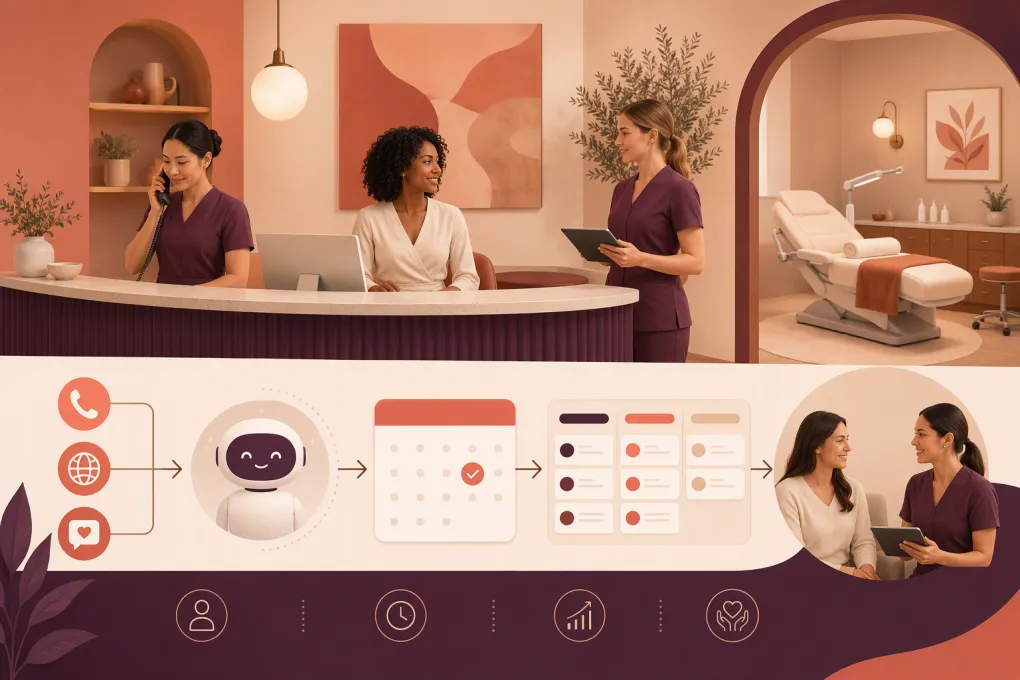
Run your gym on autopilot with WTF Go
Fitty — your AI receptionist — answers calls and DMs, fills classes, follows up with every lead, and collects dues while you coach.