Comparisons
Pickleball Club Membership Billing Software Buying Guide
Compare pickleball club membership billing software by pricing model, court workflows, payments, automation, migration, and fit for your club operation.
 Watch · 20s
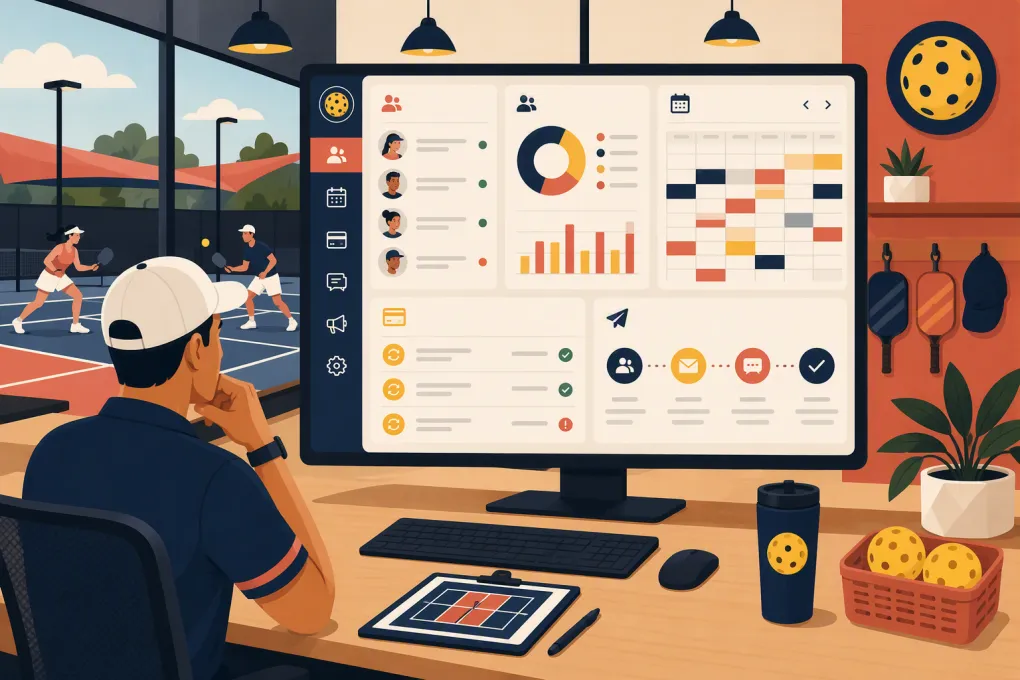
Pickleball club membership billing software has to do more than charge a card every month. It must connect each member’s plan to court privileges, program pricing, guest rules, freezes, renewals, and account status without creating another spreadsheet for the front desk.
That is why the best choice depends on your operating model. A private club with household memberships needs different controls than a public facility selling court time, clinics, leagues, and drop-ins. Before comparing vendors, document what you sell and which rules the system must enforce.
See how WTF Go handles membership operations, follow-up, and dues collection →
How this software comparison was researched
This guide evaluates vendors using publicly available product information from their official websites. The review focused on five workflows relevant to pickleball operators: recurring billing, court reservations, programs, member communication, and multi-location administration.
The sources reviewed were the official product overviews for WTF Go, CourtReserve, Playbypoint, PodPlay, and Upper Hand. These pages document each vendor’s positioning and broad feature categories.
This is not a claim that every platform was independently implemented in a live pickleball facility. Public pages rarely document every billing exception, permission rule, or integration dependency. Where a specialized capability could not be verified from public product information, the table labels it as something to confirm rather than assuming it exists.
Product packaging changes. Treat this as a shortlist, then require each vendor to demonstrate your actual workflows using a scripted demo.
Pickleball club billing software comparison
The table separates documented product focus from items that require direct verification. That distinction matters because “booking” can mean appointment scheduling, class registration, or a purpose-built court grid—and those are not interchangeable.
| Platform | Documented product focus | Billing and payments | Pickleball operations | Automation and communication | Pricing model and availability | Best fit and limitation to verify |
|---|---|---|---|---|---|---|
| WTF Go | All-in-one operating system for fitness and wellness businesses, including CRM, booking, billing, and Fitty, its AI receptionist | Membership and dues workflows are part of the broader operating platform; Fitty can assist with dues follow-up | General booking is part of the platform. A specialized pickleball court grid, leagues, ladders, player matching, door access, and court-allocation rules should not be assumed; require a live demonstration or integration plan | Fitty is designed to answer inquiries, book, follow up, and assist with collections around the clock | Obtain a current proposal covering software, payment processing, messaging, onboarding, and any integrations | Strong candidate when missed leads, fragmented member communication, and manual collections are major problems. Court-specialist functionality needs explicit validation |
| CourtReserve | Club-management software focused on tennis and pickleball organizations | Official materials describe memberships, payments, member management, and club commerce | Racquet-club positioning includes court reservations, programming, events, and related club workflows | Offers member communication and operational tools; confirm the depth of lead CRM and conversational AI required by your sales process | Review current published packages or request a quote, then add processing, communication, hardware, and implementation costs | Strong shortlist for operators prioritizing detailed court operations. Validate sales pipeline, after-hours response, and accounting workflows |
| Playbypoint | Management platform built for racquet and paddle clubs | Official materials describe payments, memberships, and club administration | Product positioning includes reservations, lessons, clinics, leagues, and racquet-sports programming | Includes communication and management tools; test whether automation covers lead qualification and overdue-account conversations | Request current pricing and a complete fee schedule; confirm whether features are bundled or sold by module | Relevant for racquet-focused facilities. Test complex household billing, reporting, and multi-location controls rather than relying on category labels |
| PodPlay | Technology platform for modern court clubs and on-site player experiences | Supports member-facing commerce and club transactions as part of a wider technology setup | Focuses on court reservations and technology-enabled facility operations | Automation depends on the selected setup; request a demonstration of lead capture, follow-up, and collections | Evaluate software, payment, implementation, access-control, and hardware costs together; this may be a broader deployment than software alone | Worth considering when facility technology and the player experience are central. Scope and implementation complexity need careful review |
| Upper Hand | Sports facility management for businesses selling memberships, lessons, camps, events, and training | Official materials describe billing, payments, memberships, and customer accounts | Supports scheduling and sports programming, but it is not positioned solely as pickleball software | Provides customer-management and business workflow tools; verify current automation and AI capabilities directly | Obtain current package details and identify payment, messaging, onboarding, and optional-feature charges | Useful when pickleball is one part of a broader sports business. Dedicated court-grid, ladder, and player-matching requirements need testing |
The fair takeaway is not that one product wins every category. CourtReserve and Playbypoint have explicit racquet-club positioning. PodPlay emphasizes a technology-led venue experience. Upper Hand serves broader sports facilities. WTF Go’s differentiation is the connection between operating software and Fitty’s AI-led inquiry, booking, follow-up, and dues workflows. Its suitability for a court-heavy club depends on whether its demonstrated booking setup—or a documented integration—can enforce your specific court rules.
Understand the pricing model, not just the subscription
Vendor prices and packages change, and several providers use sales-led proposals. Rather than publishing figures that may be incomplete or outdated, compare the same cost categories in every quote.
1. Base software subscription
Determine whether the subscription is charged per location, facility, court, staff user, active member, or feature package. Ask which environments, reports, permissions, and support services are included.
A low entry price is not comparable to an all-inclusive package if you later need paid modules for CRM, communications, waivers, leagues, or reporting.
2. Payment processing
Request the full processing schedule, including card, bank-payment, refund, chargeback, and card-not-present treatment. Confirm whether the vendor requires its preferred processor or supports alternatives.
Also ask:
- When are funds deposited?
- Can payouts be reconciled by location and revenue category?
- Are processing fees netted from deposits or billed separately?
- Who controls the merchant account?
- Can stored payment credentials be transferred during a future migration?
Do not assume saved cards are portable. Payment credentials are commonly tokenized and may be tied to a specific processor.
3. Usage-based charges
Messaging, phone usage, AI conversations, email volume, digital waivers, and storage may be included, capped, or usage-based. Ask for an example invoice based on your real inquiry and member volume—not an idealized starter account.
4. Implementation and hardware
Separate one-time costs from recurring costs. Possible categories include data migration, staff training, custom setup, kiosks, tablets, point-of-sale equipment, locks, gates, and access-control installation.
PodPlay or another technology-led facility solution may need to be evaluated as a software-and-site deployment. A conventional management platform may have a lighter implementation but require separate access or court technology.
5. Operational labor
Price the manual work left behind. If staff still have to answer every after-hours inquiry, reconcile court charges, chase expired cards, or move leads between systems, the subscription is only part of the cost.
For clubs where those tasks are the bottleneck, see how Fitty handles pickleball inquiries, booking follow-up, and dues outreach →.
Native functionality versus integrations
“Integrated” is one of the least precise words in software sales. It can mean a native feature, a real-time two-way connection, a one-way data sync, or a manual export.
For every critical workflow, label the proposed setup as one of these:
- Native: Built and supported inside the core platform
- Vendor-supported integration: A documented connection supported by both providers
- Third-party connector: Dependent on middleware or another vendor
- Manual process: Export, import, spreadsheet, or staff re-entry
- Roadmap: Not currently available and should be treated as unavailable
This is especially important when evaluating WTF Go for pickleball. WTF Go supports booking and membership operations, while Fitty handles conversations, follow-up, and dues-related outreach. However, operators should require direct verification for specialized court grids, round robins, leagues, ladders, player ratings, automated partner matching, and physical access control. If another platform supplies those functions, obtain a written integration diagram showing which system owns member records, reservations, payments, and account status.
Workflows every vendor should demonstrate
A polished dashboard does not prove the system can handle your policies. Give each vendor the same test script and ask the salesperson to complete it live.
Membership setup and changes
Ask the vendor to:
- Create individual, couple, and household memberships.
- Apply initiation fees and a promotional first billing period.
- Upgrade a member in the middle of a billing cycle.
- Freeze the plan while preserving the correct renewal date.
- Cancel according to a notice period and show the audit history.
Watch for manual calculations, duplicate contracts, and settings only the vendor’s support team can change.
Court and program rules
Test peak and off-peak privileges, advance-booking windows, reservation duration, guest limits, member and nonmember prices, cancellations, and no-shows.
Then ask the system to handle a delinquent member. Does it block reservations, remove discounts, alert staff, or do nothing? The right behavior depends on your policy, but it should be configurable and visible.
Failed-payment recovery
Have the vendor simulate an unsuccessful renewal. Confirm what the member receives, how payment information is updated, whether retries are configurable, and what staff see in the account timeline.
If an AI or automation product is involved, ask it realistic questions: “Why was I charged?”, “Can I pay Friday?”, or “I canceled last month.” Financial exceptions should route to a person with the conversation history intact.
Multi-location operations
If expansion is possible, test home-club assignments, cross-location access, shared memberships, transfers, centralized reporting, and location-specific permissions. A platform should provide consolidated visibility without preventing each general manager from seeing their own operation clearly.
Reporting and migration requirements
Your bookkeeper should be part of the buying process. Require reports for dues billed, cash collected, failed payments, refunds, credits, discounts, taxes, deferred revenue where relevant, and payouts by location.
Before signing, request sample export files for:
- Member and household records
- Membership contracts and renewal dates
- Credits and outstanding balances
- Reservations and program registrations
- Payment transaction history
- Waiver status
- Communication and account notes
Ask which fields can be imported and which must be rebuilt. Stored payment methods deserve a separate migration plan because they may not transfer with ordinary member data.
How to make the final decision
Weight the scorecard around your actual revenue model. A court-rental business should give court rules more weight than marketing automation. A membership-led club losing prospects after hours may place more value on CRM, immediate response, and consistent follow-up.
Do not award points for a feature that exists but cannot support your policy. Require the vendor to demonstrate the workflow, identify every integration, provide the full pricing model, and document who is responsible when something fails.
The right pickleball club membership billing software should reduce account exceptions, enforce access consistently, and make it easier for members to buy, book, and pay. Anything less is another system for your staff to manage.
Frequently asked questions
What should pickleball club membership billing software include?
It should manage recurring dues, plan changes, freezes, failed payments, member accounts, and reporting. For most clubs, billing should also connect to court privileges, guest fees, programs, and booking restrictions.
Does WTF Go include pickleball court scheduling?
WTF Go supports booking and membership operations, but clubs should verify specialized requirements such as court grids, leagues, ladders, player matching, and access control in a live demonstration. If an integration is proposed, request written details about data ownership and synchronization.
How should I compare pickleball software pricing?
Compare the base subscription, payment processing, messaging or AI usage, optional modules, hardware, implementation, and migration. Also account for staff work that remains manual after implementation.
Can stored member payment methods move to a new platform?
Not always. Saved payment credentials are commonly tokenized by a payment processor, so transfer depends on the processors and their security procedures. Confirm portability before signing or scheduling migration.
Is racquet-specific software always better for a pickleball club?
No. Racquet-specific platforms may offer stronger court and league workflows, while broader operating systems may provide better CRM, automation, or multi-service management. The best choice depends on which workflows drive your revenue and staff workload.
Keep reading

Run your gym on autopilot with WTF Go
Fitty — your AI receptionist — answers calls and DMs, fills classes, follows up with every lead, and collects dues while you coach.