Comparisons
Personal Trainer Software: A Practical Guide for Owners
Compare personal trainer software for scheduling, client coaching, billing, automation, and growth. Use this practical checklist to choose the right platform.
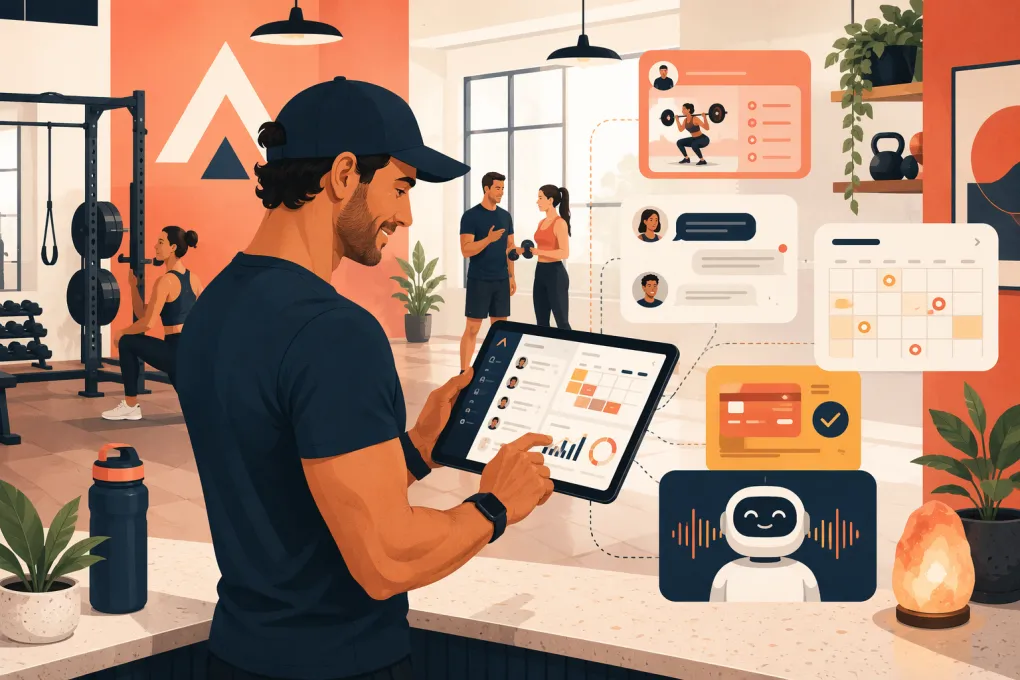 Watch · 20s
Personal trainer software should reduce the administrative load between a new inquiry and a paying, engaged client. The problem is that the category includes several different products: coaching apps, scheduling tools, payment systems, CRMs, and full fitness business platforms. They are not interchangeable.
The right choice depends on how you deliver training, where leads come from, who manages the calendar, and whether you need workout programming or front-office automation most. This guide breaks down those decisions without assuming that the platform with the longest feature list is automatically the best one.
Start With Your Personal Training Business Model
Before comparing vendors, define what the software must run. A solo online coach has different operational needs from a multi-trainer facility.
In-person one-to-one training
The core requirements are usually:
- Trainer availability and client self-booking
- Packages, session credits, and expiration rules
- Recurring payments or package billing
- Cancellation and no-show policies
- Digital waivers and intake forms
- Appointment reminders
- Basic client notes and history
Workout delivery may matter, but calendar and package accuracy usually have a more immediate operational impact.
Semi-private or small-group training
You need to manage both capacity and individual client progress. Look for:
- Session capacity limits
- Waitlists
- Recurring reservations
- Membership eligibility rules
- Trainer substitutions
- Attendance records
- Individual programming within a shared session
Ask vendors how the platform handles a client who changes membership, freezes an account, or runs out of eligible sessions. Those exceptions expose weak systems quickly.
Online coaching
For online coaching, program delivery becomes central. Useful capabilities include:
- Exercise libraries and custom exercise uploads
- Workout templates and reusable training blocks
- Progress tracking
- Habit or nutrition coaching tools
- Check-in forms
- Client messaging
- Video feedback
- Branded client apps or portals
A strong scheduling system cannot compensate for a poor client coaching experience when the product itself is delivered online.
Hybrid training or a training facility
Hybrid businesses need both sides: coaching delivery and business operations. They also tend to require stronger lead management, staff permissions, billing controls, and reporting. It may be more practical to use one broad platform or connect a business operating system with a specialized programming tool.
Personal Trainer Software Comparison
The products below serve overlapping but distinct use cases. Features and packaging change, so confirm current capabilities, processing requirements, and plan restrictions directly with each vendor.
| Platform | Primary strength | Booking and business operations | Coaching delivery | Automation and AI | Best fit | Limitation to examine |
|---|---|---|---|---|---|---|
| WTF Go with Fitty | Lead-to-member operations for fitness and wellness businesses | Booking, lead management, follow-up, payments, and business workflows | Assess whether its training-delivery depth matches your programming model | Fitty acts as an AI receptionist for lead response, booking, follow-up, and dues collection | Trainers and facilities that lose time or leads to front-desk work | Programming-focused coaches may still want a specialized workout-delivery tool |
| Trainerize | Digital training and client engagement | Offers business and client-management functions, with capabilities varying by package | Strong emphasis on workouts, habits, nutrition-related coaching, progress, and messaging | Includes automated coaching and communication capabilities; verify current plan access | Online and hybrid coaches prioritizing the client app | Confirm whether lead CRM, sales follow-up, and facility operations are deep enough for your model |
| TrueCoach | Straightforward workout programming and coach-client delivery | Provides client management but is not positioned as a full studio front desk | Programming, exercise videos, progress tracking, and messaging are central | Workflow automation is more coaching-oriented than receptionist-oriented | Coaches who primarily need to assign and review training | May require separate tools for lead management, complex booking, and broader billing operations |
| PT Distinction | Customizable online personal training delivery | Includes business and client-management tools, depending on configuration | Supports programs, assessments, coaching content, communication, and branding | Offers automation for online coaching workflows | Established online coaches wanting customization | Breadth can require more setup; verify booking, payment, and support fit for a US-based operation |
| My PT Hub | Broad coaching and client-management toolkit | Combines client management with scheduling and commercial tools | Workouts, nutrition-related features, progress tracking, and communication | Includes workflow and engagement features; check current package limits | Solo trainers and coaching teams seeking an all-in-one coaching platform | Test the exact admin, reporting, integration, and payment workflows you rely on |
| Mindbody | Broad fitness and wellness business management | Strong emphasis on scheduling, payments, staff management, and consumer discovery | Better aligned with business management than detailed strength-program design | Marketing and communication tools vary by package | Studios, gyms, and wellness businesses with classes or appointments | Can be broader and more complex than a solo trainer needs; confirm total cost and required add-ons |
There is no universal winner. A trainer selling individualized remote programming should weight coaching delivery heavily. A training gym handling a steady stream of calls, web leads, consultations, and overdue accounts should place more weight on CRM and front-office execution.
The Seven Workflows to Evaluate
Feature pages are useful for creating a shortlist, but workflows determine whether software actually saves time.
1. Lead response and consultation booking
Submit a test inquiry outside normal business hours. Then examine what happens:
- Does the lead receive an immediate, relevant response?
- Can the system answer common questions without forcing a phone call?
- Can prospects book the correct consultation type?
- Are source, status, owner, and follow-up history recorded?
- Does follow-up stop when the prospect replies or books?
This is where an AI receptionist such as Fitty can be more useful than basic autoresponders. The goal is not to send more generic messages. It is to hold a useful conversation, move qualified prospects toward booking, and hand unusual situations to a person.
2. Scheduling and capacity management
Test normal bookings and exceptions. Your demo should cover cancellations, rescheduling, waitlists, recurring appointments, trainer time off, and session-credit rules.
Also check the client experience on a phone. A booking flow that works well for staff but frustrates clients will create messages and manual corrections.
3. Payments and collections
Clarify whether the platform supports the way you sell training: recurring memberships, prepaid packages, drop-ins, paid consultations, or a combination.
Ask specifically about:
- Failed-payment handling
- Automatic reminders
- Account freezes
- Refund permissions
- Package expiration
- Taxes and receipts
- Processor requirements
- Data export and reconciliation
Do not evaluate payment processing on the advertised rate alone. Consider platform fees, add-ons, chargeback handling, payout timing, and the labor required to chase failed payments.
4. Client onboarding
A clean onboarding workflow might include an agreement, waiver, health questionnaire, goals assessment, payment setup, app invitation, and first booking. Determine which steps can be triggered automatically and which require staff action.
Sensitive client information should only be collected through appropriate forms and systems. Do not place detailed health information in casual text threads simply because texting is convenient.
5. Workout and habit delivery
If programming is part of the service, build a real client program during the trial. Do not rely on a polished sample account.
Test how long it takes to:
- Create and reuse a template
- Swap an exercise
- Add tempo, rest, or coaching notes
- Review completed sessions
- Compare progress over time
- Respond to form videos or client questions
The trainer interface matters as much as the client interface. Repetitive programming clicks become expensive when multiplied across a full roster.
6. Retention communication
Useful retention signals include declining attendance, incomplete workouts, expiring packages, unresolved payment failures, and clients who stop replying. The software should help staff act on those signals without flooding every client with the same message.
Look for segmentation, task assignment, communication history, and controls that prevent duplicate outreach from multiple staff members.
7. Reporting and multi-location control
At minimum, owners should be able to understand leads, booked consultations, sales status, attendance, active clients, upcoming expirations, and failed payments.
Multi-location operators should also test:
- Location-specific staff access
- Shared versus separate client records
- Cross-location booking
- Location-level reporting
- Central templates with local customization
- Permission controls for refunds, discounts, and exports
A platform that technically supports multiple locations may still require awkward workarounds for shared clients or centralized reporting.
How to Run a Better Software Demo
Do not let the vendor control the entire demonstration. Bring a short script based on your real operation.
Ask the representative to show these scenarios live:
- A web lead asks about pricing after hours and wants to book a consultation.
- A client cancels late and tries to reschedule with another trainer.
- A recurring payment fails and remains unresolved.
- A package client reaches the final available session.
- A manager needs to review lead follow-up across two locations.
- A trainer leaves the business and their clients must be reassigned.
Request clear answers about migration, onboarding, support channels, contract terms, payment processing, data ownership, exports, integrations, and cancellation procedures. If a critical workflow depends on an integration, ask who supports it when data stops syncing.
Plan the Migration Before You Commit
Migration is not just a contact import. Build an inventory of the records you need to preserve:
- Contact and lead records
- Notes and communication history
- Active memberships and packages
- Remaining session credits
- Future appointments
- Signed agreements and waivers
- Payment tokens or required payment updates
- Workout history and progress data
- Staff roles and permissions
- Custom fields, tags, and lead sources
Payment information often requires special handling and may not transfer like an ordinary spreadsheet. Confirm the process with both providers before setting a launch date.
Clean the data before importing it, configure one service at a time, and test with staff accounts before inviting clients. Keep a controlled record of balances and future bookings so the team can reconcile discrepancies during the transition.
Choosing the Right Personal Trainer Software
Use three filters rather than chasing the longest feature list:
- Operational fit: Can it run your actual sales, scheduling, service, and collection workflows?
- Adoption fit: Can trainers, front-desk staff, managers, and clients use it without constant workarounds?
- Economic fit: Does the total cost make sense after processing, add-ons, integrations, migration, and staff time?
If your main constraint is workout creation and remote client accountability, start with coaching-first platforms. If your constraint is unanswered leads, fragmented follow-up, booking friction, or manual collections, prioritize a business platform with strong CRM and automation. WTF Go is designed for that second operational problem, with Fitty handling receptionist work around the clock while staff take over where human judgment is needed.
The best buying decision is not the platform with every possible feature. It is the system that reliably owns the handoffs where your business currently drops work.
Frequently asked questions
What is personal trainer software?
Personal trainer software can manage scheduling, payments, client records, workout delivery, messaging, lead follow-up, or a combination of these functions. The exact scope varies significantly by platform.
Do personal trainers need an all-in-one platform?
Not always. A solo online coach may prefer a specialized coaching app, while a facility with multiple trainers may benefit from consolidated booking, CRM, billing, and staff management.
What should I look for in personal trainer booking software?
Check mobile booking, recurring appointments, cancellation rules, session credits, trainer availability, reminders, waitlists, payment handling, and calendar synchronization. Test exceptions, not just a standard booking.
Can personal trainer software follow up with leads automatically?
Many platforms offer automated email or text sequences. More advanced systems can use an AI receptionist to answer questions, qualify leads, book consultations, continue follow-up, and route exceptions to staff.
Can I switch software without losing client data?
Usually some data can be exported and imported, but workouts, communication history, signed forms, future bookings, and payment credentials may require separate handling. Confirm the migration scope in writing before committing.
Keep reading

Run your gym on autopilot with WTF Go
Fitty — your AI receptionist — answers calls and DMs, fills classes, follows up with every lead, and collects dues while you coach.