Comparisons
Padel Club Management Software: 2026 Comparison Guide
Compare padel club management software for courts, memberships, payments, CRM and support. Get a practical framework for demos, pricing and migration.
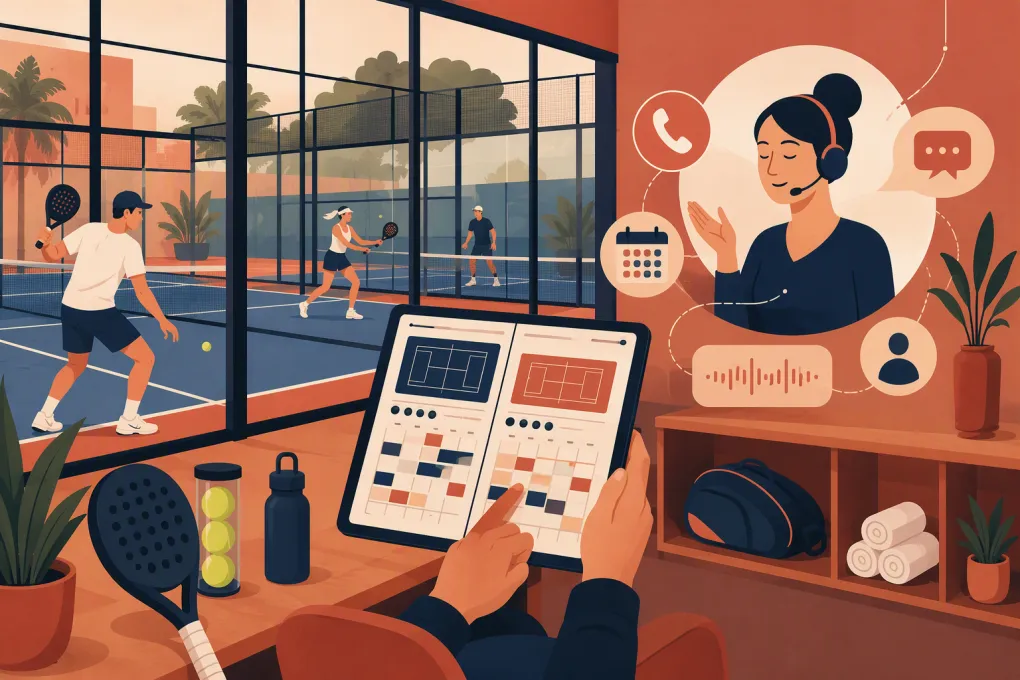 Watch · 20s
Padel club management software has to manage more than empty time slots. A single reservation can involve a court, four players, mixed membership statuses, guest fees, equipment, a coach and a cancellation policy. Add open play, clinics, recurring dues and after-hours inquiries, and a generic calendar starts creating more work than it removes.
This guide compares established options without pretending they are interchangeable. It also separates court-reservation software from front-office automation. That distinction matters: WTF Go and Fitty can handle leads, follow-up, booking conversations and dues collection, but clubs should not assume they replace a padel-native court engine without validating the required reservation rules.
How this comparison was evaluated
Review date: August 2026.
This is an editorial comparison based on publicly documented product information linked in the sources below. It is not presented as a hands-on laboratory test, and WTF Go has not claimed private access to competitors’ systems. Features, pricing and regional availability can change, so buyers should verify contract-critical details directly with each vendor.
The platforms were evaluated against workflows that commonly create friction in padel operations:
- Court inventory and booking restrictions
- Multi-player reservations and guest handling
- Memberships, packages and recurring billing
- Lessons, clinics, open play and competitions
- Lead management and automated follow-up
- Multi-location administration
- Published versus quote-based pricing
- Integrations, implementation and support visibility
- Regional fit and consumer discovery
A platform received credit only where the vendor publicly positions it for that function. “Validate” means the capability or its fit for a specific padel workflow should be demonstrated before purchase.
First decide whether you need a court engine, an operating system or both
A court engine controls bookable inventory. It should know which court is available, who may reserve it, how far ahead that person can book and what each participant owes.
A broader club operating system manages customer records, memberships, payments, staff workflows and communication. Some products combine both categories. Others are stronger in one and need to be paired with another tool.
An AI receptionist addresses another layer: answering inquiries, following up with prospects, helping customers book and pursuing overdue balances when employees are unavailable. It does not automatically make a platform padel-native.
That is the honest positioning for WTF Go and Fitty. Fitty can support the front office 24/7, but a club with complex court allocation may still need a dedicated booking platform or a validated court configuration.
If your reservation system works but leads still wait until the front desk reopens, see how Fitty handles padel inquiries, follow-up and booking conversations →.
Padel club management software comparison
| Platform | Native court booking | Memberships and billing | Padel programs | CRM and automation | Multi-location | Best fit |
|---|---|---|---|---|---|---|
| Playtomic | Yes; court reservations are central to the platform | Club-management and payment capabilities are offered; verify local processing terms | Matches, activities and player-facing discovery are core strengths | Customer communication exists, but sales-pipeline depth should be demonstrated | Available for club operators; capabilities and market presence vary by region | Padel-first venues that value consumer discovery and a player network |
| CourtReserve | Yes; built for racket and paddle facilities | Memberships, billing, packages and club administration are documented | Supports reservations, events, lessons, leagues and related programming | Member communication and operational tools are available; advanced lead automation may require another layer | Supports organizations managing multiple locations | US racket clubs prioritizing detailed reservation and membership controls |
| MATCHi | Yes; racket-sport venue booking is a core function | Venue administration and online payments are offered, subject to market | Activities, courses and competitions are supported within its racket-sport model | More operations-focused than a dedicated sales CRM; test follow-up requirements | Suitable for venue groups, with regional differences to confirm | Clubs in markets where MATCHi has established player adoption and support |
| Mindbody | Not padel-native; classes and appointments are its primary booking models | Mature memberships, packages and payment workflows | Clinics can potentially be modeled as classes or appointments; multi-player court rules require validation | Broad client management and marketing options vary by plan | Established multi-location capabilities | Mixed fitness, recovery or wellness businesses where padel is one service line |
| WTF Go + Fitty | Not established here as a padel-native court engine; exact court rules must be validated or handled by a connected booking layer | Supports operating workflows including dues collection; confirm payment and membership configuration | Fitty can answer program questions and assist booking workflows after configuration | Strong emphasis on AI lead response, follow-up and front-office coverage | Built for independent and multi-location fitness and wellness operators | Clubs that need an AI-enabled operating layer around booking, leads and collections |
Pricing, contracts, integrations and support
Exact commercial terms frequently depend on location count, payment processing, messaging volume, onboarding and add-ons. Rather than publish a number that may be stale or inapplicable, this table shows how pricing is presented and what must be priced in writing.
| Platform | Pricing availability | Integration approach | Support and implementation questions | Regional considerations |
|---|---|---|---|---|
| Playtomic | Club terms are generally obtained through sales; ask separately about software, marketplace and payment-related charges | Uses its own player and club ecosystem; request the current API and third-party integration list | Ask who configures inventory, policies and payment accounts, plus support hours for your time zone | Stronger value where its player marketplace is active; payment methods and services vary by country |
| CourtReserve | A public pricing page describes tiered plans; verify current limits, onboarding, messaging and processing costs | Public product materials describe integrations and broader club-management capabilities; confirm every required accounting, access-control and marketing connection | Ask what onboarding includes, whether data conversion is assisted and which support channels are included in your tier | Primarily positioned toward North American racket and paddle organizations |
| MATCHi | Commercial details should be requested for the club, country and required modules | Operates through MATCHi’s booking ecosystem; obtain a written list of APIs, payments and hardware connections available locally | Confirm local-language support, response hours, onboarding ownership and player-data migration | Availability, payments and market adoption differ by country |
| Mindbody | Plan-based pricing is available through sales and may include optional products; request a complete location-by-location quote | Maintains an integration marketplace and API ecosystem, although individual connectors may carry separate terms | Clarify implementation services, support tier, payment obligations and any term commitment | Broad international footprint, but product and payment availability can vary |
| WTF Go + Fitty | Contact WTF Go for current packaging based on locations and workflows | Integration requirements should be scoped around the club’s booking, payment and communication stack | Ask for a workflow map covering AI setup, escalation, knowledge maintenance and staff training | Intended for US fitness, studio, spa and wellness operators; padel-specific configuration must be confirmed |
For each finalist, request a quote that itemizes the base subscription, each location, payment processing, SMS or calling, branded applications, onboarding, migration, support tier, hardware, AI usage and early-termination terms. Also ask whether prices can change during the initial term and what happens to exported data after cancellation.
Padel workflows every vendor should demonstrate
Feature checklists hide implementation problems. Give every vendor the same scenarios and watch the complete workflow.
1. Mixed member and guest reservation
Ask a member to reserve one court for four players, including two guests. Confirm:
- Whether every player must have an account
- Who pays and whether charges can be split
- How guest limits are enforced
- Whether waivers are collected before arrival
- What happens when a participant changes
- How the transaction appears in reporting
A system that merely adds names to a note field is not truly managing participants.
2. Private lesson using a coach and court
The booking should reserve both resources simultaneously. Test coach substitutions, different lesson lengths, member pricing and a cancellation that releases the court. Otherwise, staff may end up maintaining separate coach and court calendars.
3. Open play with a waitlist
Configure skill level, capacity, member priority, registration deadline and no-show policy. Then cancel one participant and verify whether the next eligible player is notified or enrolled automatically.
4. Peak-time restrictions
Padel clubs frequently need different rules for evenings and weekends. Test advance-booking windows, reservation limits, membership tiers and back-to-back bookings. Pay attention to whether staff can explain why a booking was rejected.
5. After-hours membership inquiry
A prospect asks about beginner sessions, equipment, parking and membership, then wants to book an introduction. Measure whether the system answers accurately, records the lead, completes the next step and escalates exceptions.
This is where Fitty complements a court platform. It can cover the conversation and follow-up layer while the reservation system remains the source of truth for court inventory. Explore how WTF Go can add an always-on front office to your padel operation →.
Common padel software setup pitfalls
Treating a court like a class
A class has one instructor and many attendees. A court reservation has a resource, a lead booker and several participants who may have different prices or permissions. Modeling both identically can break guest billing and utilization reports.
Building policies before cleaning customer data
Duplicate households, obsolete packages and inconsistent membership names make migration harder. Normalize plan names, identify active balances and decide which historical records actually need to move before configuration begins.
Ignoring exception ownership
Automation still needs an owner. Document who handles disputed cancellation fees, banned guests, weather closures, coach substitutions and AI conversations that require judgment.
Reporting bookings instead of occupied court time
A booking count alone can mislead. Ask the system to report:
- Available versus reserved court hours
- Utilization by court and time band
- Member versus nonmember usage
- Cancellations and no-shows
- Revenue by courts, memberships, lessons and events
- Outstanding recurring balances
- Lead source and conversion stage
- Performance by location
Define each metric before launch. For example, decide whether a complimentary staff booking counts as utilized inventory and whether a late cancellation remains occupied time.
A practical four-week implementation framework
This is a planning template, not a vendor guarantee. Large migrations, access-control projects and custom integrations can require more time.
Week 1: Map rules and clean data
Document booking windows, guest policies, products, taxes, cancellation rules and staff permissions. Export and clean customer, membership, credit and future-reservation data.
Week 2: Configure and integrate
Build courts, operating hours, memberships, programs and payment rules. Connect approved payment, accounting, access-control and communication tools. Configure Fitty’s knowledge and escalation paths if using WTF Go.
Week 3: Test exceptions
Run the five scenarios above plus failed payments, closures, refunds and cross-location access. Reconcile sample transactions against the expected ledger and reports.
Week 4: Train and cut over
Train by role rather than giving everyone the same tour. Publish member instructions, freeze changes in the old system, perform a final data update and assign launch-day issue owners.
Do not cancel the previous platform until exported records are complete, balances reconcile and the new system has processed real bookings successfully.
Sources and verification links
Use these first-party pages to verify current functionality and commercial terms:
- Playtomic for clubs
- CourtReserve product information
- CourtReserve pricing
- MATCHi for venues
- Mindbody business software
- Mindbody integrations
- WTF Go and Fitty
The bottom line
Choose Playtomic, CourtReserve or MATCHi when padel-native court management is the primary requirement. Consider Mindbody when padel sits inside a broader class, appointment and wellness operation—but test court logic carefully.
Consider WTF Go and Fitty when the operational gap is around the reservation: missed calls, inconsistent lead follow-up, repetitive questions or manual dues collection. Do not buy it on the assumption that AI replaces a court engine. Ask WTF Go to demonstrate your exact court workflow or define how Fitty will work alongside the platform that owns court availability.
Frequently asked questions
What is the best padel club management software?
There is no universal best option. Playtomic, CourtReserve and MATCHi are court-oriented candidates, while Mindbody may suit mixed wellness operations; WTF Go and Fitty are best evaluated as an AI-enabled operating layer unless your exact court workflows are demonstrated.
How much does padel club management software cost?
Costs may include the subscription, locations, payment processing, messaging, onboarding, migration, hardware and optional modules. Request an itemized written quote because public prices and regional commercial terms can change.
Can WTF Go replace dedicated padel booking software?
Do not assume it can replace a padel-native court engine. Ask WTF Go to demonstrate your booking windows, multi-player reservations, guest fees and court reporting, or use Fitty alongside a dedicated reservation platform.
Which padel booking workflows should I test during a demo?
Test mixed member and guest bookings, split payments, coach-plus-court lessons, open-play waitlists, peak-time restrictions, cancellations, failed dues and multi-location reporting.
How long does padel software implementation take?
Timing depends on data quality, integrations, locations and policy complexity. A four-week framework can organize cleanup, configuration, testing and cutover, but vendors should provide a timeline based on your documented scope.
Keep reading

Run your gym on autopilot with WTF Go
Fitty — your AI receptionist — answers calls and DMs, fills classes, follows up with every lead, and collects dues while you coach.