Comparisons
Osteopathic Clinic Management Software: Practical Buying Guide
Compare osteopathic clinic management software for booking, notes, consent, billing, compliance and AI follow-up with a practical evaluation scorecard.
 Watch · 20s
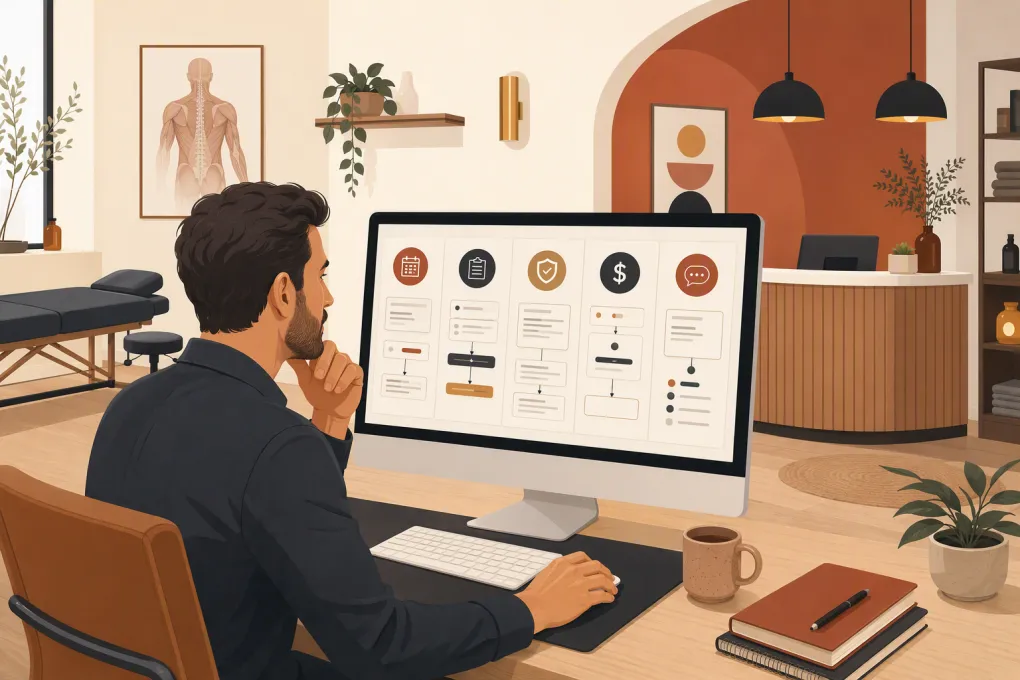
Osteopathic clinic management software has to coordinate more than appointments. A workable system must connect each inquiry, intake form, consent, room assignment, treatment note, payment and follow-up without forcing staff to re-enter the same information.
The first buying decision is whether you need a medical EHR, an allied-health practice manager or a front-office operating system. A US osteopathic physician practice providing and billing for medical care will have different documentation, coding and compliance requirements from a cash-pay osteopathic manual therapy clinic. Software that is appropriate for one may be incomplete or unnecessarily complex for the other.
Before watching demos, identify which system must be the authoritative record for clinical care. That answer determines whether a platform can operate alone or must connect to an EHR.
See how WTF Go handles inquiries, booking follow-up and payment workflows for wellness clinics →
How this comparison was assembled
The platforms below represent three relevant software categories: wellness-business operations, allied-health practice management and US medical-practice infrastructure. They were selected because their vendors publicly describe features applicable to appointment-based clinics.
The comparison uses publicly available vendor materials, including the WTF Go website, Jane feature documentation, Cliniko features, Tebra product information and athenahealth product information. It is a feature-screening guide, not a claim of hands-on testing, certification or endorsement.
Product packaging, integrations and contract terms can change. Pricing is therefore described by availability or model rather than unsupported figures. Clinics should obtain written confirmation of required functionality, implementation scope, security obligations and total cost directly from each vendor.
Osteopathic clinic software comparison
| Platform | Primary category | Scheduling and records | Automation and communication | Billing approach | Pricing availability | Strongest fit | Main limitation to verify |
|---|---|---|---|---|---|---|---|
| WTF Go with Fitty | Wellness-business operating system and AI receptionist | Supports front-office customer, booking and operational workflows; it should not be assumed to provide an osteopathic medical record | Fitty is positioned to answer leads, support booking, follow up and pursue dues using configured business rules | Direct-pay and collection workflows; processor and implementation details require confirmation | Confirm current packaging and usage terms directly | Cash-pay clinics that need faster inquiry handling and less manual front-desk follow-up | Clinical charting, medical coding, claims and regulated-record requirements may need a separate EHR or practice manager |
| Jane | Allied-health practice management | Vendor materials describe online booking, charting, intake forms, scheduling and administrative tools | Reminders, forms and patient communications support routine workflows | Private-practice payments and insurance-related capabilities vary by market and configuration | Public pricing information is generally available; verify required add-ons and regional features | Multidisciplinary and allied-health clinics wanting scheduling and notes in one platform | Confirm US payer workflows, osteopathy-specific templates, multi-location reporting and required integrations |
| Cliniko | Allied-health practice management | Vendor materials describe appointments, treatment notes, online bookings and patient administration | Includes reminders and other routine patient communication tools | Common direct-pay invoicing and payment workflows; regional integrations differ | Public plan information is generally available | Small or midsize clinics seeking focused scheduling, notes and administration | Complex US medical billing, advanced lead CRM and insurance workflows may require other systems |
| Tebra | US medical-practice technology | Offers EHR, practice-management and patient-experience products for independent practices | Communication and growth capabilities depend on the selected product package | Medical billing and revenue-cycle workflows are part of its broader offering | Typically requires a tailored vendor quote | Osteopathic physician practices needing medical documentation and payer infrastructure | Scope, implementation effort and total package may exceed the needs of a simple cash-pay clinic |
| athenaOne | Medical EHR, practice management and revenue cycle | Combines clinical, scheduling and practice-management functions | Includes patient engagement and administrative workflows | Designed for medical claims and revenue-cycle operations | Contract and pricing details require direct evaluation | Medical groups with complex clinical, payer and reporting requirements | May be more infrastructure than a small manual-therapy clinic needs; confirm contract, migration and specialty fit |
This is not a universal ranking. A comprehensive EHR can be the best option for a physician practice and the wrong option for a straightforward cash-pay clinic. Evaluate each platform against the same scripted workflows rather than comparing feature counts.
Osteopathy-specific requirements to put in your scorecard
Generic scheduling and SOAP notes are not enough to establish a good fit. Ask vendors to demonstrate how the system handles the details of your clinical and operational model.
Treatment and structural-exam documentation
For a US practice providing osteopathic manipulative treatment, a configurable note may need fields for:
- Presenting complaint, history and relevant contraindications
- Structural examination by body region
- Tissue texture changes, asymmetry, restriction of motion and tenderness where clinically appropriate
- Somatic dysfunction findings and diagnostic assessment
- Technique performed, body region treated and patient positioning
- Patient tolerance, response and post-treatment reassessment
- Home guidance, precautions and follow-up plan
- Practitioner identity, credentials, signature and amendment history
Terminology and documentation conventions vary outside the United States and between physician-led osteopathic medicine and non-physician osteopathy. The software should let the clinic configure templates without forcing practitioners to use language inappropriate to their jurisdiction or scope.
Test whether a practitioner can carry findings forward selectively. Blindly cloning an old note creates clinical and audit risk; reusing a treatment plan should not automatically reproduce findings that were not reassessed.
Rooms, tables and constrained resources
Practitioner availability is only one part of capacity. Your scheduler may also need to reserve:
- A specific treatment room or adjustable table
- Accessible rooms for patients with mobility needs
- Specialized equipment used with particular services
- A chaperone or second staff member where clinic policy requires one
- Additional time for an initial structural examination
- Cleaning, documentation or room-turnover buffers
- Different resources at different locations
Ask the vendor to book two practitioners at the same time and show how the system prevents both from claiming the same room or resource. If resource booking is unavailable, determine whether room calendars, service limits or blocked schedules provide a reliable alternative.
Consent and intake workflows
A clinic may need separate, version-controlled forms for general treatment consent, osteopathic manipulation or manual therapy, privacy practices, financial policies and communication preferences. Additional workflows may be needed for minors, guardians, sensitive-area treatment, chaperones or telehealth.
The software should record which version the patient signed, when it was signed and whether re-consent is required after a policy or treatment change. Marketing permission should be separated from operational appointment messages where applicable. Do not rely on a single permanent checkbox for every purpose.
Regional compliance and professional scope
No vendor badge eliminates the clinic’s own compliance duties. In the United States, review at least:
- Whether the clinic is a HIPAA covered entity or business associate
- Whether each relevant vendor will sign an appropriate Business Associate Agreement
- State privacy, breach-notification and consumer-health-data rules
- State record-retention and minor-consent requirements
- Professional licensing, title and scope-of-practice rules
- Payer documentation, coding and medical-necessity requirements
- Card-storage, payment and refund responsibilities
- Rules governing automated calls, texts and marketing consent
Outside the US, privacy frameworks, professional recognition and record rules differ. Have qualified legal, compliance and billing advisers review requirements in every jurisdiction where the clinic operates.
Exactly where Fitty fits—and where it does not
Fitty should be evaluated under the same criteria as every other product. Its value is concentrated in front-office workflows rather than clinical decision-making.
| Workflow | Fitty role | Implementation classification |
|---|---|---|
| Answering routine lead questions | Can respond using approved clinic information and escalation rules | Native AI capability, configured to the clinic |
| Following up with unbooked inquiries | Can continue administrative follow-up based on configured workflows | Native and configurable |
| Booking services | Can support booking when services, availability and rules are available to the workflow | Native/configurable in WTF Go; integration or implementation work may be required if another system owns the calendar |
| Dues and balance follow-up | Can support administrative collection outreach | Native workflow, with actual payment handling dependent on the configured payment setup |
| Clinical triage or diagnosis | Should not diagnose, recommend treatment or replace a licensed clinician | Not an appropriate use |
| Osteopathic treatment notes | No clinical-record capability should be assumed | Dependent on a separate clinical-record system unless WTF Go confirms otherwise in writing |
| Insurance coding and claims | No medical claims capability should be assumed | Dependent on an EHR, billing platform or billing service |
| HIPAA-regulated data handling | Depends on deployment, data flows, contracts and vendor commitments | Must be verified before implementation |
If an EHR remains the clinical source of truth, define which platform owns demographics, appointments, communication consent and balances. Also establish what happens when records conflict or an integration stops syncing.
A demo script that exposes operational gaps
Require every shortlisted vendor to complete the same scenarios live:
- A new patient asks after hours about an initial osteopathic consultation but does not complete a booking.
- The patient books a longer initial visit, receives the correct intake and signs the current consent version.
- The scheduler assigns both a practitioner and an accessible treatment room.
- The practitioner records structural findings, treatment performed, response and follow-up plan.
- The patient requests treatment involving an area covered by a separate consent or chaperone policy.
- A practitioner calls out and appointments must be reassigned without double-booking rooms.
- A cancellation creates an opening that can be offered to appropriate waitlisted patients.
- A completed visit has an unpaid direct-pay balance or an unresolved insurance workflow.
- A patient asks a clinical question that an automated agent must escalate rather than answer.
- The owner exports records, audit history and financial data for one location.
Record which steps are native, configurable, integrated, manual or unavailable. Those labels prevent a polished demo from obscuring the real implementation burden.
Check contracts, migration and total cost
Request a written breakdown of subscription fees, practitioner or location charges, messaging and AI usage, payment processing, claims services, setup, training, migration, integrations, API access and data export.
Migration deserves its own plan. Patient demographics and future appointments are usually easier to move than signed forms, note histories, attachments, audit logs, claims and saved payment credentials. Ask which data will be imported, which will remain in a read-only archive and who validates the result.
Run a controlled test before launch. Compare patient counts, future appointments, balances, consent status and a sample of clinical records in both systems. Do not cancel access to the old platform until retention and retrieval obligations are covered.
Making the final choice
Choose a medical EHR when physician documentation, coding, claims and regulated clinical workflows are central. Choose an allied-health practice manager when the clinic primarily needs booking, intake, treatment notes and direct-pay administration. Consider WTF Go and Fitty when inquiry response, booking follow-up, repetitive communication and collections are creating front-desk drag.
The best osteopathic clinic management software is the system—or clearly defined combination of systems—that preserves the clinical record, respects local requirements and reliably moves patients through the administrative journey without hidden manual work.
Frequently asked questions
Does an osteopathic clinic need an EHR or practice management software?
A physician-led practice that documents medical care or bills insurance will usually need medical-grade EHR and billing capabilities. A cash-pay osteopathy clinic may be adequately served by an allied-health practice manager, depending on local rules.
What should an osteopathic treatment-note template include?
It may include history, contraindications, structural findings, treated regions, technique, patient response, reassessment and follow-up. Templates should match the practitioner’s jurisdiction, credentials and scope.
Can Fitty replace an osteopathic clinical-record system?
No clinical-record replacement should be assumed. Fitty is intended for front-office workflows such as lead response, booking, follow-up and collections; clinical notes and claims may require a separate system.
How should clinic software manage treatment rooms?
Look for resource scheduling that reserves rooms, tables or equipment alongside the practitioner. The system should also support accessibility needs, chaperone requirements and turnover buffers.
Is HIPAA compliance the only legal consideration for a US clinic?
No. Clinics may also face state privacy and retention laws, licensing rules, minor-consent requirements, payer standards and communication-consent obligations. Requirements should be reviewed for each state of operation.
Keep reading

Run your gym on autopilot with WTF Go
Fitty — your AI receptionist — answers calls and DMs, fills classes, follows up with every lead, and collects dues while you coach.