Comparisons
Medical Weight Loss Clinic Management Software Buyer’s Guide
Compare medical weight loss clinic management software for scheduling, intake, payments, compliance, and automation—and choose the right operational fit.
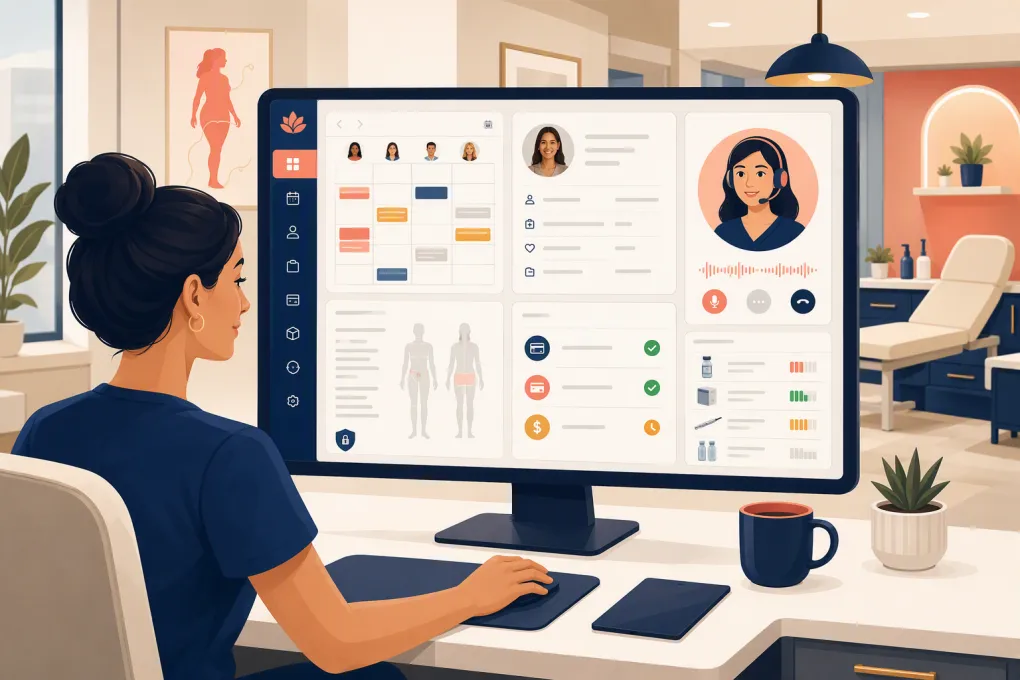 Watch · 20s
Medical weight loss clinics have an unusually complicated software problem. They need the lead management and recurring-revenue tools of a wellness business, but they may also need medical charting, prescribing, lab coordination, consent management, privacy controls, and insurance billing.
That is why the best-looking scheduling platform is not necessarily the right medical weight loss clinic management software. A system can handle appointments and payments well while leaving serious gaps in clinical documentation. Conversely, a capable electronic health record can support care delivery while making lead follow-up and membership management painfully manual.
The right choice starts with separating clinical requirements from front-office operations. Then you can decide whether one platform covers both or whether an integrated stack is the safer option.
If slow responses and missed follow-ups are costing your clinic consultations, see how Fitty handles leads and front-office conversations around the clock →. Keep clinical information in approved systems and define exactly what the AI may collect before launch.
What medical weight loss software should manage
Before comparing vendors, document how a prospective patient moves from initial inquiry through ongoing treatment. Most clinics need software support across five distinct areas.
Lead management and consultation booking
Your front office should be able to capture leads from calls, forms, advertising, and direct messages without maintaining separate spreadsheets. Useful capabilities include:
- Immediate responses to common nonclinical questions
- Lead ownership and pipeline stages
- Consultation scheduling and reminders
- Automated follow-up for unbooked inquiries
- Call notes and conversation history
- Source tracking
- No-show and cancellation workflows
Fast, consistent follow-up matters because prospective patients often contact more than one provider. Automation should support your staff without making medical claims or answering questions that require a licensed clinician.
Clinical documentation and care delivery
If the clinic diagnoses patients, prescribes medication, orders labs, or provides medical treatment, it will generally need an appropriate clinical system. Depending on the care model, requirements may include:
- Medical histories, assessments, and treatment plans
- Medication and allergy records
- E-prescribing workflows
- Lab ordering or results management
- Progress notes and clinical templates
- Telehealth
- Electronic consent forms
- Patient messaging and portal access
- Role-based access and audit logs
Do not assume a wellness CRM is an EHR. Ask each vendor to demonstrate the complete clinical workflow using your actual visit types.
Memberships, packages, and payments
Many medical weight loss businesses combine consultations, recurring programs, products, and add-on services. The software should reflect how the clinic actually charges rather than forcing everything into a standard medical visit.
Check for recurring billing, card-on-file payments, packages, account credits, failed-payment follow-up, refunds, and clear transaction reporting. If the clinic accepts insurance, evaluate claims, coding, eligibility, remittance, and billing support separately. A platform built for cash-pay memberships may not support insurance workflows.
Medication and product inventory
Inventory requirements vary widely. A clinic dispensing products or administering medications may need lot numbers, expiration dates, stock adjustments, purchase orders, and location-level controls. Ask whether inventory is connected to the patient record and transaction history, and confirm that the workflow meets applicable federal and state requirements.
Reporting and multi-location control
Operators need more than a monthly revenue total. Look for reporting that connects acquisition, booking, attendance, collections, and ongoing care while respecting access restrictions.
Multi-location groups should also test centralized reporting, staff permissions, location-specific pricing, shared patient records, inventory transfers, and cross-location booking. Never infer multi-location capability from a vendor’s marketing page; test the exact workflow during the demo.
Medical weight loss clinic software comparison
There is no universal winner because these products solve different parts of the operating model. The table below provides a practical starting point, not a substitute for a security, legal, and clinical review.
| Platform | Core strength | Clinical capabilities | Front-office automation | Pricing approach | Best fit and limitation |
|---|---|---|---|---|---|
| WTF Go with Fitty | Business operations, CRM, booking, payments, and AI-assisted lead handling for fitness and wellness businesses | Not positioned here as a replacement for a medical EHR; confirm healthcare-specific requirements, integrations, and permitted data use directly | Fitty can answer leads, follow up, support booking workflows, and help collect dues around the clock | Contact WTF Go for current packaging and implementation details | Strong option for clinics that need a responsive growth and operations layer; clinical treatment may require a separate approved system |
| PatientNow | Practice management and patient engagement for aesthetic and medical practices | Offers EMR-related workflows alongside practice management; verify weight-management templates, prescribing, labs, and billing for your use case | CRM, communications, scheduling, and marketing capabilities are available within its broader platform | Typically evaluated through a vendor consultation and quote | Relevant to medical aesthetics and elective-care practices; scope and implementation may be broader than a small wellness program needs |
| Aesthetic Record | Cloud-based EMR and practice management for aesthetic clinics | Supports clinical charting and common aesthetic-practice workflows such as consents and patient records | Includes scheduling, patient engagement, payments, and related operational tools | Plans and included features can change; confirm current terms with the vendor | Worth evaluating for clinics combining aesthetics and weight management; confirm medication, lab, and weight-loss-specific workflows |
| AdvancedMD | Broad medical practice management, EHR, and revenue-cycle workflows | Designed for medical documentation, prescribing, billing, and other conventional practice needs | Patient engagement and scheduling are available, but consumer lead nurturing may require configuration or added tools | Modular or quote-based depending on selected products and services | Stronger fit for physician-led or insurance-billing practices; potentially heavier than a simple cash-pay clinic needs |
| Jane | Scheduling, charting, forms, payments, and patient communication for health and wellness practices | Provides charting and practice-management tools; verify prescribing, lab, inventory, and specialty requirements | Good coverage of routine booking, reminders, forms, and payments; not primarily a sales CRM | Subscription tiers are generally offered; confirm current plan limits and add-ons | Useful for streamlined appointment-based practices; may require other systems for complex medical or lead-management workflows |
| Mindbody | Consumer booking, classes, appointments, memberships, and wellness-business operations | Not a medical EHR and should not be treated as the clinical record for medical care | Strong wellness booking and business-management orientation, including consumer discovery features | Plan details are generally provided through sales; products and add-ons affect cost | Suitable for wellness-led services and memberships; medical charting and prescribing require another solution |
Explore WTF Go as the operational layer for lead response, booking, recurring payments, and follow-up →. During your evaluation, identify which data belongs in WTF Go and which must remain in your clinical record system.
How to choose the right software architecture
The first decision is not which vendor to buy. It is whether your clinic needs one system or a connected stack.
Physician-led or insurance-billing clinic
Start with the EHR and practice-management requirements. Medical documentation, prescribing, claims, lab workflows, and access controls are foundational. You may then add a CRM or AI receptionist for lead conversion, provided the integration and data-handling model pass review.
Cash-pay medical clinic
A cash-pay clinic may not need insurance claims, but it still needs appropriate clinical documentation and privacy safeguards. These businesses often benefit from pairing a clinical platform with stronger CRM, membership, and follow-up tools.
The risk is duplicate data entry. Define which platform owns demographics, appointments, payment status, treatment information, and marketing consent before signing contracts.
Wellness program without medical treatment
A nonmedical coaching or wellness program may be adequately served by a business operating system with scheduling, memberships, payments, and automation. Do not make this classification based on software convenience. The services offered, staff credentials, claims made, and applicable state rules determine the compliance obligations.
Compliance and security questions to ask
HIPAA requirements cannot be reduced to a badge on a pricing page. There is no general government-issued HIPAA certification for software that removes a clinic’s responsibility to conduct due diligence.
Ask every vendor:
- Will the vendor sign a business associate agreement when required?
- What information is encrypted in transit and at rest?
- Are access permissions configurable by role and location?
- Are record access and changes logged?
- How are backups, retention, deletion, and breach response handled?
- Which subcontractors or AI providers can process clinic data?
- Can data be exported in a usable format when the contract ends?
- Which messaging channels are approved for protected health information?
- Does the platform support the clinic’s state-specific consent and retention obligations?
Have qualified legal, compliance, and security professionals review the answers. A vendor saying its platform can be used in a compliant manner is not the same as proving that your specific configuration and staff practices are compliant.
Put guardrails around AI receptionist workflows
AI can remove repetitive front-desk work, but a clinic must clearly define its boundaries. An AI receptionist can be useful for service descriptions, hours, location details, consultation booking, routine reminders, and nonclinical follow-up.
It should not independently diagnose symptoms, recommend medication, promise outcomes, or improvise answers to clinical questions. Build escalation rules for adverse reactions, urgent symptoms, prescription questions, pregnancy-related questions, contraindications, and requests to change treatment.
Also decide what the system may collect. A lead asking about appointment availability is different from a patient sharing a diagnosis or medication history. Use approved intake and clinical systems for sensitive information, and train staff not to copy protected information into unapproved tools.
Run a scripted software evaluation
Generic demos hide workflow gaps. Give each vendor the same scenarios and require them to show the steps on screen:
- A new lead calls after hours and wants a consultation.
- The lead does not book and needs follow-up the next morning.
- A patient completes intake and consent forms before arrival.
- A clinician documents the visit and manages the treatment plan.
- The patient purchases a recurring program and a product.
- A payment fails and the balance needs follow-up.
- A patient visits a second location with different staff permissions.
- The clinic exports the patient record and transaction history.
Score each scenario for staff effort, patient experience, security, reporting, and required integrations. Include implementation fees, payment-processing terms, add-ons, training, data migration, and contract length in the commercial review rather than comparing subscription prices alone.
Plan the migration before signing
A platform is only useful if the clinic can move into it safely. Inventory existing contacts, patient records, appointments, memberships, balances, forms, inventory, and communication consent. Remove duplicate or obsolete records where appropriate, then define what must be migrated and what should be securely archived.
Pilot the new workflow with a limited group of staff or one location. Test reminders, payment rules, permissions, forms, integrations, exports, and escalation paths before the full launch.
After implementation, track operational measures such as response time, consultation booking rate, no-shows, failed-payment recovery, staff touches per lead, and incomplete charts. Use your clinic’s own baseline rather than relying on generic vendor promises.
Medical weight loss clinic management software should make the business easier to run without weakening clinical controls. Choose the clinical system first when medical care demands it, then add the front-office automation needed to respond faster, book consistently, and keep revenue workflows from falling through the cracks.
Frequently asked questions
Does a medical weight loss clinic need an EHR?
A clinic providing diagnosis, prescribing, lab management, or other medical treatment will generally need an appropriate clinical record system. Confirm the exact requirements with qualified legal and clinical advisors in the states where you operate.
Can regular gym or wellness software run a medical weight loss clinic?
It can manage nonclinical functions such as leads, scheduling, memberships, and payments, but it should not automatically be treated as an EHR. Many clinics use wellness operations software alongside a separate clinical platform.
What is the most important feature to evaluate?
Start with the highest-risk workflow: clinical documentation for medical practices, insurance billing for insurance-based clinics, or lead-to-membership operations for nonmedical programs. Then evaluate integrations, security, migration, and total operating effort.
Can an AI receptionist answer medical weight loss questions?
It can handle approved nonclinical questions, scheduling, reminders, and follow-up. Clinical advice, symptom assessment, medication questions, and urgent situations should be escalated to qualified staff under documented rules.
How should clinics compare software pricing?
Compare the full cost of subscriptions, add-ons, payment processing, implementation, migration, training, integrations, support, and contract terms. Also account for staff time and any additional clinical or CRM system required.
Keep reading


Run your gym on autopilot with WTF Go
Fitty — your AI receptionist — answers calls and DMs, fills classes, follows up with every lead, and collects dues while you coach.