Comparisons
Best Med Spa Treatment Room Scheduling Software Compared
Compare med spa treatment room scheduling software for rooms, equipment, deposits, waitlists, pricing, and multi-location operations before you buy today.
 Watch · 20s
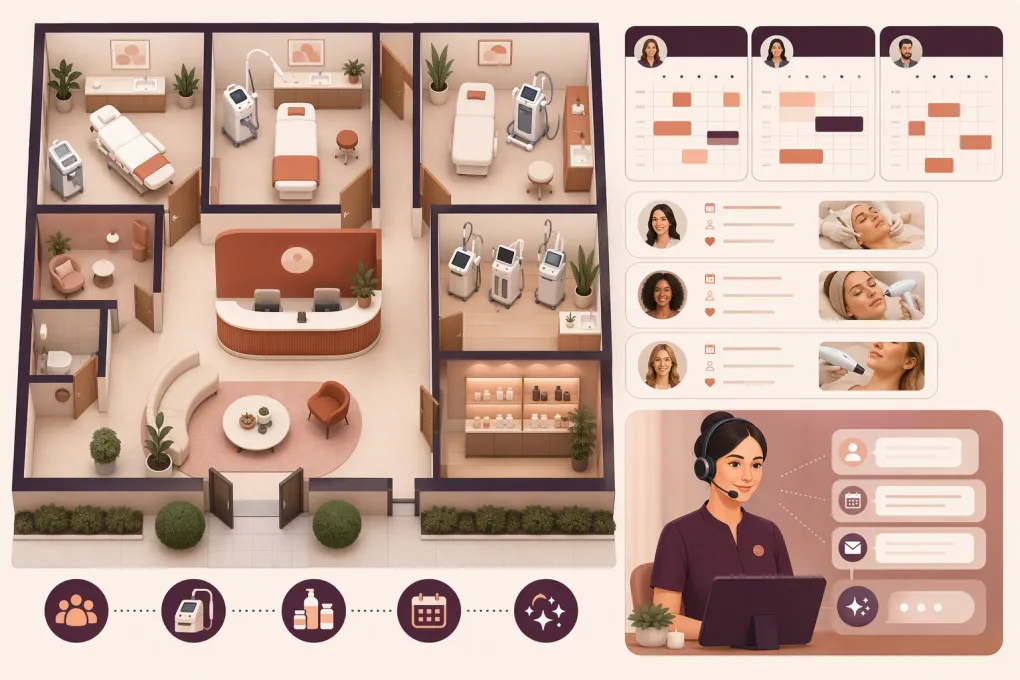
An open provider does not necessarily mean an open appointment. The treatment may also require a laser, an injectable room, a second staff member, setup time and a sanitation buffer. If scheduling software checks only the provider calendar, the front desk still has to coordinate the real operation manually.
Med spa treatment room scheduling software should prevent resource conflicts before a booking is confirmed. It should also support deposits, forms, reminders, waitlists and location-specific rules. Clinical records and compliance controls are separate requirements that must be evaluated directly—not assumed from a vendor’s med spa marketing page.
See how WTF Go and Fitty handle med spa inquiries and booking follow-up →
Quick recommendations by operating model
There is no universal winner. Based on publicly described product positioning and functionality, these are sensible starting points for a shortlist:
- Small or midsize med spa prioritizing usability and published pricing: Start with Mangomint and Boulevard.
- Med spa requiring integrated aesthetic records and clinical workflows: Start with AestheticsPro and Zenoti, then conduct a separate compliance review.
- Large or multi-location operation: Start with Zenoti; compare Boulevard and Mindbody if their ecosystems better match your service mix.
- Wellness business combining med spa services with classes or broader consumer discovery: Consider Mindbody.
- Operation losing leads after hours or relying on staff for repetitive follow-up: Evaluate WTF Go and Fitty as the inquiry, follow-up and booking layer—but require a live demonstration of every room and equipment rule before treating it as the resource scheduler.
Those are shortlist recommendations, not blanket endorsements. Your winner depends on whether a room is simply a location on the calendar or a constrained resource tied to equipment, credentials and clinical preparation.
Comparison methodology and evidence limits
This comparison is based on publicly available vendor feature and pricing pages reviewed for this article, with the feature status dated September 9, 2026. Product packaging changes frequently.
We did not receive vendor access, conduct instrumented product tests or capture authenticated screenshots. Accordingly, the table distinguishes between publicly documented functions and workflows that still require a live demonstration. A vendor’s checkmark is not proof that its rules match your operation.
Primary vendor sources:
- Boulevard med spa software and Boulevard pricing
- Mangomint features and Mangomint pricing
- Zenoti med spa software
- Mindbody business pricing
- AestheticsPro features
In the table, documented means the vendor publicly describes the capability. Partial means a related capability exists, but the exact med spa workflow is not established by the public material. Demo required means the vendor’s public information does not provide enough detail to call it supported.
Med spa scheduling software comparison
| Platform | Rooms and fixed resources | Equipment and buffers | Deposits and waitlists | Multi-location resources | Clinical records | Best fit |
|---|---|---|---|---|---|---|
| Boulevard | Resource scheduling is documented for assigning resources such as rooms to services | Resource assignment is documented; demonstrate movable-device rules and separate setup, processing and cleanup time | Payment protection, forms and waitlist-related workflows are documented; test partial deposits versus card holds or prepayment | Multi-location operation is supported; movement of shared equipment between locations requires a demo | Not positioned as a full clinical record system | Client-focused med spas wanting polished booking and front-desk workflows |
| Mangomint | Rooms and resources are documented scheduling concepts | Resources can represent operational assets; demonstrate device movement and the exact buffer behavior for each service | Deposits, automated communication and waitlist capabilities are publicly described | Multiple locations are supported; cross-location equipment inventory is not clearly documented | Not positioned as a medical record platform | Small and growing med spas prioritizing usability and visible plan options |
| Zenoti | Room and resource scheduling is part of its spa and med spa operations offering | Equipment, service timing and broader operational controls are documented; complex rules should still be tested | Payments, forms, waitlists and client communication are part of the broader platform | Strong multi-location positioning; require a live test for equipment that physically moves between sites | Med spa and electronic medical record capabilities are promoted; assess scope and compliance with counsel | Larger, operationally complex and multi-location groups |
| Mindbody | Appointment and resource management are available, although configuration is less med spa-specific than dedicated aesthetic platforms | Resource-dependent booking is possible; exact device, turnover and movable-equipment logic needs demonstration | Payment and waitlist tools exist, but appointment deposits and class waitlists are not the same workflow | Mature multi-location capabilities; cross-site equipment movement is not clearly documented | Not a full med spa clinical record system | Hybrid wellness operators and businesses valuing Mindbody’s marketplace and ecosystem |
| AestheticsPro | Appointment and room-management functions are described for aesthetic practices | Room workflows are documented; public detail on movable equipment and layered buffers is limited | Payment, client communication and practice-management functions are available; test waitlist behavior and deposit rules | Supports aesthetic practice operations, but complex enterprise resource sharing needs a demo | Electronic records and med spa-specific clinical workflows are central to the product | Med spas that want scheduling and aesthetic records in one product |
The movable-equipment gap
A vendor may support both rooms and equipment without supporting movable equipment well. If one laser can be used in several rooms—or travels between locations—the software needs to know where it is, when it is unavailable and whether travel or setup time applies.
None of the public vendor pages above provides enough detail to award an unconditional pass for cross-location movable-equipment control. Require the salesperson to demonstrate it with your actual scenario. Do not accept “you can create a resource” as the complete answer.
Pricing: compare the full operating cost
Exact prices can become outdated quickly, so use each vendor’s linked pricing page for current figures. The more useful distinction is how the purchase is structured and what can sit outside the base subscription.
| Platform | Pricing visibility | Cost items to establish in writing |
|---|---|---|
| Boulevard | Public plan structure and pricing information are available | Locations, staff limits, payment terms, forms, messaging, marketing, data migration, onboarding and optional products |
| Mangomint | Public monthly plan and add-on information is available | Additional locations, team or usage limits, forms, two-way texting, payment processing, onboarding and optional integrations |
| Zenoti | Primarily sales-led and quote-based | Implementation, data conversion, training, location minimums, support level, integrations, messaging volume, payment terms and contract length |
| Mindbody | Public plans or starting-price information are available | Feature tier, locations, branded app, marketing products, payment processing, setup, marketplace-related terms and contract structure |
| AestheticsPro | Tiered plan information is generally published | User or feature limits, records, forms, messaging, payment processing, onboarding, migration and support level |
Request a written cost sheet covering the subscription, implementation, migration, training, messaging, payment processing, integrations, additional locations and optional modules. Also ask:
- Is the agreement monthly or fixed-term?
- Does it renew automatically?
- Is pricing per location, provider, user or account?
- Are implementation and data migration mandatory charges?
- Are text messages or automated campaigns usage-based?
- What happens to historical records and stored cards during migration?
- What does exporting your data cost when you leave?
A lower base subscription can become the more expensive option if required workflows sit in add-ons or staff must maintain separate clinical, marketing and resource systems.
Use a scored live-demo test
Send vendors the same scenarios and score each one live. Use 2 points for a complete native workflow, 1 point for a workable limitation or documented integration, and 0 points for a spreadsheet, duplicate calendar or manual staff check.
| Test | Weight | Passing result |
|---|---|---|
| Provider, room and device conflict prevention | 20 | The second conflicting appointment cannot be confirmed through staff or online booking |
| Movable equipment | 15 | The device can change rooms or locations without duplicate inventory or manual calendar checks |
| Setup and cleanup buffers | 10 | Buffers reserve the appropriate resources, not just the provider |
| Credentials and service eligibility | 10 | Only qualified, scheduled providers can receive the treatment |
| Deposit and cancellation workflow | 10 | The correct amount and policy apply automatically by service or appointment type |
| Waitlist recovery | 10 | A cancellation can be offered only to clients eligible for that service, provider and resource combination |
| Multi-location controls | 10 | Location rules, permissions, services and reporting remain separate where required |
| Intake and communication | 5 | Correct forms and instructions respond automatically to booking, rescheduling and cancellation events |
| Reporting | 5 | Managers can see room, provider and device utilization without rebuilding reports manually |
| Migration and auditability | 5 | The vendor explains what migrates, what does not and how changes are recorded |
A score of 80 or higher is a reasonable shortlist threshold, but impose three non-negotiable gates: no unresolved double-booking risk, no unclear clinical-data plan and no unsigned pricing assumptions. A high total should not compensate for failure in one critical area.
Where AI reception fits—and where it does not
Treatment room scheduling solves capacity coordination. It does not automatically solve unanswered calls, slow lead response or repetitive follow-up.
Fitty, WTF Go’s AI receptionist, is designed to answer leads, support booking workflows, follow up and pursue dues around the clock. That can reduce the gap between an inquiry and a scheduled next step. It should be configured with approved service information and escalation rules; it should not improvise medical advice.
WTF Go should not be selected on the assumption that it includes med spa-specific electronic records, compliance controls or movable-equipment scheduling. Ask the team to demonstrate your required room logic and determine whether WTF Go will be the primary operating system, an integrated layer or the wrong fit for that workflow.
Give WTF Go your hardest room-and-equipment scenario and request a live Fitty workflow demo →
What to prepare before vendor demos
Document the operation before looking at interfaces. Create one row per service with:
- Eligible providers and required credentials
- Eligible rooms
- Required fixed or movable equipment
- Provider time versus total room time
- Setup, numbing, processing and cleanup intervals
- Deposit and cancellation rules
- Required forms and pre-care instructions
- Consultation or approval prerequisites
- Location restrictions
Then demonstrate a normal booking, a same-day cancellation, an equipment outage, a provider callout and a client moving between locations. If the system works only during the ideal scenario, it is not ready to run the floor.
The best med spa treatment room scheduling software is not the platform with the longest feature page. It is the one that passes your resource-conflict tests, fits your clinical system, exposes its full cost and removes manual coordination without creating new compliance or data problems.
Frequently asked questions
What is the best med spa treatment room scheduling software?
Mangomint and Boulevard are strong starting points for usability, Zenoti for complex multi-location operations, AestheticsPro for integrated aesthetic records, and Mindbody for hybrid wellness businesses. The final choice should pass a live room, equipment and buffer test.
Can med spa software prevent room and equipment double-booking?
Yes, if rooms and equipment are configured as required resources and conflicts are blocked across staff-created and online appointments. Resource labels without conflict enforcement are not enough.
Does med spa scheduling software include electronic medical records?
Some med spa-focused platforms include clinical records, while general spa and wellness schedulers may not. Evaluate records, permissions, consent and compliance separately from booking features.
How should I compare med spa software pricing?
Compare the base subscription plus locations, users, implementation, migration, messaging, payment processing, integrations and optional modules. Get contract length, renewal terms and export costs in writing.
Can an AI receptionist schedule med spa treatments safely?
It can handle approved service information, lead capture, follow-up and configured booking steps. Medical suitability questions and clinical advice should be escalated to qualified staff.
Keep reading
Run your gym on autopilot with WTF Go
Fitty — your AI receptionist — answers calls and DMs, fills classes, follows up with every lead, and collects dues while you coach.