Comparisons
Massage School Management Software: 2026 Buyer’s Guide
Compare massage school management software for academics, student clinics, pricing, implementation, integrations, data access, and front-desk automation.
 Watch · 20s
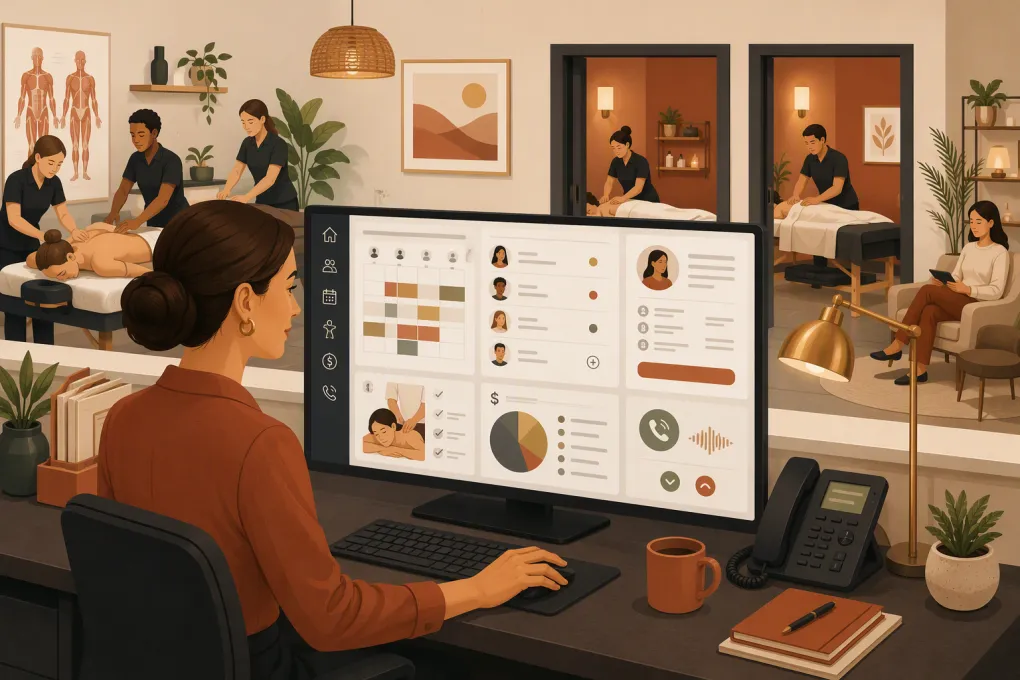
Massage schools have to run two operations at once: an education program and a public-facing clinic. The software must support prospective students, enrollment, attendance, instructors, practical training, clinic appointments, client records, payments, and communication without turning the front office into a maze of spreadsheets.
No single product is automatically best for every school. Education-focused student information systems are stronger at academic records. Practice-management platforms are usually better at client booking and checkout. Communication and automation platforms can cover missed calls, lead follow-up, scheduling, and collections but may not replace an academic system of record.
This guide explains how to evaluate those categories without assuming that a general scheduling platform satisfies school, accreditor, or state requirements.
How this comparison was researched
Review date: August 18, 2026.
This is an editorial desk review based on publicly available vendor websites, product descriptions, pricing pages where available, and public regulatory resources. It is not based on hands-on product testing, negotiated proposals, implementation projects, or private customer interviews. WTF Go is the publisher of this article, so its inclusion should be evaluated with that commercial relationship in mind.
The products were compared across:
- Academic administration
- Student clinic scheduling and payments
- Lead and client communication
- Pricing model and public pricing availability
- Implementation approach
- Integrations and data movement
- Support information
- Multi-location suitability
Capabilities, prices, packaging, and contract terms can change. Buyers should verify every requirement in a live demonstration and written order form.
First decide which system you actually need
A school may need one platform or a connected stack covering three distinct jobs.
Academic system of record
An education-focused system may be responsible for:
- Applications and enrollment documents
- Programs, cohorts, courses, and instructor assignments
- Attendance and clock-hour records
- Grades and practical competency sign-offs
- Satisfactory academic progress
- Leaves, withdrawals, reentries, and completions
- Transcripts and graduate records
- Required institutional reporting
A booking platform should not be treated as an academic system merely because it can track staff schedules or class attendance.
Student clinic management
The clinic side may require:
- Online appointment booking
- Student practitioner, room, and equipment availability
- Supervisor coverage
- Client intake and consent forms
- Service restrictions based on student eligibility
- Reminders, cancellations, and no-show handling
- Checkout, refunds, packages, and gratuities
- Restricted access to treatment documentation
The important test is not whether a platform has a calendar. It is whether the calendar can enforce your clinic’s assignment, eligibility, and supervision rules.
Admissions and front-desk communication
Schools also need to answer program questions, capture prospective students, schedule tours, respond to clinic clients, and follow up when nobody answers the first message.
WTF Go describes Fitty as an AI agent that answers leads, books appointments, follows up, and collects dues around the clock. Those are vendor-published capabilities, not independently tested findings in this review. A school considering Fitty should ask for a live demonstration using its own admissions and clinic scenarios.
Ask WTF Go to demonstrate an after-hours massage school inquiry →
Massage school management software compared
| Product | Primary orientation | Academic workflows | Clinic operations | Automation and communications | Pricing model and availability | Implementation, support, and portability | Best fit and limitation |
|---|---|---|---|---|---|---|---|
| WTF Go + Fitty | Wellness-business operations and AI-assisted front desk | Public materials do not establish a complete academic SIS for transcripts, clock hours, or accreditor reporting | Relevant to booking, payment collection, and service-business workflows; school-specific supervision rules require validation | Vendor says Fitty can answer leads, book, follow up, and collect dues 24/7 | Obtain a current proposal; confirm software, messaging, payment, onboarding, and location charges | Request implementation scope, support commitments, integration documentation, and sample exports in writing | Schools focused on response speed and front-desk workload; not proven here as a replacement for an academic SIS |
| Orbund | Cloud student information system for education providers | Oriented toward admissions, enrollment, academics, student records, and institutional administration | Public positioning is education-first rather than massage-clinic-first; clinic scheduling may require configuration or another platform | Provides education workflow and communication functions; not positioned primarily as an AI receptionist | Sales-led pricing; request a proposal based on modules, users, enrollment, and services | Expect a scoped implementation conversation. Confirm API or file-transfer options, historical-data migration, support channels, and export formats | Schools needing an academic system of record; public clinic experience must be tested separately |
| Classe365 | Student lifecycle platform combining CRM, SIS, learning, and administrative functions | Broad coverage across recruitment, student management, academics, and related education workflows | Not purpose-built around massage rooms, treatment services, and client checkout | Includes CRM and workflow capabilities; evaluate phone answering and clinic-client automation separately | Packaged or proposal-based pricing may depend on selected products and scale; verify on the vendor’s current pricing materials | Sales-led setup is likely for broader deployments. Confirm migration ownership, API access, support tier, and bulk-export rights | Schools seeking a broader education suite; scope and configuration may exceed a small clinic’s needs |
| MassageBook | Massage practice management | Not an academic SIS | Built around massage appointment booking, practitioner schedules, client management, and practice operations | Offers client-facing communication and business tools, but not academic-progress administration | Subscription-based practice software; check current plans, payment processing, and feature limits on official materials | Generally more clinic-oriented than institution-oriented. Verify onboarding assistance, calendar or data imports, support channels, and exportable client and transaction fields | Smaller student clinics with a separate academic system; cannot replace official education records |
| Vagaro | Appointment-based business management and marketplace | Not an academic SIS | Strong general fit for booking, calendars, checkout, forms, and service-business operations | Provides marketing and communication features; school admissions and AI call handling require separate evaluation | Public subscription structure with optional features and payment-related costs; verify current US pricing and location rules | Designed for service-business onboarding. Confirm available accounting or calendar connections, migration assistance, support terms, and full export coverage | Public clinics needing established booking and POS workflows; academic compliance requires another system |
The table intentionally does not list exact prices or guaranteed implementation timelines. Some vendors do not publish complete institutional pricing, and even public plans can exclude payment processing, messaging, data migration, premium support, hardware, or add-ons. Publishing an unverified number would create false precision.
For each finalist, request a written cost sheet covering:
- Subscription and required modules
- Users, students, providers, calendars, or locations
- Voice, text, email, and AI usage
- Payment processing and chargeback handling
- Data migration and configuration
- Training and premium support
- Hardware, forms, reporting, and integrations
- Renewal increases, minimum term, and cancellation rules
Requirements that vary by state, accreditor, and school type
Massage education rules are not uniform across the United States. Requirements may come from a state massage board, a state private postsecondary education agency, an accreditor, or federal programs in which the school participates.
Examples of issues that can vary include:
- Required program hours and how clock hours are calculated
- Acceptable attendance and make-up policies
- Instructor qualifications
- Curriculum content and practical training requirements
- Student clinic supervision
- Record-retention periods
- Enrollment agreement and catalog disclosures
- Satisfactory academic progress rules
- Transcript and completion documentation
- Licensure-exam eligibility reporting
The Federation of State Massage Therapy Boards provides state-regulation information, but schools should confirm current requirements directly with the relevant state authority. Accredited schools should map software reports and records to their accreditor’s current standards, such as those published by the Commission on Massage Therapy Accreditation where applicable.
FERPA is also not a universal label for every private training business. The US Department of Education explains that FERPA applies to educational agencies and institutions receiving funds under applicable department programs; see the department’s FERPA guidance. Similarly, massage client records should not automatically be described as HIPAA-covered without analyzing the entities and transactions involved.
Software vendors can show functionality, but they should not be expected to determine your legal obligations. Have the responsible compliance professional identify the required records, controls, and reports before the demo.
Demand a scenario-based demonstration
Do not let vendors control the entire demonstration. Give each one the same script and score the result.
Academic scenario
Ask the vendor to show:
- A lead becoming an applicant and enrolled student.
- Collection of required documents and signatures.
- Recording attendance and correcting an error with an audit trail.
- Calculating progress after an absence or make-up session.
- Recording instructor approval of a practical competency.
- Processing a leave, withdrawal, or reentry.
- Producing a transcript and a sample report required by your oversight body.
If the vendor says a report is customizable, ask it to build a representative report before contract signature.
Clinic scenario
Use a realistic appointment from start to finish:
- A client selects a service online or by phone.
- The system identifies an eligible student and available room.
- Required supervision is checked.
- Intake and consent instructions are delivered.
- The client reschedules after receiving a reminder.
- The clinic processes payment, package credit, refund, or no-show action.
- A student, instructor, and receptionist see only the information allowed for their roles.
Also test couples appointments, minors, accessibility requests, contraindication questions, service add-ons, and requests for a particular student.
Communication scenario
Enter a lead after normal office hours and evaluate:
- How quickly the system responds
- Whether it uses only approved program information
- Whether it can schedule a tour or call
- How it handles an unknown question
- Whether the full conversation reaches the assigned staff member
- How consent and opt-out requests are recorded
- Whether a human can take over cleanly
This is the appropriate test for Fitty and any competing answering, CRM, chatbot, or automation tool. The question is not whether AI is present. It is whether the system completes the workflow accurately and escalates appropriately.
Have Fitty run your real admissions and clinic test script →
Verify implementation, integrations, support, and data access
These areas are frequently compressed into a line item during sales discussions. Make them part of the contract review.
Implementation
Ask for named responsibilities and dates for discovery, configuration, import testing, staff training, launch, and post-launch review. A vendor should distinguish its standard onboarding from paid implementation services.
Integrations
Require vendors to identify whether each connection is:
- Native and vendor-supported
- Built through a public API
- Managed by a third-party connector
- Based on scheduled file exchange
- A manual export and import
Test the systems you actually use, such as accounting, payroll, email marketing, calendars, payment processing, learning platforms, or identity management. Do not accept “we have an API” as proof that a production-ready integration exists.
Support
Confirm support hours, available channels, escalation procedures, response targets, premium-support charges, and coverage during launch. If uptime or response time matters, request a contractual service commitment rather than relying on a sales presentation.
Data portability
Ask for sample exports before signing. Verify that you can retrieve students, clients, attendance, grades, appointments, forms, notes, payments, communication history, and attached documents in usable formats. The contract should explain access after cancellation and any export-service fee.
A defensible way to choose
Choose an education-first SIS when the primary risk is academic recordkeeping and reporting. Choose a massage or service-business platform when the main operational problem is running the public clinic. Evaluate an automation layer when missed inquiries, repetitive booking, follow-up, and collections are placing avoidable work on staff.
WTF Go should not win simply because it publishes this guide. It should win only if Fitty performs your communication scenarios better, fits your existing systems, provides acceptable data access and support terms, and produces a reasonable written cost of ownership. The same standard should apply to every vendor on the shortlist.
Frequently asked questions
Can one platform manage both massage school academics and the student clinic?
Possibly, but buyers should verify every academic, supervision, booking, payment, and reporting workflow. Many schools may be better served by an education-focused SIS connected to a clinic or communication platform.
How much does massage school management software cost?
Cost depends on modules, users, enrollment, locations, communications, payment processing, migration, and support. Request a written total-cost proposal because public subscription prices may not include the full implementation.
How long does implementation take?
There is no reliable universal timeline. Data condition, required integrations, report configuration, training, and the number of campuses all affect the schedule, so require a vendor-specific implementation plan.
What data should a massage school be able to export?
At minimum, verify access to student, applicant, attendance, academic, clinic client, appointment, payment, communication, form, and document records. Test sample exports before signing.
Does WTF Go replace a massage school student information system?
WTF Go is positioned around wellness-business operations and Fitty-powered communication, booking, follow-up, and collections. Its public materials do not establish it as a complete replacement for specialized academic records and reporting software.
Keep reading

Run your gym on autopilot with WTF Go
Fitty — your AI receptionist — answers calls and DMs, fills classes, follows up with every lead, and collects dues while you coach.