Comparisons
Martial Arts Tournament Registration Software: Top Picks
Compare martial arts tournament registration software by rulesets, brackets, scoring, payments, offline use, support, and best fit for your event needs.
 Watch · 20s
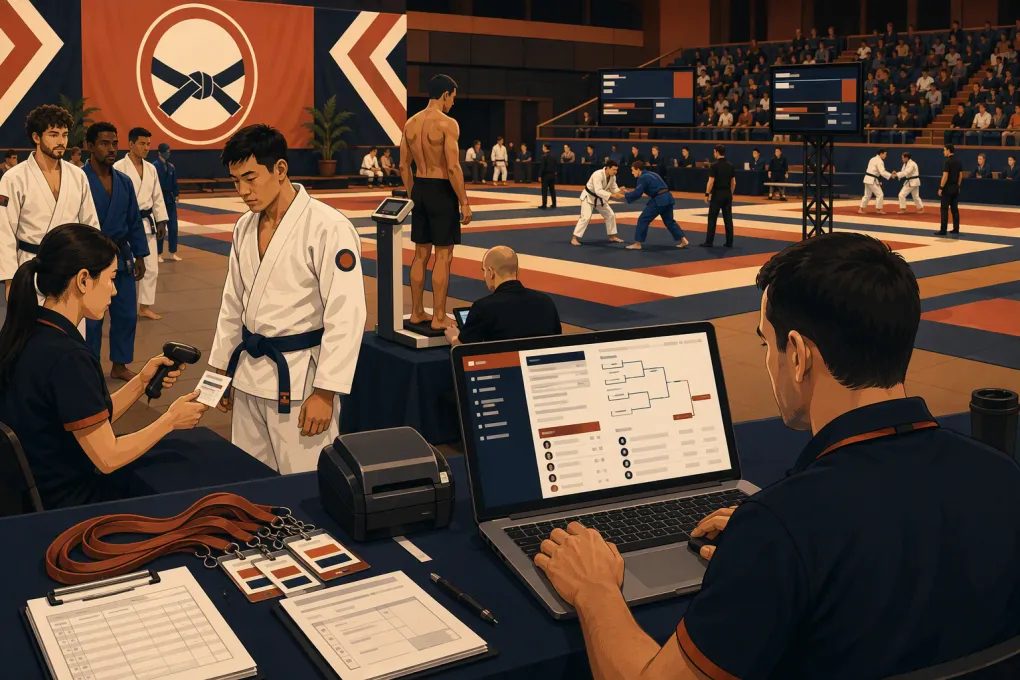
Martial arts tournament registration software has to do more than sell entries. It must place accurate competitor data into workable divisions, process payments, support your ruleset, survive event-day changes, and give staff a clear way to run brackets and report results.
That eliminates most generic ticketing platforms for serious competitions. It also means the best choice depends on what you run: a regional grappling event, a traditional martial arts tournament with forms and sparring, or a federation competition using prescribed scoring equipment.
Accuracy note — August 31, 2026: Features, payment providers, service fees, integrations, and support plans change. This guide reflects vendor-published information available for the linked products. Confirm current terms and demonstrate your exact ruleset before signing a contract.
How we evaluated the software
This is an editorial comparison, not a laboratory test or a claim that WTF Go operated a live tournament on every platform. We reviewed official vendor product pages, documentation, and published pricing information where available. We did not treat unsourced review-site claims as verified facts.
Products were evaluated on:
- Registration fields, waivers, payments, and refunds
- Division creation and bracket formats
- Ruleset-specific scoring and results
- Weigh-ins, check-in, scheduling, and ring or mat control
- Internet dependency and offline contingencies
- Required computers, displays, printers, and scoring hardware
- Organizer support and training
- Pricing transparency
- Suitability for recurring events
Where a vendor does not clearly publish a capability or price, the comparison says so rather than assuming it is included.
Tournament software will not necessarily answer calls, follow up with prospective students, or book intro classes while your staff is occupied at the venue. See how Fitty handles gym inquiries around the clock →. It complements tournament software; it does not replace brackets, scoring, or weigh-ins.
Best martial arts tournament software by use case
1. Smoothcomp: Best overall for grappling and open combat-sports events
Smoothcomp is the strongest general recommendation for Brazilian jiu-jitsu, submission grappling, judo, wrestling, and similar bracket-heavy events. Its published platform covers online registration, brackets, weigh-ins, scheduling, arena administration, results, and competitor profiles.
Organizers can configure event and division structures, move competitors, publish brackets, and operate multiple competition areas. Smoothcomp also documents a desktop product intended to support local event operations when dependable internet access is a concern. Confirm which functions remain available locally and which still require synchronization.
Pricing model: Smoothcomp uses an event-registration/service-fee model rather than presenting a simple universal monthly organizer price. Fees can depend on market, payment setup, and event configuration, so request a written fee schedule through its organizer information.
Payments: Online payment availability and settlement depend on the organizer’s country and supported payment configuration. Verify processor availability, payout timing, refunds, chargebacks, and whether fees are absorbed or passed to entrants.
Hardware: Expect to provide computers or tablets, reliable networking, and displays for each operational area. Printers, scales, and external display requirements depend on your workflow.
Limitations: Smoothcomp is tournament-centered, not a complete dojo sales CRM. Rules for kata, weapons, breaking, or highly customized traditional formats should be demonstrated before selection.
2. Sportdata: Best for federations and formal rulesets
Sportdata is the strongest fit for federations, governing bodies, and organizers running structured karate, taekwondo, kickboxing, and other sanctioned competition formats. Its ecosystem includes online entries, draws, accreditation, scheduling, results, event management, and discipline-specific scoring products.
Sportdata’s key advantage is depth around formal competition administration. Its SET product family includes desktop event-management and electronic-scoring components, making it relevant when an organizer needs more than browser-based registration.
Pricing model: Licensing and service costs vary by product, module, event, and equipment arrangement. Sportdata does not reduce its complete ecosystem to one universally applicable public price, so organizers should request a quote for the specific SET modules, online services, and support required.
Payments: Online entry and payment workflows are available, but payment methods and settlement arrangements can vary by federation, organizer, and region. Obtain a written payment-flow diagram before opening registration.
Offline capability: Desktop event-management components can reduce reliance on continuous venue internet. Ask Sportdata to identify which registration, draw, scoring, and publishing functions work offline and how data is synchronized.
Hardware: Depending on the discipline, deployment may require Windows computers, score displays, networking equipment, input devices, printers, and approved scoring hardware. Hardware requirements are materially more important here than with a simple bracket platform.
Limitations: The breadth of the system creates a steeper setup and training requirement. It can be excessive for a small local event that only needs straightforward registration and brackets.
3. Kihapp: Best for small and midsize multi-style tournaments
Kihapp is designed specifically for martial arts tournament administration. It supports registration, draws, event scheduling, scorekeeping, displays, and results across competition types that can include forms and fighting divisions.
Its appeal is a more focused tournament workflow for organizers who need martial arts functionality without adopting a large federation technology stack. It deserves a demo from operators running traditional, point-fighting, or mixed-format events.
Pricing model: Kihapp presents itself as an event-oriented service rather than conventional gym software. Because current charges can depend on event setup and payment handling, confirm the per-event or per-entry charges, minimum fees, and included support directly with the vendor.
Payments: Confirm the supported processor and countries, merchant-of-record arrangement, payout schedule, refund process, and treatment of processing fees. Do not assume the payment options available to another organizer will apply to your business.
Offline capability: Treat Kihapp as internet-dependent unless the vendor demonstrates a documented offline workflow for the functions you need. Ask what remains usable if registration, scoring, or display devices lose connectivity.
Hardware: A normal deployment may use organizer computers, ring-side devices, displays, printers, and venue networking. Request a device and browser compatibility list before purchasing or renting equipment.
Limitations: Public documentation does not make every possible ruleset, offline behavior, and support entitlement equally clear. Your demo should include the hardest division and scoring workflow you expect to run.
4. Uventex: Best for integrated event production and scoring
Uventex provides event registration and competition-management technology with scoring, scheduling, displays, and production-oriented tools. It is worth considering for larger events that want a coordinated platform spanning registration through live competition presentation.
Pricing model: Commercial terms are generally sales-led and depend on event scope, products, and services. Request an itemized quote separating software, payment charges, onboarding, on-site assistance, and hardware.
Payments and offline use: Ask for written confirmation of supported processors, fund flow, offline behavior, and recovery procedures. These details may vary by deployment and should not be inferred from a promotional overview.
Hardware: Production requirements can include laptops, tablets, networking, scoring stations, printers, displays, and audiovisual equipment. Confirm what Uventex supplies, what it certifies, and what the organizer must source.
Limitations: A production-oriented system may cost more and require more coordination than a basic regional event needs. Pricing transparency is also lower than operators may prefer during initial research.
5. DojoExpert: Best for clubs wanting member and tournament tools together
DojoExpert combines martial arts school management with tournament functions. It is the most relevant option here for a club that wants member records, grading, billing, attendance, and smaller competition workflows in a related system.
Pricing model: DojoExpert is sold as subscription-based club-management software, with current plans published on its pricing page. Confirm whether tournament functionality, payment processing, support, and any participant limits are included in the plan under consideration.
Payments and hardware: Payment integrations and availability can vary by region. Tournament operations generally use standard computers and displays, but organizers should verify scoring-device compatibility and venue connectivity requirements.
Limitations: Club-management breadth does not guarantee the bracket, live scoring, or federation controls required by a complex tournament. It is a better candidate for school-run events than an automatic choice for a major circuit.
Side-by-side comparison
| Platform | Best use case | Ruleset and format emphasis | Offline position | Pricing model | Main caution |
|---|---|---|---|---|---|
| Smoothcomp | Grappling and bracket-heavy combat sports | Strong division, bracket, weigh-in, arena, and result workflows | Desktop/local event option available; verify exact scope | Registration/service-fee model; request current schedule | Traditional forms and unusual scoring formats require validation |
| Sportdata | Federations and sanctioned competitions | Discipline-specific event management and electronic scoring | Desktop components available | Module, license, service, and equipment quote | More setup, training, and hardware complexity |
| Kihapp | Small to midsize multi-style events | Martial arts draws, forms, fighting, scoring, and displays | Do not assume offline operation; request demonstration | Event-oriented pricing; confirm current charges | Some operational details require direct vendor confirmation |
| Uventex | Larger events needing scoring and production tools | Integrated registration, scheduling, scoring, and presentation | Deployment-specific; obtain written details | Custom quote based on scope | Potentially more system and cost than a local event needs |
| DojoExpert | Schools combining member and tournament administration | Club management plus tournament functions | Verify for event-day workflows | Subscription plans | Not as competition-specialized as dedicated platforms |
The due-diligence questions most buyers miss
Minors, medical details, and sensitive data
Collect only what the event genuinely requires. Establish who can view birth dates, guardian contacts, weights, medical notes, and accommodation requests. Ask vendors about encryption, administrative permissions, audit records, breach notification, subprocessors, data location, deletion procedures, and retention periods.
Avoid placing detailed medical histories into open notes fields. Create a documented process for necessary disclosures and limit access to authorized personnel. Your attorney or privacy adviser should review obligations that apply in the states where you collect data and operate events.
Waivers and guardian consent
A checkbox does not guarantee that a waiver is enforceable. Requirements differ by jurisdiction, and agreements involving minors receive particular scrutiny. Have qualified counsel draft the waiver, release, photography consent, and guardian-signature process.
The software should retain the accepted version, signer identity, timestamp, and associated competitor. Ask how amended waivers are handled and how records can be exported for a claim.
Payment security and refunds
Prefer hosted payment fields or processor-controlled checkout so your organization does not unnecessarily handle card data. Ask whether the vendor or organizer is the merchant of record, which party manages PCI responsibilities, how chargebacks are answered, and when funds are paid out.
Document cancellation, transfer, failed-payment, duplicate-entry, and refund policies before registration opens.
Marketing consent
Operational messages about weigh-ins or schedule changes are not the same as consent to ongoing marketing. Use separate, unambiguous choices for promotional email and text messages. Preserve consent records and honor opt-outs across the systems you use.
Retention and exports
Set retention periods for unsuccessful registrations, identity documents, medical details, waivers, payment records, and competition results. Confirm that exports are usable and that deleted data is also addressed in backups according to the vendor’s retention policy.
Make your selection with a live scenario
Give each finalist the same test: register a minor in two divisions, apply a discount, accept guardian consent, change the competitor’s weight, merge a division, create a bracket, process a refund, lose internet access, and export the final records.
Also request:
- A complete fee and hardware schedule
- Support hours and event-day escalation options
- A sample implementation timeline
- Processor and payout documentation
- Security and data-processing terms
- References from organizers using a similar ruleset
For most grappling events, Smoothcomp is the clearest starting point. For federation-level karate, taekwondo, or comparable sanctioned formats, evaluate Sportdata first. Kihapp is a practical shortlist candidate for smaller multi-style tournaments, while Uventex merits consideration when production and integrated scoring are priorities.
Once the competition system is chosen, address the customer journey around it. Tournament platforms generally do not replace a gym’s lead-response, booking, collections, and follow-up systems. See how WTF Go and Fitty keep tournament inquiries from becoming missed membership opportunities →.
Frequently asked questions
What is the best martial arts tournament registration software?
Smoothcomp is a strong starting point for grappling and bracket-heavy events, while Sportdata is better suited to many federation and sanctioned rulesets. Kihapp is worth evaluating for smaller multi-style martial arts tournaments.
Can tournament software work without internet access?
Some platforms provide desktop or local event-management components, but offline scope varies. Require the vendor to demonstrate registration lookup, brackets, scoring, and synchronization under a simulated outage.
How much does martial arts tournament software cost?
Pricing may be based on registrations, events, subscriptions, modules, hardware, or custom quotes. Request a written schedule covering platform fees, payment processing, onboarding, support, equipment, refunds, and chargebacks.
Can I use gym management software to run tournament brackets?
Only if it supports your exact division, bracket, weigh-in, and scoring requirements. Most gyms running formal competitions need dedicated tournament software alongside their normal CRM or gym operating system.
What security questions should tournament organizers ask?
Ask about payment handling, encryption, user permissions, audit logs, subprocessors, breach procedures, data exports, and retention. Give extra attention to minors' records, guardian consent, medical information, and waiver evidence.
Keep reading


Run your gym on autopilot with WTF Go
Fitty — your AI receptionist — answers calls and DMs, fills classes, follows up with every lead, and collects dues while you coach.