Comparisons
Laser Hair Removal Clinic Management Software Compared
Compare laser hair removal clinic management software by booking, packages, records, AI, integrations, pricing model, and fit for each clinic type.
 Watch · 20s
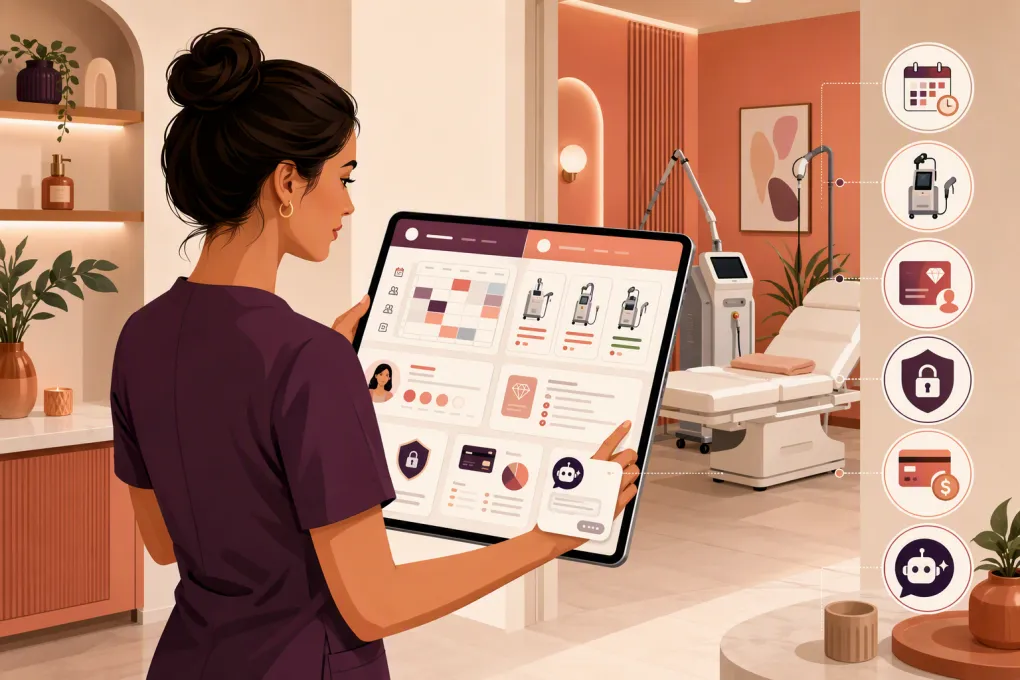
Laser hair removal clinic management software has to coordinate more than appointments. A clinic may need to qualify inquiries, book consultations, reserve a trained provider and compatible device, issue forms, sell treatment packages, document sessions, collect balances, and schedule the next visit at the right interval.
Most products cover only part of that chain exceptionally well. Some are business-management platforms. Some emphasize medical records. Others are strongest at enterprise control or consumer discovery. The best choice depends on which part of your operation cannot afford another workaround.
Disclosure and comparison methodology
WTF Go publishes this article and sells WTF Go, including Fitty, its AI receptionist. That is a direct commercial relationship. Our product receives the same scrutiny below: WTF Go is not presented as a replacement for a clinical record system, and clinics must verify whether it supports their documentation, consent, security, and regulatory requirements.
We compared products using publicly available vendor information for six workflows:
- Lead response and consultation conversion
- Provider, room, and equipment scheduling
- Package and recurring-payment management
- Clinical documentation and consent
- Integrations and multi-location administration
- Pricing availability and implementation burden
Our direct product knowledge is strongest for WTF Go. Competitor findings are based on published product, pricing, integration, and support materials—not controlled hands-on testing or mystery shopping. Features and packaging change, so links are included for verification. Buyers should require a live, scenario-based demonstration before signing.
If your immediate problem is unanswered inquiries rather than clinical charting, see how Fitty handles after-hours laser leads and booking follow-up →.
Clear winners by laser clinic type
There is no credible universal winner. These are the most defensible shortlists by operating model:
- Best for AI-supported lead response and front-desk coverage: WTF Go with Fitty. Its differentiator is an AI receptionist connected to broader business operations. It is not automatically the right clinical charting platform.
- Best for a premium, appointment-led client experience: Boulevard. Strong for polished self-booking, checkout, communications, and service-business operations; verify laser-specific charting separately.
- Best for complex multi-location administration: Zenoti. Its broad enterprise scope suits chains that need centralized controls, although implementation may be heavier.
- Best for wellness marketplace exposure: Mindbody. Its consumer marketplace is a meaningful distinction, but its generalized wellness model may require laser-specific additions.
- Best shortlist for smaller medical-aesthetics practices: AestheticsPro. It puts aesthetics-oriented records and business workflows in one evaluation, but buyers should test package rules and front-desk automation closely.
- Best shortlist for clinically complex aesthetic practices: PatientNow. Its medical-aesthetics orientation makes it relevant where CRM, patient engagement, and electronic records must work together.
Laser clinic software comparison
Pricing labels below describe the available buying model, not invented dollar estimates. When a vendor does not maintain a clear public price, it is marked as quote-based. Ask for the complete cost covering locations, users, messaging, payment processing, onboarding, data migration, support, add-ons, and contract term.
| Platform | Laser-clinic workflow fit | Automation and integrations | Clinical capability | Pricing range or availability | Implementation considerations | Main limitation |
|---|---|---|---|---|---|---|
| WTF Go | Lead capture, booking, follow-up, payments, and general wellness operations | Fitty answers leads, supports booking, follows up, and helps collect dues; confirm each required external integration during scoping | Do not assume it replaces an EMR or laser treatment record | Pricing should be confirmed directly based on operating requirements | Define approved answers, escalation rules, locations, services, policies, and migration scope | Clinics needing detailed medical charting may require a separate clinical system or validated workflow |
| Boulevard | Strong client journey for consultations, services, packages, checkout, and rebooking | Offers communications, marketing, forms, and an integration ecosystem; availability can vary by plan | Built primarily for self-care business operations rather than as a universal medical EMR | Tiered subscription plans are published or quoted by market, with higher tiers adding capabilities | Configure service variations, resources, deposits, forms, package rules, and permissions | Confirm treatment parameters, medical history, photo controls, and consent versioning before treating it as the sole record |
| Zenoti | Broad scheduling, POS, memberships, inventory, and centralized brand operations | Extensive enterprise automation and integration options | Supports spa and wellness workflows; medical-documentation suitability requires direct validation | Generally sales-led and quote-based across modules and locations | Expect discovery, data mapping, configuration, staff training, and phased rollout for larger groups | May be more system and implementation than a single-location laser studio needs |
| Mindbody | General wellness booking, payments, memberships, and consumer discovery | Marketing tools plus a broad partner ecosystem and consumer marketplace | Not primarily positioned as a laser-specific medical record | Uses packaged subscription pricing; current inclusions and add-ons should be checked on its business pricing page | Audit add-ons, marketplace settings, staff permissions, and existing client/package migration | Generic class-and-appointment structures may not capture every device, parameter, or clinical workflow |
| AestheticsPro | Relevant combination of scheduling, client management, forms, and aesthetics workflows | Includes CRM and marketing functions; confirm API and named integrations needed by your stack | Aesthetics-oriented documentation makes it a stronger clinical candidate than generic salon software | Subscription editions are offered; verify current per-user, feature, onboarding, and add-on terms | Map forms, treatment templates, photos, package balances, and user access before migration | Front-end AI response and complex multi-location controls may not be its primary advantage |
| PatientNow | Connects practice operations, CRM, patient engagement, and aesthetic medicine workflows | Integration scope should be confirmed against accounting, payments, marketing, and communications requirements | Stronger candidate where electronic records are central to the buying decision | Typically requires sales consultation and a tailored quote | Clinical template design, data conversion, permissions, training, and adoption require structured implementation | A broad medical platform can be heavier and costlier to deploy than a nonmedical studio requires |
Vendor pages establish what companies say their products do; they do not prove that a feature works for your policies. Request written confirmation for critical functions and attach those requirements to the order form or implementation plan.
Laser-specific tests vendors should perform live
A standard calendar demo will not reveal the operational gaps that frustrate laser clinics. Give every vendor the same script and watch where staff must open another module, create a duplicate record, or remember a manual step.
Test resource booking, not just provider booking
Ask the vendor to schedule two providers who share one treatment room and one compatible laser device. Then change the treatment area so the appointment requires a different duration or piece of equipment.
The system should prevent conflicts across:
- Provider credentials and availability
- Treatment room
- Laser device or other limited resource
- Service duration and turnover buffer
- Location-specific service availability
A common demo weakness is showing color-coded provider calendars without proving that equipment is a hard booking constraint. If the platform cannot reserve devices natively, document the workaround and who owns it.
Test the ugly side of package management
Selling six identical sessions is the easy demonstration. Ask the vendor to handle situations operators actually encounter:
- A client upgrades or changes treatment area
- One package session is redeemed accidentally and must be reversed
- A package is partly refunded
- Sessions expire, are extended, or are transferred under clinic policy
- A client has remaining sessions but no future appointment
- A payment plan fails while unused sessions remain
- Two locations need different redemption or transfer rules
Watch whether the audit trail preserves the original sale, redemption, adjustment, and staff member. Also ask whether reports distinguish money collected from sessions delivered. Your accounting adviser—not the scheduling dashboard—should determine formal revenue treatment.
Test clinical escalation
Enter an inquiry mentioning medication, pregnancy, a recent reaction, a skin condition, or individualized treatment suitability. An automated assistant should not improvise medical advice. It should provide only approved general information and route the conversation according to clinic policy.
This is where WTF Go and Fitty should be evaluated as critically as every other option. Clinics need to define what Fitty may answer, what it must escalate, and where the resulting conversation is stored. Review WTF Go for lead coverage, then validate it against your clinical handoff requirements →.
Migration pitfalls that change the real cost
A vendor may say it imports clients, but client names are the simplest part of a migration. The difficult records are active obligations and future work.
Before signing, obtain a field-level migration plan for:
- Future appointments and recurring bookings
- Unused package sessions and expiration dates
- Membership status and billing authorization
- Deposits, credits, gift cards, and outstanding balances
- Intake forms, signed consent versions, and treatment notes
- Before-and-after images and associated permissions
- Communication preferences and marketing consent
- Lead sources, pipeline stages, and conversation history
Stored card details often cannot simply be exported and re-imported. Ask the old and new payment providers what token migration is possible, what client action is required, and how recurring billing will continue during cutover.
Run totals before and after migration. Compare active clients, future appointments, outstanding package sessions, credits, memberships, and balances. A successful import is not proof that the totals reconcile.
How to calculate practical pricing
Subscription price is only one cost. Compare a three-year operating picture that includes:
- Base platform and required modules
- Per-location or per-user charges
- Messaging and phone usage
- Payment-processing terms
- Data migration and onboarding
- Custom forms or clinical templates
- Integration subscriptions
- Training and temporary productivity loss
- Contract length, renewal terms, and termination export fees
A lower subscription can be more expensive if staff manually reconcile packages, monitor an extra inbox, or enter treatment information twice. Conversely, a large medical platform is poor value if the clinic does not need its clinical depth.
The right laser hair removal clinic management software is the least fragmented system that safely supports your real workflow. Choose the clinical record first if documentation is the controlling requirement. Choose the operating and communication layer first if missed leads, booking friction, and payment follow-up are the larger constraint—then prove how the clinical handoff works before launch.
Frequently asked questions
What is the best laser hair removal clinic management software?
It depends on the clinic. WTF Go is strongest for AI-supported front-desk operations, Boulevard for premium appointment experiences, Zenoti for enterprise administration, and AestheticsPro or PatientNow for clinics prioritizing aesthetics-oriented clinical records.
How much does laser hair removal clinic software cost?
Pricing ranges from packaged monthly subscriptions to custom enterprise quotes, often with separate costs for payments, messaging, onboarding, locations, users, and add-ons. Request a written total-cost proposal because public plan prices rarely represent the full implementation cost.
Does laser clinic software need to be HIPAA compliant?
That depends on the clinic's legal status and whether the platform creates, receives, maintains, or transmits protected health information. Obtain security documentation and a Business Associate Agreement when applicable, then review the setup with qualified compliance counsel.
Can laser clinic software reserve a specific device and room?
Some platforms support resources in addition to providers, but implementations differ. Require a live test showing that the system prevents simultaneous booking of the same room or laser device.
Can an AI receptionist answer laser hair removal questions?
It can answer approved general questions about services, hours, policies, and booking. Questions involving contraindications, medication, reactions, or individualized suitability should be escalated to appropriately qualified staff.
Keep reading

Run your gym on autopilot with WTF Go
Fitty — your AI receptionist — answers calls and DMs, fills classes, follows up with every lead, and collects dues while you coach.