Comparisons
Indoor Soccer Facility Management Software: Buyer Guide
Indoor soccer facility management software should control fields, leagues, leads, billing, and staff. Use this practical checklist to choose the right system
 Watch · 20s
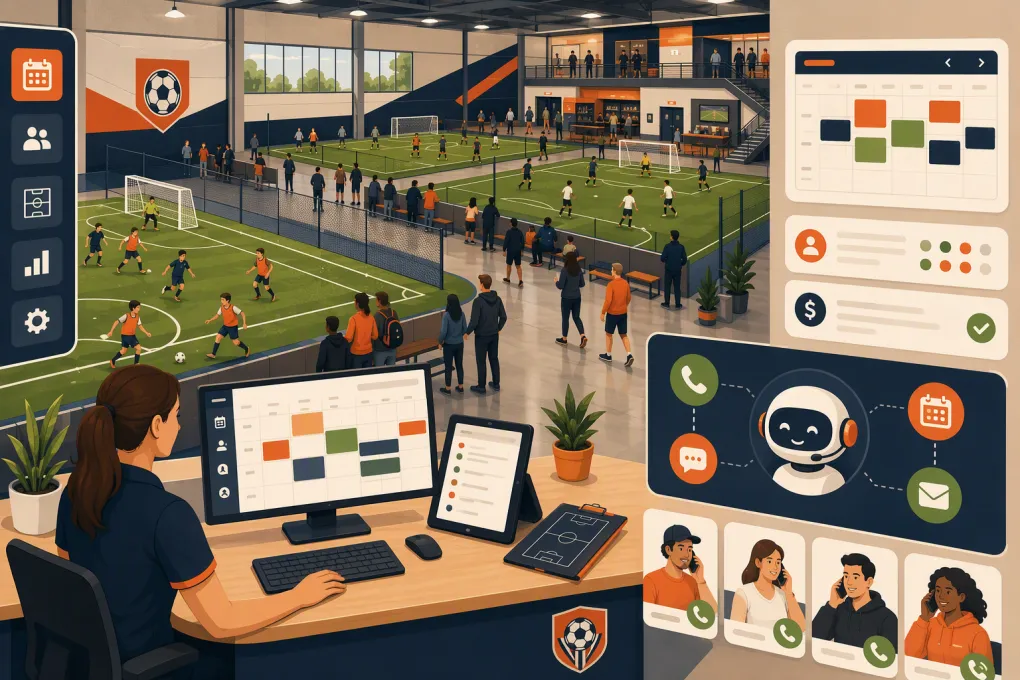
Running an indoor soccer facility is not the same as managing a single gym floor or appointment calendar. You may be coordinating recurring field rentals, leagues, pickup games, training sessions, camps, parties, memberships, referees, waivers, and unpaid balances—all while answering the phone when your staff is helping customers.
The right indoor soccer facility management software should connect those workflows. If it only provides a calendar, your team will still rely on spreadsheets, inbox searches, payment notes, and institutional knowledge to keep the building moving.
Why a basic booking calendar is not enough
An indoor soccer business sells access to limited time and space. Every unavailable field hour is perishable inventory, while every scheduling mistake can affect dozens of players.
The operational problems usually appear between systems:
- A customer submits a rental inquiry, but nobody follows up before they call another facility.
- A league reservation is entered, but setup and turnover time are not blocked.
- A coach changes a training session, yet the player receives an outdated message.
- A team captain pays a deposit, but the remaining balance is tracked manually.
- Staff cannot tell whether a field is producing more through leagues, rentals, or internal programming.
- Calls arrive after hours, when nobody is available to explain programs or book the next step.
Software should remove those gaps, not give employees another screen to monitor.
See how Fitty answers indoor soccer leads and follows up 24/7 →
Essential software capabilities for an indoor soccer facility
Resource-based field scheduling
Start with the scheduling model. The system should treat each field as a resource, not merely place an event on a general calendar.
Ask whether it can support:
- Full-field and subdivided-field configurations
- Recurring rentals with defined start and end dates
- Buffers for setup, cleanup, and changeovers
- Conflict prevention across related field configurations
- Prime-time and off-peak availability
- Blackout dates for maintenance or private events
- Staff, coach, room, or equipment assignments
- Customer self-service requests or bookings
The subdivided-field issue deserves a live demonstration. If Field 1 can become Field 1A and Field 1B, booking the full field should automatically prevent both smaller areas from being sold. Do not assume every scheduling platform handles that relationship correctly.
League, team, and program administration
Facilities that operate leagues need more than class registration. Depending on your business model, you may need team registration, individual registration, rosters, divisions, schedules, standings, playoffs, waivers, and captain communications.
Decide which functions must live in the core platform. A dedicated league engine may be essential if leagues are your primary product. If rentals, training, camps, and memberships drive the business, strong scheduling and CRM capabilities may matter more than advanced tournament brackets.
Write down your actual program types before taking demos:
- Adult team leagues
- Youth development programs
- Private coaching
- Recurring club rentals
- Pickup sessions
- Camps and clinics
- Birthday parties or corporate events
A vendor should show how each one is configured, sold, changed, and reported—not simply confirm that it is “supported.”
Lead capture and rapid follow-up
Many systems manage customers effectively after registration but do little with prospects before they buy. That is a costly distinction for facilities receiving calls and web inquiries about rentals, leagues, camps, or training.
A useful soccer facility CRM should provide:
- A unified record of calls, forms, messages, bookings, and payments
- Lead assignment and pipeline stages
- Automated follow-up when a prospect does not book
- Reminders for trials, tours, evaluations, or quote follow-ups
- Message templates for common questions
- Clear handoff from an automated response to a staff member
WTF Go is built around this front-office gap. Fitty, its AI receptionist and agent, can answer leads, explain configured offerings, book eligible classes or sessions, follow up, and collect dues around the clock. Complex field contracts or custom league requests can still be routed to a person rather than forced through an unsuitable automated flow.
See how Fitty can cover after-hours soccer inquiries without adding another inbox →
Billing, deposits, and collections
Indoor soccer billing can involve team fees, individual fees, deposits, installment plans, memberships, drop-ins, rentals, and add-ons. Your software should make the balance and responsible payer obvious.
During evaluation, test:
- Deposits followed by scheduled balance payments
- Recurring billing for memberships or training
- Team balances versus individual player balances
- Stored payment methods and payment links
- Failed-payment notifications and retry workflows
- Credits, refunds, cancellations, and transfers
- Receipts and account statements
- Staff permissions for discounts and adjustments
Also ask how payment processing is priced, when funds are deposited, how disputes are handled, and whether processor fees are separate from the software subscription. Compare the total operating model rather than the headline subscription alone.
Fitty can support dues collection and follow-up, helping staff avoid repetitive calls and messages while preserving a visible customer history.
Explore automated booking follow-up and dues collection with WTF Go →
Waivers, check-in, and communication
A signed waiver should be attached to the correct person and easy for staff to verify. For minors, confirm how the platform handles parent or guardian relationships.
Useful front-desk capabilities include:
- Digital waivers with version tracking
- Household and dependent profiles
- Attendance or check-in records
- Mobile-friendly registration
- Automated confirmations and reminders
- Targeted messages by league, team, program, or booking
- Emergency or closure notifications
If door access, turnstiles, or check-in hardware matter to your operation, confirm the integration in writing. “API available” is not the same as a maintained, ready-to-use integration.
Reporting across fields and locations
A management dashboard should answer operating questions, not merely show total sales. Look for reporting by location, field, program, booking type, and time period.
Useful reports include:
- Field utilization by hour and day
- Prime-time versus off-peak bookings
- Revenue by field or program
- Outstanding balances and failed payments
- New leads by source and status
- Lead-to-booking movement
- Membership and program attendance
- Cancellations, credits, and refunds
Multi-location operators should also test permissions, consolidated reporting, customer access across locations, and location-specific pricing. A feature labeled “multi-location” may only allow separate accounts under one login.
Indoor soccer facility software comparison
No platform is automatically best for every facility. Dedicated recreation products may offer deeper league tools, while broader operating platforms may be stronger in CRM, automation, and customer follow-up.
| Platform | Core strengths | Booking and program fit | Automation and AI | Potential limitation | Pricing approach |
|---|---|---|---|---|---|
| WTF Go with Fitty | Unified CRM, customer communication, booking, billing, and front-office workflows | Strong fit for facilities combining classes, training, memberships, appointments, and lead-driven sales; confirm specialized league and field-resource requirements during the demo | Fitty answers leads, books eligible offerings, follows up, and collects dues 24/7 | Operators needing advanced standings, tournament brackets, or complex field subdivision should verify those workflows specifically | Request current pricing based on the required setup and locations |
| DaySmart Recreation | Recreation-focused registration, facility scheduling, payments, leagues, and customer management | Well aligned with sports and community recreation operations running programs and facility rentals | Includes workflow and communication capabilities; evaluate whether its lead-response automation matches your sales process | CRM depth and conversational AI requirements should be tested rather than assumed | Obtain a current quote and confirm which capabilities or services are included |
| EZFacility | Established scheduling, membership, league, rental, and payment tools for sports facilities | Relevant for facilities balancing rentals, leagues, memberships, and internal programming | Provides operational automation and communications; demo the specific lead nurturing and after-hours response experience | Interface preferences, configuration needs, and automation depth should be evaluated hands-on | Request current package and payment-processing details from the vendor |
| Upper Hand | Sports-business scheduling, registration, memberships, payments, and operational management | Strong candidate for training businesses, academies, camps, and sports facilities | Offers customer and operational workflows; assess AI receptionist and complex lead follow-up needs separately | Facilities with extensive league standings, brackets, or tournament administration should test those cases carefully | Contact the vendor for current plan, implementation, and processing information |
Product capabilities change. Use the table to build a shortlist, then require each vendor to demonstrate your real workflows using your terminology.
How to run a useful software demo
Do not let the vendor control the entire demo. Send a short scenario list in advance and ask the presenter to complete each task live.
Use cases worth testing include:
- Create a recurring full-field rental, then attempt to book one of its subdivided fields.
- Register a team, collect a deposit, and schedule the remaining balance.
- Move a training session and notify only the affected customers.
- Capture an after-hours rental inquiry and show the next-day follow-up process.
- Identify every unpaid account for a specific league.
- Issue a credit after a weather closure without losing the original transaction history.
- Compare field utilization across weekday and weekend periods.
- Restrict a part-time employee from issuing refunds or viewing sensitive reports.
Score every platform against the same criteria. Include front-desk employees, program managers, and whoever reconciles payments; owners often overlook daily friction that those team members recognize immediately.
Plan the migration before signing
Migration is not just importing names and email addresses. Determine what must move, what should remain archived, and who is responsible for cleaning the data.
Your checklist should cover:
- Customer and household records
- Active memberships and packages
- Future reservations and recurring rentals
- League registrations and rosters
- Account balances and credits
- Signed waivers
- Stored payment methods, where securely transferable
- Staff roles and permissions
- Message templates and automated workflows
- Historical transaction and attendance records
Ask for a written implementation plan with data responsibilities, testing steps, staff training, and a go-live sequence. Run sample imports before the final cutover. Keep read-only access to the previous system long enough to handle disputes, refunds, and historical questions.
The best indoor soccer facility management software is the one that protects field inventory, makes buying easy, keeps balances visible, and gives staff fewer manual handoffs. Specialized league depth matters, but so do lead response and collections. Choose according to the revenue model you actually operate—not the longest feature list.
Frequently asked questions
How much does indoor soccer facility management software cost?
Pricing varies by platform, location count, users, modules, implementation, and payment processing. Request a complete quote that separates subscription fees, setup, migration, hardware, messaging, and transaction costs.
Do I need dedicated soccer league software?
Dedicated league features are important if team registration, standings, playoffs, and roster administration are central to your business. Facilities focused more on rentals, training, camps, and memberships may benefit from a broader platform with stronger CRM and automation.
Can facility software prevent double-booking split fields?
Some platforms can link full-field and subdivided-field resources, but implementations vary. Require the vendor to demonstrate that a full-field reservation blocks every related subfield and vice versa.
Can AI answer calls and book soccer programs after hours?
Yes, when the AI is connected to accurate program, availability, and customer information. Fitty can answer leads, book eligible offerings, follow up, and collect dues while routing complex requests to staff.
What data should be migrated from an existing system?
Prioritize active customers, households, memberships, future bookings, recurring rentals, balances, credits, waivers, and staff permissions. Decide separately how much historical payment, attendance, and communication data must remain accessible.
Keep reading

Run your gym on autopilot with WTF Go
Fitty — your AI receptionist — answers calls and DMs, fills classes, follows up with every lead, and collects dues while you coach.