AI & Automation
How to Evaluate AI Receptionist Call Quality for Gyms: Guide
Learn how to evaluate AI receptionist call quality for gyms with test calls, scorecards, transcript reviews, booking checks, and escalation rules that work.
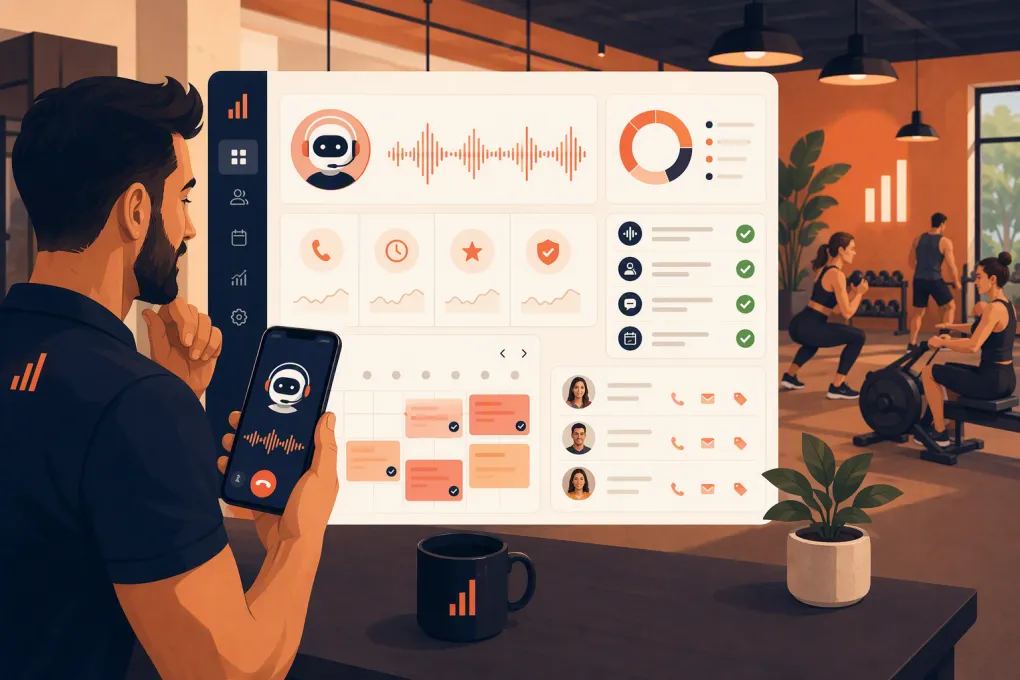 Watch · 20s
A smooth voice is not proof that an AI receptionist can handle your gym’s calls. The real test is whether it gives accurate answers, moves the caller toward the right next step, records the interaction correctly, and knows when to involve a person.
That requires more than listening to a vendor’s polished demo. You need a repeatable evaluation process built around your actual schedule, policies, offers, membership questions, and edge cases.
What call quality means for a gym
Call quality has several separate components. An AI agent can sound natural while quoting the wrong intro offer. It can answer every question politely but fail to complete the booking. It can collect a caller’s information without creating a usable lead record.
Evaluate quality across these areas:
- Accuracy: Are schedules, prices, policies, amenities, and eligibility requirements stated correctly?
- Conversation quality: Does the agent understand the caller, avoid awkward interruptions, and recover when misunderstood?
- Conversion behavior: Does it identify intent and guide a qualified caller toward booking, visiting, or another defined next step?
- Workflow execution: Does the promised booking, follow-up, or account action actually happen?
- Escalation: Does the agent transfer or create a follow-up task when a person should take over?
- Recordkeeping: Are the caller’s name, contact details, intent, and outcome captured accurately?
- Safety and compliance: Does it avoid medical advice, unsupported promises, and unsafe handling of sensitive information?
Treat these as separate criteria. If you grade only how human the voice sounds, you will miss the failures that cost leads and create front-desk cleanup.
See how Fitty handles gym calls, lead follow-up, and booking around the clock →
Build the test plan before making calls
Do not improvise every test. Create a test sheet based on the call types your staff already receives.
Start with recent call logs, front-desk notes, website inquiries, and common questions reported by staff. Remove personal information, then organize the requests by intent.
Include normal caller scenarios
Your test set should cover routine revenue and service calls such as:
- A new lead asking about membership options.
- A prospect trying to book an intro class.
- A caller asking whether a class is beginner-friendly.
- A current member checking the day’s schedule.
- A parent asking about age requirements.
- A caller asking about personal training or another premium service.
- A member asking about an overdue balance.
- A caller who wants to reschedule or cancel a reservation.
Use the exact language your customers use. Some will ask for a “trial,” others for a “free class,” “first session,” or “tour.” The agent should map common variations to the correct workflow without forcing callers to know your internal terminology.
Add difficult and ambiguous scenarios
Routine calls reveal whether the basic setup works. Edge cases show whether it is safe to deploy.
Test calls involving:
- A caller who changes topics midway through the conversation.
- An incorrect name, email address, or phone number that must be corrected.
- Background noise, speakerphone, a quiet voice, or a strong accent.
- A class that is full, canceled, restricted, or outside staffed hours.
- A request for an exception to a membership or cancellation policy.
- A billing dispute or angry caller.
- A question involving pain, injury, pregnancy, or medical suitability.
- An emergency or threatening statement.
- A request the agent cannot answer from approved information.
- A caller asking for an employee, manager, or specific trainer.
The goal is not to trick the system with absurd prompts. It is to reproduce the messy calls your team actually handles.
Use a pass-or-fail scorecard, not a general impression
Create one scorecard and use it for every agent or configuration you test. A simple rating works well:
- 0 — Failed: Incorrect, missing, unsafe, or not completed.
- 1 — Partial: The agent recovered or completed the task with avoidable friction.
- 2 — Passed: Accurate, efficient, and completed as expected.
| Criterion | What to check |
|---|---|
| Intent recognition | Did the agent understand why the person called? |
| Information accuracy | Did it use the current schedule, offer, policy, and location details? |
| Listening and turn-taking | Did it allow interruptions and avoid repeatedly talking over the caller? |
| Clarification | Did it ask a useful follow-up instead of guessing? |
| Lead capture | Were name, phone, email, interest, and location recorded correctly when needed? |
| Booking execution | Was the correct service, instructor, location, date, and time reserved? |
| Confirmation | Did the caller receive an accurate summary and the expected confirmation? |
| Escalation | Did the agent recognize when human intervention was required? |
| CRM outcome | Did the call disposition, notes, and next action appear in the right record? |
| Brand fit | Was the tone direct, helpful, and consistent with your business? |
Mark certain items as mandatory gates. An incorrect booking, invented policy, unsafe medical response, or failed emergency escalation should not be offset by a high overall score.
Review the conversation and the result
Every test call has two parts: what the caller heard and what your systems did afterward.
Listen for conversational problems
Review the recording or transcript for:
- Long or unexplained pauses.
- Repetitive acknowledgments that slow down the call.
- Responses that sound plausible but do not answer the question.
- Failure to recognize a correction.
- Excessive confirmation of information already provided.
- Abrupt transitions into sales language.
- Claims that were not present in the approved knowledge source.
Natural speech matters, but efficiency matters too. A caller should not have to repeat a phone number several times or navigate a scripted interrogation before hearing the class schedule.
Verify every promised action
If the agent says, “You’re booked,” open the booking system and check. Confirm:
- The booking exists.
- It belongs to the correct customer record.
- The location, service, class, date, and time are correct.
- Capacity and eligibility rules were respected.
- The expected confirmation was triggered.
- The lead source and call outcome were recorded.
- Any follow-up task reached the right person or workflow.
Run the same verification for payment or dues conversations. Confirm that the approved process was followed and that the account status changed only when the underlying transaction actually succeeded.
This is where integrated execution matters. Fitty does not stop at answering common questions; it can book classes, follow up with leads, and collect dues as part of the operating workflow.
Explore how Fitty turns gym calls into completed actions →
Test knowledge boundaries and hallucination control
An AI receptionist should answer from approved business information, not fill gaps with a confident guess.
Deliberately ask questions that are not covered by your knowledge base. Examples include an unannounced holiday schedule, a discount you do not offer, or whether a specific exercise is safe for an injury.
A strong response should acknowledge the limitation and take an approved next step, such as:
- Offering to have a coach or manager follow up.
- Transferring to a staffed line when available.
- Capturing the question and contact information.
- Directing the caller to emergency services when the situation warrants it.
Define forbidden response categories before launch. These may include medical advice, legal interpretations, unapproved refunds, contract exceptions, employment promises, and guarantees about fitness outcomes.
Inspect escalation and human handoff
“Someone will call you back” is not a completed escalation. Check whether the handoff produces an actionable record.
For each escalation scenario, verify:
- What triggers the handoff.
- Whether the caller is told what will happen next.
- Which employee or queue receives it.
- What context is included.
- Whether urgency is labeled correctly.
- What happens outside staffed hours.
- How unresolved items are tracked.
The receiving employee should not have to restart the conversation. The handoff should include the caller’s identity, reason for calling, relevant answers, attempted actions, and requested next step.
Run a controlled pilot before broad deployment
Start with a defined call segment rather than sending every call to the agent immediately. You might begin with after-hours lead calls, a single location, or a limited set of booking requests.
Before the pilot, document:
- The calls the agent may handle.
- The calls it must escalate.
- The source of truth for schedules, offers, and policies.
- The employee responsible for reviewing failures.
- The process for correcting knowledge or workflow issues.
- The criteria required before expanding coverage.
Review failed and escalated calls regularly. Group problems by root cause: missing knowledge, unclear instructions, integration failure, speech-recognition issue, or an undefined business policy. Fixing the category is more valuable than patching one transcript.
Call recording, transcription, consent, and retention requirements can vary by jurisdiction. Have qualified counsel review your process and make sure the vendor’s data handling fits your obligations.
See how WTF Go can support a controlled Fitty rollout for your gym →
Questions to ask an AI receptionist vendor
Ask for operational answers, not just a live voice demo:
- Can we test the agent with our own scenarios and data?
- Where does it get current schedule, pricing, and policy information?
- What happens when that information changes?
- Can we define which topics require immediate escalation?
- How are recordings, transcripts, and caller data stored?
- Can we review outcomes by call, location, and intent?
- How does it prevent duplicate customer records?
- How are failed bookings or payment attempts surfaced?
- What does implementation require from our team?
- How are changes tested before they go live?
The right evaluation standard is straightforward: the agent should produce reliable business outcomes without creating hidden work or risk. Test the call, inspect the record, verify the action, and repeat the process under realistic conditions.
Frequently asked questions
How many test calls should a gym run before using an AI receptionist?
There is no universal number. Test every major call intent, booking path, escalation type, location, and important edge case, then repeat tests after configuration or policy changes.
What is the most important AI receptionist call-quality metric?
Completed accuracy is more useful than voice quality alone. Check whether the agent understood the request, gave correct information, completed the promised action, and created an accurate system record.
Should an AI receptionist handle billing disputes or medical questions?
It can identify the issue and gather approved information, but sensitive disputes, exceptions, and medical guidance should follow clearly defined escalation rules.
How often should gym operators review AI receptionist calls?
Review calls closely during launch and after changes to schedules, offers, policies, integrations, or scripts. Ongoing reviews should focus on failures, escalations, complaints, and a sample of routine calls.
Can an AI receptionist book gym classes during a call?
Yes, if it is connected to the appropriate booking workflow. Operators should verify that each booking respects capacity, location, eligibility, customer-record, and confirmation requirements.
Keep reading

Run your gym on autopilot with WTF Go
Fitty — your AI receptionist — answers calls and DMs, fills classes, follows up with every lead, and collects dues while you coach.