AI & Automation
How to Automate Med Spa Lead Reactivation That Converts
Learn how to automate med spa lead reactivation with clean segments, compliant messaging, booking workflows, follow-up rules, and operator-ready scripts.
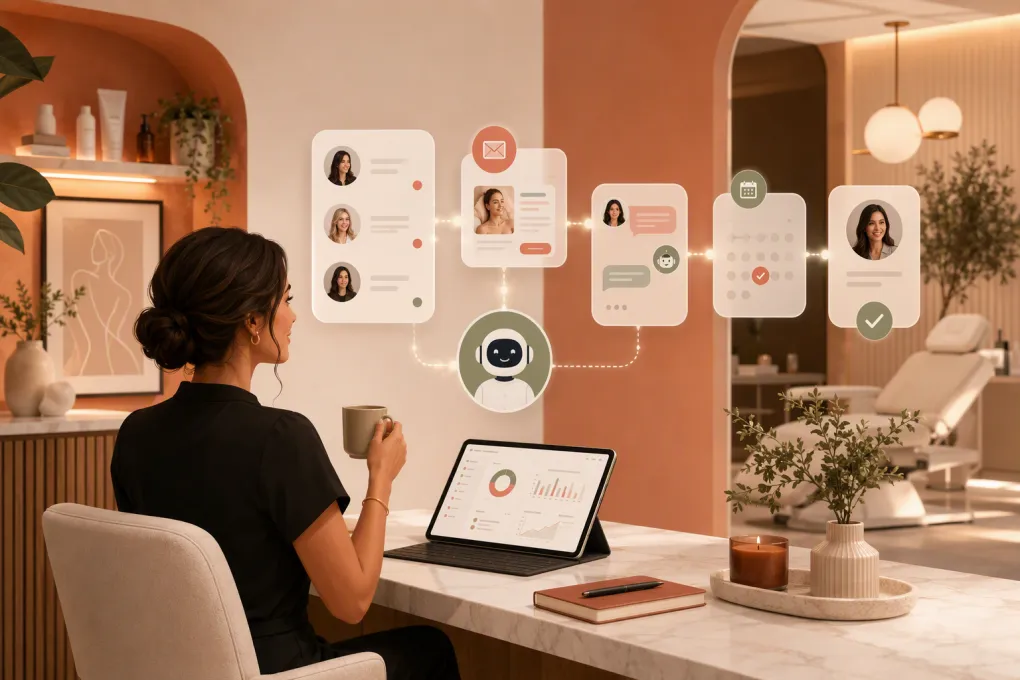 Watch · 20s
Most med spas do not need another spreadsheet full of leads. They need a reliable way to work the leads they already paid to acquire.
Old website inquiries, missed calls, unbooked consultations, canceled appointments, and prospects who stopped replying can all become reactivation opportunities. The problem is operational: manual follow-up gets pushed aside when the front desk is handling arrivals, treatment questions, payments, and the live schedule.
Automation solves that consistency problem, but only when the workflow respects consent, segments leads intelligently, and makes booking easy. Sending the same promotional text to every old contact is not a reactivation strategy.
Why med spa leads go cold
A cold lead is not always an uninterested lead. The prospect may have contacted several providers, submitted a form outside business hours, needed more time, or simply missed the response.
Med spa teams also lose opportunities when:
- Calls go to voicemail during treatments or after hours.
- Form submissions receive a delayed response.
- Staff make one follow-up attempt and move on.
- The lead must call again instead of booking directly.
- Messages focus on promotions without addressing questions or hesitation.
- No one owns the next action in the CRM.
Automation should remove those gaps. It should not remove human judgment from conversations involving treatment suitability, medical history, contraindications, or clinical expectations.
See how Fitty follows up with med spa leads while your team serves clients →
Start by defining the reactivation pool
Do not upload the entire database and press send. Build a specific audience based on where the lead stopped moving.
Useful reactivation groups include:
- New inquiry, never contacted: Submitted a form or called but never had a two-way conversation.
- Contacted, never booked: Spoke with the team but did not schedule a consultation or service.
- Consultation booked, no-showed: Reserved time but did not attend.
- Consultation completed, no purchase: Attended but did not move forward.
- Canceled and never rescheduled: Had clear intent but fell out of the booking process.
- Past client now inactive: Previously visited but has no upcoming appointment.
Keep clinical and marketing workflows separate. Someone asking whether a treatment is medically appropriate needs a qualified team member, not a generic automated answer.
Clean the data before launching
For each record, verify what you can:
- Name and preferred contact details
- Lead source
- Original inquiry date
- Service or concern of interest
- Last staff interaction
- Current pipeline status
- Consent and opt-out status
- Assigned location for multi-location practices
- Existing client status
Suppress duplicate records, invalid contact details, previous opt-outs, and anyone who should not receive marketing messages. If consent records are unclear, get legal guidance before contacting older leads.
Texting and email rules can depend on the message, consent collected, channel, jurisdiction, and carrier requirements. Follow applicable federal and state requirements, honor opt-outs promptly, and avoid putting sensitive health information into marketing messages. This is an operational framework, not legal advice.
Segment by intent, not just age
A prospect who inquired last week should not receive the same message as a client who last visited a year ago. Segmenting lets the automation acknowledge context without pretending to know more than the record shows.
| Segment | Message focus | Primary action |
|---|---|---|
| Missed call or untouched form | Fast acknowledgment and assistance | Continue the conversation |
| Unbooked inquiry | Answer questions and remove booking friction | Book a consultation |
| No-show or canceled visit | Make rescheduling simple | Choose a new time |
| Consultation without purchase | Address remaining questions | Speak with a coordinator |
| Inactive past client | Reconnect based on known service history | Book or request help |
For multi-location med spas, segment by location as well. The booking link, hours, service availability, and escalation contact must match the clinic the prospect intended to visit.
Give every campaign one clear next step
A reactivation message fails when it asks the lead to call, browse a service menu, review financing, and claim an offer at the same time.
Choose one primary conversion action:
- Reply with a question
- Book a consultation
- Reschedule a canceled visit
- Request a call from a coordinator
- Confirm whether the person is still interested
The offer does not have to be a discount. Faster access to answers, a straightforward consultation, or easier scheduling may be enough. If you use a promotion, define its terms, eligibility, expiration, participating locations, and service restrictions before the campaign starts.
Avoid medical promises and manufactured urgency. Your copy should accurately represent what the med spa can provide.
Build a reactivation sequence, not a single blast
One message is easy to miss. A short sequence gives the lead several reasonable opportunities to respond while keeping clear stop rules.
A practical starting workflow might look like this:
- Day 0: Send a brief text and supporting email tied to the original inquiry.
- Day 2: Follow up with a simple question or direct booking option.
- Day 5: Address a common nonclinical barrier, such as scheduling or what happens during a consultation.
- Day 9: Offer a choice between booking, asking a question, or closing the inquiry.
- Day 14: Send a respectful close-the-loop message, then end the sequence.
This cadence is a starting point, not a universal rule. Adjust it to your consent language, buying cycle, channel performance, staffing, and local requirements.
Set stop conditions first
Automation should stop immediately when the lead:
- Replies
- Books
- Opts out
- Is marked ineligible by staff
- Enters another active workflow
- Is identified as an existing client needing service support
Without stop conditions, a booked prospect can continue receiving reminders to book. That makes the practice look disconnected and creates cleanup work for staff.
Use scripts that sound like a person
Keep the message short, identify the business, provide context, and offer an easy action. Do not imply a previous conversation if none occurred.
Unbooked inquiry text
Hi {{first_name}}, this is {{agent_name}} with {{med_spa}}. You reached out about {{service}} and I wanted to see if you still had questions or wanted help scheduling a consultation. You can reply here or choose a time: {{booking_link}}. Reply STOP to opt out.
No-show or cancellation text
Hi {{first_name}}, this is {{agent_name}} from {{med_spa}}. It looks like your consultation was not rescheduled. Would you like help finding another time? Reply here or view availability: {{booking_link}}. Reply STOP to opt out.
Close-the-loop message
Hi {{first_name}}, I have not heard back, so I will close this inquiry for now. If you would still like help with {{service}}, reply here and we can pick it back up. Reply STOP to opt out.
Use personalization only when the data is dependable. An incorrect treatment name or location can do more damage than a slightly more general message.
Make replies and booking part of the automation
The campaign is only the first half of the system. Leads will reply after hours, ask basic questions, request pricing context, or need help finding an appointment. If those replies sit unanswered until the next business day, the reactivation workflow has recreated the original problem.
Fitty, WTF Go’s AI receptionist, can answer incoming leads, continue follow-up, and help move the conversation toward booking around the clock. Your staff can then take over when a conversation requires clinical guidance, an exception, or a sensitive discussion.
See how Fitty turns reactivated conversations into booked appointments →
Create explicit handoff rules for:
- Medical or treatment-suitability questions
- Adverse-event or post-treatment concerns
- Requests for guaranteed outcomes
- Complex pricing, financing, or refund issues
- Frustrated prospects
- VIP or high-value opportunities that require a coordinator
The goal is not to automate every sentence. It is to automate predictable administrative work while routing the right conversations to qualified people.
Measure movement through the funnel
Do not judge a campaign by message opens alone. Track whether leads moved toward a real appointment and whether the operation handled those appointments effectively.
Useful measures include:
- Delivery rate: Delivered messages divided by attempted messages
- Reply rate: Leads who replied divided by delivered contacts
- Booking rate: Leads who booked divided by contacted leads
- Show rate: Completed visits divided by booked visits
- Opt-out rate: Opt-outs divided by delivered contacts
- Time to first response: Time between an incoming reply and the next useful response
- Revenue collected: Completed revenue attributed according to a documented attribution rule
Review performance by segment, service, location, channel, and lead source. A campaign may work well for canceled consultations but poorly for very old, untouched inquiries. That distinction tells you where to adjust the message or stop spending staff attention.
Put someone in charge of the system
Even a strong automated workflow needs an owner. Assign one operator to review exceptions, stale conversations, booking errors, opt-outs, and handoff delays on a set schedule.
A simple operating rhythm is:
- Check failed deliveries and urgent escalations daily.
- Review open conversations that have no next action.
- Confirm booking links and calendars remain accurate.
- Sample automated conversations for tone and correctness.
- Review segment-level results after each campaign cycle.
- Update scripts when services, policies, hours, or locations change.
The best med spa lead reactivation system is not the one with the most messages. It is the one that consistently identifies the right prospects, starts a relevant conversation, creates a frictionless path to booking, and gets staff involved at the right moment.
Frequently asked questions
How old can med spa leads be for a reactivation campaign?
There is no universal cutoff. Prioritize leads with clear consent and usable context, then segment by inquiry age so recent prospects and much older contacts receive different treatment.
Should med spa lead reactivation use text or email?
Use the channels the prospect consented to receive. Text is useful for short conversations and scheduling, while email can provide more context; many workflows coordinate both without sending duplicate messages.
How many follow-ups should a med spa send?
Use a limited sequence with clear spacing and a respectful close-the-loop message. Stop immediately when the lead replies, books, opts out, or requires staff intervention.
Can AI answer medical questions from reactivated leads?
AI can handle administrative questions and booking, but treatment suitability, medical history, contraindications, and clinical concerns should be routed to appropriately qualified staff.
What is the most important med spa reactivation metric?
Track completed appointments and attributable revenue, not just opens or replies. Also monitor opt-outs, show rate, and response time to understand the full operational impact.
Keep reading

Run your gym on autopilot with WTF Go
Fitty — your AI receptionist — answers calls and DMs, fills classes, follows up with every lead, and collects dues while you coach.