AI & Automation
How to Automate Fitness Studio Lead Nurturing That Works
Learn how to automate fitness studio lead nurturing with practical workflows for fast replies, follow-up, booking, handoffs, and better lead tracking.
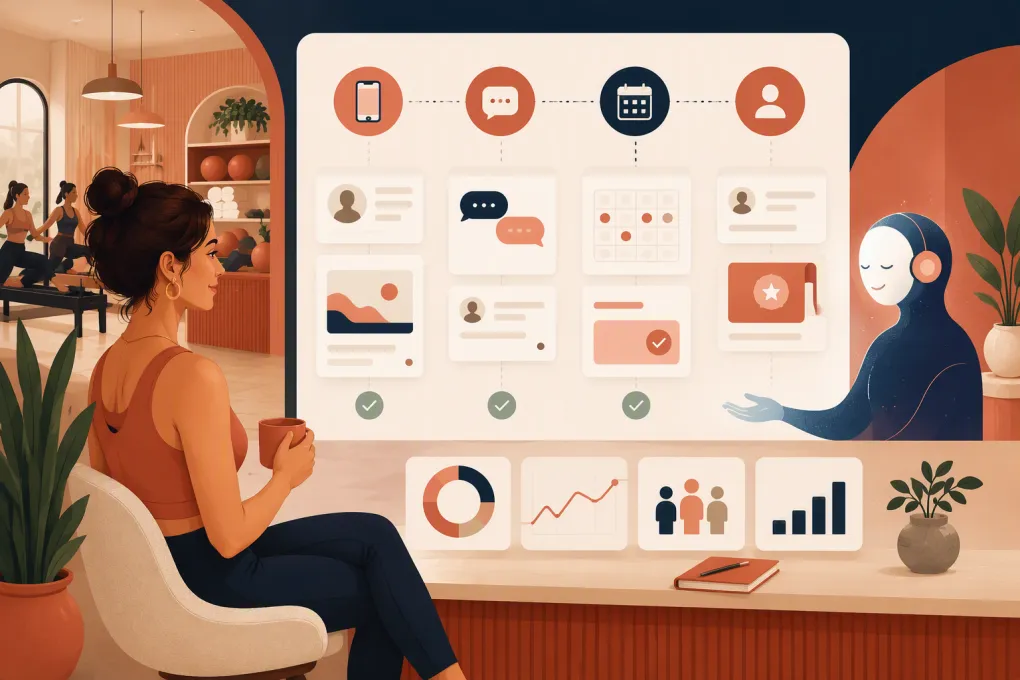 Watch · 20s
A fitness lead rarely moves from first inquiry to paid membership in one conversation. They ask about schedules, compare options, get distracted, miss a trial, or wait until their current routine stops working. If your staff has to remember every reply and follow-up manually, qualified prospects will quietly disappear.
Automation solves the consistency problem. It does not replace good sales conversations. The goal is to respond quickly, keep the next step clear, and bring a person into the conversation when judgment is required.
What fitness studio lead nurturing should accomplish
Lead nurturing is the process between a prospect’s first inquiry and a clear outcome: booked, joined, not interested, or not ready yet.
A useful automated system should:
- Capture every inquiry in one lead record.
- Respond without waiting for the front desk to become available.
- Answer common questions about classes, appointments, pricing, and policies.
- Move the lead toward one specific next step.
- Confirm bookings and reduce avoidable confusion.
- Alert staff when a prospect needs personal attention.
- Continue appropriate follow-up when the lead goes quiet.
- Stop sales messages when someone joins or opts out.
Without those controls, automation becomes another source of duplicate texts, stale tasks, and awkward messages to people who already purchased.
See how Fitty handles fitness lead responses, follow-up, and booking 24/7 →
Map your lead pipeline before automating it
Do not begin by writing a month of messages. First define the stages a lead can occupy and the event that moves the record forward.
A practical studio pipeline might include:
- New inquiry: Contact information has been captured, but no conversation has occurred.
- Contacted: The studio or its AI receptionist has replied.
- Qualified: The lead’s goal, preferred service, timing, and major constraints are known.
- Trial or consultation booked: A specific date and time are on the calendar.
- Attended: The prospect completed the introductory visit.
- Offer pending: The relevant membership or package has been presented.
- Won: The prospect purchased.
- Long-term nurture: The prospect is interested but not ready.
- Lost or opted out: Follow-up should end or change substantially.
Each stage needs a clear entry rule. For example, submitting a form creates a new inquiry, while completing a scheduled intro changes the record to attended. Do not rely on staff to interpret vague labels such as warm or active.
Capture the fields that make follow-up relevant
At minimum, collect:
- Name and preferred contact information
- Lead source and campaign
- Service or class of interest
- Preferred location
- Goal or reason for inquiring
- Preferred days or times
- Booking status
- Assigned staff member
- Consent and opt-out status
- Last contact and next action
Ask only for information you will use. A short form followed by a conversational qualification process is usually easier to manage than a long form with fields your team never reviews.
Build automations around real lead events
The strongest workflows react to behavior. A generic sequence that sends the same message to every lead cannot account for someone who has already booked, replied, or joined.
1. New inquiry response
When a lead submits a website form, starts a conversation, or contacts the studio, the workflow should immediately:
- Create or update the lead record.
- Identify the source and location.
- Send an acknowledgment through an approved channel.
- Answer the initial question when possible.
- Offer the correct next step, such as booking an intro.
- Notify a team member if the question cannot be resolved.
Keep the first response focused. A useful structure is: acknowledge the request, answer what was asked, and present one action.
For example:
Hi Taylor, thanks for asking about beginner Pilates. We have introductory options at our Downtown studio. Would you like to see available times for an intro session?
That is more useful than sending a long description of every membership.
2. Unanswered inquiry follow-up
If the lead does not reply, use a short sequence across a reasonable period rather than sending the same prompt repeatedly.
| Timing | Purpose | Example next step |
|---|---|---|
| Immediately | Confirm the inquiry and answer the initial question | View times or reply with a goal |
| Later the same day | Remove a common obstacle | Ask about schedule or experience level |
| Next day | Reopen the conversation with context | Offer two relevant options |
| A few days later | Make a low-pressure final attempt | Ask whether to pause follow-up |
| Later nurture | Stay available without frequent sales pressure | Share a relevant program update |
These are starting points, not universal rules. Adjust timing to your sales cycle, operating hours, channel, and the consent the lead provided.
3. Booking confirmation and reminders
Once a prospect books, stop acquisition messages and switch to attendance support. Send the information needed to arrive prepared:
- Date, time, location, and instructor or provider
- Parking, entry, or check-in instructions
- What to bring or wear
- Cancellation or rescheduling link
- A contact method for questions
The automation should use live booking status. If the prospect cancels, offer a rescheduling path. If they reschedule, suppress reminders for the old appointment.
4. No-show recovery
A missed intro should trigger a helpful recovery message, not a reprimand. Acknowledge that plans change, offer a simple rebooking option, and create a staff task if the lead previously showed strong intent.
Avoid endless no-show sequences. If a prospect repeatedly books without attending, move the record to a lower-frequency workflow or require a staff review.
5. Post-visit conversion
After the trial, consultation, tour, or first appointment, follow-up should reference what actually happened. Ask staff to record the recommended plan and any stated objection before the automated sequence begins.
The workflow can then:
- Thank the prospect for attending.
- Restate the recommended membership or package.
- Provide the enrollment or payment step.
- Answer routine questions.
- Escalate concerns involving injuries, contracts, refunds, or special accommodations.
- End automatically when the purchase is completed.
This is where connected data matters. A follow-up system that cannot see attendance or payment status will create embarrassing mistakes.
Use AI for conversations, not just scheduled blasts
Traditional automation follows fixed branches: if a lead clicks, send one message; if not, send another. AI can add a conversational layer by understanding common questions and guiding a prospect toward an available booking.
For a fitness studio, an AI receptionist can help with repetitive work such as:
- Responding when staff members are coaching or the studio is closed
- Explaining introductory options and basic policies
- Asking what the prospect wants to achieve
- Finding an appropriate class or appointment
- Booking the next step
- Following up with leads who have not completed booking
- Routing sensitive or unusual questions to a person
The guardrails matter as much as the responses. Your AI should use approved information, avoid making medical promises, respect location-specific rules, and know when to hand off.
Fitty is WTF Go’s AI receptionist and agent for handling leads, booking classes, following up, and collecting dues around the clock. That makes the lead conversation part of the operating system rather than a disconnected chatbot your team has to monitor separately.
See how Fitty can turn unanswered fitness inquiries into booked next steps →
Define the human handoff rules
Automation should make staff attention more precise, not eliminate it. Create alerts for situations such as:
- A lead explicitly asks to speak with someone.
- The prospect has a medical, accessibility, or injury-related concern.
- A pricing or contract exception is requested.
- The lead expresses frustration.
- A high-intent prospect replies but does not book.
- The system cannot answer confidently.
- A multi-location request requires coordination.
Every alert should include the conversation history, lead source, requested service, and recommended next action. Making employees search across an inbox, booking platform, and spreadsheet defeats the purpose of automation.
Keep messaging compliant and controlled
US operators should treat consent as a workflow requirement, not a line buried in a form. Your setup should record how and when a lead agreed to receive messages, honor opt-outs, and apply appropriate quiet hours.
For commercial email, include accurate sender information and a working unsubscribe method. For calls and texts, review the consent and communication rules that apply to your channels, vendors, state, and use case. If conversations are recorded or transcribed, account for applicable disclosure and consent requirements. Obtain legal guidance for your specific operation rather than assuming software alone makes a campaign compliant.
Also set frequency caps. A lead should not receive overlapping messages from a campaign, an employee, and an AI agent because three systems failed to share status.
Measure the workflow, not just total leads
A larger lead count does not reveal where the process is breaking. Review performance by source, location, service, and pipeline stage.
Track operational measures such as:
- Time from inquiry to first response
- Percentage of leads receiving a successful reply
- Inquiry-to-booking progression
- Booking-to-attendance progression
- Attendance-to-purchase progression
- No-show and rescheduling patterns
- Human handoff volume and reasons
- Opt-outs, failed deliveries, and incorrect automations
- Leads stuck in a stage without a next action
Read conversation samples as well. A workflow may look active while repeatedly misunderstanding pricing questions or offering the wrong location. Quantitative reporting shows where to look; conversation review shows what to fix.
A practical rollout checklist
Start with one service and one location before automating every path.
- Document the current lead sources and response process.
- Define pipeline stages and ownership.
- Clean up duplicate records, outdated schedules, and conflicting offers.
- Create the new-inquiry and booking-confirmation workflows first.
- Write approved answers for common questions.
- Establish human handoff and failure rules.
- Test using different services, locations, replies, cancellations, and opt-outs.
- Train staff on where to find context and how to take over.
- Review conversations frequently after launch.
- Add no-show, post-visit, and long-term nurture workflows once the core path is reliable.
The objective is not maximum automation. It is a lead journey in which every prospect receives a relevant next step, staff can intervene with context, and the system stops when the conversation is finished.
Explore WTF Go’s connected approach to fitness lead nurturing and operations →
Frequently asked questions
What is fitness studio lead nurturing?
It is the structured follow-up process that moves a prospect from initial inquiry to booking, attendance, and purchase while keeping their status and next action visible.
How often should a fitness studio follow up with a new lead?
Respond promptly, then use a short sequence that becomes less frequent over time. Adjust the cadence based on lead behavior, consent, channel, and whether the person has booked or replied.
Can AI book fitness classes for leads?
Yes, when the AI agent is connected to accurate schedules and booking workflows. It should also recognize exceptions and transfer medical, contractual, or unusual questions to staff.
Which lead nurturing workflow should a studio automate first?
Start with immediate new-inquiry response, qualification, and booking confirmation. Those workflows establish clean records and clear status changes before more complex follow-up is added.
Should automation stop after a prospect books?
Sales follow-up should stop, but the lead should enter a booking support workflow for confirmations, reminders, preparation instructions, and rescheduling.
Keep reading

Run your gym on autopilot with WTF Go
Fitty — your AI receptionist — answers calls and DMs, fills classes, follows up with every lead, and collects dues while you coach.