AI & Automation
How to Automate Dance Studio Trial Class Follow-Up Better
Learn how to automate dance studio trial class follow-up with timely texts, emails, staff tasks, lead routing, and enrollment-ready workflows that convert.
 Watch · 20s
A trial class is not an enrollment. Even when the dancer has a great experience, the parent may leave with unanswered questions, get distracted, or assume someone from the studio will contact them later. If that contact depends on an instructor remembering to update a spreadsheet after the last class of the night, good leads will slip away.
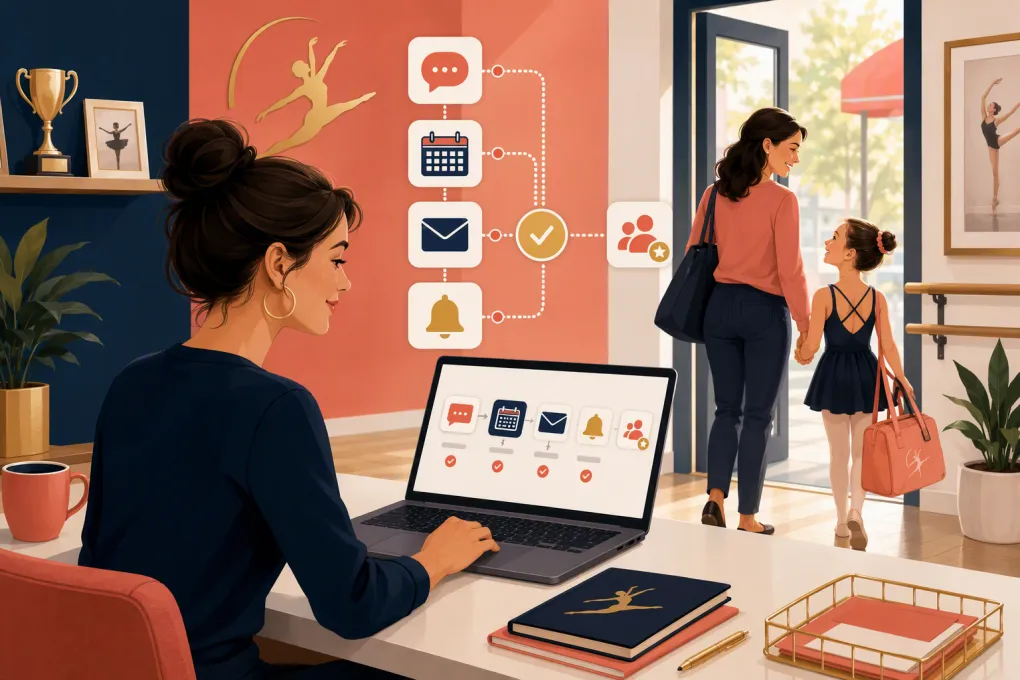
The answer is not sending more generic messages. It is building a follow-up system that reacts to what actually happened: booked, confirmed, attended, missed, canceled, replied, or enrolled.
Here is how to automate dance studio trial class follow-up without making the experience feel robotic.
Start with the outcome, not the messages
Before writing a text sequence, define what the workflow should accomplish. For a dance studio, the desired next step might be:
- Enrolling the dancer in the class they tried
- Recommending a more appropriate level or age group
- Booking a second trial when the first class was not a fit
- Scheduling a conversation about placement, tuition, or competition teams
- Collecting registration details and the first payment
Automation should move the family toward one of those outcomes. It should also recognize when a staff member needs to take over.
A parent asking, “Is my child ready for the intermediate class?” needs a knowledgeable human response. A parent asking, “What time does Tuesday’s class start?” can usually be helped immediately by an automated agent with access to the correct schedule.
See how Fitty can handle dance studio inquiries and follow-up 24/7 →
Build the workflow around trial-class statuses
A reliable workflow starts with accurate statuses. Do not treat every trial lead as one undifferentiated contact.
At minimum, track:
- New inquiry: The family has asked about classes but has not booked.
- Trial booked: A specific dancer, class, date, and time are confirmed.
- Trial confirmed: The parent has acknowledged the appointment.
- Trial attended: The dancer participated.
- No-show: The dancer did not arrive.
- Canceled: The family canceled before class.
- Needs placement review: An instructor must recommend the right class.
- Enrolled: Registration and any required payment are complete.
- Not moving forward: The family declined or asked not to be contacted.
These statuses prevent common mistakes, such as sending “How did class go?” to a no-show or continuing enrollment reminders after a family has registered.
Decide what changes each status
Document the event that moves a lead forward. Examples include:
- A website form creates a new inquiry.
- A parent selects a class and creates a trial booking.
- A confirmation link marks the trial confirmed.
- Front-desk check-in marks the dancer attended.
- The instructor submits a placement note after class.
- A completed registration form changes the lead to enrolled.
Avoid relying on manual updates for every step. Keep human input for decisions that require judgment, such as class placement or readiness for a performance group.
Capture the information needed for relevant follow-up
Automation is only as useful as the data feeding it. Your trial form should capture enough information to personalize the next step without becoming unnecessarily long.
Useful fields include:
- Parent or guardian name
- Mobile number and email address
- Dancer’s first name
- Dancer’s age or date of birth
- Dance style of interest
- Prior experience, if relevant to placement
- Preferred location for multi-location studios
- Selected trial class, date, and instructor
- How the family heard about the studio
- Communication consent
When the dancer is a minor, direct operational and marketing communication to the parent or guardian. Do not build a workflow that assumes the child is the purchasing contact.
The selected class should be stored as structured data rather than buried in a free-text note. That lets the system insert the correct time, location, attire instructions, parking details, and enrollment link.
Create a pre-class sequence that reduces uncertainty
Trial families need enough information to arrive prepared. They do not need five versions of the same reminder.
A practical pre-class workflow can include the following steps.
Immediately after booking
Send a confirmation by text or email containing:
- Dancer’s name
- Class name and level
- Date and start time
- Studio address
- What to wear or bring
- Arrival guidance
- A way to reschedule or ask a question
Example:
Hi Jordan, Maya’s trial for Beginner Ballet is booked for Tuesday at 5:00 p.m. at our Westside studio. Please arrive 10 minutes early. She can wear comfortable fitted clothing and socks if she does not have ballet shoes yet. Reply here with any questions.
Only include policies that actually apply to that class. Generic instructions create confusion when different programs have different attire or arrival requirements.
The day before class
Send a concise reminder and ask for confirmation. A simple reply such as “YES” gives the studio a clearer attendance signal and creates an opportunity to handle objections before class.
If the trial is booked less than a day in advance, skip this step. Your automation should use conditional timing rather than sending several messages close together.
A few hours before class
Use a final operational reminder only if it adds value. Parking instructions, a building entrance note, or the instructor’s name can be useful. Repeating the entire confirmation usually is not.
Split attended trials from no-shows immediately
This is the most important branch in the workflow. An attendance-based trigger should determine what happens next.
If the dancer attended
Send a brief thank-you after the class has ended and the attendance record is complete. Invite a reply, but do not force the parent through a survey before presenting the next step.
Example:
Thanks for bringing Maya to Beginner Ballet today. We’d be happy to help with enrollment or answer any questions about the class. You can register here: [link]. How did the class feel for her?
If an instructor needs to approve placement, replace the immediate registration link with an accurate expectation:
Ms. Taylor is reviewing the best class placement for Maya. We’ll follow up once that recommendation is ready.
The instructor’s placement note can then trigger the appropriate class recommendation and enrollment link.
If the dancer did not attend
Do not use guilt or pretend the class happened. Make rescheduling easy.
Example:
Hi Jordan, we missed Maya at ballet today. If you’d still like to try a class, I can help you find another date. Would Tuesday or Thursday usually work better?
A response can route to a staff member or an AI receptionist that can check availability and book the replacement trial.
If the family canceled
A cancellation is different from a no-show. Acknowledge it, retain the context from the original booking, and offer appropriate alternatives. Do not restart the family as a brand-new lead.
See how Fitty can answer follow-up questions and book the next trial →
Build a short post-trial enrollment sequence
If an attendee does not enroll after the first message, use a limited sequence across text and email. The exact timing should reflect your studio’s sales cycle and class availability, but each message needs a distinct purpose.
A useful structure is:
Follow-up 1: Answer the obvious next questions
Send tuition, schedule, registration requirements, and the correct enrollment link. If pricing varies by program, location, or number of classes, explain the relevant option rather than linking to a broad pricing page.
Follow-up 2: Address fit and placement
Ask whether the parent has concerns about level, schedule, instructor fit, or the dancer’s comfort. Route replies mentioning placement or readiness to the appropriate instructor or program director.
Follow-up 3: Provide a clear decision point
Remind the family how to enroll and explain any real scheduling constraint. If the class is close to capacity, the system can invite them to confirm current availability. Do not manufacture urgency or claim that a spot is disappearing unless your booking data supports it.
Stop when the status changes
The sequence should end when the family:
- Enrolls
- Books another trial
- Requests a staff call
- Declines
- Unsubscribes
- Is marked unsuitable for the selected program
Continuing after one of these events makes the studio look disorganized and increases the risk of communication complaints.
Add human tasks where automation should stop
A strong system automates repetition while exposing conversations that need judgment.
Create staff tasks for situations such as:
- The instructor recommends a different class.
- The parent asks about advanced placement or competition teams.
- The dancer needs accommodations.
- The family has multiple children or a complex schedule.
- A payment attempt fails during enrollment.
- A lead replies with a question the system cannot answer confidently.
- A high-intent family has engaged repeatedly without completing registration.
Assign each task to a role, not just a person. “Program director” or “front desk” is more durable than a workflow tied to one employee who may be unavailable.
Set an internal response target and make overdue tasks visible. Automation cannot fix unclear ownership.
Keep text and email compliant and trustworthy
Only message people who have provided the appropriate contact information and consent for the type of communication you are sending. Clearly identify the studio, honor opt-out requests, and maintain suppression records so an unsubscribed contact is not accidentally re-added to a sequence.
For text messages, include standard opt-out language where appropriate and avoid unnecessary messages during unreasonable hours. For marketing email, use truthful subject lines, identify the sender, provide required business information, and include an unsubscribe method.
Consent and messaging requirements can depend on the channel, message type, and applicable law. Have qualified counsel review your process rather than assuming software configuration alone makes a campaign compliant.
Test the entire journey before turning it on
Run test contacts through every branch using staff-owned email addresses and phone numbers. Check:
- New inquiry without a booking
- Same-day trial booking
- Confirmed attendance
- No-show
- Cancellation and rebooking
- Instructor placement review
- Enrollment before the sequence ends
- Opt-out by text or email
- Duplicate inquiry from an existing family
- Missing phone number or invalid email address
Verify links on a mobile device. Confirm that dates, time zones, locations, dancer names, and class names render correctly. Make sure an enrollment immediately stops promotional follow-up.
Repeat this test whenever schedules, locations, forms, or enrollment links change.
Measure the workflow by stage
Do not judge the system only by message opens. Track movement through the actual enrollment path:
- Inquiries that book a trial
- Booked trials that confirm
- Confirmed trials that attend
- No-shows that rebook
- Attendees who enroll
- Replies requiring staff help
- Time from inquiry to first response
- Leads stuck in a status without a next action
Review results by class, age group, lead source, and location when you have enough data to make the comparison meaningful. A weak attendance rate may point to scheduling or reminder problems. Strong attendance but weak enrollment may indicate a class-fit, pricing, experience, or post-trial follow-up issue.
Let the system handle routine follow-up without losing context
WTF Go brings lead management, booking, follow-up, and payment workflows into one operating system for fitness and wellness businesses. Fitty, its AI receptionist and agent, can respond to dance studio leads, answer routine questions, book classes, continue follow-up, and help collect dues around the clock.
The operational advantage is not simply sending texts automatically. It is keeping the conversation tied to the lead’s booking, status, questions, and next action—while handing nuanced decisions to your team.
See how WTF Go can automate your dance studio trial-to-enrollment workflow →
Frequently asked questions
How soon should a dance studio follow up after a trial class?
Follow up after the class has ended and attendance is recorded. The message should thank the family, address the correct next step, and make enrollment or placement help easy.
Should trial class follow-up use text, email, or both?
Text works well for timely reminders and short replies, while email can carry detailed tuition, schedule, and policy information. Use each channel with appropriate consent and stop messages when a contact opts out.
What should happen when a trial student is a no-show?
Move the lead into a separate no-show sequence that acknowledges the missed class and offers easy rescheduling. Do not send an attended-trial message or immediately push enrollment.
Can AI answer dance studio trial class questions?
AI can handle routine questions about schedules, locations, attire, booking, and enrollment when connected to accurate studio information. Placement decisions, accommodations, and other judgment calls should be escalated to staff.
What information is needed to automate trial follow-up?
Capture the parent’s contact details, dancer’s name and age, class interest, location, trial date, attendance status, and communication consent. Structured booking and status data make the follow-up relevant and prevent incorrect messages.
Keep reading

Run your gym on autopilot with WTF Go
Fitty — your AI receptionist — answers calls and DMs, fills classes, follows up with every lead, and collects dues while you coach.