Comparisons
Facial Spa Booking Software: 6 Leading Options Compared
Compare facial spa booking software for rooms, intake, deposits, packages, memberships, automation, compliance, and pricing before booking demos.
 Watch · 20s
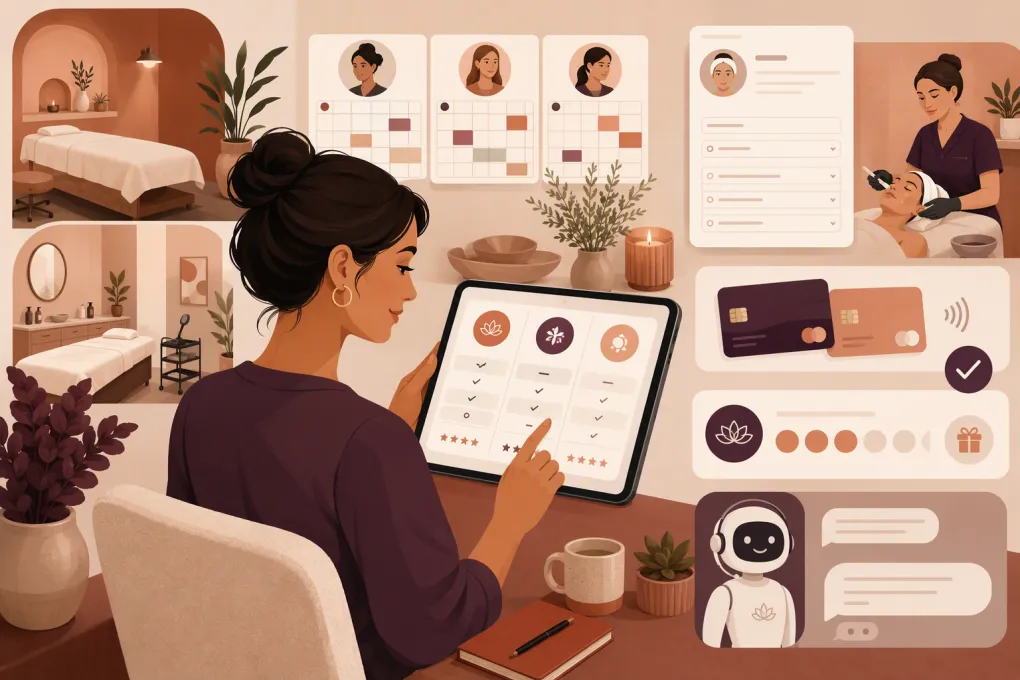
Facial spa booking software has to coordinate more than available time. A single appointment may require a qualified esthetician, a specific treatment room, shared equipment, intake and consent forms, a deposit, preparation instructions, and a package or membership credit.
When those pieces live in separate systems, the front desk becomes the integration. Staff re-enter information, check balances manually, chase incomplete forms, and answer routine booking questions while clients wait.
The goal is not simply to buy a prettier calendar. It is to build a reliable path from inquiry to completed treatment and rebooking.
See how Fitty handles facial-spa inquiries and booking when your team is unavailable →
How this comparison was built
This is an editorial buying framework, not a hands-on software lab test or a claim that every product was implemented inside the same spa. No customer anecdotes, undisclosed reviews, or invented practitioner results are used.
The products were selected because they represent different buying categories: beauty-focused software, wellness marketplaces, premium client-experience platforms, enterprise spa systems, and an AI-led operating platform. Placement is not a ranking. WTF Go is included because it publishes this guide and because Fitty addresses lead response, booking, follow-up, and failed-payment workflows relevant to spas.
The comparison evaluates the workflows a facial spa should demonstrate during a live demo:
- Staff, room, and equipment scheduling
- Service-specific intake and consent forms
- Deposits, cards on file, and cancellation rules
- Packages, gift cards, and recurring memberships
- Lead response and booking automation
- Multi-location controls
- Medical-spa and HIPAA-related considerations
- Pricing model and likely add-on exposure
Last editorial review: August 12, 2026. Vendor pages are linked so buyers can verify current packaging. Software features and prices change frequently, and historical price references below are benchmarks—not current quotes.
Facial spa booking software comparison
| Platform | Rooms and equipment | Intake and deposits | Packages and memberships | Automation and AI | Multi-location | HIPAA or clinical use | Pricing reference | Best fit and limitation |
|---|---|---|---|---|---|---|---|---|
| Boulevard | Supports beauty-business scheduling and resource-oriented workflows; demonstrate room assignment and buffers for your setup | Digital forms, client profiles, checkout, and booking-policy tools are core areas to review | Supports beauty-business loyalty and recurring-revenue workflows; test package exceptions | Client messaging and marketing automation are available; do not assume autonomous lead handling without a demo | Oriented toward established and growing beauty brands | Do not treat general security claims as proof of HIPAA suitability; request written confirmation and a BAA if needed | As a dated benchmark, Boulevard publicly advertised an entry plan around $158 per location per month in 2024. Check its current sales quote and payment terms | Strong client experience and beauty workflows; potentially more platform and cost than a solo esthetician needs |
| Fresha | Provides team scheduling; verify whether current resource controls can reserve every room or device independently | Booking policies, forms, payments, and client communication vary by current plan and market | Supports common beauty and wellness sales workflows; test membership billing and package liability reporting | Automated messages and marketing tools are available; marketplace discovery is a notable differentiator | Can support teams and multiple venues | Not a substitute for a clinical record system; obtain written answers before storing protected health information | A 2025 US pricing benchmark listed an independent plan at $19.95 per month and a team plan at $14.95 per bookable team member per month. Marketplace, payment, and marketing charges can also apply; verify the live page | Useful for operators valuing marketplace reach; assess marketplace economics and ownership of the direct client relationship |
| Mindbody | Appointment and resource scheduling are available, but configuration should be tested with rooms, equipment, and cleanup buffers | Offers booking, forms, payments, and policy controls across its broader wellness platform; availability can depend on package | Broad support for memberships, packages, gift cards, and recurring billing | Marketing and client communication automation are available; confirm whether AI answers and books conversationally or routes through fixed workflows | Established multi-location capabilities | General wellness software should not be assumed HIPAA-ready; medical operators need written scope, access controls, and BAA answers | Mindbody commonly uses sales-led, package-based pricing. Use its pricing page for a current quote and identify paid add-ons | Broad ecosystem and consumer marketplace; configuration, package structure, and add-ons may be heavier than a small facial spa requires |
| Vagaro | Supports service-provider calendars and business resources; require a demo of room and equipment collision prevention | Forms, booking rules, deposits, cards on file, and payments are available within its spa and salon toolset | Supports memberships, packages, gift cards, and recurring sales workflows | Notifications and marketing automation are available; advanced features may require add-ons | Suitable for solo providers and growing locations | Do not assume HIPAA coverage for every feature or message channel; ask which products are covered and whether a BAA is offered | A widely published US benchmark has been $30 per month for one bookable calendar, with costs increasing for additional calendars and add-ons. Confirm the current total on the linked page | Accessible breadth for independent and midsize spas; modular features can make the final cost higher than the base subscription |
| WTF Go | Scheduling is part of the operating workflow, but spas should confirm room, device, and turnover-rule requirements during scoping | Booking, client management, payments, and follow-up are supported; confirm service-specific form and consent requirements | Relevant for memberships and payment follow-up; demonstrate package redemption and spa-specific balance rules before buying | Fitty is an AI receptionist that answers leads, books, follows up, and helps recover failed membership payments | Designed for independent and multi-location fitness and wellness operators | WTF Go should not be treated as an EMR; medical spas must verify data handling, access, integration, and BAA requirements | Sales-assisted pricing; request a written quote covering locations, messaging, payment processing, onboarding, and migration | Best considered when unanswered inquiries and repetitive front-desk follow-up are major problems; specialized clinical charting may require another system |
| Zenoti | Extensive enterprise scheduling for providers, rooms, and operational resources | Offers broad intake, appointment, payment, and guest-management workflows | Strong recurring revenue, package, gift card, and centralized management capabilities | Centralized marketing and automation are major platform areas; exact AI functionality should be demonstrated | Strong orientation toward chains, franchises, and complex location groups | Zenoti markets to med spas, but buyers still need written confirmation of covered products, safeguards, and BAA terms | Custom, sales-led enterprise pricing; request implementation, training, integration, messaging, and payment costs separately | Appropriate for sophisticated multi-location groups; implementation and administration may be excessive for a small independent spa |
Price benchmarks are included only where a dated public reference could provide context. They exclude potential processing, messaging, marketplace, hardware, onboarding, and add-on charges. Save a screenshot or PDF of the live pricing page on the day you request a quote.
The features that matter most in a facial spa
Resource scheduling, not just staff scheduling
A calendar can show an esthetician as available while the required room or hydrodermabrasion device is already occupied. The software must evaluate every constrained resource before offering a time online.
Give each vendor this test during the demo:
- Create two services performed by the same esthetician.
- Require a shared device for only one service.
- Assign a room to both services.
- Add treatment and cleanup time.
- Try to book another provider into the room or onto the device.
The system should block the conflict without relying on a staff member to notice it. Also test what happens when an add-on extends the appointment.
Forms that follow the service
A first-time sensitive-skin facial may need different questions from a returning client’s routine appointment. Medical treatments can introduce additional consent, documentation, and access requirements.
Check whether the platform can:
- Assign forms by service and client type
- Send forms automatically before the appointment
- Collect electronic signatures
- Alert staff when a required form is incomplete
- Restrict who can see sensitive information
- Preserve form versions and signature history
- Export records in a usable format
A digital form is not automatically a compliant medical record. Medical spas should have qualified legal or compliance counsel evaluate their obligations.
Deposits and enforceable booking policies
Long appointments and equipment-dependent services justify stronger booking controls. Your software should support different deposit, cancellation, and rescheduling rules by service—not one blanket setting for the entire business.
Test a late cancellation, a partial refund, a reschedule after the cutoff, and a disputed no-show fee. Confirm that the policy shown during checkout matches what the system can actually enforce.
Packages and memberships under real conditions
Do not stop when a salesperson demonstrates a straightforward package sale. Ask them to process the exceptions your front desk encounters:
- A client upgrades while redeeming a package credit
- A membership payment fails before the appointment
- A package expires with unused services
- A client pays with both a gift card and credit card
- A membership is frozen or canceled
- Credits are restricted to one location
- A manager adjusts a balance and needs an audit trail
The platform should make the client’s eligibility and remaining balance obvious before checkout.
Where AI reception changes the buying decision
Traditional spa software often begins after the client selects “Book now.” It may not solve the earlier problem: a prospective client sends a message asking which facial to choose, whether there is downtime, or whether an evening appointment is available.
Fitty is relevant here because it operates as a receptionist rather than only sending preset reminders. It can respond to inquiries, move the conversation toward an appropriate booking, continue follow-up, and address outstanding membership balances or failed payments.
That does not mean AI should answer every question. Establish escalation rules for contraindications, adverse reactions, treatment suitability, prescription products, pregnancy-related questions, and anything requiring an esthetician or clinician’s judgment.
See how WTF Go connects AI lead response with spa booking and payment follow-up →
Run a controlled demo before signing
A credible buying decision should be based on observed workflow performance, not a feature grid alone. Use the same test script for every vendor and record the results.
Ask a receptionist, service provider, manager, and client to complete these tasks:
- Book a new client who is unsure which service to select.
- Reserve the correct provider, room, device, and cleanup period.
- Collect a deposit and send service-specific intake.
- Reschedule inside and outside the cancellation window.
- Redeem a package and add a paid upgrade.
- Process a failed membership payment.
- Restrict access to sensitive client information.
- Export appointments, balances, forms, and transaction data.
- Run reports by service, provider, location, cancellation, and rebooking status.
- Submit an inquiry after the spa closes and measure what happens next.
Document whether each task is native, requires an add-on, depends on an integration, or cannot be completed. That evidence is more useful than a vendor’s broad claim that it supports “spa management.”
Get the commercial terms in writing
Before signing, request one document covering the base subscription, users or calendars, locations, payment processing, text usage, marketing, marketplace fees, forms, reporting, onboarding, hardware, data migration, contract length, renewal terms, and data export.
Also define what will migrate. Names and email addresses are easier to transfer than treatment history, signed forms, package balances, gift cards, recurring memberships, future appointments, and stored payment credentials.
The best facial spa booking software is the one that passes your operational test, fits your compliance requirements, and reduces manual work without hiding essential costs behind add-ons.
Explore WTF Go and test Fitty against your facial-spa inquiry workflow →
Frequently asked questions
What should facial spa booking software include?
It should coordinate providers, rooms, equipment, intake, deposits, cancellation rules, packages, memberships, checkout, follow-up, and reporting. Medical spas may also need a separate clinical record system and documented compliance safeguards.
How much does facial spa booking software cost?
Pricing can be per provider, calendar, location, or custom enterprise contract. Compare the complete cost, including payment processing, messaging, forms, marketplace fees, add-ons, onboarding, and migration.
Can spa scheduling software prevent treatment-room conflicts?
Some systems support room and equipment resources, but implementation varies. Require the vendor to demonstrate conflict prevention using your actual providers, rooms, devices, service durations, and cleanup buffers.
Is facial spa booking software HIPAA compliant?
Do not assume it is. Medical spas should verify which products and communication channels are covered, whether the vendor will sign a business associate agreement, and whether access, audit, retention, and export controls meet their requirements.
Can AI book facial appointments safely?
AI can answer routine questions and book within approved services, availability, and policies. Clinical, contraindication, adverse-reaction, and treatment-suitability questions should be escalated to qualified staff.
Keep reading

Run your gym on autopilot with WTF Go
Fitty — your AI receptionist — answers calls and DMs, fills classes, follows up with every lead, and collects dues while you coach.