Comparisons
EMS Fitness Studio Management Software: 2026 Guide
Compare EMS fitness studio management software for scheduling, billing, waivers, AI, reporting, migration, and contracts with a scored buyer matrix.
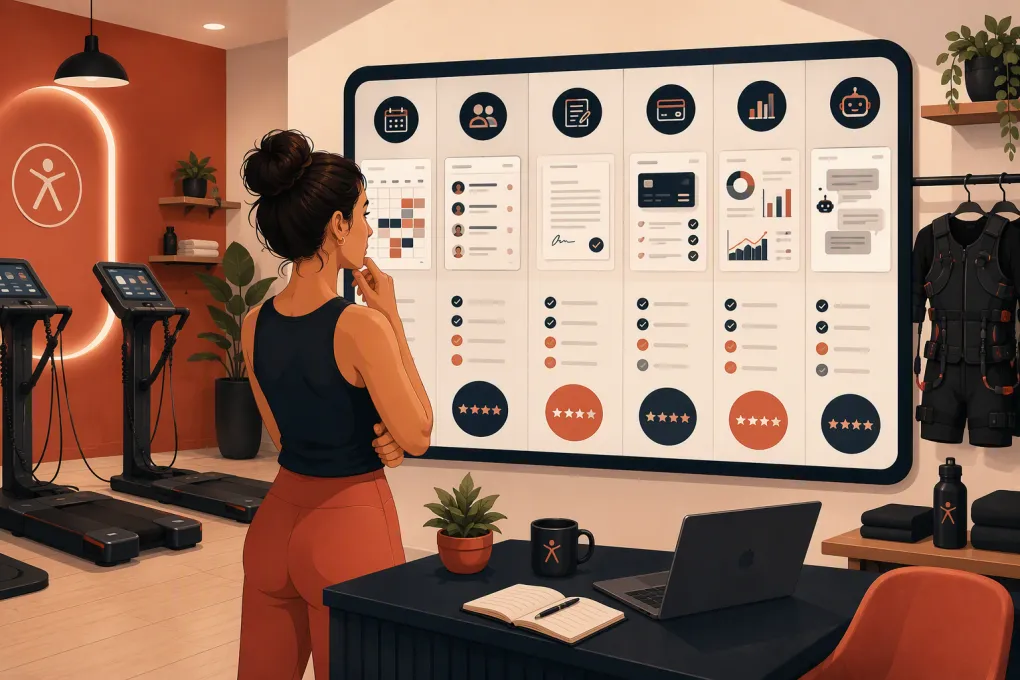 Watch · 20s
EMS fitness studio management software must coordinate people, equipment, forms, payments, and follow-up—not merely put sessions on a calendar. A platform can look polished in a demo and still fail when two coaches share three EMS stations, a prospect needs screening before booking, or a member’s recurring payment fails.
This comparison focuses on those operational realities. It includes broad fitness platforms and vendors that explicitly position their products for EMS operators. It also distinguishes documented capabilities from items that require a live demonstration.
One safety boundary matters from the start: AI should not determine whether someone is medically eligible for EMS training. Health history, contraindications, symptoms, pregnancy, implanted devices, and other suitability questions require an approved screening process and escalation to a qualified human. An AI receptionist can explain your process, send approved forms, and arrange the correct next step; it should not diagnose, clear, or reassure a prospect about medical risk.
See how Fitty can answer EMS inquiries while escalating health and suitability questions →
How this comparison was built
The shortlist was reviewed on August 2, 2026, using publicly available vendor product and pricing pages. It was selected to cover three realistic buying paths:
- AI-led front-office operations: WTF Go
- Established boutique fitness systems: Mindbody, Glofox, Zen Planner, and PushPress
- Platforms that explicitly address EMS businesses: Magicline and Virtuagym
This is not presented as independent hands-on testing. We did not receive sandbox accounts, inspect contracts, run migrations, or interview vendor customers for this article. No practitioner quotes or performance claims are invented. Scores reflect capabilities described in public vendor materials; anything unclear is marked for verification.
Review the current source pages before purchasing: WTF Go, Mindbody pricing, Glofox, Zen Planner, PushPress pricing, Magicline, and Virtuagym.
Scored EMS software comparison matrix
Scores use this scale:
- 3: Clearly documented as a substantial capability
- 2: Documented, but depth or EMS configuration needs verification
- 1: Possible through a basic feature, add-on, integration, or workaround
- ? Public documentation was insufficient to score responsibly
For contract clarity, a higher score means public terms or purchasing constraints are easier to evaluate—not that the contract is necessarily better.
| Platform | Resource scheduling | Waivers/forms | Failed-payment workflow | Integrations | Support | Migration | Reporting | Contract clarity |
|---|---|---|---|---|---|---|---|---|
| WTF Go | 2 | 2 | 3 | 2 | 2 | 2 | 2 | ? |
| Mindbody | 2 | 3 | 2 | 3 | 3 | 3 | 3 | 2 |
| Glofox | 2 | 2 | 2 | 2 | 3 | 3 | 3 | 1 |
| Zen Planner | 1 | 3 | 2 | 2 | 3 | 2 | 3 | 2 |
| PushPress | 1 | 2 | 2 | 3 | 3 | 2 | 3 | 3 |
| Magicline | 3 | 2 | 3 | 2 | 2 | 2 | 3 | 1 |
| Virtuagym | 2 | 2 | 2 | 3 | 3 | 2 | 3 | 1 |
These scores are screening tools, not final verdicts. For example, a vendor may support rooms or resources without tracking individual EMS suits. Similarly, “failed-payment workflow” can mean anything from displaying a failed charge to automatically contacting the member and collecting the balance. Require the vendor to show your exact use case.
What each option is actually suited for
| Platform | Concrete strengths | Limitations to test | Best-fit buyer | Public pricing status reviewed August 2, 2026 |
|---|---|---|---|---|
| WTF Go | Fitty is positioned to answer inquiries, book eligible services, follow up with leads, and pursue dues; the platform is designed around connected gym, studio, spa, and wellness workflows. | Public materials do not establish every EMS resource, waiver, integration, migration, or contract detail. Test station limits, suit allocation, screening escalation, and reporting live. | EMS operators whose main gap is unstaffed lead response and front-office follow-up. | No dependable public numeric range was available in the reviewed material; request a written quote covering locations, messaging, payment processing, onboarding, and AI usage. |
| Mindbody | Mature class and appointment booking, memberships, forms, reporting, consumer discovery, and a broad integration ecosystem. | Confirm whether equipment must be represented as rooms or other resources. Product breadth, add-ons, marketplace economics, and staff training can increase complexity. | Established studios that need broad fitness-and-wellness functionality and consumer marketplace exposure. | Tiered plans are shown through the vendor’s pricing process, but final cost can depend on package, location, add-ons, and processing. Confirm the current written total directly. |
| Glofox | Boutique-fitness scheduling, memberships, branded member experiences, lead management, reporting, and multi-location capabilities. | Verify appointment-style EMS sessions, equipment-level capacity, waivers, failed-payment actions, API access, and which features require higher packages. | Boutique brands that prioritize a branded app and standardized member journey. | Sales-led quote; no reliable universal numeric range was published on the reviewed page. |
| Zen Planner | Membership billing, schedules, digital waivers, member records, attendance, and reporting for gyms and training businesses. | Its class- and membership-centered model may require workarounds for individual devices, suits, or tightly timed appointment resources. Verify automated lead response separately. | Membership-driven EMS studios with relatively simple station allocation. | Public packaging may vary by business size and selected services. Obtain a dated quote including onboarding, payments, communications, and websites if needed. |
| PushPress | Straightforward gym operations, billing, scheduling, reporting, member tools, integrations, and publicly visible plan packaging. | The gym-first model may not natively represent each EMS device or garment. Confirm forms, consultations, resource conflicts, and multi-location controls. | Operators who want focused gym management and comparatively transparent package selection. | The vendor publishes plan prices and inclusions on its live pricing page. Use that page for the current numeric range and confirm optional products, processing, onboarding, and contract terms in writing. |
| Magicline | Explicitly markets to EMS studios and documents scheduling, memberships, payment processes, access, communication, and reporting within a broad club-management platform. | Availability, payment services, integrations, support, and commercial terms can differ by country. US operators must verify domestic implementation and processor compatibility. | EMS businesses that want a platform already oriented toward equipment-constrained club operations, especially where Magicline has local support. | Quote-based; request US-specific pricing, implementation scope, support hours, payment terms, and contract length. |
| Virtuagym | Fitness business management, scheduling, memberships, coaching, member apps, engagement, and integrations; it also publishes material aimed at EMS studio operations. | Confirm whether its EMS positioning translates into individual station or suit inventory rather than ordinary appointment capacity. Coaching features may be unnecessary for some studios. | Studios that want business management plus digital coaching or member engagement. | Quote-based in the reviewed materials; request separate costs for business management, coaching, branded apps, onboarding, and additional locations. |
Exact prices are intentionally not copied where they could not be verified as stable, current US rates. A made-up or stale range is worse than no range. Save a dated copy of every quote and make vendors identify one-time charges, optional modules, processing terms, usage limits, and renewal changes.
The EMS workflows every vendor should demonstrate
1. Equipment-aware booking
Give the salesperson a realistic constraint: two coaches, four stations, three usable suits in a required size, and a cleaning buffer. Ask the vendor to book concurrent individual and small-group sessions without overcommitting resources.
Determine whether the platform can track:
- Coaches, rooms, stations, and devices separately
- Different capacities by service
- Setup and turnover buffers
- Equipment taken out of service
- Intro sessions with longer durations
- Cross-location resource availability
A calendar with a class capacity is not automatically resource scheduling.
2. Screening with mandatory human escalation
Create a test lead who asks whether EMS is safe with a medical condition. The correct workflow is not an AI-generated eligibility decision.
The system should be able to:
- Give an approved, non-diagnostic response.
- Avoid making a medical clearance claim.
- Send the studio’s screening or readiness form.
- Prevent an unrestricted session from being booked when review is required.
- Escalate the record to an authorized employee or qualified professional.
- Document the handoff and outcome.
Your legal and clinical advisers should define the screening language, contraindication policy, data handling, and staff responsibilities.
3. Failed-payment recovery
Ask the vendor to process a simulated failed recurring payment. Then inspect what happens next.
A useful workflow should show the balance, notify the appropriate people, record contact attempts, provide a secure payment route, update account access according to your policy, and stop reminders after resolution. Ask whether messages are automated, configurable, and included in the quoted plan.
Fitty is designed to help pursue dues rather than leaving every failed payment for staff to chase manually. That claim still needs to be tested against your processor, escalation rules, communication consent, and membership policies.
Walk through an EMS failed-payment and follow-up workflow with WTF Go →
4. Waivers and sensitive records
Confirm that required forms can be assigned by service, completed before arrival, versioned when language changes, and retrieved by authorized staff. Ask whether form completion can block check-in or trigger manual review.
EMS screening information may be sensitive. Review role-based access, exports, deletion procedures, audit history, breach processes, and applicable privacy obligations. Software availability does not make a studio’s form or data practice legally sufficient.
How to compare the real cost
Request a written three-year cost schedule from every finalist, even if you expect a shorter commitment. Include:
- Base subscription and additional locations
- Required modules
- AI, phone, text, or email usage
- Payment processing and chargeback fees
- Data migration and onboarding
- Branded apps or websites
- Staff training and premium support
- Hardware or access-control costs
- API or integration access
- Renewal increases and early-termination terms
Also price the workaround. If employees must manually reconcile station capacity, copy leads between systems, or chase every missed payment, that labor belongs in the comparison.
A practical selection process
Narrow the field to three vendors: one EMS-oriented platform, one established fitness platform, and one automation-led option. Give all three the same demo script and scoring sheet.
Before signing, require written answers on:
- How EMS equipment capacity will be configured
- What AI may answer and what it must escalate
- Who owns and can export your data
- Which migration fields are included
- Whether payment tokens can transfer
- Available integrations and API restrictions
- Support hours and escalation channels
- Contract length, renewal, and cancellation notice
WTF Go belongs on the shortlist when lead response, booking follow-up, and dues collection are major bottlenecks. It should win only if it also passes the same resource, safety, migration, reporting, and contract tests applied to every competitor.
Compare Fitty against your current EMS inquiry and booking process →
Frequently asked questions
Is there software built specifically for EMS fitness studios?
Magicline and Virtuagym explicitly address EMS businesses, while broader platforms can sometimes be configured for EMS. An EMS label does not guarantee suit-level inventory or US payment support, so test those requirements directly.
Can AI decide whether a prospect is medically eligible for EMS?
No. AI should provide only approved process information, send screening materials, and escalate health, contraindication, or suitability questions to an authorized human or qualified professional.
What is the most important EMS scheduling feature?
The system must prevent bookings from exceeding available coaches, stations, devices, or other required resources. Ask the vendor to demonstrate overlapping services, buffers, and out-of-service equipment.
Why are exact software prices difficult to compare?
Many vendors use sales-led quotes, while total cost can change with locations, modules, messaging, payment processing, onboarding, and contract terms. Request a dated written quote with every required component.
Should an EMS studio choose a specialized or general fitness platform?
Choose based on demonstrated workflows rather than category labels. Specialized software may model EMS resources better, while general platforms may offer stronger integrations, consumer apps, automation, or US support.
Keep reading

Run your gym on autopilot with WTF Go
Fitty — your AI receptionist — answers calls and DMs, fills classes, follows up with every lead, and collects dues while you coach.