Comparisons
Dance Studio Room Rental Management Software Comparison
Compare dance studio room rental management software by scheduling, deposits, approvals, e-signatures, automation, pricing, and best-fit studio type today.
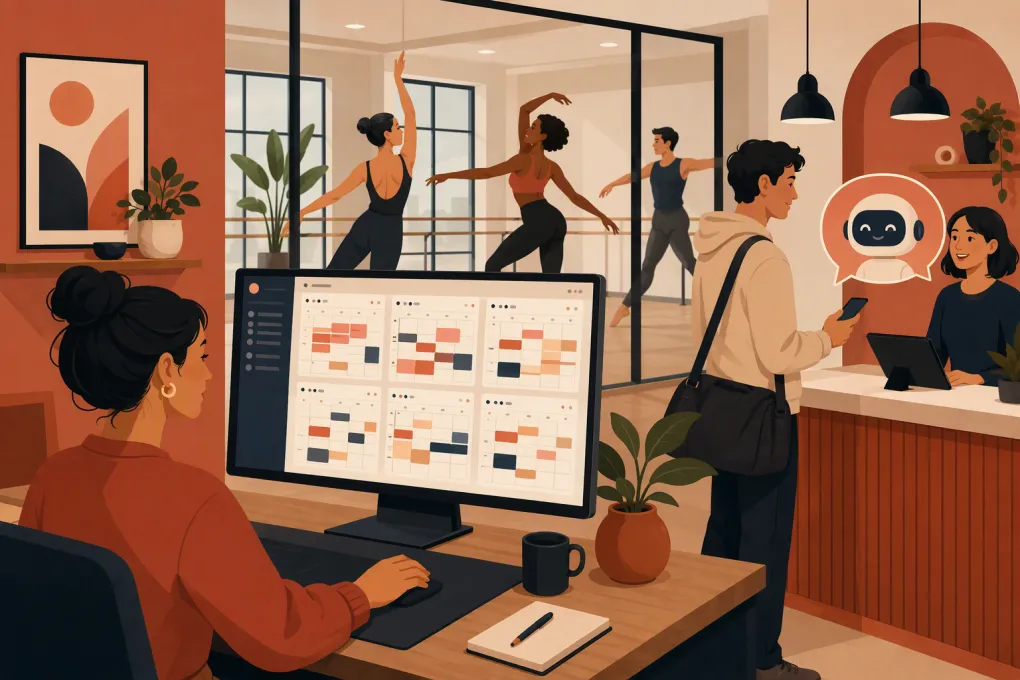 Watch · 20s
Renting unused studio hours can add a valuable revenue line. It can also create double bookings, unpaid balances, missing agreements, and a steady stream of after-hours questions if the operating system is not built for the job.
The right dance studio room rental management software must do more than display an open room. It should control availability, qualify renters, enforce approval rules, collect required payments, store documents, and communicate what happens next.
Different software categories handle those tasks differently. Dedicated space-booking platforms usually offer stronger room controls. Dance-school systems prioritize enrollment, tuition, and family accounts. Broader operating platforms connect rental inquiries with customer communication, booking, and payment follow-up.
WTF Go belongs in that third category. According to its product information, Fitty is designed to answer leads, book, follow up, and collect dues 24/7. Operators should still request a demonstration using their actual room rules, payment requirements, and approval process rather than assume every rental workflow is available out of the box.
Ask WTF Go to demonstrate your complete room-rental workflow →
What the software must handle
Room rental is not simply another class type. It introduces external customers, variable pricing, legal documents, deposits, and building-access concerns.
Room and resource conflicts
Every rentable room needs a separate schedule containing internal classes, rehearsals, maintenance holds, rental bookings, and turnover buffers. The system should prevent a renter from taking Studio A when a class or cleanup period already occupies it.
Resource conflicts matter too. Two rooms may be open while only one portable sound system, staff host, or equipment package is available. Ask whether the software books these items as resources or merely records them in notes.
Inquiries, approvals, and recurring bookings
A renter should be able to submit the activity, attendance, dates, equipment needs, and responsible contact. Staff may then need to approve the request before it becomes a reservation.
Recurring bookings require special attention. Test whether staff can:
- Change one occurrence without altering the series
- Skip a holiday or recital weekend
- Move one session to another room
- Apply a different rate to one date
- Cancel the remaining series without erasing completed bookings
A generic recurring calendar event does not necessarily support these rental exceptions cleanly.
Deposits, balances, and documents
Studios may require a booking deposit, damage deposit, final balance, rental agreement, or proof of insurance. These are separate requirements.
Confirm whether the platform can distinguish a refundable security deposit from a partial payment. Also ask whether e-signatures are native, handled through an integration, or replaced by a checkbox accepting terms. Those approaches do not provide identical records or workflows.
Have a qualified local attorney review rental agreements, waivers, and insurance requirements. Software can distribute and store documents; it cannot determine whether the terms are adequate for your jurisdiction.
Feature-by-feature software comparison
The table below is an editorial comparison based on publicly described vendor capabilities reviewed in September 2026. It is not based on hands-on testing, and it should not replace a live workflow demonstration. “Verify” means the capability may depend on configuration, plan, integration, or a workflow not clearly documented as a dedicated rental feature.
| Platform | Room and resource conflicts | Approval workflow | Deposits and balances | E-signatures | Recurring exceptions | Calendar syncing | Rental lead automation |
|---|---|---|---|---|---|---|---|
| WTF Go + Fitty | Verify room- and resource-level configuration | Verify against your approval stages | Dues collection is promoted; verify security deposits, refunds, and split balances | Verify native or integrated document signing | Verify series-level and occurrence-level editing | Verify supported calendars and sync direction | Core positioning includes answering leads, booking, follow-up, and dues collection; test escalation and guardrails |
| Skedda | A core focus of its space-booking model, including spaces and booking rules | Documented booking controls; verify whether your desired request-to-approval sequence is plan-dependent | Verify payment, deposit, refund, and processor requirements | Not a core space-scheduling function; expect to verify an integration or separate process | Recurring bookings are relevant to the platform; test single-occurrence changes | Calendar and integration options are documented; verify real-time direction and selected plan | Booking communication is available, but broad lead nurturing is not its main purpose |
| Spacebring | Designed around rooms and flexible-space resources | Relevant to its member and space workflows; verify external-renter approval details | Billing is part of the broader platform; verify damage deposits and rental-specific balance rules | Verify native signing or integration | Test exceptions for long recurring rental series | Verify supported calendar connections and limitations | Member communication is supported; general sales-lead automation requires evaluation |
| DanceStudio-Pro | Class and studio scheduling are central; verify external rental resource conflicts | Verify a dedicated outside-renter approval workflow | Billing is strong for dance customers; verify refundable deposits and one-off rental balances | Document and waiver capabilities should be tested for rental agreements | Test rental series separately from class-session scheduling | Verify external calendar sync and source-of-truth behavior | Communication focuses primarily on dancers, parents, and prospects |
| Jackrabbit Dance | Built for dance class scheduling and administration; verify rentable-resource rules | Verify whether outside renters can follow a dedicated approval pipeline | Strong dance-school billing context; verify security deposits and rental invoices | Verify whether rental contracts require a separate signing tool | Test exceptions outside normal class enrollment workflows | Verify calendar export, import, and two-way synchronization | Lead and customer communication are available, but room-rental qualification is not the primary use case |
| Mindbody | Supports service and facility scheduling concepts; test simultaneous room, staff, and equipment constraints | Verify approval requirements for rentals configured as services | Payment collection is established; verify security deposits and staged rental balances | Verify separate agreement and e-signature needs | Test recurring rentals rather than assuming recurring appointments behave identically | Integration availability is broad, but exact calendar behavior should be demonstrated | Marketing and client tools are available; custom venue-rental qualification may need adaptation |
Public reference pages include Skedda’s platform overview, Spacebring’s product site, DanceStudio-Pro’s features, Jackrabbit Dance’s features, Mindbody’s business site, and WTF Go’s product site. Vendor terminology, plans, and capabilities change, so obtain written confirmation for any requirement that determines whether you can operate safely or collect payment.
Strengths, limitations, and pricing context
WTF Go with Fitty
WTF Go is the most relevant option here when the main problem is not merely room inventory but the entire journey from inquiry to payment follow-up. Fitty’s stated role as an AI receptionist makes it worth evaluating for studios losing rental leads outside staffed hours.
The same scrutiny should apply as with every other option. Ask WTF Go to demonstrate conflict prevention, approval checkpoints, deposit handling, failed-payment escalation, document storage, calendar synchronization, and the point at which Fitty hands a conversation to a person. Pricing should be obtained directly, including implementation, messaging, payment processing, users, and locations.
Skedda
Skedda is a focused candidate when rooms and booking policies are the center of the operation. Its strength is structured space scheduling rather than dance enrollment, recital administration, or tuition management.
Skedda publishes plan information on its pricing page. Check which rules, integrations, identity controls, and support options belong to the plan under consideration. A separate dance-school system may still be necessary.
Spacebring
Spacebring is better aligned with studios operating like shared creative facilities: multiple rooms, recurring members, and broader flexible-space services. Its limitation is that dance-specific family accounts, costumes, recitals, and class enrollment are not the center of the product.
Review its current pricing information and confirm charges tied to locations, users, apps, payment processing, or implementation.
DanceStudio-Pro and Jackrabbit Dance
Both deserve consideration when the core business is a dance school and room rental is secondary. Their operational center is the relationship among classes, students, families, attendance, and billing.
That strength can become a limitation if outside renters need venue-style quotes, security deposits, insurance documents, and conditional approvals. Review DanceStudio-Pro pricing and Jackrabbit pricing for current plan structure, then ask each vendor to demonstrate an external renter who is not a student or parent.
Mindbody
Mindbody is most relevant for businesses mixing dance with fitness classes, appointments, memberships, or wellness services. Its service marketplace and consumer-booking orientation may be useful, but a room rental with legal documents and staged approval is not the same as booking a class or appointment.
Mindbody directs businesses through its current pricing and sales process. Request a complete quote covering required features, locations, implementation, messaging, and payment processing.
A sharper shortlist by studio type
Use this decision framework before booking demos. Room count and rental volume are operational indicators, not automatic purchasing rules.
| Studio profile | First option to evaluate | Also compare | Why |
|---|---|---|---|
| One or two rooms; occasional rentals; established dance school | DanceStudio-Pro or Jackrabbit Dance | WTF Go | Keeping student administration central may outweigh specialized rental controls |
| Several rooms; frequent outside renters; complex availability rules | Skedda | Spacebring and WTF Go | Room inventory, permissions, buffers, and recurring reservations become the primary problem |
| Shared arts facility with members, tenants, and multiple bookable resources | Spacebring | Skedda | Flexible-space operations matter more than dance-school administration |
| Dance, fitness, and wellness services sold together | Mindbody | WTF Go | Service booking and customer management span several business categories |
| High inquiry volume or meaningful after-hours demand | WTF Go + Fitty | Skedda paired with separate CRM automation | Lead response, qualification, follow-up, and collection need to connect with scheduling |
| Multi-location dance school with substantial tuition administration | DanceStudio-Pro or Jackrabbit Dance | WTF Go for lead and communication workflows | Dance-specific administration remains central; rental workflows should be tested separately |
A useful scoring method is to give each platform zero, one, or two points for every non-negotiable requirement:
- 0: Not supported or requires an unacceptable manual workaround
- 1: Available through configuration, integration, or a higher plan
- 2: Demonstrated natively using your exact scenario
Double the score for the three capabilities that create the most risk for your studio—often conflict prevention, payment status, and agreements. Do not award points based solely on a sales-page label.
Run one demanding demo scenario
Give every vendor the same test:
An outside choreographer requests Studio B every Tuesday for eight weeks. An internal class ends 15 minutes before the requested start. One date conflicts with a recital rehearsal. The renter needs a sound system, must sign an agreement, provide insurance, pay a booking deposit, and clear the balance before the first session.
Ask the vendor to show, not describe:
- How the inquiry enters the system
- Whether the room is held while approval is pending
- How the turnover buffer blocks the earlier start
- How one conflicting occurrence is moved
- How the sound system is prevented from being double-booked
- Where the agreement and insurance record live
- How the deposit differs from the remaining balance
- What happens after a failed payment
- Which messages are automatic
- How a staff member takes over an AI or automated conversation
If the workflow requires copying details among a calendar, spreadsheet, inbox, payment processor, and document app, include that labor and failure risk in the decision.
Have WTF Go demonstrate this exact recurring-rental scenario with Fitty →
Make one system the source of truth
Whichever platform you choose, do not maintain competing schedules. Assign one system as the authority for room availability. Document who can create holds, approve renters, override conflicts, issue refunds, and edit recurring series.
Then standardize the rental statuses: new inquiry, qualification needed, pending approval, deposit due, confirmed, balance due, completed, canceled, and follow-up required.
The best dance studio room rental management software is the one that passes your real operational test. Dedicated room software wins when space rules dominate. Dance-school software wins when enrollment and tuition dominate. An operating platform such as WTF Go becomes more compelling when fast lead response and consistent follow-up are as important as the calendar itself.
Frequently asked questions
What is the best software for renting dance studio rooms?
Skedda and Spacebring merit attention for space-heavy operations, while DanceStudio-Pro and Jackrabbit Dance fit dance schools where rentals are secondary. WTF Go is worth evaluating when inquiry response, booking follow-up, and collections need to connect with the broader operation.
Can room rental software manage deposits and signed agreements?
Some platforms support payments or documents, but security deposits, staged balances, refunds, and true e-signatures may require specific plans or integrations. Require a vendor to demonstrate each step before purchasing.
How should a studio test recurring room bookings?
Create a multi-week booking with one holiday, one room change, and one canceled occurrence. Verify that staff can edit individual dates without breaking the full series or losing payment records.
Is dance-school software enough for outside renters?
It may be enough for occasional rentals, especially if class scheduling and family billing remain the main priorities. Frequent external rentals often require stronger approval, agreement, deposit, and room-resource controls.
What costs should be included when comparing platforms?
Include the subscription, implementation, additional locations or users, messaging, payment processing, integrations, support, migration, and the staff time required for manual workarounds.
Keep reading


Run your gym on autopilot with WTF Go
Fitty — your AI receptionist — answers calls and DMs, fills classes, follows up with every lead, and collects dues while you coach.