Comparisons
Dance Studio Private Lesson Scheduling Software Compared
Compare dance studio private lesson scheduling software for rooms, packages, recurring bookings, instructor pay, integrations, migration, and total cost.
 Watch · 20s
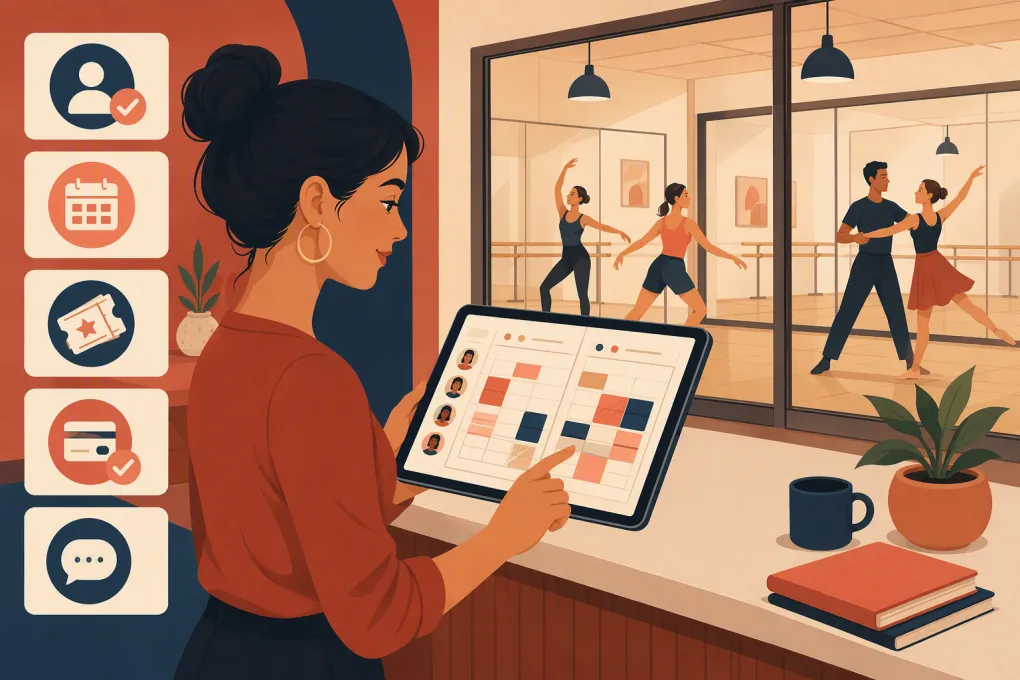
Private lessons create more scheduling complexity than their one-to-one format suggests. One booking can involve an instructor, student, parent, room, package balance, cancellation rule, and compensation rate. If any part lives in a separate calendar or spreadsheet, the front desk becomes the integration.
Dance studio private lesson scheduling software should do more than display open times. It should prevent resource conflicts, enforce payment rules, preserve package balances, and make schedule changes without creating cleanup work.
Before comparing vendors, map the entire path from inquiry to completed lesson. If your current gaps begin before the calendar—missed calls, slow lead response, incomplete follow-up, or unpaid balances—see how WTF Go and Fitty connect lead handling with studio operations →.
What private lesson software must manage
A general appointment calendar may work for a solo teacher. A studio with multiple instructors needs tighter controls.
People, rooms, and availability
The system should check the availability of the student, instructor, and required room before confirming a lesson. If instructors work across locations, travel time and overlapping availability also matter.
Ask vendors to demonstrate whether a room is a true bookable resource or merely text attached to an appointment. A true resource should be unavailable as soon as another lesson or class reserves it.
Packages and payment accounting
The platform should connect each appointment to the correct package, credit, or payment. Test what happens when:
- A package is expired or has no remaining credits
- A parent purchases lessons for more than one child
- A credit is restored after an approved cancellation
- A late cancellation should consume the credit
- A student changes to a lesson with a different price or duration
- A refund is issued after an instructor has already been credited
A scheduler that accepts the appointment but requires staff to reconcile credits manually is not a complete studio system.
Recurring-series changes
Private students often reserve the same time each week. Staff must be able to change one occurrence, all future occurrences, or the entire series without damaging unrelated bookings.
This is a critical demo test. Moving one Tuesday lesson should not silently move every Tuesday lesson, duplicate the room, or reverse the wrong package credit.
Instructor compensation
Scheduling and payroll are related but not identical. Some platforms calculate compensation or produce payroll reports; others only export completed appointments.
Clarify whether the system can distinguish among:
- Flat pay per lesson
- Hourly compensation
- Percentage-based compensation
- Different rates by service or instructor level
- Paid versus complimentary appointments
- Completed lessons versus late cancellations
Even if payroll remains in another system, the scheduling platform should provide a reliable, auditable export.
Software comparison at a glance
The table below distinguishes native strengths from areas that require configuration or validation. Product packaging changes, so exact plan access should be confirmed in writing before purchase.
| Platform | Private lessons and room resources | Packages, recurring bookings, and cancellations | Instructor pay and calendar connections | Migration approach | Pricing model and cost checks | Best fit and primary limitation |
|---|---|---|---|---|---|---|
| WTF Go with Fitty | Combines scheduling with CRM, communication, payment, and operational workflows. Require a live demonstration of room conflict prevention and private-appointment rules for your configuration. | Designed to connect booking and payment activity; verify package expiration, series editing, and cancellation-credit behavior against your policies. | Confirm compensation reporting, payroll export, and any external calendar connections required by instructors. | Scope customer, package, payment, and future-booking migration in the implementation plan; require a test import before cutover. | Obtain a written proposal covering software, Fitty, implementation, messaging, payment processing, and each location. | Best for studios prioritizing unified lead response, follow-up, scheduling, and collections. Dance-specific recital or costume workflows should be validated separately. |
| DanceStudio-Pro | Dance-focused administration with class and private-lesson workflows. Ask whether rooms are independently conflict-checked or handled through calendar setup. | Stronger dance context than a generic scheduler; test package balances, recurring exceptions, and automatic enforcement of late-cancellation rules. | Dance administration includes staff-management functions, but studios should verify their exact pay formula and calendar-sync requirements. | Ask which student, family, balance, enrollment, and future-booking fields can be imported and which require manual setup. | Uses published plan tiers tied to studio usage or size. Check payment processing, communication, mobile, setup, and optional-feature costs. | Best for dance schools that need family accounts and broader dance-program administration. Confirm that appointment-heavy workflows are as efficient as class enrollment. |
| Jackrabbit Dance | Primarily built around dance-school enrollment and administration. Have the vendor demonstrate private lessons without forcing them into an awkward one-student class structure. | Supports recurring dance-program operations and billing. Test individual series edits, private-lesson credits, and cancellation penalties specifically. | Provides staff and reporting tools; verify compensation calculations for private lessons and whether instructors need external calendar sync. | Request a field-level migration plan for families, students, balances, classes, and private appointments, plus a reconciliation process. | Pricing is generally structured around active student count. Confirm minimums, payment fees, communication costs, onboarding, and feature access. | Best for established enrollment-driven dance schools. A studio centered on flexible appointments should scrutinize the private-booking experience. |
| WellnessLiving | Supports both classes and appointments, making it relevant to hybrid dance and wellness businesses. Ask the vendor to configure and conflict-test rooms or other assets during the demo. | Supports memberships, passes, and service purchases. Test recurring edits, package-sharing rules, refunds, and whether cancellation fees or lost credits are enforced automatically. | Offers staff-management and reporting capabilities; verify each compensation formula, payroll output, and calendar connection on the proposed plan. | Migration assistance depends on scope and package. Require written responsibility for client records, balances, passes, waivers, and future appointments. | Sold through tiered business plans and sales proposals. Price payment processing, messaging, branded apps, onboarding, integrations, and locations separately. | Best for studios combining appointments, classes, memberships, and marketing. Dance-specific recital and costume administration may remain outside the platform. |
| Mindbody | Mature class and appointment scheduling with staff and resource-management capabilities. Confirm how rooms are assigned and whether every booking channel respects resource conflicts. | Supports service pricing, packages, memberships, and cancellation settings. Test series exceptions, family purchasing, expired credits, and staff overrides. | Provides staff compensation and operational reporting options; exact capabilities vary by configuration. Verify calendar sync and payroll export requirements. | Data conversion and onboarding scope varies. Ask for a written list of imported objects, exclusions, historical-data handling, and validation steps. | Generally sold through plan-based sales quotes, with some capabilities or services potentially packaged separately. Calculate add-ons, payment fees, messaging, setup, and multi-location needs. | Best for operators wanting a broad fitness and wellness ecosystem or marketplace presence. Smaller studios should assess complexity and total cost carefully. |
| Acuity Scheduling | Strong general appointment scheduling with multiple calendars. Rooms can often be represented through dedicated calendars, but this is less specialized than a studio resource engine. | Handles recurring appointments and can sell appointment packages or subscriptions depending on plan and payment setup. It is not a complete dance-studio ledger, so test family credits and cancellation accounting carefully. | Connects with common external calendar services. It does not replace studio payroll or detailed instructor-compensation reporting. | Usually a self-managed setup. Expect to configure appointment types, calendars, intake forms, clients, and package rules rather than migrate a complete dance database. | Public fixed-price subscription tiers make initial comparison easier. Add payment processing and any separate business tools needed for classes, payroll, CRM, or messaging. | Best for solo instructors and simple private-lesson businesses. Limited for class enrollment, family accounts, studio-wide reporting, and complex compensation. |
How to compare total cost without relying on a headline price
A monthly subscription alone does not show the operating cost. Ask every vendor for a written cost worksheet covering the same items:
- Base subscription and included users
- Additional locations or calendars
- Online payment processing
- Email, SMS, voice, or AI usage
- Branded app or website booking components
- Setup, training, and data migration
- Required add-ons or integration fees
- Contract term and cancellation conditions
- Support level and response channels
- Cost of keeping separate payroll, CRM, or recital tools
Public tier pricing is useful, but it can still exclude operational necessities. Quote-based pricing is not automatically worse, provided the proposal defines usage limits, implementation work, and renewal terms.
Run these tests during every demo
Do not accept a slideshow. Give each vendor the same sample data and ask the representative to complete these actions live:
Resource and scheduling test
Create a private lesson requiring Instructor A and Studio Room 2. Then try to reserve Room 2 for another lesson at the same time. Repeat the test through both the staff calendar and customer booking page.
Package-accounting test
Sell a five-lesson package, book two lessons, cancel one inside the penalty window, and move the other to a higher-priced service. Review the customer’s balance and transaction history after every action.
Recurring-series test
Create ten weekly lessons. Move only the third occurrence, cancel the sixth, and change the instructor for all remaining dates. Confirm that room reservations, notifications, and package credits remain correct.
Compensation test
Complete one lesson, mark one as a late cancellation, and comp a third. Generate the instructor compensation report and confirm whether each appointment is paid according to studio policy.
Calendar test
Connect an instructor’s external calendar, add a personal conflict, and confirm whether that time becomes unavailable for customer booking. Then change a studio appointment and inspect what updates externally.
Migration test
Import sample families with multiple children, active packages, account balances, waivers, and future appointments. Compare source and destination totals rather than checking only whether names appeared.
Cancellation-enforcement test
Cancel from the customer portal, staff account, and automated workflow. Confirm when a fee is charged, a credit is consumed, or a manager override is required.
Where Fitty fits—and what to verify
Fitty is WTF Go’s AI receptionist and agent. WTF Go presents it as a 24/7 tool for answering leads, booking classes, following up, and collecting dues. Those capabilities depend on the channels, scheduling rules, payment workflow, and account configuration connected to your implementation.
For private lessons, ask WTF Go to demonstrate the exact path you need: what Fitty can answer directly, whether it can complete the relevant booking or sends a booking handoff, how it identifies an appropriate instructor, and what happens when no valid slot exists. For collections, confirm the connected payment processor, authorization rules, escalation path, and which balances Fitty can address.
That qualification matters. An AI agent should not promise instructor suitability, override age restrictions, or waive cancellation fees unless the studio has explicitly configured those rules.
Request a Fitty walkthrough using your real private-lesson and dues workflow →
Best option by studio type
There is no universal winner. There is a clearer shortlist for each operating model:
- Solo instructor with straightforward appointments: Acuity Scheduling is the simplest place to start if classes, payroll, family accounting, and complex room management are not required.
- Traditional dance school centered on enrollment and family administration: DanceStudio-Pro or Jackrabbit Dance deserves the first demo. Compare their private-lesson handling against your actual appointment volume.
- Hybrid studio offering classes, appointments, and wellness services: WellnessLiving or Mindbody provides broader service models. Compare configuration complexity, marketplace value, and total proposal cost.
- Studio losing leads between inquiry, follow-up, booking, and payment: WTF Go with Fitty should be evaluated when the priority is connecting those workflows rather than adding another standalone calendar.
- Multi-location operator: Shortlist platforms only after they demonstrate centralized reporting, location-level permissions, cross-location staff availability, resource conflicts, migration, and consolidated package rules.
The best dance studio private lesson scheduling software is the system that survives your hardest booking exception—not the one with the cleanest default calendar. Test room conflicts, package accounting, recurring edits, compensation, integrations, migration, and cancellation enforcement before signing.
Frequently asked questions
Can private lessons and group classes run in the same scheduling system?
Yes. The platform should handle private lessons as appointments with instructor and room constraints while managing group classes through capacity, enrollment, and roster rules.
What should private lesson scheduling software cost?
Pricing models include fixed subscription tiers, active-student pricing, and sales quotes. Compare total cost after payment processing, messaging, locations, migration, apps, integrations, and required add-ons.
Can scheduling software calculate dance instructor pay?
Some studio platforms offer compensation calculations or payroll reports, while general appointment tools may only export completed bookings. Test flat, hourly, percentage, complimentary, and late-cancellation scenarios.
How should dance studios handle rooms in scheduling software?
Treat each room as a bookable resource that can be conflict-checked across private lessons and classes. Test customer booking and staff booking separately to ensure neither can double-book the space.
Can Fitty book private dance lessons and collect overdue dues?
Fitty is presented by WTF Go as an AI agent for lead response, class booking, follow-up, and dues collection. Private-lesson and collection workflows depend on the configured scheduling, communication, and payment setup, so request a demonstration using your exact rules.
Keep reading

Run your gym on autopilot with WTF Go
Fitty — your AI receptionist — answers calls and DMs, fills classes, follows up with every lead, and collects dues while you coach.