Comparisons
Compression Therapy Studio Booking Software: Buyer Guide
Compare compression therapy studio booking software by scheduling, intake, memberships, payments, automation, and multi-location tools before you buy.
 Watch · 20s
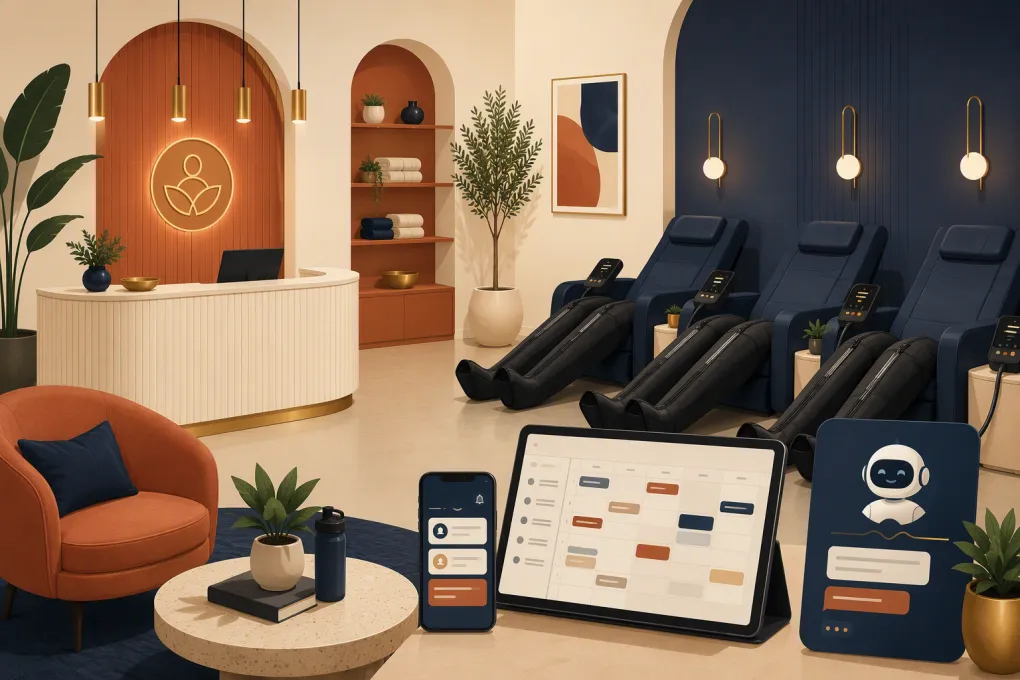
Compression therapy looks simple on a booking calendar: a client reserves a time, uses a station, and leaves. Operationally, each appointment can involve equipment capacity, room availability, intake forms, contraindication screening, membership credits, cleaning buffers, reminders, and follow-up.
Generic appointment software may handle the calendar but leave staff manually checking the rest. At the other extreme, a large wellness platform can add features and complexity that a focused recovery studio never uses.
The right compression therapy studio booking software should reduce front-desk work without creating unsafe shortcuts or a frustrating client experience. It should also support the way your studio actually makes money, whether that is single sessions, packs, recurring memberships, or compression therapy offered alongside cryotherapy, infrared sauna, massage, or fitness services.
See how Fitty handles compression therapy inquiries and booking follow-up 24/7 →
What compression therapy booking software needs to manage
A basic appointment scheduler is not automatically a good recovery studio operating system. Before comparing brands, document the workflows the software must support.
Service, equipment, and room availability
Your calendar needs to understand what makes an appointment possible. Depending on the studio, that may include:
- A specific compression system or station
- Multiple sets of boots connected to limited control units
- A private room, lounge chair, or recovery bay
- A staff member for setup or supervision
- Turnaround time for cleaning and resetting equipment
- Different appointment lengths for first visits and returning clients
Ask whether the software treats equipment as a bookable resource, not just an employee. Otherwise, the calendar may accept two appointments that require the same station.
If the platform cannot model resources directly, test whether separate calendars, capacity-based classes, or blocked schedules provide a reliable workaround. Workarounds are acceptable only if staff can understand and maintain them.
Intake, waivers, and screening
Clients should receive the correct intake form before their first session. The form may cover health history, studio policies, consent, and acknowledgment of potential contraindications.
Software can collect and route this information, but it should not make clinical decisions unless the product is specifically designed and approved for that purpose. Create a clear staff review process for answers that require professional judgment.
If your business is subject to healthcare privacy obligations, do not assume a standard waiver tool is sufficient. Ask the vendor about data handling, permissions, audit controls, and whether it will sign a business associate agreement when one is legally required.
Memberships, packages, and credits
Compression therapy studios often sell access rather than isolated appointments. The system should clearly distinguish among:
- One-time sessions
- Multi-session packages
- Monthly credits
- Unlimited or frequency-limited memberships
- Introductory offers
- Add-ons attached to another service
Test what happens when a credit expires, a payment fails, a client books beyond the plan limit, or a membership is paused. Staff should not need a spreadsheet to determine whether someone can book.
Automated communication
At minimum, clients need confirmations, reminders, rescheduling instructions, and post-visit follow-up. Studios also need fast responses when prospects ask questions after hours.
This is where an AI receptionist can be more useful than another set of scheduled templates. Fitty, WTF Go’s AI agent, can answer lead questions, help book eligible services or classes, follow up, and collect dues around the clock. The objective is not to remove staff from sensitive conversations. It is to keep routine inquiries and revenue tasks from sitting unanswered.
Compression therapy studio booking software compared
The strongest choice depends on whether compression therapy is your entire business, one service inside a broader wellness menu, or an add-on inside a gym. Product capabilities and plan packaging change, so confirm resource rules, forms, messaging usage, payment terms, and migration support in a live demo.
| Platform | Scheduling and core workflows | Automation and lead handling | Strengths | Potential limitations | Best fit |
|---|---|---|---|---|---|
| WTF Go | All-in-one operations for gyms, studios, spas, booking, client management, payments, and recurring revenue workflows | Fitty answers leads, supports booking conversations, follows up, and collects dues 24/7 | Combines day-to-day operations with an AI receptionist instead of treating AI as a separate inbox | Operators should confirm their exact equipment-resource configuration, forms, and required integrations during setup | Recovery businesses that want booking, revenue operations, and lead response in one system |
| Mindbody | Broad appointment, class, client, payment, and business-management capabilities | Marketing and communication tools are available; exact automation depends on the selected products and plan | Established wellness ecosystem and consumer discovery marketplace; supports businesses with varied service menus | Breadth can mean more configuration than a small compression-only studio needs; review total plan and add-on requirements | Established wellness businesses wanting broad functionality and marketplace exposure |
| Vagaro | Appointment and class scheduling, client management, payments, forms, memberships, and marketplace visibility | Includes communication and marketing capabilities, with features varying by plan | Strong fit for appointment-led beauty, fitness, and wellness businesses; familiar online booking experience | Confirm advanced equipment-resource logic and the exact cost of optional capabilities | Studios combining compression therapy with spa, beauty, or other appointment services |
| WellnessLiving | Scheduling, memberships, client management, payments, and business marketing tools | Automated client communications and lead-management features are available | Designed around fitness and wellness membership operations, including recurring client relationships | Specialized intake, equipment capacity, and migration requirements should be validated in a demo | Membership-based wellness or recovery studios with classes and appointments |
| Acuity Scheduling | Online appointments, intake forms, calendar management, reminders, and payment connections | Supports standard scheduling notifications and workflow connections | Straightforward option for appointment-led businesses that do not need a full gym or studio system | Less suited to complex membership access, dues recovery, multi-service capacity, and full front-desk operations | Small studios with simple appointment inventory and limited membership complexity |
No comparison table can replace testing your own schedule. A vendor may technically support resources or packages while requiring a workflow your team finds cumbersome.
Explore how WTF Go unifies recovery-studio booking, payments, and Fitty’s lead response →
How to evaluate the software in a live demo
Do not let the vendor control the entire demonstration. Give the salesperson realistic scenarios and watch each one from the client’s and operator’s perspective.
Test a first-time booking
Ask the vendor to show a new client who:
- Finds a compression session online.
- Selects an available time.
- Creates an account without unnecessary fields.
- Pays or applies an introductory offer.
- Receives the correct intake form and waiver.
- Gets confirmation and reminder messages.
- Reschedules without calling the front desk.
Count the manual steps staff must complete. Also test the experience on a phone, since many clients will book from one.
Test an active member
Have an existing member book with a monthly credit, reach a plan limit, and attempt to book at another location. Then pause the membership and create a failed payment.
You need to see how the software communicates restrictions and how quickly staff can fix legitimate exceptions. A feature labeled memberships is not enough; the rules must match your agreements.
Test capacity and buffers
Attempt to book the last available compression station twice. Add a cleaning buffer and see whether it blocks availability correctly. If different services share a room or staff member, create an overlapping request.
A clean-looking calendar is irrelevant if it permits operational conflicts.
Test after-hours lead response
Send common prospect questions outside staffed hours:
- What should I wear?
- How long is a session?
- Can I book two people together?
- Do you offer memberships?
- I missed a payment. Can I still schedule?
Evaluate whether the system can answer approved operational questions, capture contact information, move the person toward booking, and escalate questions requiring human or clinical judgment.
See how Fitty keeps after-hours recovery leads moving toward a booking →
Pricing questions that uncover the real cost
Published subscription prices rarely tell the entire operational story. Request a written breakdown covering:
- Base subscription and per-location charges
- Required onboarding or data migration services
- Payment processing requirements
- Additional staff accounts or permissions
- Text, email, phone, or AI usage charges
- Branded app or custom domain options
- Forms, waivers, marketing, and reporting add-ons
- Hardware requirements
- Contract length and cancellation terms
- Data export availability if you leave
Avoid evaluating software solely by its monthly fee. A low-cost scheduler that creates daily reconciliation work may be more expensive operationally than a broader system. Conversely, there is no reason to pay for enterprise features your staff will not use.
Plan the migration before signing
Switching systems affects future bookings, active memberships, stored payment methods, credits, waivers, client notes, and reporting history. Ask the new vendor exactly what it imports and what must remain in a read-only archive.
Build a migration checklist that includes:
- Cleaning duplicate and inactive client records
- Mapping services, durations, prices, and resources
- Verifying package balances and membership status
- Rebuilding intake forms and waiver versions
- Testing payment and recurring billing workflows
- Training staff with role-specific scenarios
- Running test bookings before public launch
- Communicating any required client account reset
Do not cancel the old platform until future appointments, financial records, and legally necessary documents have been accounted for.
Choose for the operation you are building
The best compression therapy studio booking software protects capacity, makes purchasing easy, enforces membership rules, and gives staff a clear next action. For a simple appointment book, a focused scheduler may be enough. For a multi-service or membership-based recovery operation, prioritize unified booking, payments, follow-up, and multi-location controls.
If missed calls, slow lead response, and unpaid dues are already consuming staff time, AI should be part of the buying decision—not an unrelated tool added later. That is the practical advantage of pairing WTF Go’s operating system with Fitty as the always-on front line.
Frequently asked questions
Can standard appointment software manage compression therapy bookings?
It can work for a simple studio, but confirm that it can prevent equipment conflicts, add cleaning buffers, collect intake forms, and apply membership credits correctly.
Should compression equipment be configured as a resource?
Usually, yes. Resource-based scheduling helps prevent multiple clients from booking the same control unit, station, room, or other limited asset.
Does compression therapy booking software need to be HIPAA compliant?
That depends on your business model, the information you collect, and whether healthcare privacy laws apply to your operation. Ask qualified counsel and verify the vendor's data practices and agreement options.
What should I test before choosing a booking platform?
Test first-time intake, mobile booking, resource capacity, membership credits, failed payments, rescheduling, reminders, after-hours inquiries, reporting, and data export.
Can an AI receptionist answer compression therapy leads?
Yes, an AI agent such as Fitty can handle approved operational questions, capture leads, support booking, follow up, and collect dues while escalating clinical or sensitive questions to staff.
Keep reading

Run your gym on autopilot with WTF Go
Fitty — your AI receptionist — answers calls and DMs, fills classes, follows up with every lead, and collects dues while you coach.