Comparisons
Clinical Pilates Practice Management Software Guide 2026
Compare clinical Pilates practice management software by charting, reformer scheduling, payments, AI, pricing structure, geography, and setup needs.
 Watch · 20s
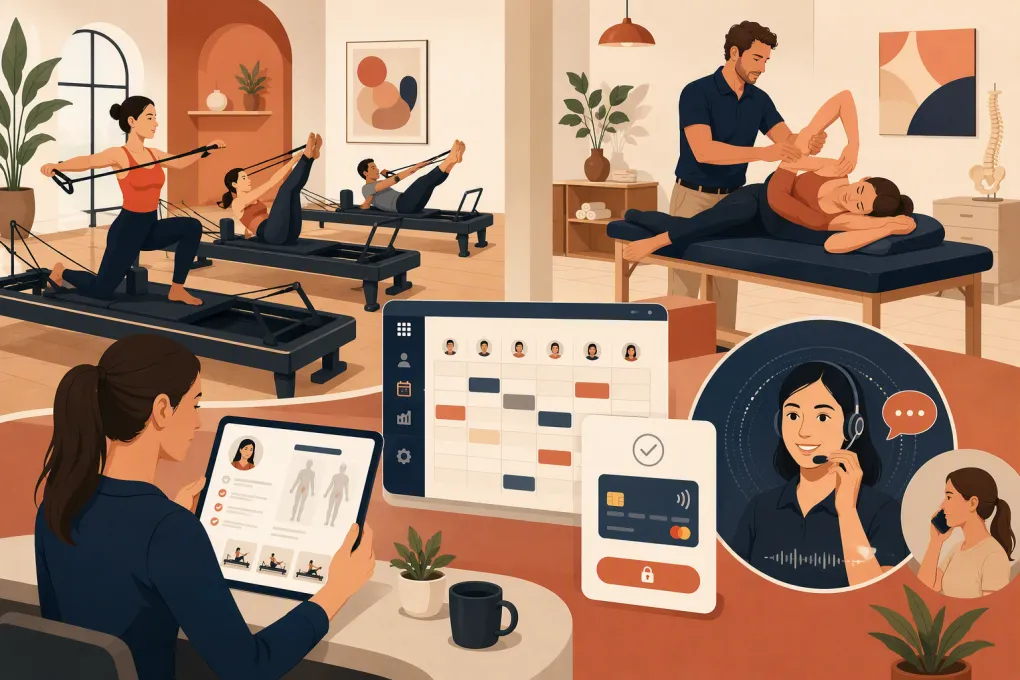
Clinical Pilates practices sit between healthcare and boutique fitness. A client may enter through an assessment, complete a practitioner-led block of private sessions, progress into a small reformer group, and eventually buy a recurring membership. Software that handles only appointments—or only classes—creates administrative gaps along that path.
The difficult part is not finding a calendar. It is finding a system that supports your mix of clinical records, practitioner permissions, reformer capacity, packages, recurring billing, lead follow-up, and multi-location scheduling.
This comparison separates clinical-first systems from studio-first platforms and front-desk automation tools. That distinction matters: an effective sales and scheduling platform is not automatically an electronic health record, and clinical charting software is not automatically good at converting inquiries into memberships.
See how WTF Go and Fitty handle Pilates inquiries, bookings, follow-up, and dues →
How this comparison was evaluated
The products below were selected because they represent the main categories a US clinical Pilates operator is likely to consider:
- Clinical-first systems: Cliniko and Jane
- Health-practitioner software: Practice Better
- Fitness and wellness platforms: Mindbody, Glofox, and Vagaro
- Operations and AI-led front desk: WTF Go with Fitty
Evaluation criteria were based on a clinical Pilates client journey: inquiry, initial assessment, consent and intake, practitioner notes, private treatment, progression into group sessions, package or membership billing, and ongoing follow-up.
This is an editorial comparison based on vendors’ published product positioning and documentation—not a claim of hands-on testing, practitioner endorsement, or independent security certification. No screenshots, customer results, response-rate statistics, or fabricated case studies are presented. Product packaging changes, so verify current features and prices on the linked vendor pages before purchasing. Editorial review date: August 23, 2026.
Clinical Pilates software comparison
| Platform | Scheduling and commercial workflows | Clinical-record capability | Automation and integrations | Pricing and availability | Implementation and best fit |
|---|---|---|---|---|---|
| WTF Go + Fitty | Built around gym, studio, spa, and wellness operations. Fitty answers inquiries, books, follows up, and supports dues collection. | WTF Go is not presented here as a dedicated EHR, medical billing system, or replacement for specialized clinical charting. Practices that create protected clinical records must verify note formats, access controls, exports, retention, and BAA availability directly. | Fitty is designed to remain available 24/7 for configured operational conversations. That describes system availability—not a guarantee of booking outcomes or clinical-answer accuracy. Request the current integration list during a demo. | Contact WTF Go for current pricing, supported markets, messaging costs, and onboarding scope; a public standardized range is not relied upon here. | Best considered when unanswered leads, booking work, inconsistent follow-up, and overdue balances are the primary operational problems. A separate clinical record may still be required. |
| Cliniko | Supports practitioner calendars, online booking, group appointments, reminders, payments, and multiple locations. | Clinical-first functionality includes treatment notes, patient records, forms, letters, files, and practitioner access controls. | Offers integrations and an API; it is more focused on practice administration than gym-style lead nurturing and membership sales. | Publishes practitioner-count-based monthly tiers on its official pricing page, ranging from solo-practitioner plans through large-team tiers. It serves practices internationally; payment and messaging options vary by country. | Relatively direct setup for a clinic moving from calendars or spreadsheets. Strong fit for practitioner-led clinical Pilates where records matter more than complex studio memberships. |
| Jane | Combines online booking, scheduling, payments, reminders, classes, and patient administration. | Charting, intake forms, templates, files, and clinical workflows are central parts of the platform. Insurance-related capabilities vary by country and plan. | Provides patient communications and a range of integrations, but it is not primarily a gym sales CRM or autonomous lead-response system. | Uses published subscription plans with features varying by tier and market. Jane has a strong North American presence; confirm country-specific payments, insurance, and tax support. | Good fit for allied-health practices combining Pilates with physiotherapy, chiropractic, massage, or similar services. Configuration is required for charts, forms, services, and permissions. |
| Mindbody | Mature class and appointment scheduling, memberships, packages, payments, waitlists, consumer discovery, and branded-client options. | Maintains client profiles and forms, but specialized clinical charting is not its core identity. Do not assume a client profile replaces a compliant practitioner record. | Provides marketing, communications, reporting, and an established integration ecosystem; specific features depend on package and add-ons. | Pricing is generally quote-led, with package and add-on differences rather than one universal public range. Operates across multiple international markets. | Best for class-heavy or multi-location Pilates businesses prioritizing consumer booking, memberships, and marketplace reach. Setup and data migration can be more involved than a simple scheduler. |
| Glofox | Focuses on boutique fitness scheduling, memberships, payments, member apps, and multi-location operations. | It is fitness-management software rather than a dedicated clinical charting platform. Clinical notes and regulated record workflows may need another system. | Supports member communications, sales workflows, and integrations, with availability depending on the commercial package. | Uses custom sales quotes rather than a dependable public price range. Serves fitness businesses in multiple markets; confirm local payment and messaging support. | Stronger fit for reformer-class and membership-led operators than clinician-led practices. Expect implementation work around migration, products, schedules, and branded experiences. |
| Vagaro | Supports appointments, classes, memberships, packages, forms, payments, and wellness-business administration. | Offers client records and form-related tools, but practices should compare its documentation depth with clinical-first systems before treating it as the clinical source of truth. | Includes marketing and communication options, with features and costs affected by the selected package and add-ons. | Publishes location- and calendar-oriented pricing with optional paid features. Availability and payment services differ by supported country. | Practical for appointment-heavy Pilates, spa, and wellness businesses wanting broad front-desk functionality. Map add-on costs before comparing its total price with bundled platforms. |
| Practice Better | Supports appointments, programs, packages, forms, payments, tasks, and client communication for wellness practitioners. | Designed for practitioner-client workflows, including notes, protocols, forms, and secure client information. Verify whether its records match your profession’s exact obligations. | Includes workflow automation and integrations, but equipment-based capacity and high-volume studio sales are not its main emphasis. | Publishes tiered plans that generally vary by feature access, practitioner needs, and client capacity. Check current plan limits and regional payment support. | Better suited to solo or smaller practitioner-led businesses than reformer studios requiring sophisticated room, equipment, waitlist, and membership operations. |
Official product and pricing references: WTF Go, Cliniko pricing, Jane pricing, Mindbody business pricing, Glofox, Vagaro pricing, and Practice Better pricing.
Exact dollar ranges are not reproduced where a vendor uses custom quotes or where pricing can vary by country, billing period, payment product, message volume, add-on, or client limit. A defensible comparison should use written quotes generated for the same locations, users, records, and communication volume—not stale headline prices.
Decide whether the clinical record or the studio system is primary
A clinical Pilates business usually needs one authoritative record for each major type of information:
- Clinical source of truth: assessment, consent, contraindications, treatment notes, practitioner decisions, and progress reviews
- Commercial source of truth: leads, bookings, packages, memberships, attendance, invoices, payments, and failed collections
- Communication source of truth: calls, texts, emails, follow-up status, and opt-in records
One platform may cover all three, but do not force that outcome. A clinical-first system paired with an operations platform can be safer than storing sensitive notes in generic membership fields or running the front desk from an EHR that was never designed for lead conversion.
If WTF Go is being considered, ask for a live demonstration of the exact boundary between Fitty, the member record, and any external clinical system. Fitty should be configured to answer administrative questions and escalate clinical ones—not interpret symptoms or determine whether exercise is medically appropriate.
Book a WTF Go walkthrough focused on your clinical-to-group Pilates workflow →
Clinical Pilates workflows to test in every demo
Generic software demos tend to show a clean booking and a successful payment. Your test should include the awkward transitions that create real front-desk work.
Assessment to reformer progression
Create a new client who must complete an initial assessment before joining a semi-private reformer session. Test whether the software can:
- Prevent direct booking into the restricted group
- Assign the assessment to an appropriately qualified practitioner
- Collect intake and consent forms before arrival
- Record practitioner clearance without exposing clinical notes to every instructor
- Unlock the correct class or package after clearance
- Schedule a reassessment after a defined stage of the program
A generic “tag” may be enough for booking eligibility, but it should not reveal a diagnosis or treatment detail to staff who do not need it.
Equipment, room, and practitioner capacity
Clinical Pilates capacity is not simply the number of open calendar spaces. A session may require one practitioner, four reformers, a private treatment area, and a specific qualification.
Ask the vendor to demonstrate simultaneous constraints. If it cannot, document the manual control your team will need to prevent an instructor, room, or reformer from being booked twice.
Clinical communication escalation
Test an after-hours inquiry that says, “I had spinal surgery recently—can I book a reformer class?” A safe workflow should acknowledge the inquiry, avoid clinical advice, capture contact information, and route the person to a qualified practitioner or assessment.
Fitty can address the availability problem by handling configured administrative conversations around the clock. Your team still needs to define approved answers, prohibited topics, escalation language, staff ownership, and response deadlines. The 24/7 capability should be tested with transcripts and edge cases before launch; it should not be treated as evidence that every answer will be clinically appropriate without configuration and oversight.
Mixed billing models
Run separate tests for:
- A paid initial assessment
- A private-session package with an expiration date
- A recurring reformer membership
- A late cancellation due to a clinical issue
- A failed recurring payment before a booked session
- A refund or credit after a practitioner changes the plan
- Insurance documentation or superbills, if applicable
Fitness payment processing and insurance claims are different workflows. If you bill insurers, require the vendor to show the claim process rather than accepting “billing supported” as an answer.
Build a comparable total-cost quote
Send every shortlisted vendor the same operating profile:
- Number of locations and treatment rooms
- Number of practitioners, instructors, and administrators
- Active clients and monthly leads
- Appointment and class volume
- Text, call, and email volume
- Required forms, note templates, and historical records
- Branded app or website booking requirements
- Payment-processing needs
- Data migration and staff-training requirements
- Required integrations and API access
Request a written breakdown of subscription fees, onboarding, migration, messaging, phone usage, payment processing, premium support, branded apps, extra locations, extra users, and contract terms. This produces a meaningful range for your practice without inventing a universal price that does not exist.
A clinical-Pilates-specific implementation plan
Start by separating data that instructors need from data restricted to clinicians. Create roles for reception, general instructors, clinical practitioners, managers, and finance staff. Test each role using a real client record.
Next, define progression statuses such as assessment required, clinical private, approved for semi-private, approved for general class, reassessment due, and practitioner hold. Keep these operational statuses free of unnecessary diagnostic detail.
Finally, build Fitty or another automation layer around an approved knowledge base covering prices, parking, clothing, cancellation rules, assessment length, booking eligibility, and escalation routes. Review conversation logs regularly and update answers when services or policies change.
The right clinical Pilates practice management software is the one that respects the clinical boundary while removing commercial friction. Clinical-first practices should prioritize charting and access controls. Class-led studios should prioritize capacity, memberships, and booking. Operators losing leads after hours should add a properly governed response and follow-up layer rather than expecting practitioners to monitor the phone all day.
Frequently asked questions
Is Pilates studio software the same as clinical practice software?
No. Studio software usually emphasizes classes, memberships, payments, and marketing, while clinical systems emphasize notes, forms, practitioner permissions, and patient records. A hybrid practice may need an integrated pair.
Does clinical Pilates software need to support HIPAA?
It depends on your legal status and how protected health information is handled. If HIPAA applies, verify safeguards, access controls, auditability, data exports, subcontractors, and business associate agreement availability.
Can Fitty replace a clinical record system?
Fitty is positioned as an AI receptionist for inquiries, booking, follow-up, and dues—not as a substitute for specialized clinical charting or medical billing. Verify how WTF Go connects with your chosen clinical source of truth.
Which software is best for a physiotherapist-led Pilates practice?
Clinical-first products such as Cliniko or Jane are logical starting points when practitioner documentation drives the workflow. Compare them with a studio or automation platform if memberships, class conversion, or after-hours lead response are also important.
How should I compare software pricing?
Request written quotes using identical location, user, client, messaging, migration, payment, and integration requirements. Include add-ons and processing costs rather than comparing only advertised subscription prices.
Keep reading


Run your gym on autopilot with WTF Go
Fitty — your AI receptionist — answers calls and DMs, fills classes, follows up with every lead, and collects dues while you coach.