Comparisons
Best Breathwork Studio Management Software: 7 Leading Options
Compare breathwork studio management software for scheduling, payments, privacy, reporting, automation, and hybrid delivery using a practical buyer checklist.
 Watch · 20s
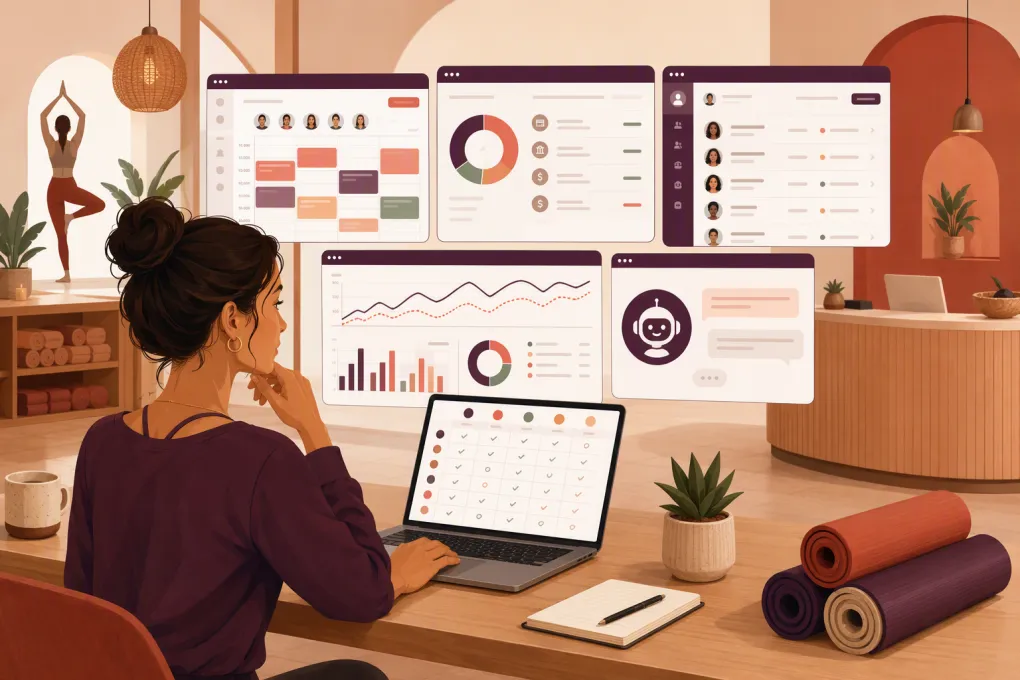
Breathwork studios rarely fit neatly into one software category. A single business may sell drop-in classes, private sessions, memberships, facilitator-led workshops, virtual programs, and practitioner training. Add intake forms, preparation instructions, payment recovery, and first-timer questions, and a simple booking calendar quickly becomes an operational bottleneck.
The best breathwork studio management software is therefore not necessarily the platform with the longest feature list. It is the one that supports your actual service mix, protects sensitive client data, and reduces the manual work between an inquiry and a completed session.
How this software shortlist was selected
This guide is an editorial comparison based on publicly available product information from each vendor’s official website. It is not presented as a hands-on lab test, practitioner interview study, or substitute for a live product trial.
Platforms were included when they met most of these criteria:
- Serve US-based fitness, wellness, class, or appointment businesses
- Support group classes, private appointments, or both
- Offer payments, packages, subscriptions, or memberships
- Provide client communication or workflow automation
- Publish enough product information for an operator to evaluate the category
- Represent a distinct use case, from solo practitioners to multi-location studios
Features, packaging, and pricing can change. Follow the linked product documentation, request current terms in writing, and make every finalist demonstrate your real workflows.
If your largest gap is unanswered inquiries rather than calendar functionality, see how WTF Go positions Fitty for lead response and booking coverage →. Treat it as one option to evaluate—not an automatic fit for every studio.
Breathwork studio software comparison
| Platform | Scheduling and payments | Automation and AI | Reporting and multi-location | Mobile and integrations | Pricing and implementation | Best fit and main limitation |
|---|---|---|---|---|---|---|
| WTF Go | Built as an operating system for gyms, studios, spas, and wellness businesses; confirm support for your exact class, appointment, cohort, and form workflows | WTF Go describes Fitty as a 24/7 AI agent that answers leads, books classes, follows up, and collects dues | Intended for studio operations; multi-location reporting depth should be demonstrated against your required rollups | Ask for a current integration list, mobile workflow demo, and API or export documentation | Request current pricing, onboarding scope, migration responsibilities, and message or payment-related fees | Best considered when missed calls, delayed lead response, and manual follow-up are central problems; less suitable if you only need a lightweight calendar |
| Mindbody | Broad class, appointment, membership, package, and payment functionality | Marketing and communication capabilities are available, with packaging dependent on the selected offering | Mature reporting and multi-location capabilities are a core reason larger operators consider it | Consumer marketplace and mobile experiences are notable strengths; integration availability should be checked by plan and region | Generally a sales-led purchase with a more involved setup than a simple scheduler | Strong for established studios wanting a broad ecosystem and consumer discovery; smaller operators may find the scope and administration heavier than necessary |
| WellnessLiving | Supports scheduling, memberships, payments, client management, and wellness-business workflows | Includes automated marketing and client communication tools | Designed for both single-site and multi-location businesses, with operational reporting features | Offers client-facing and staff-oriented mobile capabilities; verify every required integration during the demo | Plan-based suite requiring configuration and data migration planning | A broad alternative for studios wanting many functions under one vendor; buyers should test usability and identify which features or services are packaged separately |
| Vagaro | Handles appointments, classes, memberships, packages, and payments | Provides marketing and communication tools rather than positioning itself primarily as an AI receptionist | Business reporting and multi-location management are available for operators with mixed services | Strong consumer mobile presence and marketplace discovery; commonly evaluated by appointment-led wellness businesses | Modular packaging can make the final cost depend on selected capabilities and locations | Good for studios combining private practitioner sessions with group offerings; verify cohort programs, breathwork-specific intake, and complex membership rules |
| Momence | Focuses on classes, events, appointments, memberships, and payments for experience-based businesses | Offers communication, marketing, and operational automation features | Suitable for growing studios; operators should inspect cross-location permissions and consolidated reporting | Provides customer-facing digital experiences and integration options; request a current compatibility list | Typically requires a sales conversation and guided evaluation of package scope | Worth considering for studios with workshops, events, and community-driven programming; test back-office depth if financial or multi-site reporting is a priority |
| Arketa | Supports scheduling, payments, memberships, on-demand content, and wellness-business delivery | Includes marketing and client-engagement capabilities | Relevant to digital-first and growing wellness brands; confirm the reporting granularity needed by finance and regional managers | Particularly relevant for branded digital experiences, virtual delivery, and on-demand content | Packaging depends on business needs; implementation is broader when migrating video libraries and memberships | Strong candidate for hybrid or online-heavy breathwork brands; may be more platform than an in-person, appointment-only practitioner needs |
| OfferingTree | Combines scheduling, payments, memberships, forms, website tools, and digital offerings | Includes practical marketing and client communication functions | Better aligned with independent practitioners and smaller businesses than complex enterprise reporting | Web-centered client experience with an emphasis on reducing the number of separate tools | Public plan information makes early comparison easier; setup is generally more self-directed than enterprise suites | Useful for solo facilitators and small studios seeking simplicity; multi-location controls and advanced reporting should be examined carefully |
Acuity Scheduling is another credible alternative for appointment-led operators. Its scheduling-first model can work well for private sessions and simpler calendars, but many studios will need additional systems for deeper membership management, lead nurturing, attendance, and multi-location operations. See the official Acuity Scheduling product information before deciding whether that lighter approach is enough.
Match the platform to your operating model
Solo practitioner or private-session practice
Prioritize fast self-booking, calendar synchronization, intake forms, deposits, appointment reminders, and easy rescheduling. OfferingTree, Acuity, and Vagaro belong on this shortlist. A larger studio suite may add cost and administrative work without removing a meaningful bottleneck.
Class-based breathwork studio
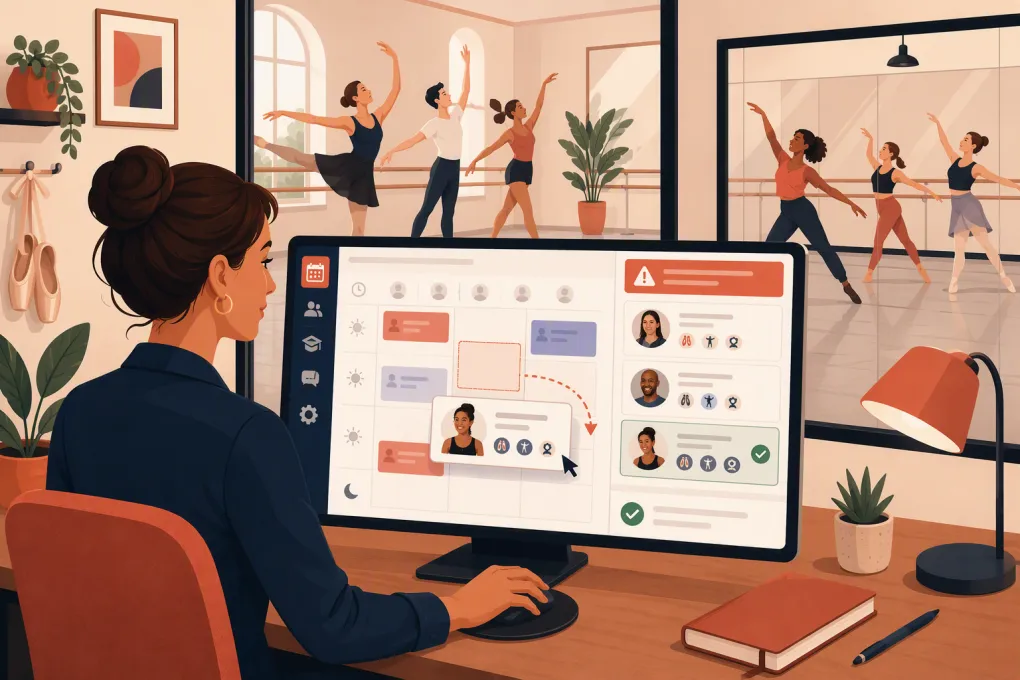
Look closely at capacity limits, waitlists, recurring schedules, substitutions, attendance, memberships, and class packs. Test whether staff can see missing forms from the roster and whether clients can move between eligible sessions without manual intervention.
Mindbody, WellnessLiving, Momence, and WTF Go approach this market from different angles. Mindbody and WellnessLiving emphasize broad studio administration. Momence is relevant to experience- and event-led programming. WTF Go is more compelling when conversational lead handling and follow-up are major requirements.
Hybrid, virtual, or content-led business
Ask how live links are delivered, how recordings are restricted, whether access expires, and whether one purchase can combine in-person and digital benefits. Arketa deserves consideration when digital content and a branded online experience are central rather than secondary.
Multi-location operator
Do not accept “supports multiple locations” as a complete answer. Require a live demonstration of:
- Consolidated revenue and attendance reporting
- Location-level permissions
- Shared versus location-specific memberships
- Staff working across multiple sites
- Centralized client records and duplicate handling
- Location-specific taxes, policies, schedules, and waivers
- Data exports by location, service, practitioner, and date
Privacy, consent, and payment questions to ask
Breathwork intake can collect information about medications, pregnancy, cardiovascular conditions, mental health history, or other sensitive matters. Avoid collecting information merely because a template makes it possible.
HIPAA does not automatically apply to every breathwork studio. Applicability depends on the business, relationships, and transactions involved. Other federal and state privacy, consumer-protection, breach-notification, biometric, and health-data rules may still apply. Obtain qualified legal advice for your operation rather than relying on a vendor’s marketing language.
Ask each finalist these concrete questions:
Health and intake information
- Where is form data stored, and in which country or region?
- Is data encrypted in transit and at rest?
- Can access be limited by role, practitioner, and location?
- Are access and change logs available?
- What is the retention and deletion process?
- Will the vendor sign a business associate agreement if your business actually requires one?
- Does the vendor use client data to train AI models, and can that use be disabled?
Keep medical or contraindication-related decisions with appropriately qualified humans. An automated assistant should follow approved scripts and escalation rules, not infer whether someone is safe to participate.
Messaging consent
Automated email and text follow-up requires more than having a phone number. Determine how the platform records consent, stores the source and timestamp, processes opt-outs, and separates transactional messages from marketing campaigns. Ask counsel how federal and state telemarketing rules apply to your outreach.
Payment security
You generally want card details handled by a payment provider rather than stored directly by the studio. Ask which party processes payments, how tokenization works, what PCI responsibilities remain with you, how chargebacks are handled, and whether you can migrate recurring payment credentials if you leave.
Data ownership and exit
Before signing, request a sample export. Confirm that you can retrieve client profiles, attendance, purchases, memberships, notes, form records, consent records, and financial transaction references in usable formats. Ask what cannot be exported, how long post-termination access lasts, and what deletion confirmation the vendor provides.
Test the real client journey before buying
A polished dashboard demo will not reveal how the system handles exceptions. Give every vendor the same scenario list:
- A first-time prospect asks after hours whether a beginner class is appropriate.
- The prospect books, pays, and receives the correct preparation instructions.
- The session fills and another client joins the waitlist.
- A participant arrives on the roster without a completed intake form.
- A member’s recurring payment fails.
- A client opts out of marketing texts but still needs a booking confirmation.
- A facilitator needs today’s roster without access to unrelated sensitive records.
- The owner exports all client and transaction data before terminating service.
WTF Go says Fitty can answer leads, book classes, follow up, and collect dues around the clock. Before relying on those capabilities, ask the team to demonstrate your wording, escalation rules, communication channels, consent handling, and staff handoff process. Request a workflow-specific look at Fitty for a breathwork studio →.
Make the final decision with a scorecard
Score each platform from one to five across the criteria that matter to your business. Weight essential functions more heavily than attractive extras.
Your scorecard should cover booking, payments, forms, privacy controls, lead response, messaging consent, reporting, mobile usability, integrations, migration, support, total pricing, and data portability. Include staff in the trial, and complete at least one booking as a new client on a phone.
A solo facilitator may reasonably choose a simpler product with fewer reports. A multi-location studio may accept a longer implementation in exchange for stronger permissions and consolidated administration. A studio losing leads after hours may prioritize an AI-supported front desk. The right decision follows the bottleneck—not the loudest feature list.
Frequently asked questions
What features should breathwork studio management software include?
Most studios should evaluate class and appointment booking, memberships, payments, intake forms, waivers, reminders, attendance, reporting, permissions, data exports, and lead follow-up. Hybrid studios may also need live-stream and on-demand content controls.
Does a breathwork studio need HIPAA-compliant software?
Not every breathwork studio is subject to HIPAA, but sensitive health data may still be covered by contracts or other privacy laws. Have qualified counsel assess your obligations and verify the vendor’s security, retention, access, and breach procedures.
Which software is best for a solo breathwork practitioner?
A scheduling-first or small-business platform such as Acuity, OfferingTree, or Vagaro may be sufficient for private sessions and a limited class schedule. Compare the complete workflow, including forms, payments, reminders, exports, and recurring offers.
Can an AI receptionist determine whether a client is safe for breathwork?
It should not make clinical or medical judgments. AI can share approved information and escalate sensitive questions, while participation and health decisions remain with qualified humans following documented policies.
How should I compare breathwork software pricing?
Request the total cost for subscriptions, locations, staff, onboarding, migration, messaging, payment processing, add-ons, branded apps, support, and contract termination. Also ask whether exporting data or moving recurring payment credentials creates additional cost or limitations.
Keep reading

Run your gym on autopilot with WTF Go
Fitty — your AI receptionist — answers calls and DMs, fills classes, follows up with every lead, and collects dues while you coach.