Comparisons
How to Choose Body Contouring Clinic Management Software
Compare body contouring clinic management software by booking, lead follow-up, packages, payments, compliance, and AI to choose the right operational fit.
 Watch · 20s
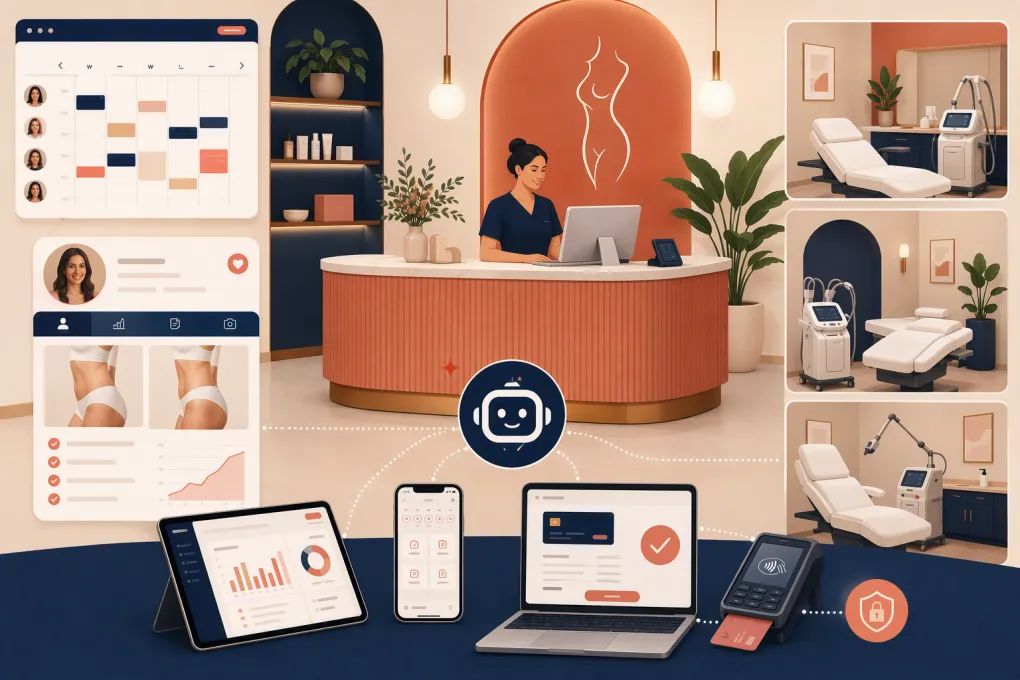
Body contouring clinics do not have a simple scheduling problem. They have a connected workflow problem: capture the lead, answer questions, book a consultation, recommend a plan, sell a package, schedule multiple sessions, document treatment, collect payment, and keep the client engaged between visits.
Generic calendars handle only one piece. The right body contouring clinic management software should connect the entire client journey without forcing staff to re-enter information across a CRM, booking system, payment terminal, phone, and clinical record.
That distinction matters when evaluating vendors. A polished booking page is useful, but it will not fix missed calls, slow lead response, unused package sessions, inconsistent follow-up, or fragmented reporting.
See how Fitty handles body contouring inquiries and booking around the clock →
What body contouring clinic software should manage
Start with the workflows your team performs every day. Separate must-have capabilities from features that look impressive during a demo but rarely affect operations.
Lead capture and follow-up
Body contouring prospects often have questions before they are ready to book. They may ask about treatment areas, session length, downtime, financing, eligibility, or expected next steps.
Your software should help staff:
- Capture leads from calls, website forms, chat, social campaigns, and walk-ins
- Keep every conversation attached to one contact record
- Assign a status such as new, contacted, consultation booked, sold, or lost
- Trigger follow-up when a prospect does not book
- Record the source and campaign behind each inquiry
- Escalate clinical or suitability questions to a qualified team member
Speed matters, but accuracy matters too. An automated receptionist should answer approved administrative questions without making medical claims or determining whether someone is a suitable treatment candidate.
Consultation and treatment scheduling
Body contouring scheduling is more complex than placing a name on a calendar. An appointment may require a specific provider, room, device, duration, or preparation window.
Look for scheduling controls that support:
- Separate consultation and treatment appointment types
- Provider, room, and equipment availability
- Buffers for cleaning, setup, and photography
- Deposits and cancellation rules
- Online rescheduling within clinic-defined limits
- Automated confirmations and reminders
- Waitlists or backfill workflows for canceled appointments
- Multi-session treatment plans
During a demo, ask the vendor to schedule two appointments that need the same device. The system should prevent a resource conflict even if different providers are available.
Packages, memberships, and session balances
Many clinics sell a series rather than a single visit. Software should clearly show what the client bought, what has been used, what remains, and whether the package has an expiration policy.
Verify that staff can handle:
- Packages with multiple sessions
- Different treatment areas or service categories
- Partial redemptions
- Membership credits or recurring billing
- Package upgrades and approved transfers
- Refunds and charge adjustments
- Expiration dates and renewal outreach
- Balances across locations, if applicable
Do not accept a verbal promise that packages are supported. Build one during the demo, redeem a session, reschedule another, and process a cancellation.
Comparing body contouring clinic management software
The market includes general wellness platforms, med spa systems, clinical practice software, and newer operations platforms centered on automation. The best fit depends on whether your clinic primarily needs medical documentation, front-office automation, enterprise controls, or a combination.
| Platform | Core strengths | Booking and client workflows | Automation and AI | Multi-location fit | Important limitation to evaluate | Best suited for |
|---|---|---|---|---|---|---|
| WTF Go with Fitty | Connected operations, lead management, booking, follow-up, payment collection, and an AI receptionist | Designed to move inquiries into booked appointments and continue follow-up | Fitty can answer leads, book, follow up, and collect dues 24/7 | Relevant to independent and multi-location operators | Confirm whether your clinic needs a separate clinical EMR for medical charting, treatment records, or prescribing workflows | Clinics prioritizing fast lead response and front-office automation |
| Aesthetic Record | Aesthetic-practice EMR and practice management capabilities | Supports aesthetic clinic workflows, scheduling, records, and related practice operations | Offers workflow and practice automation; evaluate the exact communication channels in your plan | Worth evaluating for growing aesthetic practices | Confirm how its lead response and after-hours sales workflows compare with a dedicated AI receptionist | Med spas that place clinical documentation at the center of the system |
| PatientNow | Practice management, clinical records, CRM, and marketing capabilities for aesthetic and elective medical practices | Broad patient journey coverage from inquiry through treatment | Automation capabilities vary by product and configuration | Suitable for practices needing a broader platform | Breadth can mean a more involved evaluation and implementation process | Established med spas, plastic surgery practices, and elective medical groups |
| Boulevard | Strong client experience, booking, point of sale, forms, and business management for appointment-based businesses | Polished online booking and front-desk workflows | Includes communication and marketing automation; verify AI receptionist requirements separately | Supports growing salon, spa, and med spa operators | May not replace a specialized medical EMR where clinical documentation is required | Service-led spas and clinics focused on booking and client experience |
| Mindbody | Widely used wellness booking, payments, marketing, and consumer marketplace exposure | Mature class and appointment management | Provides business automation, but clinics should test lead qualification and conversational booking needs | Commonly considered by single- and multi-site wellness businesses | Not purpose-built around body contouring documentation or medical charting | Clinics combining wellness services, appointments, and broader consumer discovery |
| Zenoti | Broad enterprise platform for salons, spas, and med spas, including booking, POS, marketing, and centralized controls | Extensive operational workflows across locations | Offers automation and AI-related capabilities across its platform | Strong candidate for larger multi-location organizations | Implementation scope and platform complexity should be assessed carefully | Larger operators requiring centralized administration and standardized processes |
Product capabilities and packaging change. Ask each vendor to demonstrate your actual workflow and provide current pricing, implementation terms, support scope, and security documentation in writing.
Clinical records and compliance cannot be an afterthought
Some body contouring businesses operate as nonmedical wellness providers; others are medical spas subject to healthcare-specific rules. Your requirements depend on your services, ownership structure, location, and the information you collect.
If your clinic handles protected health information, ask vendors about:
- Whether they will sign a Business Associate Agreement when required
- Role-based access controls
- Audit logs showing who viewed or changed a record
- Data encryption and backup practices
- Record retention and export options
- Secure intake forms, consent documents, and treatment photography
- Procedures for terminating staff access
- Incident response and breach notification processes
Software does not make a clinic compliant by itself. Policies, staff training, account permissions, device security, vendor agreements, and operating procedures all matter. Obtain qualified legal or compliance advice for your situation.
Payment processing deserves a similar review. Ask how card data is handled, whether deposits can be stored securely, how disputes are documented, and how recurring charges are authorized. For automated texts and marketing, make sure your consent and opt-out process aligns with applicable requirements.
Where an AI receptionist changes clinic economics
A receptionist can be excellent during business hours and still lose opportunities at night, during treatments, or when several calls arrive together. Hiring more people is not the only answer. The underlying problem is that inbound demand does not follow the front desk schedule.
An AI receptionist for a body contouring clinic should be able to:
- Respond immediately across supported channels.
- Explain approved services and administrative policies.
- Collect the prospect’s contact details and goals.
- Offer eligible consultation times based on live availability.
- Book or reschedule according to clinic rules.
- Follow up when a lead stops responding.
- Route clinical questions, complaints, or unusual requests to a person.
- Record the interaction so staff know what happened.
Fitty is WTF Go’s AI receptionist and agent. It answers leads, books appointments, follows up, and collects dues 24/7, giving operators a way to extend front-desk coverage without building a patchwork of disconnected tools.
Explore how Fitty can turn after-hours body contouring inquiries into booked consultations →
Automation still needs boundaries. Create an approved knowledge base covering services, hours, locations, preparation instructions, cancellation policies, financing options, and escalation rules. Do not allow an automated agent to diagnose conditions, guarantee results, or improvise medical advice.
A practical software evaluation scorecard
Score each platform against the same criteria instead of relying on separate vendor presentations. A simple 1-to-5 rating works, provided your team documents why it assigned each score.
Operational criteria
- Lead capture and response
- Consultation conversion workflow
- Provider, room, and device scheduling
- Package and membership management
- Deposits, payments, refunds, and recurring billing
- Reminders, rebooking, and inactive-client follow-up
- Multi-location permissions and reporting
- Ease of use for receptionists and providers
Clinical and technical criteria
- Intake, charting, consent, and photography requirements
- Security documentation and applicable vendor agreements
- Data export in a usable format
- Website, phone, accounting, and marketing integrations
- API or integration options for future systems
- Implementation ownership and staff training
- Support channels and escalation process
Commercial criteria
Do not compare only the monthly subscription. Request a complete cost outline covering setup, migration, payment processing, messaging, phone usage, add-on modules, extra locations, extra users, support, and contract terms.
Exact pricing is less useful than understanding how the bill changes as the clinic grows. Ask what happens when you add a provider, open another location, send more messages, or increase call volume.
Run these tests during every software demo
Send vendors a test script before the meeting. Ask them to complete the tasks live rather than showing slides.
- Capture a new lead from a website inquiry.
- Respond to a pricing question without making a clinical claim.
- Book a consultation that requires a particular room.
- Sell a six-session package and redeem one session.
- Prevent two providers from booking the same device.
- Take a deposit and apply it to the final balance.
- Reschedule a visit and trigger updated reminders.
- Find leads who inquired but never booked.
- Show remaining sessions across two locations.
- Export the client record, appointment history, and package balance.
Include your receptionist, clinic manager, provider, and finance lead in the final review. Each role sees different failure points.
Plan migration before signing the contract
A weak migration can undermine otherwise capable software. Decide what must move: active clients, contact permissions, future appointments, package balances, memberships, treatment history, forms, notes, photographs, and outstanding balances.
Ask the new vendor who maps and validates the data. Run a test import, reconcile package balances, and review a sample of client records before launch. Keep access to the old system for an appropriate transition period, subject to your record-retention obligations.
Finally, define success in operational terms. Track response time, consultation booking, show rates, package utilization, outstanding balances, and staff time spent on repetitive administration. The right platform should make those workflows easier to manage and easier to inspect.
Frequently asked questions
What is body contouring clinic management software?
It is software used to manage leads, consultations, treatment scheduling, packages, payments, communication, and reporting. Medical clinics may also need specialized EMR, consent, charting, and treatment-photo capabilities.
Can body contouring software track multi-session packages?
Many platforms can, but the details vary. Test partial redemption, expirations, cancellations, upgrades, refunds, and balances across locations before choosing a system.
Does a body contouring clinic need HIPAA-compliant software?
That depends on the clinic's services, structure, and handling of protected health information. If HIPAA applies, evaluate vendor agreements, access controls, audit logs, security practices, and your own internal procedures with qualified guidance.
Can an AI receptionist book body contouring consultations?
Yes, if it connects to current availability and follows clinic-defined rules. It should escalate medical suitability questions and avoid diagnosing clients or promising treatment outcomes.
How should a clinic compare software pricing?
Compare total operating cost, not just the base subscription. Include implementation, data migration, payments, messaging, phone usage, add-ons, locations, users, training, support, and contract terms.
Keep reading

Run your gym on autopilot with WTF Go
Fitty — your AI receptionist — answers calls and DMs, fills classes, follows up with every lead, and collects dues while you coach.