AI & Automation
Bilingual AI Receptionist for Med Spas: Complete Buyer’s Guide
Choose a bilingual AI receptionist for med spas that handles calls, books consultations, follows up, and protects patient privacy in English and Spanish.
 Watch · 20s
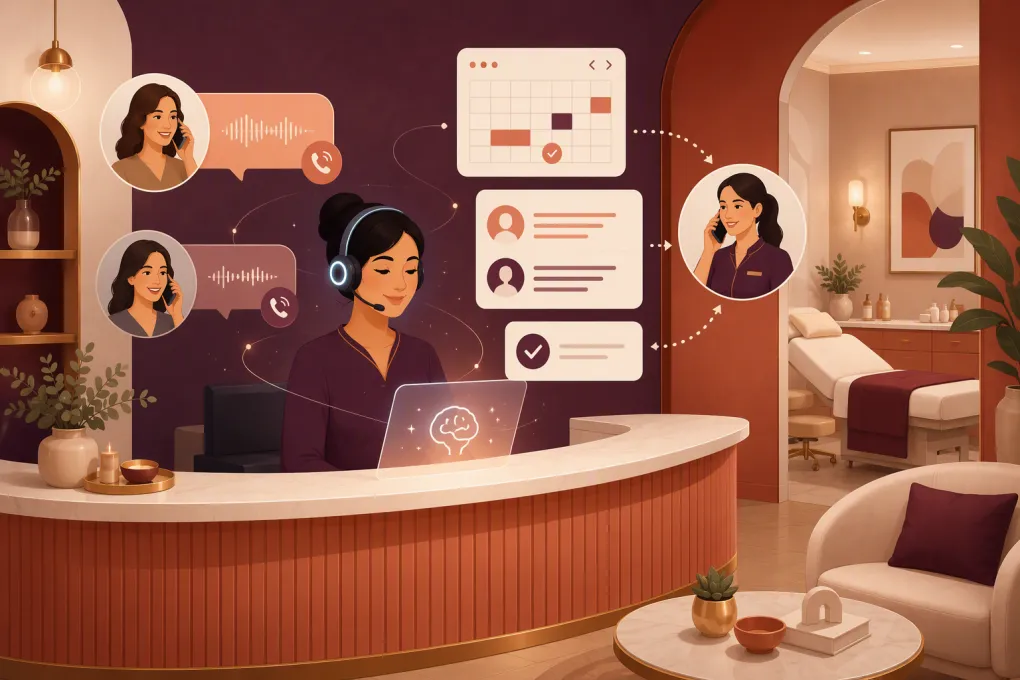
A prospective client sees your treatment video after dinner and calls with questions in Spanish. Nobody answers, so she tries the next med spa. The problem is not a lack of demand. It is a gap between when clients want help, how they prefer to communicate, and when your team can respond.
A bilingual AI receptionist can close that gap, but only if it does more than translate a script. It must understand treatment terminology, handle mixed-language conversations, follow your booking rules, know when to involve a person, and avoid drifting into medical advice.
That makes vendor selection an operational decision—not simply a language feature on a software checklist.
See how Fitty can support bilingual med spa lead response and booking workflows →
What a bilingual AI receptionist should actually handle
The right system acts as a controlled front-desk layer across calls, texts, and follow-up. It should help clients complete routine administrative tasks while escalating clinical, sensitive, or unusual questions to your staff.
Detect and switch languages naturally
Language detection should happen without forcing every caller through a long menu. The receptionist should also handle:
- Callers who switch between English and Spanish mid-conversation
- Regional accents and common variations in treatment terminology
- Names, email addresses, dates, and phone numbers spoken in either language
- Clarification when audio or intent is uncertain
- A direct request to speak with a bilingual person
Do not evaluate this using a polished vendor demonstration alone. Test it with real front-desk scenarios, background noise, interruptions, code-switching, and multiple speakers.
Answer administrative treatment questions
A useful receptionist can explain information approved by your business, such as:
- Treatments offered at each location
- Consultation requirements
- General preparation instructions
- Business hours and parking information
- Accepted payment methods
- Membership or package basics
- Cancellation and rescheduling policies
It should not diagnose a condition, assess treatment suitability, promise results, or improvise clinical guidance. Questions such as “Is this reaction normal?” or “Can I receive this treatment while pregnant?” need a defined human escalation path.
Book the correct appointment
Booking is where superficial automation often breaks. Your AI receptionist needs to understand the difference between a consultation, treatment session, follow-up, and touch-up. It may also need to apply rules involving:
- New versus returning clients
- Provider credentials and availability
- Room or equipment availability
- Location-specific services
- Treatment duration and buffers
- Deposits or cards on file
- Prerequisites and consultation status
- Age restrictions or consent requirements
Ask whether the system reads live availability and writes confirmed appointments into your scheduling platform. A bot that only submits a callback request is lead capture, not complete booking automation.
Follow up without creating duplicate work
The first call is not always enough. A qualified prospect may need a booking link, a reminder, or a staff callback. The receptionist should record the interaction and trigger the next approved step without requiring an employee to copy information between systems.
Useful workflows include missed-call follow-up, consultation reminders, incomplete-booking outreach, rescheduling, and answers to common pre-visit questions. Any marketing texts or automated outreach must follow applicable consent and opt-out requirements.
Comparing bilingual reception options
A bilingual employee, outsourced service, and AI receptionist solve different versions of the problem. The best choice depends on your call volume, clinical complexity, operating hours, and existing systems.
| Option | Bilingual conversations | Booking and CRM workflows | After-hours coverage | Main strength | Main limitation | Best fit |
|---|---|---|---|---|---|---|
| Bilingual in-house receptionist | Usually strong when the employee speaks the client’s preferred language | Can handle complex exceptions manually | Limited to scheduled coverage unless staffed in shifts | Judgment, empathy, and knowledge of local operations | Coverage depends on staffing and availability | Med spas with complex calls and enough volume for dedicated front-desk coverage |
| Bilingual answering service | Depends on agent availability and language coverage | Often takes messages; booking depth varies by service and integration | Commonly available | Human interaction without adding an internal shift | Agents may have limited treatment knowledge or system access | Businesses primarily needing overflow or after-hours message capture |
| Traditional IVR or phone tree | Uses prerecorded language menus | Limited unless connected to other tools | Available whenever the phone system is running | Predictable and tightly controlled | Friction-heavy and poorly suited to open-ended questions | Simple routing with few client intents |
| Generic voice AI platform | Language support varies by model and configuration | Can be customized, but may require technical setup and separate integrations | Typically designed for continuous availability | Flexibility across industries and workflows | Med spa logic, guardrails, and maintenance may fall on the operator | Teams with technical resources and unusual requirements |
| WTF Go with Fitty | Designed for automated lead conversations and follow-up; confirm required languages during evaluation | Centralizes lead response, booking workflows, follow-up, and payment-related operations | Built around 24/7 AI assistance | Combines AI reception with broader wellness-business operations | Fit and compliance requirements still need to be validated against your services and systems | Med spas wanting reception automation connected to day-to-day operations |
Price should not be compared in isolation. Ask whether billing is based on locations, users, calls, minutes, messages, booked appointments, or usage tiers. Also identify implementation, phone, integration, and support costs before calculating the total.
How to test bilingual conversation quality
A vendor saying it “supports Spanish” tells you very little. Build a test script from actual calls your front desk receives and score every system against the same scenarios.
Include prompts such as:
- A new client asks in Spanish about a treatment, then switches to English for scheduling.
- A caller mispronounces a provider’s name and gives an email address containing English words.
- A client asks for an appointment that violates your consultation rules.
- A caller describes a possible post-treatment reaction.
- A returning client wants to reschedule at another location.
- A prospect asks about a promotion that has expired.
- A caller requests a human and refuses to provide more information.
Evaluate whether the receptionist correctly understands the request, follows policy, confirms important details, and creates the right record. Pay attention to tone as well. A literal translation can be grammatically correct while sounding unnatural or overly formal.
Your bilingual employees should review scripts and test conversations before launch. They will catch awkward phrasing and terminology that a monolingual evaluator may miss.
Privacy, consent, and payment requirements
Med spa reception can involve personal and health-related information. Before deploying an AI system, map what information it receives, where that data goes, how long it is retained, and who can access transcripts or recordings.
Ask direct privacy questions
Your review should cover:
- Whether the vendor will sign a business associate agreement when required
- How recordings, transcripts, and contact records are stored
- Whether your data is used to train shared models
- Available retention and deletion controls
- Staff permissions and audit logs
- Security practices for integrations and data transfers
- Procedures for security incidents and account termination
A business associate agreement is not, by itself, proof that a workflow is compliant. Whether HIPAA applies can depend on your services, business structure, and the data involved. State privacy rules may create additional obligations. Review the proposed workflow with qualified legal or compliance counsel.
Control recording and outreach
Call-recording consent requirements vary by jurisdiction. Your greeting and recording configuration should reflect the laws that apply to your business and callers.
Text follow-up also needs proper consent, identification, and opt-out handling. Separate transactional communications—such as appointment confirmations—from promotional campaigns in your policies and automation rules.
Keep card data out of conversation logs
If the receptionist collects deposits or payments, use a payment flow designed for card-data security. Clients should not read full card details into a conversation that may be recorded or transcribed. Ask the vendor to demonstrate exactly how payment information is collected, tokenized, stored, and separated from call records.
Explore how WTF Go connects AI lead handling with booking, follow-up, and payment workflows →
Build the workflow before turning on the AI
Automation exposes unclear policies. If your staff members give different answers about deposits, consultations, or late arrivals, an AI receptionist will not fix the underlying inconsistency.
Document a basic call map first:
- Identify the client’s language and reason for contacting you.
- Determine whether the request is administrative, sales-related, or clinical.
- Answer only from approved business information.
- Collect the minimum information required for the next step.
- Check eligibility and booking rules.
- Confirm the appointment or create a clearly assigned staff task.
- Send the approved confirmation and record the outcome.
Create separate escalation paths for urgent medical concerns, post-treatment reactions, complaints, refund requests, legal threats, accessibility needs, and requests for a specific clinician. The AI should never imply that a message was clinically reviewed when it was only logged for follow-up.
Measure operational results after launch
Start with a limited workflow, such as after-hours new-client calls for one location. Review conversations frequently before expanding to every service and language.
Track operational measures including:
- Calls answered versus abandoned
- Qualified inquiries that become booked consultations
- Bookings completed without staff intervention
- Transfers and escalations by reason
- Incorrect answers or booking errors
- Follow-up tasks completed on time
- Rescheduling and cancellation outcomes
- Language preference by channel and location
Do not optimize solely for containment—the percentage of conversations handled without a person. A fast escalation is the correct result when a caller has a clinical concern or the system is uncertain.
Also establish ownership. Someone should be responsible for updating treatment details, provider schedules, promotions, policies, bilingual scripts, and escalation contacts. An AI receptionist is an operating system component, not a set-and-forget phone greeting.
The practical buying checklist
Before signing an agreement, require the vendor to demonstrate your workflows rather than a generic salon or medical-office script. Confirm:
- Which languages and dialects are supported in voice and text
- How the system handles language switching
- Whether it books directly into your live schedule
- How location, provider, room, and consultation rules are enforced
- What happens when confidence is low
- How clinical questions are blocked and escalated
- Whether humans can take over a conversation cleanly
- What clients hear when the system is unavailable
- How transcripts, recordings, and consent are managed
- What implementation, integration, and ongoing maintenance require
- How pricing changes with usage and additional locations
- How data is exported if you leave
The best bilingual AI receptionist for a med spa is not the one with the most impressive conversation demo. It is the one that reliably executes your policies in both languages, protects sensitive information, books the right services, and gives your staff a clean handoff when human judgment is needed.
Request a WTF Go walkthrough using your actual bilingual med spa call scenarios →
Frequently asked questions
Can a bilingual AI receptionist book med spa appointments directly?
Yes, if it integrates with your scheduling system and can enforce rules for providers, rooms, consultations, service duration, and locations. Verify this with a live workflow rather than assuming calendar access means complete booking.
Can an AI receptionist answer treatment questions in Spanish?
It can answer approved administrative questions in Spanish, but it should not diagnose conditions, determine treatment suitability, or provide improvised clinical advice. Those requests need a defined staff escalation.
Does a med spa AI receptionist need to be HIPAA compliant?
That depends on your business, services, and the information the system handles. Evaluate data flows, security controls, retention, access, and whether a business associate agreement is required with qualified counsel.
Should an AI receptionist replace a bilingual front-desk employee?
Not necessarily. AI is well suited to routine questions, after-hours coverage, booking, and follow-up, while employees remain important for clinical concerns, exceptions, complaints, and sensitive conversations.
How should a med spa test bilingual AI before launch?
Use real scenarios involving accents, code-switching, rescheduling, clinical escalation, multiple locations, and policy exceptions. Have bilingual employees review accuracy, tone, booking outcomes, and handoff quality.
Keep reading

Run your gym on autopilot with WTF Go
Fitty — your AI receptionist — answers calls and DMs, fills classes, follows up with every lead, and collects dues while you coach.