AI & Automation
Bilingual AI Receptionist for Massage Therapy Clinics Guide
See how a bilingual AI receptionist for massage therapy clinics can answer leads, book treatments, follow up, and support clients after hours, every day.
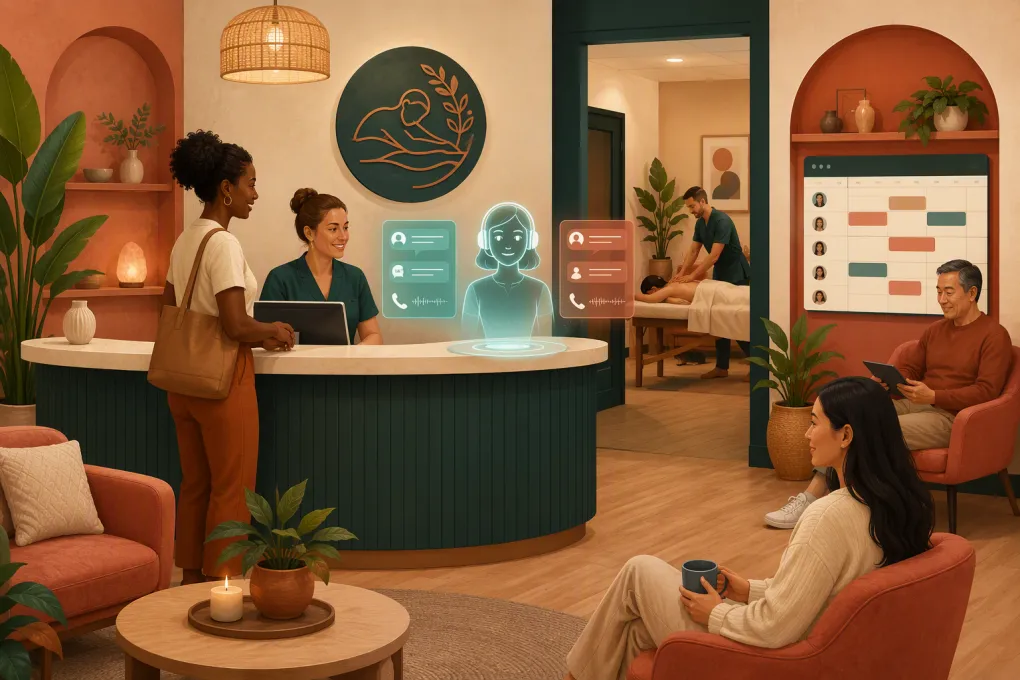 Watch · 20s
A missed call at a massage therapy clinic is rarely just a missed call. It may be a new client comparing availability, an existing client trying to reschedule, or someone looking for a specific modality in a language your front desk does not speak confidently.
The challenge gets worse when therapists are in sessions. Calls go unanswered, voicemail piles up, and response times depend on when someone can step away. Hiring bilingual front-desk coverage can help, but maintaining coverage across evenings, weekends, breaks, and multiple locations is difficult.
A bilingual AI receptionist gives clinics another option. Properly configured, it can answer routine questions, communicate in the client’s preferred supported language, check real availability, book appropriate services, and escalate sensitive conversations to a person. The value is not replacing every front-desk interaction. It is making sure routine demand does not disappear while your team is working with clients.
See how Fitty can support your clinic’s bilingual booking workflow →
What a bilingual AI receptionist should actually do
Language capability alone is not enough. A useful receptionist needs access to the clinic’s operating rules and must be able to complete the next step.
For a massage therapy business, that generally means handling tasks such as:
- Answering inbound calls and lead messages
- Recognizing or confirming the client’s preferred language
- Explaining services without making medical claims
- Identifying the requested location, therapist, modality, and duration
- Checking live appointment availability
- Booking, rescheduling, or canceling within clinic policy
- Sending confirmations and intake instructions
- Following up with leads who did not book
- Answering questions about parking, accessibility, pricing, and preparation
- Routing clinical, urgent, or unusual requests to a qualified team member
- Assisting with approved payment or account-balance workflows
A basic voice bot may answer questions. An operational AI receptionist should move the conversation into your booking, CRM, follow-up, and payment workflows without forcing staff to re-enter the information.
Bilingual service is more than direct translation
Literal translation can produce awkward or misleading conversations. Massage terminology, service names, policies, and cultural expectations do not always map cleanly from one language to another.
Build an approved service glossary
Create a bilingual glossary for every bookable treatment. Include the official service name, a plain-language description, duration, price, practitioner requirements, and any wording the AI should avoid.
For example, your clinic may distinguish among therapeutic massage, relaxation massage, prenatal massage, sports massage, and lymphatic techniques. The receptionist should not treat those terms as interchangeable. It also should not imply that a service diagnoses, treats, or cures a condition unless your clinic is legally and professionally permitted to make that claim.
Have a fluent staff member or qualified reviewer check the glossary. Machine-generated wording should not be the final authority for service descriptions.
Preserve the client’s language preference
Once a client selects a language, that preference should carry into confirmations, reminders, follow-up messages, and future conversations when possible. Switching back to English immediately after a Spanish booking call creates an inconsistent experience and can cause clients to miss important instructions.
Your CRM should record the preference in a structured field rather than burying it in call notes.
Define what requires a human
An AI receptionist should not improvise when a client asks for medical advice, describes an emergency, disputes a charge, reports misconduct, requests an accommodation that needs review, or presents a complicated contraindication.
Create explicit escalation paths. During staffed hours, that may mean a live transfer or an internal alert. After hours, the system can collect limited information, explain when the clinic will respond, and provide emergency guidance approved by your clinic. It should never present itself as emergency or medical support.
The highest-value workflows for massage clinics
The best place to start is not every possible conversation. Start with repetitive calls that have a clear operational outcome.
New-client booking
A practical booking flow should ask only what is needed to find the right appointment:
- Which language does the client prefer?
- Which clinic location works best?
- What service or general goal are they interested in?
- Do they have a therapist preference?
- What appointment length do they want?
- Which days or time ranges work?
- Is this a new-client appointment requiring intake paperwork?
The AI should then offer a small set of real openings, confirm the selection, capture contact information, and send the required next steps. It should not overwhelm the caller by reading an entire calendar aloud.
After-hours lead response
Many clients search and call outside standard front-desk hours. A bilingual AI receptionist can answer immediately, clarify the request, and book if an appropriate opening exists.
If the client is not ready, the system should record the lead, language, requested service, preferred time, and reason the booking was not completed. That creates a useful follow-up task instead of an anonymous voicemail.
See how Fitty answers leads and keeps after-hours inquiries moving →
Rescheduling and cancellations
Routine schedule changes consume front-desk time but require firm guardrails. Configure the AI around your actual cancellation window, late-cancellation policy, package rules, and practitioner availability.
Do not let the receptionist negotiate exceptions. When a client disputes a fee or has an unusual circumstance, route the conversation to an authorized person.
Rebooking and lapsed-client follow-up
Follow-up should be tied to client behavior and consent, not indiscriminate messaging. Useful triggers may include:
- A new lead who asked about availability but did not book
- A client who canceled without rescheduling
- A completed appointment with no future visit scheduled
- An expiring package or membership, where permitted
- An unpaid account balance requiring an approved reminder
Messages should remain in the client’s preferred language and offer a concrete action, such as viewing available appointments or speaking with the clinic.
How to prepare your clinic before launch
An AI receptionist exposes unclear policies quickly. If different staff members give different answers, the AI will not know which version represents the business.
Before going live, document:
Scheduling rules
List service durations, turnaround time between appointments, room or equipment dependencies, therapist qualifications, location restrictions, and booking lead times. Include which services new clients may book directly and which require staff review.
Front-desk policies
Write down cancellation terms, late-arrival handling, deposits, package rules, gift-card procedures, accepted payment methods, age requirements, and intake expectations. Use language a client can understand rather than internal shorthand.
Safety and professional boundaries
Massage clinics need scripts for inappropriate requests, sexualized language, threats, suspected emergencies, and requests outside the clinic’s scope. The AI should end or escalate conversations according to a written policy, not attempt to persuade the caller.
Escalation ownership
Assign a person or role to each escalation category. Specify staffed hours, expected response procedures, and the information the AI may collect. A general instruction to notify the team usually creates alerts with no clear owner.
Consent and compliance requirements
Review call-recording disclosures, text-message consent, payment handling, privacy obligations, and data-retention settings with appropriate legal or compliance advisers. Requirements can vary by state, communication channel, and whether the clinic is subject to healthcare privacy rules.
If protected health information may be involved, confirm whether each vendor will sign any required agreement and how information is stored, accessed, and deleted. Keep the receptionist focused on scheduling and approved intake rather than collecting unnecessary clinical detail.
Test in both languages before sending every call
Run controlled tests using real scenarios from your front desk. Do not test only ideal conversations.
Include callers who:
- Change languages halfway through the call
- Use informal or regional terms for a service
- Ask for a therapist who is unavailable
- Request a modality at the wrong location
- Have a strong accent or noisy connection
- Need to reschedule inside the cancellation window
- Ask a medical or contraindication question
- Make an inappropriate request
- Want an appointment that requires staff approval
Check the booking record, not just the conversation. Confirm that the correct service, duration, therapist, location, language, and contact details reached the calendar and CRM.
A sensible rollout can begin with after-hours calls or overflow traffic. Review transcripts and outcomes, correct recurring errors, and expand coverage after the workflows are reliable.
Measure operational results, not conversation volume
A large number of answered calls does not prove the system is working. Track whether conversations produce accurate outcomes.
Useful measures include:
- Inquiries answered versus sent to voicemail
- Booking completion by language and channel
- Time from inquiry to first response
- Calls transferred or escalated
- Failed bookings and their causes
- Incorrect service or location selections
- Cancellations successfully rescheduled
- Leads recovered through follow-up
- No-shows after AI-booked appointments
- Complaints, corrections, or requests for a human
Review results by language. A strong English workflow can hide weak terminology, awkward prompts, or booking failures in the second language.
Where WTF Go and Fitty fit
A standalone answering tool can create another inbox for staff to monitor. WTF Go takes a broader approach by combining business operations with Fitty, its AI receptionist and agent.
Fitty is designed to answer leads, support booking workflows, follow up, and collect dues around the clock. For a massage therapy clinic, the practical benefit is continuity: the conversation, client record, appointment process, and follow-up can operate inside one system instead of being handed among disconnected tools.
During evaluation, confirm the specific languages, communication channels, booking rules, payment workflows, and escalation behavior your clinic requires. The right setup should reflect how your therapists and front desk already operate while removing repetitive work that does not need a person.
Explore WTF Go and map Fitty to your massage clinic workflow →
A bilingual AI receptionist works best when it is treated as an operating system component, not a translation feature. Give it accurate policies, clear boundaries, real scheduling access, and regular quality review. That is how a clinic turns more inquiries into properly booked appointments without sacrificing client care or adding another pile of front-desk tasks.
Frequently asked questions
Can a bilingual AI receptionist book massage appointments directly?
Yes, if it is connected to the clinic's scheduling system and configured with accurate service, therapist, location, and availability rules. Complex or restricted appointments should be routed to staff.
Can an AI receptionist switch languages during a call?
Some systems can recognize or respond to a language change, but performance varies by platform and supported language. Test accents, regional terminology, and mid-call switching before launch.
Is a bilingual AI receptionist appropriate for medical questions?
It can provide approved administrative information, but it should not diagnose conditions or give medical advice. Clinical questions, contraindications, and emergencies need a clearly defined escalation process.
What should a massage clinic test before going live?
Test booking accuracy, service terminology, language preference, cancellations, therapist restrictions, escalation paths, confirmations, and CRM records. Include difficult calls rather than testing only straightforward bookings.
Can Fitty handle after-hours massage clinic inquiries?
Fitty is designed to answer leads and keep booking and follow-up workflows moving 24/7. Clinics should confirm their required languages, scheduling rules, channels, and escalation setup during implementation.
Keep reading

Run your gym on autopilot with WTF Go
Fitty — your AI receptionist — answers calls and DMs, fills classes, follows up with every lead, and collects dues while you coach.