AI & Automation
Bilingual AI Receptionist for Dance Studios: Operator Guide
Learn how a bilingual AI receptionist for dance studios handles English and Spanish leads, books trials, follows up, and supports your front-desk staff.
 Watch · 20s
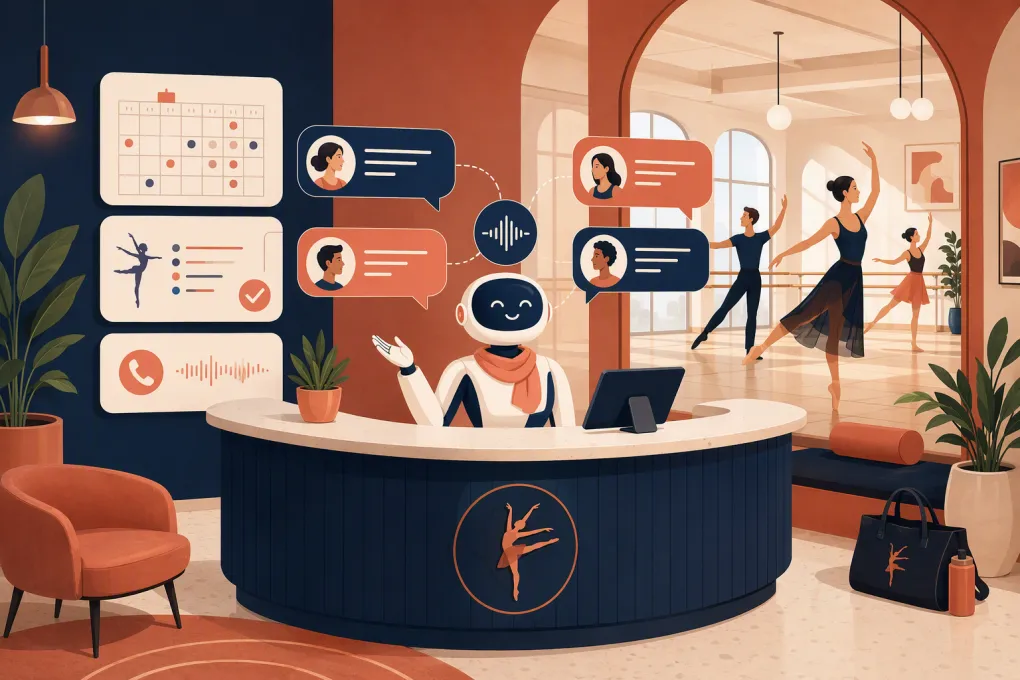
A parent finds your dance studio after dinner and asks—in Spanish—whether her daughter can try Saturday’s beginner ballet class. Another lead wants adult salsa pricing. A current member needs to reschedule a lesson. If those inquiries sit unanswered until the front desk reopens, your studio risks losing the enrollment or creating more work for tomorrow.
A bilingual AI receptionist helps close that coverage gap. It can answer routine questions, capture lead details, recommend the appropriate next step, book eligible trials and follow up in the prospect’s preferred language. The important distinction is that it should do more than translate words. It needs to follow your studio’s actual enrollment rules.
See how Fitty can answer bilingual dance studio leads after hours →
What a bilingual AI receptionist actually does
A bilingual AI receptionist is a customer-facing agent configured to communicate in two or more languages across supported channels. For many US dance studios, the immediate need is English and Spanish, although language requirements should reflect the families in the local market.
Depending on its setup and system access, the receptionist can handle workflows such as:
- Answering questions about styles, age groups and experience levels
- Explaining trial-class and introductory-offer policies
- Collecting the dancer’s name, age, goals and prior experience
- Finding an appropriate class or prompting staff to review placement
- Booking trials when the class is eligible and has availability
- Sharing dress-code, arrival and parking instructions
- Following up with leads who have not booked
- Routing sensitive, unusual or high-value inquiries to a person
- Reminding members about balances or directing them to an approved payment process
The AI should recognize the lead’s language and continue in that language without forcing the person through a complicated menu. It should also preserve the conversation context for staff. A receptionist should not have to ask the parent to repeat everything in English the next morning.
Why dance studios need more than generic translation
Dance enrollment involves decisions that a basic translation tool does not understand. A six-year-old asking about ballet, a teenager preparing for auditions and an adult looking for beginner bachata require different questions and recommendations.
A useful AI receptionist must understand the operational boundaries behind the language.
Age and level placement
Your rules may differ by program. Some classes are based strictly on age. Others require instructor approval, an evaluation or prerequisite training. The AI should know when it can book and when it must create a placement request.
It should never invent a recommendation simply to complete a booking.
Trials, drop-ins and enrollment windows
Not every class accepts trials. Competition teams, recital rehearsals, full classes and advanced programs may have restrictions. Configure those restrictions explicitly rather than relying on broad instructions such as “help everyone book a class.”
Family context
The person contacting you may be a parent, an adult dancer or a current member asking on someone else’s behalf. Your intake flow should distinguish among them and collect only the information needed for the next step.
Studio terminology
Words such as “company,” “session,” “intensive” and “private” can mean different things across studios. Build a bilingual glossary using the terms your staff and local customers actually use. Keep program names consistent rather than translating branded class names differently from one conversation to the next.
The workflows worth automating first
Do not begin by feeding the AI every policy document you own. Start with repetitive inquiries that have a clear, low-risk outcome.
1. New-lead qualification
A practical intake sequence asks:
- Is the inquiry for the person contacting the studio or for a child?
- What is the dancer’s age?
- Which style or goal interests them?
- What experience do they have?
- Which days or times could work?
- Would they like to book a trial or speak with the studio?
The receptionist should avoid making the exchange feel like a form. If the lead already says, “I need hip-hop for my eight-year-old on Saturdays,” the AI should use that information instead of asking for it again.
2. Trial-class booking
Connect booking only after your eligibility rules are documented. The system needs accurate schedules, capacity information and any restrictions on age, level or enrollment timing.
A complete confirmation should include:
- Class name, date and start time
- Studio location and room, if relevant
- Recommended arrival time
- Clothing, shoes and what to bring
- Trial fee or payment requirement, if applicable
- Cancellation or rescheduling instructions
- What happens after the trial
3. Lead follow-up
Many prospects ask a question and disappear. A structured follow-up sequence can remind them about the recommended class, answer another question or offer staff assistance.
Follow-up should stop when the lead books, opts out, becomes ineligible or asks to speak with someone. Review applicable consent and messaging requirements with qualified counsel, particularly when using automated texts or calls. Language preference does not replace communication consent.
4. Current-member support
After the new-lead workflows are reliable, add selected member requests: schedule questions, absence reporting, makeup-class policies, account directions and balance reminders. Protect account details and require appropriate verification before exposing personal or payment information.
Explore how Fitty can book trials, follow up and collect dues around the clock →
How to build a bilingual studio knowledge base
The quality of the receptionist depends heavily on the quality of its source material. Assemble one approved operating reference instead of pulling answers from old web pages, staff notes and outdated PDFs.
Include:
- Current class schedule and location details
- Age ranges and level prerequisites
- Trial, drop-in and waitlist eligibility
- Tuition structure and approved ways to describe fees
- Registration, costume and recital policies
- Dress codes by class
- Instructor or director escalation rules
- Holiday closures and enrollment deadlines
- Refund, cancellation and makeup policies
- Directions, parking and accessibility information
For bilingual use, review high-impact answers with a fluent staff member or qualified translator. Prioritize pricing, payments, cancellation terms, waivers, safety instructions and placement requirements. Conversational AI can make language access easier, but consequential policies still deserve human review.
Assign one person to own updates. When a schedule, fee or policy changes, update the source used by the AI—not just the public website or a message pinned at reception.
Set clear escalation rules
A well-run AI receptionist knows when to stop automating. Define situations that require a staff member, along with the information the AI should collect before handing over the conversation.
Common escalation triggers include:
- Injury, safety or medical questions
- Complaints involving an instructor or another student
- Refund disputes and chargebacks
- Scholarship or financial-hardship requests
- Advanced placement and company auditions
- Accessibility accommodations requiring discussion
- Requests the AI cannot answer from approved information
- A lead who explicitly asks for a person
Tell the customer what happens next. “I am sending this to the studio director” is more useful than a vague promise that someone will respond. If you have defined service hours, provide a realistic response window without guaranteeing what your staff cannot deliver.
Test the experience in both languages
Do not launch after testing only a few clean questions. Prospects use abbreviations, switch languages mid-conversation and provide incomplete information.
Before launch, test scenarios such as:
- A Spanish-speaking parent looking for a first ballet class
- A bilingual lead switching between English and Spanish
- A child whose age falls between program boundaries
- A request for a full or restricted class
- An adult asking about partner requirements
- A current member disputing a balance
- A lead asking a question not covered by the knowledge base
- A customer requesting a human immediately
Review whether the AI selected the right workflow, used natural terminology, captured contact information and escalated correctly. Also check what staff see after handoff. A fluent customer conversation is not enough if the resulting record is incomplete or confusing.
Measure operational outcomes, not conversation volume
The goal is not to maximize how many messages the AI sends. Track whether it moves legitimate inquiries forward without creating avoidable cleanup.
Useful operating measures include:
- Qualified leads captured by language
- Trial bookings completed
- Handoffs requiring staff action
- Follow-ups stopped after booking or opt-out
- Questions the AI could not answer
- Incorrect class recommendations or policy responses
- Attendance and enrollment outcomes from booked trials
- Repeated questions that reveal website or policy gaps
Audit conversation samples regularly in each supported language. Use the findings to improve rules and source material—not to pressure the AI into answering questions outside its authority.
Where Fitty fits into the front desk
Fitty, WTF Go’s AI receptionist and agent, is designed to handle the repetitive work that otherwise waits in the inbox or follows staff home: answering leads, booking classes, following up and collecting dues 24/7.
For a bilingual dance studio, the practical value is continuity. The lead can ask a question in their preferred language, receive an approved answer and move toward a trial without waiting for a specific bilingual employee to become available. Staff can concentrate on placement decisions, parent relationships, instruction and exceptions that require judgment.
AI should not replace the human relationships that keep dancers enrolled. It should prevent routine reception work from becoming a barrier to those relationships.
See how WTF Go and Fitty can support your bilingual front desk →
Frequently asked questions
Can a bilingual AI receptionist switch between English and Spanish?
A properly configured AI receptionist can detect and continue in the customer's preferred language, including some mixed-language conversations. Studios should still test local terminology and review important policy wording.
Can an AI receptionist book dance trial classes?
Yes, when it has access to accurate availability and clear rules for age, level, capacity and trial eligibility. Placement-sensitive or restricted classes should be escalated to staff.
Will a bilingual AI receptionist replace front-desk staff?
It is better used to cover repetitive and after-hours work while staff handle placement, complaints, exceptions and relationship-driven conversations.
What information should the AI collect from a dance lead?
Usually the dancer's age, style or goal, experience level, schedule preferences, contact details and preferred language. Collect only what is necessary for booking or staff follow-up.
How should a studio test bilingual AI before launch?
Run realistic scenarios in both languages, including class restrictions, unclear requests, language switching, payment questions and human handoffs. Review both the customer response and the record delivered to staff.
Keep reading

Run your gym on autopilot with WTF Go
Fitty — your AI receptionist — answers calls and DMs, fills classes, follows up with every lead, and collects dues while you coach.