AI & Automation
Bilingual AI Receptionist for Chiropractic Clinics: Guide
Use a bilingual AI receptionist for chiropractic clinics to book new-patient exams, manage Spanish calls, evaluate vendors, and protect staff time daily.
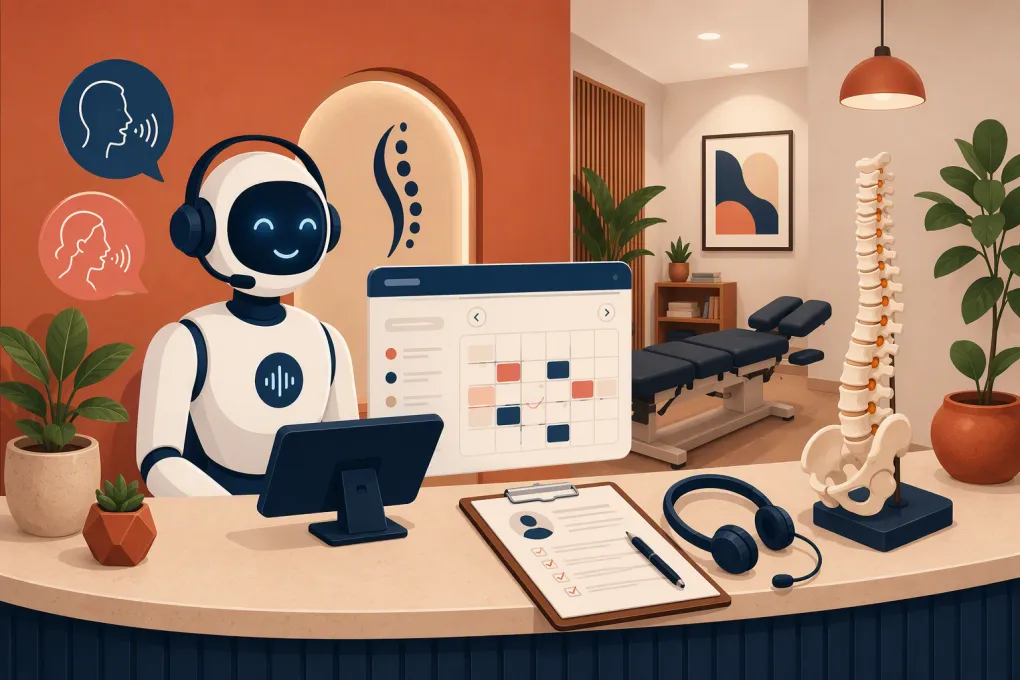 Watch · 20s
A chiropractic front desk does not manage a generic medical calendar. It may be balancing new-patient exams, report-of-findings visits, recurring adjustments, massage appointments, decompression resources, family bookings, personal-injury documentation, and patients arriving for short treatment slots—all while the phone keeps ringing.
Now add a caller who prefers Spanish. If the only bilingual employee is assisting a patient, the call may sit on hold or become a message that requires another round of phone tag. A bilingual AI receptionist can help, but only if it understands the clinic’s actual scheduling rules. Fluent translation alone is not enough.
The right system should distinguish an adjustment from a new-patient evaluation, avoid making clinical or insurance promises, and transfer conversations that require judgment.
Ask WTF Go to demonstrate your real English-Spanish chiropractic call flow →
Where chiropractic calls become operationally difficult
Many chiropractic appointments are short and recurring. That makes an interruption at the front desk disproportionately disruptive. An employee may be checking in one patient, collecting a balance from another, and trying to schedule a family’s next three visits when a new-patient call arrives.
The caller rarely opens with the exact appointment type needed. They may say:
- “I need an adjustment.”
- “Me duele la espalda.”
- “I was in a car accident.”
- “Do you take my insurance?”
- “Can I come in for decompression?”
- “My chiropractor told me to return next week.”
Those statements require different administrative paths. A new patient asking for an adjustment may need an exam before treatment. An existing patient may be eligible for a standard adjustment slot. A personal-injury caller may require staff review, attorney or claim information, and a different intake process. A decompression request may depend on provider approval and equipment availability.
A useful AI receptionist follows those distinctions instead of placing every caller into the next open appointment.
Chiropractic workflows a bilingual AI receptionist can handle
New-patient exam requests
The agent can identify whether the caller has visited the clinic before, collect basic contact information, offer approved new-patient appointment blocks, and send intake instructions.
A typical administrative flow is:
- Confirm preferred language.
- Determine whether the person is new or established.
- Ask which clinic location they want.
- Identify the general visit category without diagnosing.
- Offer eligible new-patient times.
- Confirm what to bring and how to complete forms.
- Send a bilingual confirmation.
The AI should not promise that an adjustment, X-ray, or other service will occur during the first visit. That depends on clinic policy and the chiropractor’s assessment.
Existing-patient adjustments
Recurring adjustment visits often have different durations and scheduling permissions from examinations. Configuration should account for:
- Provider-specific calendars
- Care-plan or visit-frequency rules
- Minimum time between appointments, if used by the clinic
- Whether inactive patients require re-examination
- Late-arrival and same-day cancellation policies
- Family members booked in adjacent slots
- Whether the patient needs a longer progress exam instead of a routine visit
If the scheduling system does not expose these rules, the AI should create a callback task rather than guess.
Report of findings and progress exams
A report-of-findings visit should not be treated as an interchangeable follow-up slot. It may require a specific provider, room, duration, or sequence after the initial exam.
Likewise, a progress exam or re-examination may need more time than an adjustment. The receptionist should use the appointment labels and eligibility rules already defined by the clinic, not infer the visit type from symptoms.
Massage, decompression, and other resources
Clinics offering massage therapy, spinal decompression, rehabilitation, or similar services may need both a provider and a physical resource available. Ask whether the AI can check linked calendars instead of booking only from a general opening.
A caller requesting decompression should not automatically receive that service. The workflow can collect the request and schedule an approved consultation or staff callback when clinical clearance is required.
Personal-injury and workers’ compensation inquiries
These calls often involve details beyond ordinary self-pay scheduling. The agent may collect limited administrative information, such as the incident date, claim status, attorney contact, or referral source, only when the clinic has approved that workflow.
It should not interpret liability, confirm case acceptance, or promise coverage. Complex cases belong in a staff review queue.
English and Spanish call-flow examples
Scripts should be translated for meaning, not word for word. A fluent reviewer should check terminology, tone, and regional clarity before launch.
| Call step | English | Spanish |
|---|---|---|
| Opening | “Thank you for calling [Clinic]. I’m the automated scheduling assistant. Would you like to continue in English or Spanish?” | “Gracias por llamar a [Clínica]. Soy el asistente automatizado de citas. ¿Prefiere continuar en inglés o en español?” |
| Patient status | “Have you been treated at this clinic before?” | “¿Ha recibido atención en esta clínica anteriormente?” |
| General request | “Are you calling for a new-patient evaluation, an existing appointment, or another question?” | “¿Llama para una evaluación de paciente nuevo, una cita existente u otra consulta?” |
| Nonclinical clarification | “I can help with scheduling, but I cannot determine which treatment you need.” | “Puedo ayudarle con la cita, pero no puedo determinar qué tratamiento necesita.” |
| Insurance boundary | “We can collect your insurance information, but benefits and payment responsibility must be verified.” | “Podemos recopilar la información de su seguro, pero los beneficios y la responsabilidad de pago deben verificarse.” |
| Human handoff | “This question needs a team member. May I arrange a callback?” | “Esta pregunta requiere la ayuda de un miembro del equipo. ¿Puedo solicitar que le devuelvan la llamada?” |
Useful terminology includes “cita para paciente nuevo” for new-patient appointment, “evaluación” for evaluation, “ajuste quiropráctico” for chiropractic adjustment, and “seguro médico” for health insurance. Avoid treating “consulta” as a precise appointment type without context; callers may use it broadly to mean a question, consultation, or visit.
The agent can acknowledge that a caller reports pain, but it should not translate that statement into a diagnosis or treatment choice. Emergency or severe-symptom language should follow a clinic-approved escalation script.
Scheduling-system and integration requirements
Your practice-management or EHR system must remain the source of truth. Chiropractic clinics commonly evaluate systems such as ChiroTouch, Jane, Genesis Chiropractic Software, zHealth, or ClinicMind, but product configurations vary. Naming a system is not proof that an AI vendor integrates with it.
Ask each vendor to demonstrate the workflow using your edition and setup. Confirm:
- Can the AI read live availability?
- Can it create, reschedule, and cancel appointments?
- Does it support your custom appointment types and durations?
- Can it enforce new-patient, provider, location, and resource rules?
- How are duplicate patient records prevented?
- Can it recognize family accounts without exposing another patient’s information?
- Where are call summaries, recordings, and intake details stored?
- What happens if the scheduling system or integration is unavailable?
- Is write-back performed through an official API, middleware, or manual task?
- Which system owns consent status and communication preferences?
If no direct integration exists, define the limitation plainly. An AI that collects a preferred time and creates a staff task can still help with coverage, but that is appointment requesting—not confirmed booking.
See how Fitty could fit around your current inquiry and booking process →
A practical vendor-comparison checklist
Do not buy from a polished demonstration alone. Use the same scenarios for every vendor and score the completed workflow.
| Criterion | What to require in a demonstration | Warning sign |
|---|---|---|
| Language handling | English, Spanish, mid-call switching, names, dates, addresses, and interruptions | Only prerecorded or idealized conversations |
| Chiropractic logic | New exams, adjustments, re-exams, reports of findings, and resource-based visits | Every request maps to a generic appointment |
| Scheduling | Live availability and accurate write-back to your actual system | Calendar shown is not your software or configuration |
| Escalation | Transfer, callback task, failed-call handling, and staff notification | The agent improvises when uncertain |
| Insurance | Collects approved details without guaranteeing benefits | Claims that coverage is confirmed without verification |
| Privacy | Documented data flow, access controls, retention, deletion, and contract terms | Vague assurances that the platform is “HIPAA ready” |
| Administration | Clinic staff can update hours, scripts, providers, and policies | Every change requires an undefined support process |
| Reporting | Outcomes for answered calls, bookings, transfers, failures, and corrections | Reporting focuses only on total call volume |
| Downtime | Clear fallback when the internet, calendar, or vendor service is unavailable | No documented failure path |
Also ask who performs implementation, what information the clinic must supply, how long number routing takes, how staff are trained, and what support is available when a booking rule changes.
How to test before routing every call
Start with after-hours new-patient calls or overflow coverage, not the entire phone queue. Build a test list from situations your staff actually handles:
- A Spanish-speaking new patient asks for an adjustment today.
- An existing patient needs a routine visit with a specific chiropractor.
- A parent wants adjacent appointments for family members.
- A patient requests decompression without prior evaluation.
- A caller mentions a recent auto accident and an attorney.
- Someone asks whether insurance will cover the visit.
- A patient needs to reschedule a report-of-findings appointment.
- The requested provider, room, or equipment is unavailable.
- The caller switches languages halfway through the call.
- The scheduling connection fails during booking.
Check the resulting calendar entry, patient record, summary, language, and staff notification—not merely whether the voice sounded natural. A pleasant call that creates the wrong appointment still adds front-desk work.
Privacy, consent, and clinical boundaries
Chiropractic clinics may transmit protected health information through calls, forms, recordings, and appointment notes. Before launch, review whether the vendor will sign a Business Associate Agreement when required and whether the intended workflow meets your legal and contractual obligations.
Determine what is recorded, how callers are notified, where data is stored, who can access it, how long it is retained, and whether it is used for model training. Automated calling and texting also require appropriate consent and opt-out handling. State recording and disclosure laws may differ, so obtain qualified guidance for your locations.
The AI should immediately escalate clinical advice requests, severe or rapidly worsening symptoms, complaints, records requests, legal questions, and any caller who asks for a person.
Where Fitty fits—and what to verify
WTF Go positions Fitty around defined front-office jobs: answering leads, booking, following up, and supporting dues collection around the clock. For a chiropractic clinic, those general capabilities are only the starting point.
Before deployment, ask WTF Go to document and demonstrate:
- Support for the languages and language switching you require
- Compatibility with your exact scheduling or practice-management system
- Whether appointments are confirmed directly or passed to staff
- Handling of protected health information and BAA requirements
- Rules for chiropractic appointment types and multi-resource scheduling
- Human transfer, callback, and downtime behavior
- Limits on clinical, insurance, personal-injury, and payment conversations
Fitty should not be presented as a clinician, diagnostic tool, or universal replacement for chiropractic practice software. The appropriate role is narrower: automate approved, repetitive conversations while routing exceptions to staff.
Request a Fitty walkthrough using your appointment types, Spanish scripts, and scheduling system →
The operating standard to aim for
A bilingual AI receptionist earns its place when it produces clean appointments and clear handoffs—not simply when it answers in Spanish.
Give the vendor your real visit types, scheduling restrictions, escalation rules, bilingual terminology, and failure scenarios. Then verify the results in the calendar and patient workflow. That is how a chiropractic clinic gains coverage without replacing missed calls with booking errors.
Frequently asked questions
Can a bilingual AI receptionist schedule chiropractic adjustments?
Yes, if the patient is eligible and the system can enforce the clinic’s provider, duration, and visit-type rules. New or inactive patients may need an evaluation instead of a routine adjustment slot.
Can it work with ChiroTouch, Jane, Genesis, or zHealth?
Compatibility depends on the vendor, product edition, API access, and clinic configuration. Require a live demonstration using your system and confirm whether the AI writes appointments directly or only creates staff requests.
How should Spanish chiropractic scripts be reviewed?
Have a fluent reviewer test appointment terminology, insurance language, names, dates, and regional phrasing. The Spanish workflow should preserve the clinic’s rules rather than translate English sentences literally.
Can an AI receptionist discuss symptoms or recommend treatment?
It can collect limited information needed for routing, but it should not diagnose, select treatment, or make clinical recommendations. Clinical and urgent questions require an approved human or emergency escalation path.
What should a clinic test before going live?
Test new-patient exams, recurring adjustments, re-exams, family bookings, bilingual switching, insurance questions, personal-injury calls, unavailable resources, human transfers, and scheduling-system downtime.
Keep reading

Run your gym on autopilot with WTF Go
Fitty — your AI receptionist — answers calls and DMs, fills classes, follows up with every lead, and collects dues while you coach.