Comparisons
Aqua Fitness Class Management Software: An Operator Guide
Compare aqua fitness class management software for booking, passes, instructors, payments, and follow-up. Use this practical guide to choose the right fit.
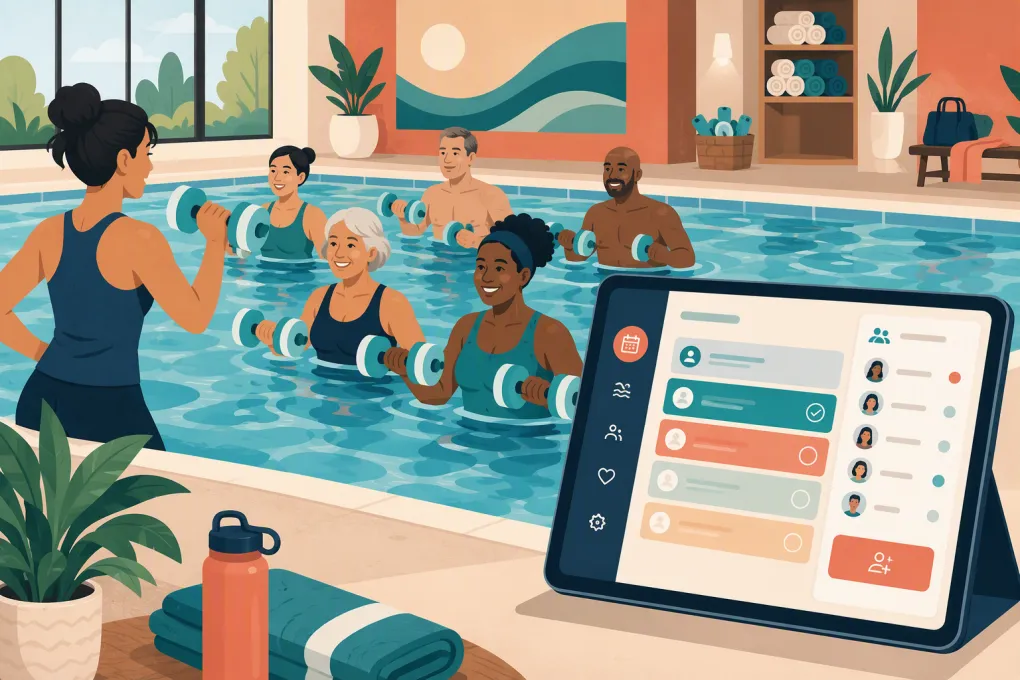 Watch · 20s
Running aqua fitness classes looks simple from the pool deck. Put a class on the calendar, accept registrations, and check people in. Behind the scenes, operators are managing pool capacity, instructor availability, passes, recurring memberships, waitlists, waivers, payment issues, and questions from customers who may prefer calling over using an app.
Generic scheduling tools can handle a calendar. The right aqua fitness class management software should manage the complete path from first inquiry to paid attendance—and make that path usable for both staff and members.
Before comparing vendors, define what you actually operate. A standalone water aerobics instructor has different requirements from a health club with one pool, a swim school adding adult fitness, or a municipal aquatic center sharing lanes among several programs.
See how Fitty handles aqua fitness inquiries, bookings, follow-up, and dues around the clock →
What aqua fitness software needs to manage
Aqua fitness is still a class-based business, but the pool creates operating constraints that ordinary appointment software may not understand.
Class schedules and pool capacity
The system should support recurring classes, one-time sessions, substitutions, cancellations, and capacity limits. Confirm whether capacity can be set by class, location, room, or resource.
If multiple programs use the same pool, ask whether the software can prevent conflicting reservations. A class may need the whole pool, two lanes, the shallow end, or a specific warm-water pool. Some fitness platforms schedule classes well but do not offer detailed facility-resource allocation.
Memberships, passes, and eligibility
Aqua programs commonly sell access through several models:
- Monthly recurring memberships
- Fixed-count class packs
- Drop-in admission
- Session-based enrollment
- Memberships shared with a gym or wellness facility
- Discounted access for defined customer groups
Test whether the software applies the correct pass automatically during booking. Staff should not need to inspect accounts manually every morning.
Also check expiration rules, failed-payment handling, freezes, credits, refunds, and whether customers can hold more than one valid purchase option.
Waitlists and cancellation rules
Pool capacity is finite, so an unreliable waitlist creates empty spots and frustrated members. Look for automatic promotion, clear acceptance rules, and configurable notification timing.
Decide how the platform should handle late cancellations and no-shows. The system may need to return a class credit, retain it, or apply a fee depending on the membership agreement. Make sure those rules can be communicated during checkout—not buried in a confirmation email.
Lead response and assisted booking
Not every aqua fitness customer wants to download an app and navigate a new account. Some will ask whether the pool is heated, what equipment is provided, whether beginners are welcome, or which class has a gentler pace.
Software that only provides a booking link leaves those questions with the front desk. An AI receptionist can answer routine inquiries, guide a prospect toward an appropriate class, complete the booking, and follow up when the person does not finish registering.
That matters after hours, when staff are coaching, or when the front desk also serves the rest of a facility. The goal is not to eliminate human support. It is to stop straightforward inquiries from waiting unnecessarily.
Instructor and staff workflows
An instructor-facing schedule should show the information needed to run the class without exposing unnecessary customer data. Useful workflows include:
- Mobile attendance and check-in
- Substitute assignments
- Instructor availability
- Class notes and internal alerts
- Roster exports when required
- Notifications for schedule or pool changes
Ask how permissions work. An instructor may need attendance access without permission to issue refunds, edit memberships, or view business-wide reports.
Waivers and customer records
The platform should collect required agreements during registration and retain a record of acceptance. If guardians register dependents, test the family-account workflow carefully.
Avoid collecting health information simply because a form allows it. Decide what staff genuinely need, limit access, and establish retention practices. Software does not determine whether your waiver, screening process, or data practices meet applicable legal requirements; those questions belong with qualified counsel and your insurer.
Aqua fitness software comparison
No platform is automatically best for every aquatic operation. The most useful shortlist depends on whether your business is primarily a fitness studio, swim school, recreation department, or multi-service wellness facility.
| Software | Best suited to | Core strengths | Automation and lead handling | Limitation to examine | Pricing approach |
|---|---|---|---|---|---|
| WTF Go | Independent and multi-location gyms, studios, spas, and wellness operators offering aqua fitness | All-in-one operating platform with class and customer workflows | Fitty answers leads, books classes, follows up, and collects dues 24/7 | Confirm how your pool, lane, or shared-resource structure should be configured | Contact WTF Go for current plan details |
| Mindbody | Established fitness and wellness businesses that want broad business management and consumer discovery | Scheduling, client management, memberships, payments, marketing tools, and a consumer marketplace | Offers business communication and marketing capabilities; verify which package supports the automation you need | The breadth of the platform and package structure may exceed the needs of a small standalone program | Plans and add-ons vary; request current pricing |
| WellnessLiving | Fitness and wellness businesses wanting scheduling, memberships, payments, and engagement tools | Broad class-management and customer-facing features | Includes marketing and client-engagement capabilities, with availability varying by plan | Validate aquatic resource scheduling and the total cost of required features | Tiered plans and optional features; confirm current terms |
| TeamUp | Independent fitness businesses prioritizing straightforward class and membership administration | Class scheduling, memberships, payments, forms, and customer self-service | Supports customer communications and integrations; evaluate whether lead response is automated enough for your operation | May require another tool or process for detailed pool-resource management and conversational lead handling | Generally subscription-based; check current plan and payment terms |
| Amilia SmartRec | Community recreation organizations and facilities managing multiple activities and resources | Registration, activities, memberships, facilities, and recreation administration | Stronger orientation toward recreation administration than AI-led sales conversations | May be more operationally extensive than a boutique aqua fitness provider needs | Organization-specific pricing; request a quote |
| Jackrabbit Swim | Swim schools where lessons, family accounts, enrollment, and billing are central | Swim-school administration, class enrollment, billing, family workflows, and skill tracking | Communication tools support school operations; assess separate needs for sales follow-up | Adult drop-in fitness, gym memberships, or broader wellness services may not match its swim-school model | Pricing typically depends on business configuration; verify current rates |
Vendor features and packaging change. Treat this table as a shortlist, then confirm current functionality in a live demonstration and written proposal.
Compare your current booking and follow-up process with WTF Go and Fitty →
How to choose the right system
Map the customer journey first
Do not begin with a feature checklist copied from a vendor page. Map one real customer journey:
- The prospect asks which aqua class is appropriate.
- The business responds and recommends a session.
- The prospect creates an account and signs required documents.
- The customer buys a pass or membership.
- The system books the class and sends confirmation.
- The customer joins a waitlist or cancels if needed.
- Staff check the customer in.
- The business follows up after the first visit.
- The system handles renewal or an overdue balance.
During each demo, ask the vendor to perform that journey without skipping steps. Count the staff interventions, separate logins, and manual messages required.
Build a requirements scorecard
Separate requirements into three groups:
Non-negotiable: Functions required to operate safely and collect revenue, such as capacity controls, payments, waivers, and attendance.
High-value: Functions that reduce repetitive work, such as automated follow-up, waitlist promotion, and failed-payment outreach.
Optional: Useful features that should not outweigh a poor booking experience.
Score each system using the same scenarios. Do not award points merely because a feature exists. Confirm that it works with your rules, staff permissions, and customer types.
Test the booking experience on a phone
Complete a booking as a new customer using a mobile browser. Look for avoidable friction:
- Is account creation required before the schedule is visible?
- Are class level, water depth, duration, and equipment requirements clear?
- Can the customer choose the right pass without understanding your internal terminology?
- Are cancellation rules visible before payment?
- Can someone get help without abandoning the page?
Also test larger text settings, keyboard navigation, contrast, and error messages. Many aqua programs serve a broad age range, so readability and assisted booking deserve serious attention.
Examine reporting and exports
At minimum, operators should be able to review attendance, capacity utilization, no-shows, membership status, sales, and outstanding balances. Multi-location businesses should ask whether reporting can be viewed by pool, program, instructor, and location.
Confirm that customer, payment, and attendance data can be exported in a usable format. Data portability matters during analysis, accounting work, and any future migration.
Plan the migration before signing
A weak migration can make capable software feel broken. Ask who is responsible for importing customer profiles, memberships, remaining class credits, future bookings, waivers, and stored payment credentials.
Payment credentials usually require special handling and may not transfer like an ordinary spreadsheet. Get the process, responsibilities, expected downtime, and fallback plan in writing.
Use a staged launch:
- Clean duplicate and inactive records.
- Configure services, passes, taxes, policies, and permissions.
- Import a test group.
- Run staff through booking, cancellation, refund, and check-in scenarios.
- Publish customer instructions.
- Monitor the first billing and renewal cycles closely.
Do not cancel the old platform until financial reconciliation and critical data exports are complete.
Where Fitty fits an aqua fitness operation
Scheduling software records a booking. Fitty addresses the conversation that often has to happen before and after it.
For an aqua fitness business, that can mean responding when a lead asks about beginner classes, booking the selected session, following up with an inquiry that did not convert, or collecting dues without requiring staff to work through a call list.
This is especially useful when the same employee is checking in members, handling towels or equipment, responding to pool closures, and supporting other facility programs. Fitty gives routine revenue and service conversations a consistent path while staff retain control over exceptions.
See how WTF Go can run your aqua fitness bookings and Fitty-powered follow-up in one system →
The final decision should come down to operational fit. Choose software that handles your actual pool constraints, makes booking comfortable for your customers, gives staff a clean daily workflow, and prevents leads or overdue accounts from disappearing into manual follow-up lists.
Frequently asked questions
What is aqua fitness class management software?
It is software used to schedule aquatic fitness classes, manage registrations and capacity, sell passes or memberships, collect payments, track attendance, and communicate with customers.
Can regular gym software manage water aerobics classes?
Often, yes. Confirm that it supports your pool-capacity rules, recurring schedules, waitlists, passes, waivers, and any shared pool or lane resources.
What should a municipal aquatic center look for?
Prioritize activity registration, family accounts, facility and resource scheduling, permissions, financial reporting, accessibility, and support for multiple programs beyond aqua fitness.
Can aqua fitness software automate calls and follow-up?
Some platforms provide messaging or marketing automation, but capabilities vary. WTF Go includes Fitty, an AI agent that answers leads, books classes, follows up, and collects dues 24/7.
How should I compare aqua fitness software demos?
Give every vendor the same real-world scenario, from a new inquiry through booking, check-in, cancellation, and renewal. Track how many manual staff actions and separate tools each workflow requires.
Keep reading


Run your gym on autopilot with WTF Go
Fitty — your AI receptionist — answers calls and DMs, fills classes, follows up with every lead, and collects dues while you coach.