AI & Automation
Use AI to Collect Gym Membership Dues Without Extra Staff
Learn how to use AI to collect gym membership dues with compliant reminders, smart follow-up, payment links, escalation rules, and human oversight built in.
 Watch · 20s
Unpaid gym dues rarely come from one problem. A card expires, a member switches banks, an account lacks funds, or someone assumes a cancellation request was completed. The balance then sits untouched because the front desk is handling check-ins, calls, classes, and sales.
Using AI to collect gym membership dues does not mean turning a chatbot loose on overdue accounts. It means giving an automated agent clear rules for identifying payment issues, contacting members, answering routine questions, sharing secure payment options, and escalating exceptions to a person.
Done well, the result is a more consistent collections process without making every payment problem feel like a confrontation.
What AI can handle in the dues collection process
AI is most useful for communication and workflow coordination. Your billing system or payment processor should remain the system responsible for storing payment credentials, processing authorized charges, and recording transaction status.
An AI agent can support that system by:
- Detecting failed or overdue payments from billing events
- Distinguishing an expired card from a disputed balance
- Sending reminders through approved channels
- Adjusting messages based on the account status and prior response
- Providing a secure link to update payment details or pay
- Answering basic questions about the balance or next step
- Recording replies and promised payment dates
- Alerting staff when a member needs individual help
- Stopping follow-up after payment, cancellation, or an opt-out
This is more capable than a fixed reminder sequence. A conventional automation sends the next message because a timer expired. An AI-driven workflow can also consider whether the member replied, asked for help, updated a card, disputed the charge, or requested human contact.
Start with a clear collections policy
Automation will amplify whatever process you give it. Before configuring AI, define the rules your team is supposed to follow.
Your policy should answer:
- When is a payment considered late?
- Does access change while a balance is outstanding?
- Are grace periods available?
- Can staff offer payment arrangements or waived fees?
- Who can approve an exception?
- What happens when a member disputes the amount?
- When should automated contact stop?
- When does an account move to manual review or an outside collection provider?
Make these rules consistent with your membership agreement and applicable law. If the written agreement says one thing while the AI agent says another, you create avoidable disputes.
Multi-location operators should also decide which rules are companywide and which can vary by location. The AI needs the correct agreement, contact information, escalation owner, and access policy for each member’s home club.
Build the workflow around payment status
Do not put every unpaid account into the same sequence. Use the reason for nonpayment to select the next action.
| Account status | Recommended automated action | When staff should step in |
|---|---|---|
| Failed card payment | Explain that the payment did not process and send a secure update link | Member says the card is valid or reports repeated errors |
| Expired card | Ask the member to replace the payment method through the billing portal | Member cannot access the portal |
| Insufficient funds | Send a neutral notice and offer an authorized retry or payment link | Member requests more time or an arrangement |
| Outstanding invoice | Identify the invoice and provide a way to review and pay it | Member disputes the service or amount |
| Cancellation claim | Pause collection messaging and route the account for agreement review | Always, unless your system clearly confirms the cancellation |
| Financial hardship | Acknowledge the request without promising unauthorized terms | A manager should review available options |
| No response | Continue the approved cadence, then escalate according to policy | Balance reaches your manual-review threshold |
The AI should never invent a fee, settlement, refund, or payment-plan term. Limit it to options your business has approved.
Use a measured contact sequence
The goal is to resolve the balance, not overwhelm the member. A practical starting sequence might look like this:
Immediately after a failed payment
Send a brief transactional notice. State what happened, identify the business, and provide a secure next step.
Hi Jordan, your membership payment to Northside Fitness did not process. You can update your payment method securely here: [billing portal link]. Reply if you believe this is an error or need help.
Avoid language implying misconduct. Many failed payments are administrative problems, not deliberate nonpayment.
After two or three days
If the balance remains open and there has been no reply, send a concise follow-up. Mention any relevant account consequence only if it is supported by the membership agreement and your actual policy.
Your Northside Fitness balance is still open. You can review and pay it through this secure link: [billing portal link]. If you have already handled it, no action is needed.
After several more days
Offer a clear route to a person. This is especially important when the account has multiple failures, prior disputes, or a long-standing membership.
We have not been able to resolve the outstanding balance on your membership. Reply HELP if you would like our team to review the account with you.
The exact timing should reflect your billing cycle, agreement, communication consent, and operating policy. Test the sequence on internal accounts before applying it to members.
Give the AI the right data and boundaries
An AI agent cannot make sound decisions from an email address and a balance alone. It needs structured, current account information.
Useful inputs include:
- Member name and preferred contact channel
- Home location and membership type
- Payment status and failure reason
- Amount due as recorded by the billing system
- Due date and prior contact attempts
- Payment portal URL
- Agreement status, including freeze or cancellation activity
- Communication consent and opt-out status
- Notes requiring human review
Access should follow the principle of least privilege. The agent needs enough information to explain the next step, but it should not receive full card numbers or unnecessary personal data. Payment updates should happen through a PCI-compliant processor or hosted billing portal, not inside a free-form AI conversation.
Set hard boundaries as well. Require human review for disputed charges, legal threats, bankruptcy notices, deceased members, suspected fraud, complex cancellations, and unusual refund requests.
Protect consent, privacy, and member trust
Automated collections touch several compliance areas. Requirements can depend on the channel, message type, jurisdiction, whether you are collecting your own debt, and whether a third party is involved. Have qualified counsel review your process rather than assuming one rule covers every situation.
At an operational level:
- Document consent for automated texts and calls where required
- Honor opt-outs promptly
- Use reasonable contact hours
- Clearly identify the business
- Avoid misleading deadlines or consequences
- Do not expose account details in messages that someone else might see
- Keep an audit trail of messages, replies, status changes, and staff actions
- Pause automation when a balance is disputed
- Define how long conversation and payment-status data is retained
The Fair Debt Collection Practices Act generally focuses on third-party debt collectors, but state laws and other federal rules may still affect an operator’s communications. The Telephone Consumer Protection Act can also matter when using automated calls or texts. Compliance should be designed into the workflow, not added after a complaint.
Measure resolution, not message volume
Sending more reminders is not the objective. Track whether the workflow resolves accounts accurately and respectfully.
Useful operating metrics include:
- Number and value of newly failed payments
- Accounts resolved through self-service
- Time from failure to payment
- Payment-link completion
- Replies requiring staff assistance
- Disputes and cancellation claims
- Opt-outs and complaints
- Messages sent after an account was already resolved
- Accounts repeatedly returning to delinquent status
Review conversation samples regularly. Look for incorrect account details, vague instructions, broken links, excessive follow-up, or promises outside policy. AI workflows need quality control just like front-desk scripts do.
Where Fitty fits into the process
Fitty, the AI receptionist inside WTF Go, can handle dues follow-up alongside lead response, class booking, and routine member communication. That gives an operator one agent that can stay available around the clock while keeping conversations connected to broader member workflows.
The important part is configuration. Fitty should be given your approved payment rules, escalation paths, location details, and communication boundaries. Secure payment processing should still run through the appropriate billing environment rather than through improvised collection of card details.
If you are evaluating AI for dues collection, ask to see how the system handles a dispute, an opt-out, a completed payment, and a cancellation claim—not just how it sends the first reminder.
A practical implementation checklist
Before activating an AI dues workflow, confirm that you have:
- Documented collection and exception policies
- Clean payment-status data
- A secure member-facing payment portal
- Approved message templates and contact windows
- Consent and opt-out records
- Clear rules for stopping messages
- Named staff owners for escalations
- Location-specific information where necessary
- Test accounts covering common failure scenarios
- A weekly review process for exceptions and conversation quality
Start with one payment-failure category, such as expired cards, and run it through the complete workflow. Once status updates, messages, payment links, stop conditions, and escalations work correctly, expand to more complex account types.
AI can remove repetitive chasing from the front desk, but it should not remove judgment from collections. The strongest setup combines immediate automated follow-up, secure self-service payment, accurate account context, and a clear path to a human when the situation is no longer routine.
Frequently asked questions
Can AI automatically charge a member's card for overdue dues?
AI should not initiate unauthorized charges. Any retry or recurring charge must follow the membership agreement, the member's authorization, and the rules of your payment processor.
Should overdue members receive texts, emails, or calls?
Use channels for which you have the appropriate contact information and consent. Email and text often support secure self-service links, while sensitive or disputed accounts may require a staff call.
What payment information should an AI agent have access to?
Give it payment status, the amount due, failure reason, and a secure portal link. Do not expose full card numbers or other unnecessary financial data to the conversation.
When should an AI dues conversation be escalated to staff?
Escalate disputes, cancellation claims, hardship requests, legal issues, suspected fraud, unusual refunds, and any case the approved policy does not clearly cover.
Can Fitty collect gym membership dues after business hours?
Yes. Fitty can conduct dues follow-up around the clock, subject to configured contact hours, consent rules, payment workflows, and human escalation policies.
Keep reading
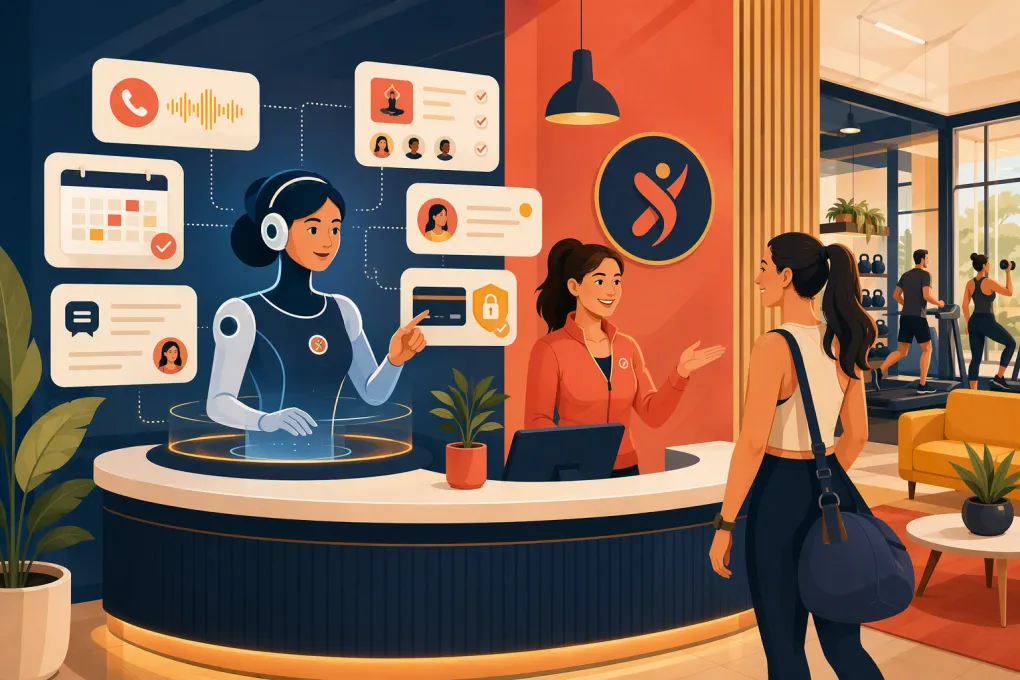


Run your gym on autopilot with WTF Go
Fitty — your AI receptionist — answers calls and DMs, fills classes, follows up with every lead, and collects dues while you coach.