Comparisons
AI Receptionist vs Virtual Receptionist for Gyms: Which Works?
Compare AI receptionist vs virtual receptionist for gyms across speed, cost structure, booking, lead follow-up, dues, oversight, and member experience.
 Watch · 20s
A missed call at 7:30 p.m. is not just a missed call. It may be a trial request, a membership question, a class cancellation or a member trying to resolve a payment issue. If nobody responds until the next shift, that conversation can go cold—or become tomorrow’s front-desk fire.
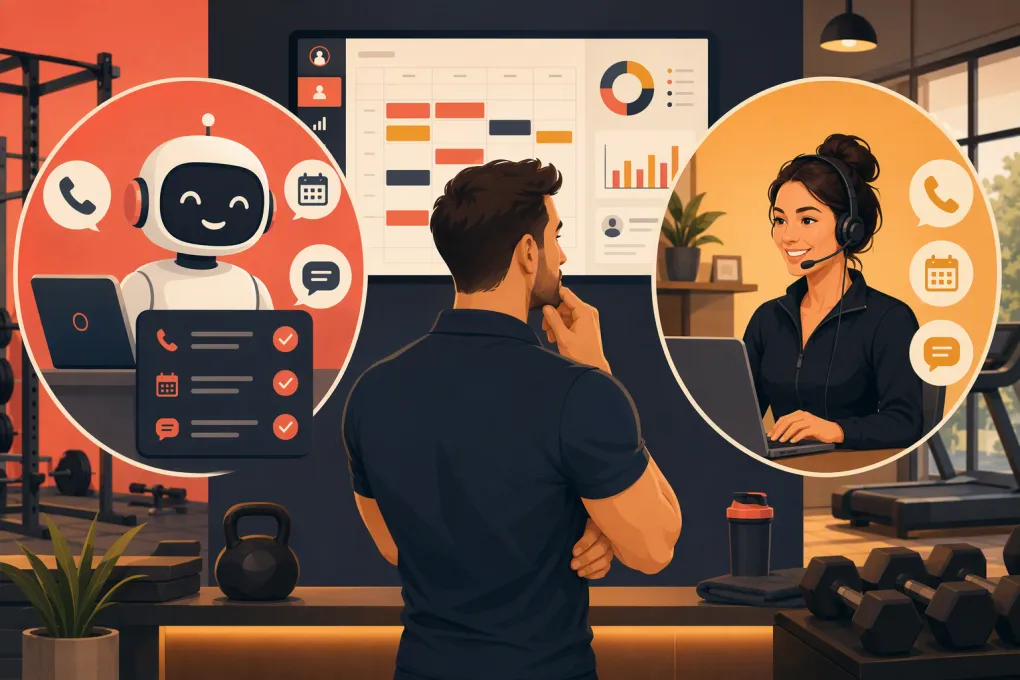
Both AI receptionists and virtual receptionists can extend coverage beyond the physical front desk. But they solve the problem differently. AI is built for immediate, repeatable execution at scale. A virtual receptionist provides human judgment and conversation, but capacity, consistency and coverage depend on staffing and service terms.
The right choice depends less on whether AI or humans are universally better and more on what you need the receptionist to accomplish.
See how Fitty handles gym leads, bookings and follow-up around the clock →
What is an AI receptionist for gyms?
An AI receptionist is software that communicates with prospects and members, interprets common requests and takes predefined actions. Depending on the platform and configuration, those actions may include:
- Answering questions about memberships, schedules and amenities
- Capturing and qualifying leads
- Booking trials, classes or appointments
- Sending confirmations and reminders
- Following up with prospects who have not booked
- Routing unusual or sensitive requests to staff
- Directing members to a secure dues-payment workflow
A useful AI receptionist should do more than generate conversational answers. It needs access to current business rules and the ability to complete the next step. Telling someone that a trial is available is less valuable than actually booking the correct trial, recording the lead and triggering confirmation.
AI is strongest when requests are frequent, time-sensitive and governed by clear rules. Its performance depends heavily on setup quality. Incorrect schedules, vague policies or poorly designed escalation rules will produce a poor experience quickly and consistently.
What is a virtual receptionist?
A virtual receptionist is a person working remotely who answers calls or messages on behalf of the gym. The receptionist may be a dedicated contractor, part of an agency team or an employee provided through a reception service.
Virtual receptionists can generally:
- Answer calls using an approved script
- Explain common services and policies
- Take messages or transfer calls
- Enter lead information into a system
- Schedule appointments when given booking access
- Handle conversations requiring empathy or judgment
- Escalate complaints and unusual situations
The main advantage is human interpretation. A skilled receptionist can recognize hesitation, adapt their language and manage an emotional caller without relying on a predefined path.
The limitation is operational. A person can only manage a limited number of simultaneous conversations, and service quality may vary by receptionist, shift, training and familiarity with your gym.
AI receptionist vs virtual receptionist for gyms
| Criterion | AI receptionist | Virtual receptionist | Traditional answering service | In-house front desk |
|---|---|---|---|---|
| Availability | Can operate continuously when the platform and workflows are active | Based on contracted hours and staffing | Usually sold around defined coverage plans | Limited to scheduled employee hours |
| Simultaneous demand | Can handle multiple routine conversations at once | Limited by human capacity | Calls may queue or roll across agents | Walk-ins, calls and admin work compete for attention |
| Response consistency | Applies configured rules consistently | Depends on training and individual judgment | Usually follows standardized scripts | Depends on staff training and shift execution |
| Nuanced conversations | Best for common, structured requests | Strong when empathy and interpretation matter | Varies by agent quality and account knowledge | Strong when experienced staff are available |
| Booking | Can book directly if connected to live availability and rules | Can book if trained and given system access | Often takes messages; direct booking varies | Usually has direct booking access |
| Lead follow-up | Can trigger repeatable follow-up automatically | Requires assigned tasks, time and oversight | Often outside basic answering scope | Frequently delayed by floor responsibilities |
| Dues workflows | Can send approved payment steps or secure links | Can explain options and guide members | Usually escalates payment matters | Can handle payments under internal procedures |
| Training and updates | Update the knowledge base, rules and workflows | Retrain the receptionist or service team | Submit scripts and account instructions | Train each employee and reinforce changes |
| Pricing model | Commonly platform-, feature- or usage-based | Commonly hourly, monthly, per-call or per-minute | Often plan-, minute- or call-based | Wages plus management, payroll and workspace costs |
| Best fit | High-volume routine conversations and fast follow-up | Complex calls needing human judgment | Basic overflow and message taking | On-site service, tours and member relationships |
Exact capabilities and pricing vary by provider. Ask whether booking, outbound follow-up, transfers, payment workflows and integrations are included rather than assuming that every receptionist service supports them.
Where AI usually has the operational advantage
Speed to lead
AI can respond as soon as an inquiry arrives, including when staff are coaching, closing the facility or asleep. That matters because prospects often contact multiple gyms while they are motivated to act.
The workflow should not stop at an instant greeting. A practical sequence is:
- Identify the prospect’s goal, preferred location and schedule.
- Recommend an appropriate trial, consultation or intro class.
- Offer live availability.
- Book the selected time.
- Send confirmation and preparation instructions.
- Follow up if the prospect does not complete the booking.
Without those steps, an AI receptionist is just a faster message taker.
Consistency across locations
Multi-location operators need consistent answers without making every response sound generic. An AI receptionist can apply organization-wide policies while using location-specific schedules, offers, parking instructions and escalation contacts.
This requires clean data ownership. Assign one person to approve changes and document when information was last reviewed. Do not let old promotions, holiday hours or class rules remain available indefinitely.
Routine follow-up
Front-desk employees rarely ignore leads intentionally. They get pulled into check-ins, towel issues, tours, cleaning, coach questions and member conversations. Automated follow-up removes that competition for attention.
Fitty, WTF Go’s AI receptionist, is designed to answer leads, book classes, follow up and help collect dues within the same operating system. That reduces the handoff gap between the conversation and the operational record.
See how Fitty turns gym inquiries into booked next steps →
Where a virtual receptionist can be the better choice
Emotional or sensitive conversations
Membership disputes, injury concerns, complaints about another member and complicated freezes may need careful human judgment. Even if AI starts the conversation, these requests should move to an accountable staff member or trained virtual receptionist.
Complex sales conversations
Boutique services, high-ticket coaching and medically adjacent wellness offerings may involve detailed questions that do not fit a standard qualification flow. A strong human salesperson can explore objections, understand context and adjust the conversation in real time.
Rapidly changing operations
If your policies live in employees’ heads and change constantly, AI implementation will expose that weakness. A virtual receptionist may adapt faster through direct instruction, although undocumented changes will still create inconsistent service.
This is not an argument against AI. It is a reason to document the business before automating it.
The best setup is often a controlled hybrid
You do not have to choose one system for every conversation. A practical hybrid model uses AI for immediate handling and humans for defined exceptions.
Let AI handle:
- New lead qualification
- Trial and class booking
- Schedule and amenity questions
- Confirmations and routine reminders
- Unfinished lead follow-up
- Secure payment-link delivery
- Basic cancellation and freeze instructions
Escalate to a human for:
- Safety concerns or emergencies
- Charge disputes and refund decisions
- Injury or medical questions
- Harassment or conduct complaints
- Contract interpretation
- Repeated misunderstanding or explicit requests for a person
- High-value sales opportunities requiring consultation
Create an escalation matrix with the issue type, owner, contact method and expected response window. If AI says someone will call back but no task is assigned, the automation has only hidden the failure.
How to compare providers without buying a demo
Give every provider the same test scenarios. Use questions that reflect real front-desk traffic, not idealized demos:
- I want to try a class tomorrow after work. What can I book?
- Can my teenager attend this class?
- I am running late. Will I still be admitted?
- I need to freeze my membership because of an injury.
- Your website shows two different schedules. Which is correct?
- My payment failed. How can I update it securely?
- I booked the wrong location. Can you fix it?
- I want to speak with a manager.
Score each option on:
- Accuracy
- Time to response
- Ability to complete the requested action
- Correct use of location-specific information
- Quality of escalation
- Recordkeeping in your operating system
- Ease of updating policies
- Reporting and conversation review
Also ask what happens when the receptionist does not know an answer. A trustworthy system should escalate or admit uncertainty—not invent a policy.
What to measure after launch
Review outcomes weekly during rollout, then establish a regular operating cadence. Useful measures include:
- Calls or inquiries answered
- Time to first response
- Qualified leads created
- Trials or consultations booked
- Booking completion and show rate
- Conversations escalated to staff
- Unresolved requests
- Opt-outs and complaints
- Dues workflows started and completed
- Incorrect answers identified during review
Pair the numbers with conversation audits. A high booking count is not useful if people are placed in the wrong class or receive inaccurate arrival instructions.
Which receptionist model should your gym choose?
Choose an AI receptionist when your biggest problems are delayed responses, repetitive questions, inconsistent follow-up or unattended after-hours demand.
Choose a virtual receptionist when conversations regularly require judgment, empathy or flexible sales skills and you have a process for training and monitoring the person handling them.
Choose a hybrid when you want immediate coverage without forcing automation to handle situations it should not own. For many gyms, this is the most operationally sound model: AI handles the repeatable front line, while staff take over when their judgment has real value.
The deciding question is not whether the voice sounds human. It is whether the system can move a prospect or member to the correct next step, record the outcome and involve your team at the right moment.
Explore WTF Go and see how Fitty can cover the repetitive front-desk work →
Frequently asked questions
Can an AI receptionist book gym classes and trials?
Yes, if it has access to current availability, eligibility rules and the booking workflow. Confirm whether a provider completes bookings or only collects information for staff.
Is an AI receptionist cheaper than a virtual receptionist?
It can be more economical for high volumes of routine conversations, but pricing models vary. Compare total costs for coverage, booking, follow-up, usage, implementation and staff oversight.
Will members know they are speaking with AI?
Disclosure practices depend on the channel, provider and applicable rules. Clear identification is generally the safer operational approach because it sets expectations and makes human escalation easier.
Can AI safely collect overdue gym dues?
AI can explain the balance and direct members to an approved secure payment workflow. Avoid collecting sensitive card details through unapproved calls, chats or messages.
Should a multi-location gym use AI or a virtual receptionist?
AI is useful for consistent, location-specific answers and repeatable follow-up across locations. A hybrid model is often appropriate when complex complaints, sales consultations or policy exceptions still require people.
Keep reading

Run your gym on autopilot with WTF Go
Fitty — your AI receptionist — answers calls and DMs, fills classes, follows up with every lead, and collects dues while you coach.