Comparisons
AI Receptionist vs Answering Service for Med Spas: Guide
Compare an AI receptionist vs answering service for med spas across speed, booking, compliance, cost, lead follow-up, and patient experience to choose well.
 Watch · 20s
A med spa rarely loses a lead because it lacks treatments. Leads are lost when nobody answers, the caller cannot get a clear response, or booking requires too much back-and-forth.
That makes the choice between an AI receptionist and an answering service more than a phone coverage decision. You are deciding who—or what—will represent the business, qualify inquiries, schedule consultations, manage routine requests, and hand sensitive situations to your team.
Both options can improve coverage. They solve the problem differently, and the right choice depends on the work you expect the service to complete.
The core difference
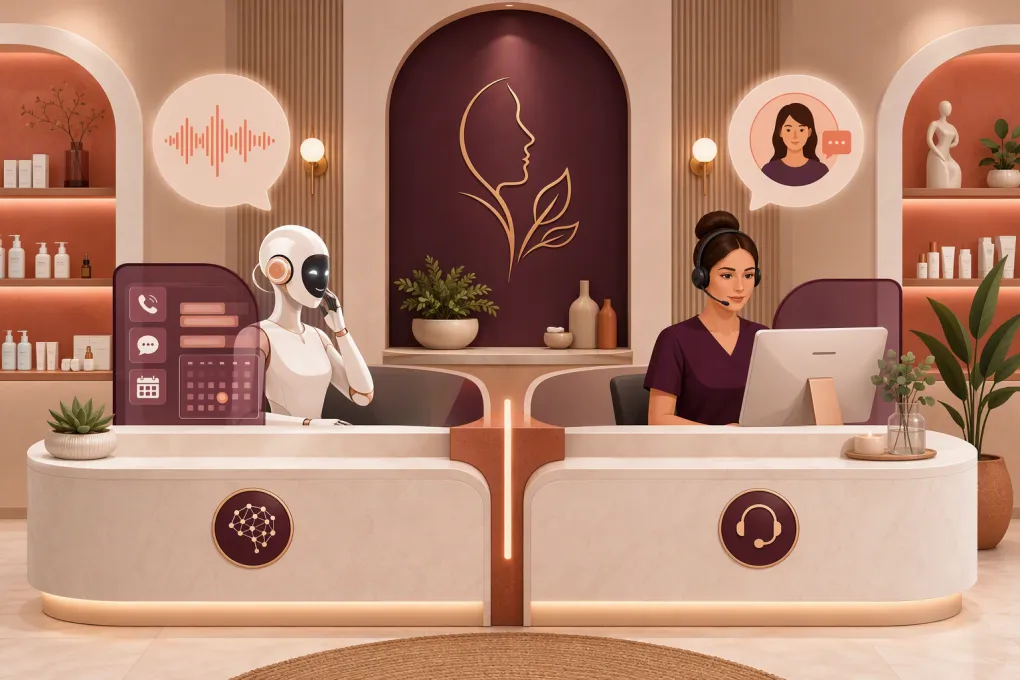
An AI receptionist uses voice and messaging automation to handle conversations according to your business rules. Depending on the platform and setup, it may answer questions, capture contact information, schedule appointments, send follow-ups, and escalate calls to staff.
A traditional answering service routes calls to human agents outside your business. Agents follow scripts, take messages, transfer calls, and—in more capable arrangements—book appointments or perform basic intake.
The practical distinction is action versus coverage.
Many answering services are designed primarily to make sure a person answers. An AI receptionist is typically designed to complete repeatable front-desk workflows across calls and messages. That distinction is not universal: some answering services offer robust scheduling, while some AI products do little beyond collecting a message. Evaluate the actual workflow, not the category label.
See how Fitty can answer med spa leads and move them toward booking 24/7 →
AI receptionist vs answering service for med spas
| Criterion | AI receptionist, including Fitty | Traditional answering service | Hybrid model |
|---|---|---|---|
| Availability | Can respond continuously without shift changes, subject to platform uptime and configuration | Coverage depends on the contracted schedule and staffing model | AI handles routine demand while humans cover defined hours or escalations |
| Response consistency | Uses the same approved rules, service descriptions, and escalation logic every time | Quality can vary by agent, training, turnover, and call volume | Automation provides consistency; humans handle exceptions |
| Appointment booking | Can book directly when connected to the correct calendar, availability, and eligibility rules | Some services book appointments; others only take messages | AI books standard visits and routes complex requests to staff |
| Lead follow-up | Can continue conversations by text or other configured channels and prompt leads to book | Often requires a separate follow-up service or internal staff action | AI performs routine follow-up while staff handles high-value or sensitive leads |
| Human judgment | Limited to configured knowledge, logic, and escalation paths | Better suited to ambiguity, emotion, and unexpected questions | Preserves human judgment where it adds the most value |
| Clinical questions | Should not diagnose or improvise medical guidance; must escalate appropriately | Agents also should not provide clinical advice unless specifically qualified and authorized | Both routes direct clinical questions to licensed personnel |
| Integrations | Value depends heavily on calendar, CRM, phone, messaging, and payment connections | Integration depth varies; manual message delivery remains common | Can combine system actions with live-agent escalation |
| Pricing model | Commonly subscription-, feature-, or usage-based | Commonly based on minutes, calls, coverage, staffing, and added services | Usually carries multiple vendor or staffing costs |
| Best fit | High inquiry volume, after-hours leads, repeatable FAQs, booking, and follow-up | Low or unpredictable volume where human conversation is the priority | Med spas needing automation without removing human support |
| Main limitation | Poor configuration can create rigid or inaccurate conversations | Agents may lack deep knowledge of your services and may not complete the next action | Requires clear ownership and clean handoffs between systems and people |
Where an AI receptionist usually has the advantage
Immediate lead response
Prospective clients often contact several providers while comparing treatments, availability, financing, and location. If a call goes to voicemail, your staff must reconnect later and hope the prospect still wants to talk.
An AI receptionist can answer during treatments, lunch breaks, evenings, and weekends. More importantly, it can move the conversation forward by identifying the requested service, answering approved questions, and offering the correct next step.
Direct booking instead of message taking
A message such as “Interested in Botox, please call back” creates another task. A confirmed consultation creates an appointment.
For AI booking to work well, the receptionist needs clear rules:
- Which services can be booked directly
- Which treatments require a consultation first
- Provider availability and location
- New-client versus returning-client appointment types
- Buffers, room requirements, and scheduling restrictions
- Deposit or card-on-file requirements
- Circumstances that require staff review
Without these rules, automation simply makes confusion happen faster.
Persistent follow-up
Many leads are interested but not ready to book during the first conversation. They may need to check a calendar, discuss cost, or compare treatment options.
An AI receptionist can run an approved follow-up sequence and stop when the lead books, declines, or requests no further messages. That removes a repetitive task from the front desk while keeping the opportunity visible.
Follow-up must respect applicable consent, opt-out, telemarketing, and messaging requirements. Do not treat an old inquiry as unlimited permission to contact someone forever.
Consistent answers
AI is useful when the question has a stable, approved answer:
- Hours and directions
- Parking instructions
- Services offered
- Consultation process
- Accepted payment methods
- Membership or package basics
- Cancellation policies
- General pre-visit instructions approved by the practice
It should not invent treatment recommendations, promise outcomes, determine candidacy, or answer clinical questions beyond the boundaries established by qualified staff.
Explore how Fitty handles lead response, booking, and follow-up in one workflow →
Where an answering service can be the better choice
Emotionally sensitive or unusual calls
A skilled person can recognize anxiety, frustration, confusion, and urgency in ways that rigid automation may miss. This matters when a caller reports a possible adverse reaction, disputes a charge, or needs help that does not fit the standard script.
The answering agent still should not give medical advice unless qualified and authorized. The advantage is judgment: a person can identify that the script is no longer appropriate and escalate the call.
Low-volume, high-complexity inquiries
If the med spa receives relatively few calls and most require nuanced conversation, human coverage may be more useful than extensive automation. This is especially true when treatment plans are highly customized or providers prefer to review every new inquiry before scheduling.
A deliberately human brand experience
Some practices position live conversation as a core part of a premium experience. An answering service can support that positioning, provided its agents are well trained and sound like an extension of the practice rather than a generic call center.
Ask to review agent training, scripts, quality-control processes, escalation procedures, and sample call recordings where legally permitted.
Why a hybrid model often makes sense
The decision does not have to be all AI or all human. A strong hybrid workflow assigns predictable work to automation and reserves people for situations requiring discretion.
For example:
- The AI answers every new inquiry immediately.
- It handles approved FAQs and offers a consultation slot.
- It transfers sales-ready callers during staffed hours.
- It creates an urgent task for post-treatment concerns without attempting clinical guidance.
- It follows up with leads who did not book.
- Staff review exceptions in a single queue instead of checking scattered voicemail, texts, and social messages.
This model can reduce interruptions without making clients feel trapped in automation. The key is an obvious escape route: callers should be able to request a person, and urgent scenarios should trigger a defined escalation.
Compliance and privacy questions to ask
Med spas operate at the intersection of aesthetics, healthcare, payments, and marketing. Do not assume a vendor is appropriate because its website mentions healthcare or security.
Before sharing sensitive information, determine with qualified legal or compliance guidance whether HIPAA applies to your practice and the vendor relationship. If a vendor will create, receive, maintain, or transmit protected health information on behalf of a covered entity, evaluate whether a business associate agreement is required.
Also review:
- What information the receptionist collects and why
- Where call recordings, transcripts, and contact records are stored
- Who can access or export that data
- Data retention and deletion controls
- Whether data is used to train models
- Call-recording consent requirements in applicable states
- Consent and opt-out handling for outbound calls and texts
- How potential medical issues are escalated
- Whether payment collection uses an appropriate payment provider
A BAA alone does not make a workflow safe. Limit data collection to what is needed. A booking conversation generally does not need a detailed medical history.
How to compare vendors using real med spa scenarios
Do not buy from a polished demonstration built around generic restaurant reservations. Give each vendor the situations your front desk actually handles.
Test at least these scenarios:
- A new lead asking about a treatment and wanting the earliest consultation
- A caller who is unsure which service to book
- A returning client rescheduling an appointment
- A caller requesting a specific provider at a specific location
- A lead asking about price when your policy is to quote only after consultation
- A client reporting a post-treatment concern
- A caller who asks for a human repeatedly
- A Spanish-speaking or otherwise non-English-speaking lead, if relevant to your market
- A lead who starts by phone but wants booking details by text
- A caller trying to book outside your approved scheduling rules
Score each option on accuracy, booking completion, escalation, tone, latency, reporting, and staff workload after the conversation. Also inspect what happens when the system does not know the answer. A safe escalation is better than a confident fabrication.
What to prepare before implementation
Technology will not repair an undefined front-desk process. Build a simple operating document covering:
Approved knowledge
List current services, locations, providers, hours, policies, memberships, financing options, and nonclinical FAQs. Assign someone to update this information whenever the business changes.
Scheduling rules
Document which appointment types can be booked, duration, provider eligibility, buffers, consultation requirements, deposits, and exceptions.
Escalation paths
Define separate routes for clinical concerns, upset clients, billing disputes, VIP requests, technical failures, and general staff callbacks. Include who owns each route and expected handling times.
Conversation boundaries
State what the receptionist may explain and what it must never attempt. Treatment candidacy, diagnosis, medication questions, complications, and promises of results belong with appropriately qualified personnel.
Success measures
Track operational outcomes rather than call volume alone. Useful measures include answered inquiries, consultations booked, transfers completed, unresolved conversations, follow-up status, scheduling errors, opt-outs, and staff tasks created.
Which option should your med spa choose?
Choose an AI receptionist when your main problems are missed calls, delayed response, inconsistent follow-up, and front-desk time consumed by routine booking questions.
Choose an answering service when most conversations require human judgment and your primary goal is ensuring a person answers outside normal hours.
Choose a hybrid when you want immediate coverage and automated execution without asking AI to handle sensitive or unpredictable situations.
Fitty is built for operators who want more than message taking. It can answer leads, support booking workflows, follow up, and keep routine front-desk work moving around the clock. As with any med spa deployment, the result depends on accurate business rules, appropriate integrations, clear clinical boundaries, and a tested escalation process.
See whether Fitty fits your med spa’s front-desk workflow →
Frequently asked questions
Can an AI receptionist book med spa appointments directly?
Yes, if it connects to the appropriate scheduling system and has accurate rules for services, providers, consultations, buffers, and eligibility. Complex or clinical requests should be escalated.
Is an AI receptionist HIPAA compliant?
HIPAA applicability depends on the practice, vendor relationship, data handled, and workflow. Review security controls, data practices, and whether a business associate agreement is required with qualified compliance counsel.
Is an answering service more expensive than an AI receptionist?
It depends on call volume, coverage hours, services, integrations, and pricing structure. Compare total workflow cost, including the staff time required to process messages and follow up.
Can a med spa use both AI and human receptionists?
Yes. AI can handle routine questions, booking, and follow-up while human staff or an answering service handles clinical concerns, emotional callers, and unusual requests.
Keep reading
Run your gym on autopilot with WTF Go
Fitty — your AI receptionist — answers calls and DMs, fills classes, follows up with every lead, and collects dues while you coach.