AI & Automation
The AI Receptionist for Wellness Centers: Owner’s Guide
Learn how an AI receptionist for wellness centers handles inquiries, books services, follows up, and collects payments without losing the human touch.
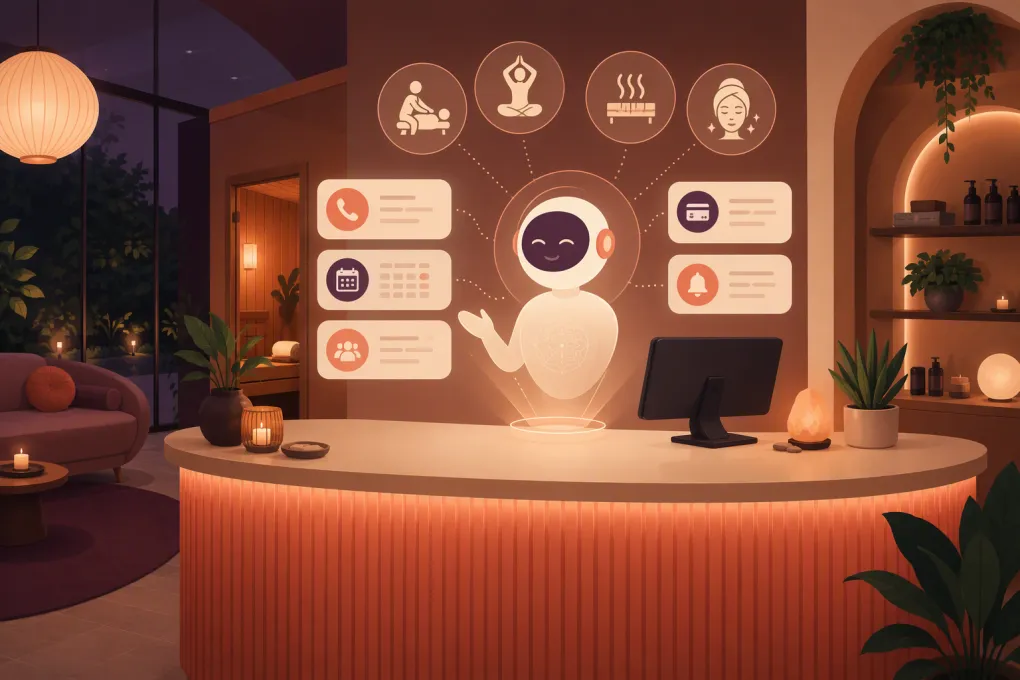 Watch · 20s
A wellness center rarely loses a lead because the service is wrong. More often, the lead called after closing, waited too long for a reply, could not figure out which appointment to book, or gave up after playing phone tag.
Front-desk teams already juggle arrivals, practitioners, rooms, waivers, schedule changes, retail sales, and member questions. Asking them to answer every new inquiry immediately is unrealistic. Hiring enough people to cover evenings and weekends is not practical for many independent operators either.
An AI receptionist fills that coverage gap. It can answer routine questions, qualify leads, guide clients toward the right service, book eligible appointments or classes, follow up, and help resolve overdue dues. The goal is not to remove your team. It is to keep repetitive reception work from controlling your team’s day.
See how Fitty can cover wellness center inquiries and booking workflows 24/7 →
What an AI receptionist actually does
An AI receptionist is more than a website chat bubble or a recorded phone menu. It acts within defined business rules and moves a conversation toward an outcome.
For a wellness center, those outcomes usually include:
- Answering questions about services, hours, amenities, policies, and location
- Identifying whether someone wants a class, appointment, consultation, or membership
- Collecting the minimum information needed to continue
- Offering appropriate times based on live availability
- Booking, rescheduling, or canceling according to your rules
- Following up when a lead does not finish booking
- Sending payment or dues reminders through an approved process
- Escalating sensitive, complex, or high-value conversations to a person
The important phrase is within defined business rules. A useful AI receptionist should not improvise treatment recommendations, invent availability, make unauthorized exceptions, or promise outcomes your practitioners cannot guarantee.
Where wellness centers get the most value
After-hours lead response
Prospects often research wellness services outside normal reception hours. If they ask about a massage package, recovery session, skin treatment, or introductory class at night, waiting until the next business day creates an avoidable gap.
An AI receptionist can respond when interest is active. It can answer basic questions, clarify the requested service, and offer the next step without requiring an employee to monitor a phone all evening.
Build the workflow around common buying questions:
- What does the service include?
- How long is the appointment?
- What should I bring or wear?
- Is there a first-visit offer?
- Can I book with a specific practitioner?
- What is the cancellation policy?
- Are there prerequisites or restrictions?
Review your recent calls, messages, and front-desk notes to find the questions people actually ask. Those conversations are better source material than a generic FAQ copied from another business.
Appointment and class booking
Booking wellness services can be more complicated than placing an open time on a calendar. Availability may depend on the practitioner, room, equipment, appointment length, cleanup buffer, client type, or prerequisite consultation.
Before allowing AI-assisted booking, document:
- Which services can be booked without staff approval
- Which providers can perform each service
- Required rooms, equipment, and schedule buffers
- New-client eligibility and intake requirements
- Deposit, cancellation, and no-show rules
- Cases that require a consultation or staff review
The AI should only offer appointments that satisfy those rules. If a request falls outside them, it should collect the relevant details and create a clear handoff instead of guessing.
For class-based centers, the same principle applies to capacity, waitlists, membership eligibility, and late-cancel policies. The best automation makes the booking path easier while preserving the operational controls that protect your schedule.
Explore how Fitty connects lead conversations with booking and follow-up →
Lead follow-up without front-desk chasing
Many inquiries do not convert during the first conversation. A prospect may need to check a calendar, discuss a package with a partner, or simply get distracted before completing the booking.
Without a follow-up process, those leads sit in an inbox until someone remembers them. An AI receptionist can keep the next action moving by checking whether the prospect still wants help, answering another question, or returning them to the booking flow.
Keep follow-up useful rather than relentless. A practical sequence should:
- Refer to the service the person asked about
- Provide a clear next step
- Stop when the person declines or opts out
- Escalate when the question requires judgment
- Avoid continuing indefinitely when there is no response
Your outreach must also follow applicable consent, calling, and messaging rules. Automation does not remove the operator’s responsibility to use compliant contact practices.
Membership dues and payment recovery
Overdue membership dues are easy to postpone because collection calls are uncomfortable and time-consuming. A consistent system can contact the member, explain the account issue in neutral language, and direct them to an approved payment process.
Do not ask clients to send card details in ordinary chat or text messages. Use secure payment links and a payment provider designed to handle card information. The AI should also know when to hand off disputes, hardship requests, cancellation claims, or repeated payment failures.
Fitty is designed to help wellness businesses follow up and collect dues alongside reception and booking work, so payment recovery does not live in a disconnected staff spreadsheet.
See how Fitty supports dues follow-up without adding another front-desk queue →
Where AI should hand the conversation to a person
Automation needs firm boundaries, especially when wellness services overlap with health concerns. Define escalation triggers before launch.
A person should generally take over when a client:
- Reports an injury, adverse reaction, or urgent health concern
- Requests medical advice or asks whether a service is safe for a condition
- Disputes a charge or demands a refund exception
- Describes a sensitive personal situation
- Needs an accommodation outside standard scheduling rules
- Is upset after repeated service or billing problems
- Requests a service the AI cannot confidently identify
- Asks for information the system is not authorized to access
The handoff should include a concise conversation summary, contact details, requested service, and the unresolved question. Making the client repeat the entire story defeats much of the value of automation.
Protect privacy, consent, and trust
Wellness centers handle different levels of sensitive information. A yoga studio and a medically supervised wellness practice do not have identical compliance requirements.
Before deploying an AI receptionist, determine:
- What information the assistant is allowed to request
- Where conversation data is stored
- Which employees can access it
- How long records are retained
- Whether vendors meet your contractual and regulatory requirements
- Which conversations must move to an approved clinical or administrative channel
If your center is subject to HIPAA or other healthcare privacy obligations, do not assume that every AI product or messaging channel is appropriate. Confirm requirements with qualified legal or compliance counsel and evaluate vendors accordingly.
Clients should also understand when they are interacting with an automated assistant. Clear identification sets the right expectation and makes escalation feel intentional rather than deceptive.
How to implement an AI receptionist without creating chaos
1. Start with one measurable workflow
Do not automate every reception task on day one. Start with a defined problem such as after-hours service inquiries or unfinished appointment bookings.
Choose a workflow with a clear outcome: booked, handed off, declined, or unresolved. This makes quality easier to review.
2. Clean up your operating rules
AI exposes vague policies quickly. If staff members give different answers about deposits, package expiration, late arrivals, or first-visit eligibility, the assistant will not have a reliable standard to follow.
Create a source of truth covering:
- Service descriptions and durations
- Pricing and package rules
- Hours and holiday closures
- Cancellation and refund policies
- Provider and room constraints
- Membership access rules
- Escalation contacts
Assign an owner to each policy so updates do not disappear between departments.
3. Test real conversations
Use actual scenarios rather than ideal scripts. Test misspelled service names, vague requests, last-minute cancellations, unavailable providers, billing frustration, and clients who change topics halfway through.
Confirm that the receptionist can recognize uncertainty and hand off safely. A confident wrong answer is more damaging than an honest escalation.
4. Give your staff a clear role
Explain what the AI handles, what still belongs to staff, and how handoffs appear. Team members should know where to find the conversation history and who owns unresolved items.
Position the system as reception coverage, not surveillance or a silent replacement plan. Adoption is stronger when employees see that it removes repetitive chasing while preserving conversations that need judgment.
5. Review quality every week
Read a sample of completed, abandoned, and escalated conversations. Look for incorrect answers, booking friction, unnecessary handoffs, missed intent, and outdated policies.
Track operational outcomes that matter to your center, such as:
- Inquiries that reach a clear resolution
- Bookings completed from conversations
- Leads waiting for staff follow-up
- Common reasons for escalation
- Cancellations or corrections caused by bad information
- Overdue accounts moved to an appropriate next step
Use the review to improve rules and content. An AI receptionist is an operating system component, not a set-it-and-forget-it widget.
What to look for before choosing a platform
Evaluate the complete workflow, not just how naturally the assistant can chat. A convincing demo has limited value if staff still need to copy every lead into another system.
Ask vendors whether the platform can:
- Work with your booking, membership, and payment processes
- Respect provider, class, room, and eligibility rules
- Preserve conversation history for staff
- Follow up automatically with clear stopping conditions
- Route urgent or sensitive requests correctly
- Support your location structure and permissions
- Explain how data is handled and retained
- Let operators update policies without rebuilding everything
WTF Go brings reception, lead follow-up, booking, and dues workflows together, with Fitty serving as the always-on AI agent. For operators, the practical advantage is continuity: the inquiry can move toward a booking or payment outcome instead of becoming another disconnected message for staff to process.
The right goal is better coverage, not fewer humans
Wellness is a relationship business. Clients still need practitioners and front-desk employees who can show empathy, solve unusual problems, and create a welcoming experience in person.
Use an AI receptionist to handle speed, consistency, routine questions, and persistent follow-up. Keep your people focused on judgment, care, and the moments that shape client trust. That division of labor gives wellness centers stronger reception coverage without turning every interaction into an impersonal script.
Frequently asked questions
Can an AI receptionist book wellness appointments automatically?
Yes, if it has access to current availability and clearly defined rules for providers, rooms, buffers, eligibility, deposits, and cancellations. Requests outside those rules should be handed to staff.
Can an AI receptionist answer medical questions?
It should not diagnose conditions or provide individualized medical advice. Health concerns, contraindication questions, injuries, and adverse reactions should be escalated to an appropriately qualified person.
Will an AI receptionist replace front-desk staff?
Its best use is covering repetitive inquiries, booking steps, follow-up, and payment reminders. Staff remain essential for sensitive conversations, exceptions, relationship building, and in-person service.
How should a wellness center start using an AI receptionist?
Start with one controlled workflow, document the relevant policies, test realistic conversations, define human handoffs, and review performance regularly before expanding automation.
Is an AI receptionist appropriate for a HIPAA-covered wellness center?
Potentially, but operators must verify the platform, data handling, contracts, and communication channels against their specific obligations. Consult qualified legal or compliance counsel rather than assuming a general AI tool is suitable.
Keep reading

Run your gym on autopilot with WTF Go
Fitty — your AI receptionist — answers calls and DMs, fills classes, follows up with every lead, and collects dues while you coach.