AI & Automation
AI Receptionist for Weight Loss Clinics: A Practical Guide
Learn how an AI receptionist for weight loss clinics handles calls, books consultations, follows up with leads, and supports compliant front-desk workflows.
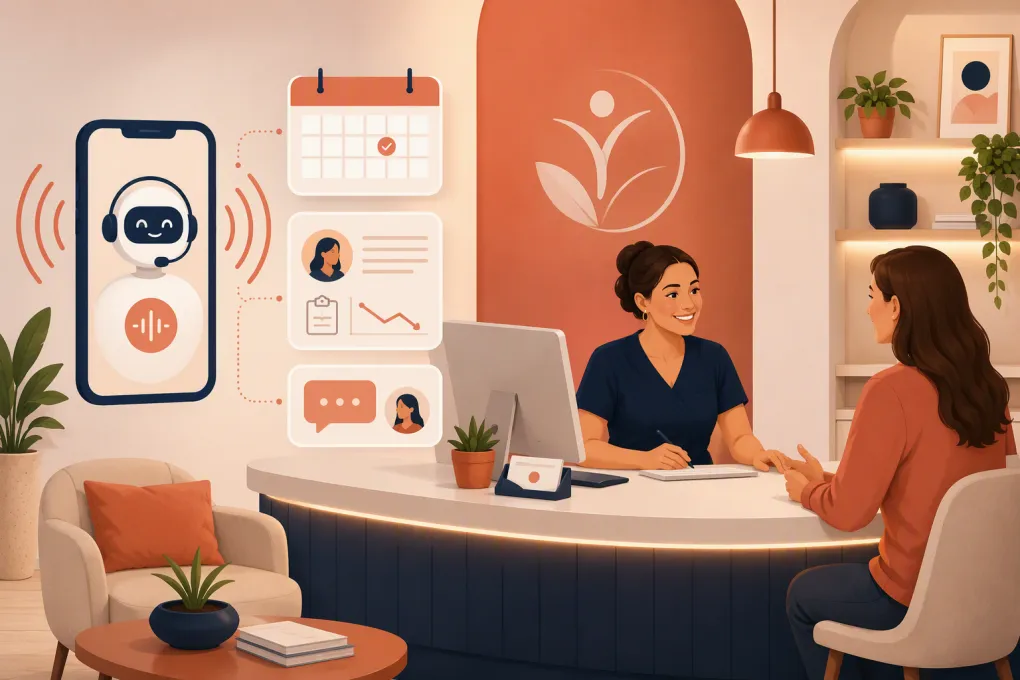 Watch · 20s
A missed call to a weight loss clinic is rarely just a missed call. It may be a prospective patient comparing programs, an existing member trying to reschedule, or someone asking whether your clinic offers a specific service. If nobody answers quickly, that person can move to the next clinic before your team finishes with the patient in front of them.
An AI receptionist gives clinics another way to manage that demand. It can answer routine questions, capture lead information, book consultations, send follow-ups, and route sensitive requests without forcing staff to monitor the phone around the clock.
The important distinction is that an AI receptionist should handle administrative workflows, not make clinical decisions. Weight loss clinics often operate at the intersection of healthcare, wellness, memberships, prescriptions, and recurring services. That makes thoughtful setup more important than simply switching on a chatbot.
See how Fitty can answer weight loss leads and book consultations after hours →
What an AI receptionist does for a weight loss clinic
An AI receptionist is a voice, text, or multichannel agent that handles defined front-desk tasks. Unlike a basic phone menu, it can interpret natural-language requests and move the conversation toward an appropriate next step.
For a weight loss clinic, that can include:
- Answering calls when staff are busy or the clinic is closed
- Explaining location, hours, parking, and appointment availability
- Capturing a new lead’s name, contact details, and preferred location
- Booking an initial consultation into an approved calendar
- Sending appointment confirmations and reminders
- Following up with prospects who did not book
- Answering approved, nonclinical program questions
- Routing billing, prescription, side-effect, and urgent requests to staff
- Collecting membership dues when the clinic’s policies and payment setup allow it
The AI should work from clinic-approved information. It should not improvise answers about eligibility, medication safety, expected outcomes, diagnoses, or treatment plans.
Where AI creates the most operational value
Answering leads outside business hours
Prospective patients do not limit their research to front-desk hours. They may call during lunch, after work, or over the weekend. An AI receptionist can respond immediately, identify why they are calling, and offer a consultation slot instead of sending everyone to voicemail.
A useful after-hours workflow looks like this:
- Identify the clinic and disclose that the caller is speaking with an automated assistant when appropriate.
- Ask whether the caller is a new or existing patient.
- For a new lead, gather only the information needed to book or request a callback.
- Present available consultation times.
- Confirm the appointment and send the clinic’s approved next-step message.
- Escalate clinical, urgent, or unusual questions rather than attempting an answer.
This makes after-hours coverage productive without treating the AI as a clinician.
Converting inquiries into consultations
Many front desks answer questions well but fail to ask for the appointment. An AI workflow should be designed around a defined outcome.
After answering an approved question about program structure, the agent might offer to schedule an initial consultation. If the caller is not ready, it can request permission for follow-up and record the reason for hesitation, such as scheduling, location, cost questions, or a desire to speak with a clinician.
Keep qualification administrative. Appropriate questions may include:
- Which clinic location is most convenient?
- Are you looking for an initial consultation or an existing-patient visit?
- Do you prefer a morning or afternoon appointment?
- Would you like a staff member to explain payment or insurance policies?
Questions about medical history, contraindications, medication eligibility, or treatment selection belong in a clinic-controlled intake and clinical review process.
Reducing repetitive front-desk work
Staff should not have to stop an in-person conversation every time someone asks for directions or opening hours. Build a controlled knowledge base covering repetitive topics such as:
- Locations and operating hours
- Consultation types and durations
- Rescheduling and cancellation policies
- What to bring to an initial visit
- Whether telehealth appointments are offered
- General payment and insurance policies
- How to contact the clinical team
- How existing patients request prescription support
Every answer should have an owner and a review date. When hours, services, or policies change, update the source information rather than relying on staff to correct the AI one conversation at a time.
Following up consistently
Lead follow-up often breaks down during busy clinic hours. An AI agent can manage a defined sequence across phone and text, subject to the clinic’s consent and communications rules.
For example, it can:
- Confirm that an inquiry was received
- Offer a direct scheduling option
- Remind a lead about an unfinished booking
- Confirm an upcoming consultation
- Ask a no-show whether they want to reschedule
- Stop follow-up when the person opts out or requests staff contact
Fitty, WTF Go’s AI receptionist, is built to answer leads, book appointments, run follow-up, and support payment collection workflows around the clock. Explore how Fitty can take repetitive lead follow-up off your clinic’s front desk →
Administrative request or clinical request?
Your routing rules should make the boundary explicit.
| Request | AI receptionist action |
|---|---|
| Clinic hours or directions | Answer from the approved knowledge base |
| Initial consultation booking | Offer approved appointment types and times |
| Cancellation or rescheduling | Apply the clinic’s stated policy and update the calendar |
| Program pricing question | Provide approved information or route to staff |
| Insurance coverage question | Explain the clinic’s general policy without guaranteeing coverage |
| Medication eligibility | Route to a licensed clinical team member |
| Side effects or worsening symptoms | Stop the routine workflow and follow the clinic’s escalation protocol |
| Prescription or refill request | Capture the request through the approved channel; do not promise approval |
| Emergency or crisis language | Provide the clinic-approved emergency direction and end normal sales automation |
Test these boundaries with realistic variations. Callers may say “I feel sick after my injection” rather than label the issue a side effect. Your system needs to recognize meaning, not just exact keywords.
Privacy, consent, and compliance questions to resolve
Medical weight loss clinics may handle protected or otherwise sensitive information. Do not assume every AI receptionist, phone platform, CRM, or texting tool is suitable for every clinic workflow.
Before launch, determine:
- What information the AI will collect
- Where transcripts, recordings, and contact records are stored
- Whether data is used to train general AI models
- Which vendors and subcontractors can access it
- How long data is retained and how it can be deleted
- Whether role-based access controls and audit logs are available
- Whether a business associate agreement is required and available
- How callers are notified about automation or call recording
- How text consent, opt-outs, and do-not-call requests are recorded
- Which state-specific privacy, recording, telehealth, and advertising rules apply
HIPAA is not the only consideration. Telephone and text outreach can also implicate federal and state communications rules. Recording consent requirements vary by jurisdiction. Clinic leadership should have qualified legal and compliance professionals review the intended workflows.
When evaluating WTF Go for a medically operated clinic, discuss your privacy requirements, required agreements, data flows, and integrations before deploying Fitty in any workflow involving patient information. Use the agent only for approved use cases that match your organization’s obligations.
How to evaluate an AI receptionist
A polished demo is not enough. Test the platform against the work your front desk actually performs.
Booking and system fit
Confirm whether the agent can access real appointment availability, distinguish appointment types, respect location and provider rules, and prevent double booking. If it cannot connect to a clinical scheduling system, define a safe fallback such as a booking request or staff callback task.
Escalation controls
The agent should know when to transfer, create a task, send an alert, or stop. Ask what happens when the clinic is closed, a caller repeatedly asks for clinical advice, or no staff member accepts a transfer.
Knowledge management
Look for a clear way to approve answers, separate information by location, and update policies. Multi-location operators should be able to prevent one clinic’s hours, pricing, or services from appearing in another location’s answers.
Conversation review
Managers need access to outcomes, transcripts where appropriate, booking records, and escalation reasons. Review tools help operators identify incorrect answers and workflow gaps without listening to every call.
Human support
Ask who configures the agent, who troubleshoots failed bookings, and how quickly urgent changes can be made. AI still requires accountable human ownership.
A practical rollout plan
Start with a narrow, measurable workflow rather than automating the entire front desk.
1. Map call reasons
Review recent calls and staff notes. Group requests into new leads, scheduling, billing, clinical questions, prescription requests, directions, and other common categories.
2. Choose low-risk tasks
Begin with hours, locations, lead capture, and initial consultation booking. Keep clinical requests routed to humans.
3. Write the escalation matrix
Document which requests go to reception, billing, a clinician, an on-call process, or emergency services. Include what the AI may say while routing the request.
4. Test difficult conversations
Test unclear speech, interruptions, frustrated callers, Spanish-language requests if supported, wrong-location questions, repeated clinical prompts, and requests to stop receiving messages.
5. Launch with oversight
Run the AI after hours or as overflow coverage first. Review conversations frequently, correct source information, and expand only after the workflow is reliable.
What to measure
Track operational outcomes rather than judging the system by how human it sounds. Useful measures include:
- Calls answered versus abandoned or sent to voicemail
- Consultations booked from inbound inquiries
- Booking errors and manual corrections
- Transfers completed successfully
- Leads requiring staff follow-up
- Appointment confirmations, cancellations, and reschedules
- Opt-out and complaint patterns
- Clinical requests correctly escalated
- Staff time spent correcting AI actions
Compare performance by call type, location, and time of day. A system that books well but routes sensitive requests poorly is not ready for broader use.
The right role for AI in a weight loss clinic
An AI receptionist should make your clinic easier to reach while giving staff more room to focus on patients. Its strongest role is administrative: answer promptly, provide approved information, secure the next appointment, follow up consistently, and hand off anything clinical or sensitive.
The winning setup is not the one with the most automation. It is the one with clear boundaries, reliable booking, disciplined follow-up, and a fast path to a qualified human when the conversation requires one.
Frequently asked questions
Can an AI receptionist book consultations for a weight loss clinic?
Yes, if it can access approved appointment types and current availability. Clinics should test location, provider, rescheduling, and double-booking rules before launch.
Can an AI receptionist answer questions about weight loss medication?
It can provide limited clinic-approved administrative information, but it should not determine eligibility, recommend medication, interpret symptoms, or give treatment advice.
Is an AI receptionist HIPAA compliant?
That depends on the vendor, contracts, configuration, data handling, and specific workflow. Clinics should review security controls, data use, subcontractors, retention, and business associate agreement requirements.
Should a clinic disclose that callers are speaking with AI?
Disclosure and recording requirements can vary by jurisdiction and use case. Clear disclosure is generally a sound operational practice, but clinics should obtain advice for the laws that apply to them.
How should a weight loss clinic start using an AI receptionist?
Start with low-risk tasks such as hours, lead capture, and consultation booking. Add follow-up and other workflows only after testing escalation, consent, scheduling accuracy, and staff oversight.
Keep reading


Run your gym on autopilot with WTF Go
Fitty — your AI receptionist — answers calls and DMs, fills classes, follows up with every lead, and collects dues while you coach.