AI & Automation
AI Receptionist for Waxing Salons: Practical Buyer Guide
Choose an AI receptionist for waxing salons that books accurately, protects client data, handles calls correctly, and fits your front-desk workflow daily.
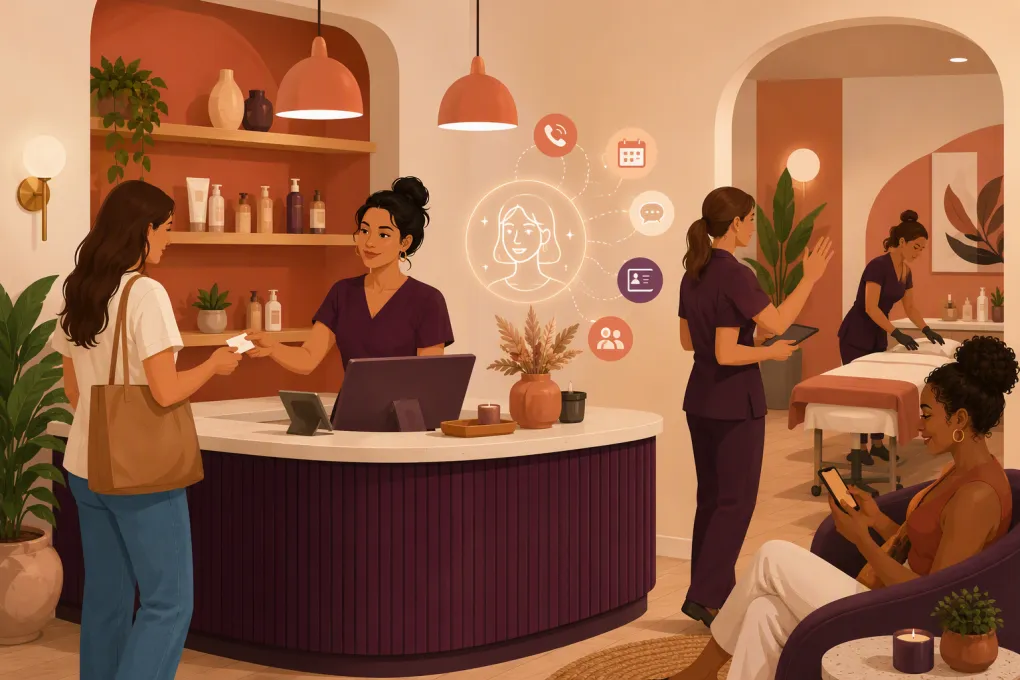 Watch · 20s
A waxing salon does not usually lose bookings because nobody cares. It loses them in the operational gaps: the phone rings during a Brazilian appointment, a new client chooses the wrong bikini service online, or an after-hours caller wants reassurance before putting down a deposit.
An AI receptionist for waxing salons can cover those gaps, but only if it understands your service menu, scheduling constraints and escalation rules. A generic bot that gives polished answers but creates incorrect appointments will add work rather than remove it.
The buying decision is therefore not simply, “Can it answer the phone?” You need to know whether it can complete a valid booking, protect sensitive information, transfer calls properly and stay inside boundaries approved by your salon.
See how Fitty can support routine waxing inquiries and follow-up →
Why waxing workflows expose weak AI receptionists
Waxing has booking details that broad appointment tools can easily mishandle. Service names are not standardized across salons. “Bikini,” “extended bikini” and “Brazilian” may have different definitions, durations and prices at different businesses. A client may also use informal language that does not match the menu.
The schedule adds another layer. The requested provider may not perform every service. Combining brows, underarms and a bikini service changes appointment length. Cleanup or room-reset buffers may apply. A late arrival may leave enough time for one service but not the full booking.
There are also conversations clients may prefer to handle discreetly. First-time guests may ask about hair length, menstruation, pregnancy, medications, skin treatments, age requirements or what clothing to wear. The response needs to be clear without turning an automated receptionist into a medical adviser.
These are not edge cases to test after launch. They are core waxing workflows.
Start with actual salon conversations, not a feature list
Before evaluating vendors, map the calls and messages your team handles during a normal week. Include the questions that interrupt services and the booking errors staff repeatedly repair.
A useful list usually covers:
- Differences between similarly named waxing services
- First-time guest preparation
- Service combinations and add-ons
- Provider preferences and qualifications
- Same-day availability
- Deposits and card-on-file requirements
- Late arrivals, cancellations and no-shows
- Membership, package or prepaid-service balances
- Post-service concerns
- Requests involving medications, pregnancy or minors
Then write the correct action for each inquiry. Should the receptionist answer, book, collect information, transfer the call or create a task for staff?
A realistic booking test
Consider a prospective client who says, “I need a bikini wax and maybe brows after work Thursday. I have never been waxed before.”
A capable receptionist should not immediately place a generic bikini appointment. It should:
- Explain your salon’s service options using approved descriptions.
- Confirm which services the client wants.
- Identify whether your first-visit rules affect the booking.
- calculate the combined duration using your configured menu.
- Check qualified-provider and room availability.
- Apply any deposit or card requirement.
- Send only the preparation guidance approved by your salon.
Now add a complication: the client mentions a prescription skin treatment. The automated flow should stop giving eligibility advice and hand the question to appropriately qualified staff under your salon’s approved protocol.
That test reveals more than a scripted demo about answering FAQs.
What the AI receptionist should be able to do
Match client language to your service menu
The system needs a controlled way to clarify what a client wants. It should use your exact definitions rather than assuming that industry terms mean the same thing everywhere.
Ask vendors whether service matching is based on configurable questions, free-form generation or both. Confirm what happens when confidence is low. The safe result is a clarifying question or staff handoff—not a guessed appointment.
Create bookings that respect operational rules
A booking is only useful if the salon can fulfill it. Test whether the system recognizes:
- Service and add-on duration
- Provider qualifications
- Provider and room availability
- Cleanup or turnover buffers
- Location-specific menus
- First-time-client requirements
- Deposits or payment authorization
- Cancellation windows
- Multi-service sequencing
Do not accept “integrates with your calendar” as a complete answer. A calendar can show open time without understanding which provider, service or resource can use it.
Handle calls and handoffs predictably
Phone behavior deserves its own demonstration. Ask the vendor to show—not just describe—what happens when the AI cannot resolve a call.
Confirm whether it supports:
- Live transfer to a specific person, location or queue
- A warm transfer with a summary before staff joins
- A fallback when nobody answers
- Voicemail or callback-task creation
- Different routing during and after business hours
- Caller identification and duplicate-contact handling
- Transcripts, recordings and call summaries
- Immediate staff takeover when requested
Call recording and transcription requirements vary by jurisdiction. Determine what notice or consent your salon needs before enabling those features.
Follow up without creating compliance problems
Follow-up should be tied to a clear business event: an unanswered inquiry, an incomplete booking or an approved rebooking reminder. Define how many attempts are allowed, which channels may be used and what stops the sequence.
Ask how the system stores communication consent, processes opt-outs and separates transactional messages from marketing. Your legal obligations can depend on the channel, message and location. A vendor feature does not replace your responsibility to use it lawfully.
Set firm boundaries for health and consent questions
An AI receptionist can repeat salon-approved general preparation information. It should not determine whether a service is medically appropriate for a particular client.
Medication, pregnancy, skin condition, contraindication and post-service reaction workflows must be written or approved by appropriately qualified staff. They must also align with applicable licensing rules, consent requirements, salon policy and local law.
The same principle applies to minors. Age thresholds, parent or guardian consent, identification and service restrictions can vary. Do not let an AI infer the rules or copy them from another salon.
Require human review for:
- Prescription medication or recent treatment disclosures
- Pregnancy-specific eligibility questions
- Possible burns, skin lifting, bleeding, infection or allergic reactions
- Requests involving minors or uncertain consent
- Complaints about pain, privacy, staff conduct or service quality
- Refunds, disputed charges and policy exceptions
The receptionist can gather the client’s name, contact details and a limited description needed for routing. Avoid asking clients to submit unnecessary medical details through a general chat or text channel.
Evaluate integrations before signing
The word “integration” can mean anything from a live two-way connection to a link that opens your booking page. Find out exactly what data moves in each direction.
| Area | Questions to ask the vendor | Why it matters |
|---|---|---|
| Scheduling | Can it read live availability and create, change and cancel appointments? | Read-only access cannot complete the workflow. |
| Service rules | Does it recognize duration, provider eligibility, add-ons, rooms and buffers? | Open time is not always bookable time. |
| Client records | Does it match existing clients and avoid duplicates? | Duplicate profiles split history and package information. |
| Payments | Can it request deposits, use an approved payment flow or only send a payment link? | Payment capability varies widely by platform and processor. |
| Communications | Which phone, SMS, web chat and email channels are supported? | Do not assume every advertised channel is included. |
| Multi-location | Are menus, staff, hours and policies configurable by location? | One universal rule set can create incorrect bookings. |
| Failure handling | What happens if the booking or payment system is unavailable? | The AI should not promise a booking it failed to create. |
Use a sandbox or controlled test account when possible. If the vendor relies on custom middleware, ask who maintains it, how failures are monitored and whether changes to your salon software could break the connection.
Ask direct questions about privacy and data handling
Waxing conversations can include sensitive personal information even when the salon is not operating as a healthcare provider. Collect only what the business needs and understand where it goes.
Your review should cover:
- What call audio, transcripts, messages and client fields are stored
- Where data is processed and retained
- Who can access conversations inside your business and at the vendor
- Whether data is used to train shared AI models
- Available retention and deletion controls
- Encryption and account-access protections
- How incidents are reported
- What data can be exported when the contract ends
- Which subprocessors or third parties receive data
Do not rely on a broad security badge or a generic claim of compliance. Ask for the vendor’s current documentation and have the appropriate legal or security adviser review obligations that apply to your business.
How to compare vendors using live scenarios
Run every finalist through the same tests. A controlled evaluation is more useful than comparing polished feature pages.
Include scenarios such as:
- A first-time client who uses an ambiguous service name.
- A returning client combining services with different durations.
- A caller requesting a provider who is unavailable.
- A reschedule inside the cancellation window.
- A medication or pregnancy question requiring escalation.
- A client reporting a post-service skin concern.
- A caller asking for a person immediately.
- A booking-system outage during the conversation.
- A client who opts out of follow-up.
- A multi-location client trying to use a package elsewhere.
Score accuracy, booking completion, handoff quality, policy compliance and cleanup work required from staff. A natural-sounding voice should not outweigh operational accuracy.
What implementation should look like
Implementation time depends on menu complexity, locations, integrations, phone setup, payment requirements and data cleanup. Instead of accepting a fixed launch promise, ask for a scoped implementation calendar with owners and dependencies.
A controlled rollout has five phases:
1. Workflow audit
Document services, policies, staff qualifications, location differences, escalation owners and top inquiry types.
2. Integration and channel setup
Connect approved systems, configure phone or messaging channels and test identity matching, booking writes and failure behavior.
3. Knowledge and boundary configuration
Load approved answers. Define topics the AI may answer, topics requiring clarification and topics that must go directly to staff.
4. Staff testing
Have receptionists, managers and experienced service providers test normal bookings and uncomfortable edge cases. Providers should approve service descriptions and contraindication-related handoffs.
5. Limited launch and review
Start with a controlled channel, location or set of workflows. Review transcripts and booking results before expanding. Track incorrect appointments, unresolved transfers, duplicate records and conversations staff must repair.
Talk with WTF Go about mapping Fitty to your salon’s booking workflow →
Where Fitty fits—and what to confirm
Fitty is the AI receptionist and agent within WTF Go, an operating system for gyms, studios, spas and wellness businesses. Its core role includes answering leads, supporting bookings, following up and collecting dues around the clock.
For a waxing salon, the practical use case is handling repetitive lead questions and moving qualified inquiries toward a completed booking while staff serve clients. However, do not assume that every salon system, communication channel or payment workflow is automatically supported.
During a Fitty evaluation, confirm:
- Compatibility with your current scheduling and client-management system
- Whether your required phone and messaging channels are available
- How appointments are created, changed and cancelled
- Whether deposits, cards on file, package balances or other salon payment needs are supported
- How live transfers, missed transfers and after-hours escalations work
- What setup, data cleanup and staff training your team must complete
- How location-specific menus and policies are configured
- Which privacy, retention and access controls apply to your account
Fitty’s dues-collection capability should not be treated as proof that every deposit, refund, tip, package or salon payment scenario works identically. Ask the WTF Go team to demonstrate your actual payment flow with your current systems.
That is the standard to apply to any vendor: show the complete workflow, including what happens when the AI cannot finish it.
See whether Fitty supports your waxing salon’s systems and call flow →
The right AI receptionist should give clients a faster path to a correct appointment—not merely a faster answer. Buy around booking accuracy, safe escalation, integration depth and staff control. Those are the details that determine whether automation protects the front desk or creates another queue to manage.
Frequently asked questions
Can an AI receptionist book waxing appointments automatically?
Yes, if it has a reliable connection to live availability and understands service duration, provider qualifications, buffers and booking rules. Require a demonstration using your actual service menu before buying.
Can AI answer questions about medication, pregnancy or waxing contraindications?
It should only provide language approved by appropriately qualified staff and aligned with applicable local requirements. Client-specific eligibility questions and possible reactions should be escalated to a person.
What booking integrations should a waxing salon require?
Look for live availability, appointment creation and changes, service and provider rules, client matching and clear failure handling. Confirm compatibility with your exact software and account configuration.
How long does implementation take?
It depends on menu complexity, locations, communication channels, integrations and payment workflows. Ask for a scoped timeline covering configuration, testing, staff approval and a limited launch rather than accepting a generic estimate.
What should happen when a caller asks for a human?
The system should follow a defined transfer or callback workflow without forcing the caller through unnecessary prompts. Test live transfers, unanswered transfers, after-hours routing and staff notifications before launch.
Keep reading

Run your gym on autopilot with WTF Go
Fitty — your AI receptionist — answers calls and DMs, fills classes, follows up with every lead, and collects dues while you coach.