AI & Automation
AI Receptionist for Tennis Clubs: Complete Operator Guide
Learn how an AI receptionist for tennis clubs handles calls, court bookings, lessons, lead follow-up, and dues without creating a poor member experience.
 Watch · 20s
A tennis club phone rarely rings with a simple question. A caller may want an indoor court tonight, a private lesson for a beginner, details about junior clinics, or help with a membership balance. Answering correctly requires more than recording a name and number.
That is why an AI receptionist for tennis clubs must do more than provide generic answers. It needs to understand club terminology, follow your booking and membership rules, capture usable lead information, and know when a staff member should take over.
Implemented properly, an AI receptionist gives members and prospects a reliable first point of contact when the desk is busy, the club is closed, or staff are working elsewhere. Implemented poorly, it creates duplicate bookings, inaccurate promises, and more cleanup for your team.
Where tennis clubs lose calls and revenue
The front desk sits in the middle of nearly every club workflow. Staff may be checking in members, answering questions at the counter, coordinating coaches, managing court changes, and handling weather interruptions at the same time.
Calls still arrive during those moments. Common examples include:
- Prospects asking about memberships or trial options
- Parents comparing junior programs
- Players looking for clinics at a specific level
- Members trying to reserve, cancel, or change a court
- Beginners asking to be matched with an instructor
- Guests checking access, attire, equipment, or parking policies
- Members asking about dues or failed payments
- Players reporting a late coach, locked gate, or facility issue
Voicemail is a weak handoff for many of these requests. The caller still has to wait, and an employee must later listen to the message, reconstruct the request, look up availability, and call back. By then, a prospect may have contacted another club.
See how Fitty can answer tennis club inquiries and follow up after hours →
What an AI receptionist should handle
The right scope depends on your systems and operating rules. Start with high-volume, repeatable conversations where the correct response can be defined clearly.
Membership and program inquiries
An AI receptionist can explain approved information about:
- Membership categories and basic eligibility
- Trial or introductory offers
- Junior and adult programming
- Group clinics and class levels
- Private lesson request procedures
- Guest and nonmember access
- Club hours, location, parking, and amenities
The agent should also turn an inquiry into a structured lead. At minimum, capture the caller’s name, contact details, preferred location, playing level, program of interest, availability, and desired start date.
Avoid giving the agent open-ended permission to interpret pricing or policy. If initiation fees, seasonal rates, or membership availability vary, it should explain the next step and route the lead to the appropriate employee.
Court and class booking workflows
Court reservations are more complicated than a standard calendar appointment. Before allowing an AI agent to confirm a reservation, determine whether it can reliably access and enforce rules such as:
- Member authentication and booking privileges
- Court duration and advance-booking windows
- Indoor versus outdoor court availability
- Singles, doubles, ball machine, or practice court use
- Guest limits and applicable charges
- Cancellation and no-show policies
- Recurring reservation restrictions
- Maintenance blocks, events, leagues, and tournaments
If your court management system cannot provide dependable real-time availability, do not let the agent promise a court. It can collect the request, answer policy questions, provide a booking link, or escalate to staff instead.
Classes and clinics are often easier to automate because they use defined schedules, capacities, and eligibility rules. Fitty can answer leads and book classes around the clock, helping clubs move an interested player toward registration without waiting for the front desk to reopen.
Lesson requests and coach matching
A request for a private lesson usually requires more context than a date and time. Have the AI receptionist ask:
- Is the lesson for an adult or junior?
- What is the player’s approximate level?
- What does the player want to improve?
- Are there preferred days and times?
- Is a specific coach requested?
- Does the player prefer private, semi-private, or group instruction?
- Which club location is preferred?
The agent can book directly when coach calendars and assignment rules are available. Otherwise, it should create a complete request for the tennis director rather than claiming that a coach is confirmed.
Lead follow-up
Many tennis leads are not ready to join during the first conversation. A parent may need to check a school schedule, or an adult player may want to compare clinic times.
A useful follow-up workflow can:
- Send the relevant schedule or registration link
- Confirm whether the prospect still needs help
- Remind someone about an introductory visit
- Ask whether a trial participant wants membership information
- Notify a staff member when the lead asks a complex question
- Stop outreach when the person opts out or says no
This is a practical use for Fitty: the same agent that answers the initial inquiry can continue the approved follow-up instead of leaving every reminder to the front desk.
Build a reliable tennis club knowledge base
AI performance depends heavily on the information behind it. Do not train the agent from an outdated website and assume it understands club operations.
Create one approved source of truth covering the following areas.
Facilities and access
Document locations, operating hours, court surfaces, indoor and outdoor court counts, lighting, locker rooms, equipment rental, accessibility information, parking, and check-in procedures.
Programs and levels
List each clinic, class, camp, league, and social program. Define the intended age or skill level, prerequisites, schedule, registration process, capacity rules, and who can participate.
Use the same level language your staff uses. If your club relies on NTRP ratings, internal colors, coach assessments, or age divisions, explain each system and tell the agent not to assign a level when an evaluation is required.
Membership and payment policies
Provide approved descriptions of membership types, billing schedules, guest policies, freezes, cancellations, overdue balances, and refund rules. Mark every situation that requires management approval.
For payments, use a secure processor or payment link. Card details should not be collected in ordinary chat messages, emails, or unrestricted notes. Fitty can collect dues as part of an organized workflow without forcing staff to repeatedly chase routine balances.
Explore how Fitty combines answering, follow-up, booking, and dues collection →
Define when the AI must escalate
A capable AI receptionist should not try to finish every conversation. Clear escalation rules protect the member experience and reduce operational risk.
Route the conversation to a person when it involves:
- Injuries, emergencies, or immediate safety concerns
- Member complaints or disciplinary matters
- Refund disputes and chargebacks
- Exceptions to booking or cancellation policy
- Contract interpretation
- Sensitive junior-player concerns
- Custom event or tournament requests
- A caller explicitly asking for an employee
- Uncertainty about availability, pricing, or authorization
Define both urgent and nonurgent paths. An urgent facility issue might trigger an on-call notification, while a membership exception can become a task for the next business day. The AI should tell the caller what will happen next rather than ending with a vague promise that someone will respond.
A practical implementation plan
Avoid launching every workflow at once. A phased rollout makes errors easier to identify and correct.
Phase 1: Answer and capture
Start with hours, directions, amenities, basic membership information, program descriptions, and structured lead capture. Review the questions the agent cannot answer and improve the knowledge base.
Phase 2: Follow up and route
Add confirmation messages, registration links, lead reminders, and staff assignments. Establish ownership so every escalated request has a person or department responsible for it.
Phase 3: Book approved services
Connect classes, clinics, evaluations, tours, or lessons only when availability and eligibility can be verified. Test cancellations, full sessions, waitlists, duplicate contacts, and requests involving multiple family members.
Phase 4: Support account workflows
Add approved balance reminders and secure dues collection. Keep policy exceptions, refunds, and disputed charges with authorized employees.
Before going live, have staff test realistic scenarios—not just easy questions. Ask for an outdoor court during rain, a junior clinic above the player’s age group, a lesson with an unavailable coach, a guest booking without a member sponsor, and a cancellation outside the permitted window.
How to evaluate performance
Do not judge the system only by how many conversations it handles. Review whether it produces correct operational outcomes.
Track indicators such as:
- Calls answered versus abandoned or sent to voicemail
- Leads captured with complete contact and interest data
- Bookings completed without staff correction
- Conversations escalated for the right reasons
- Follow-up tasks completed on time
- Duplicate records or reservations created
- Frequently unanswered questions
- Payment links sent and balances resolved
- Opt-outs and communication complaints
Listen to or read a sample of conversations regularly. Update seasonal schedules, holiday hours, coach assignments, program capacity, and weather procedures before they change—not after members encounter incorrect information.
What to look for in an AI receptionist
When evaluating options, ask for a live demonstration using your own tennis club scenarios. A polished generic demo does not prove the agent can handle your policies.
Confirm that the system can:
- Answer phone and digital inquiries outside staffed hours
- Use a controlled, club-specific knowledge source
- Capture structured lead data
- Follow booking eligibility and cancellation rules
- Transfer or escalate conversations with context
- Follow up across approved channels
- Respect consent and opt-out requirements
- Use secure payment workflows
- Separate locations, programs, and policies when needed
- Provide conversation history for staff review
Also ask who maintains the knowledge base and what happens when systems are unavailable. Your team needs a fallback process for outages, schedule conflicts, and incomplete integrations.
An AI receptionist should make the club easier to reach without making operations harder to control. Fitty is built around that objective: answering leads, booking classes, following up, and collecting dues 24/7 while giving operators a consistent system for managing the work behind each conversation.
Frequently asked questions
Can an AI receptionist book tennis courts automatically?
It can when it has reliable access to real-time availability and your booking rules. If those conditions are not met, it should capture the request, provide a booking link, or escalate instead of promising a court.
Will an AI receptionist replace tennis club front desk staff?
It is better used to handle repeatable inquiries, after-hours calls, follow-up, and approved bookings. Staff should retain complaints, policy exceptions, safety issues, and relationship-sensitive conversations.
What information does a tennis club need before launching an AI receptionist?
Prepare current hours, facilities, program schedules, playing-level definitions, membership policies, booking rules, payment procedures, and clear escalation instructions.
Can an AI receptionist support multiple tennis club locations?
Yes, provided each location's schedules, amenities, policies, booking access, and escalation contacts are kept separate and current.
How should an AI receptionist handle membership payments?
It should use an approved secure payment workflow or link. Refunds, disputes, unusual account changes, and policy exceptions should be routed to authorized staff.
Keep reading


Run your gym on autopilot with WTF Go
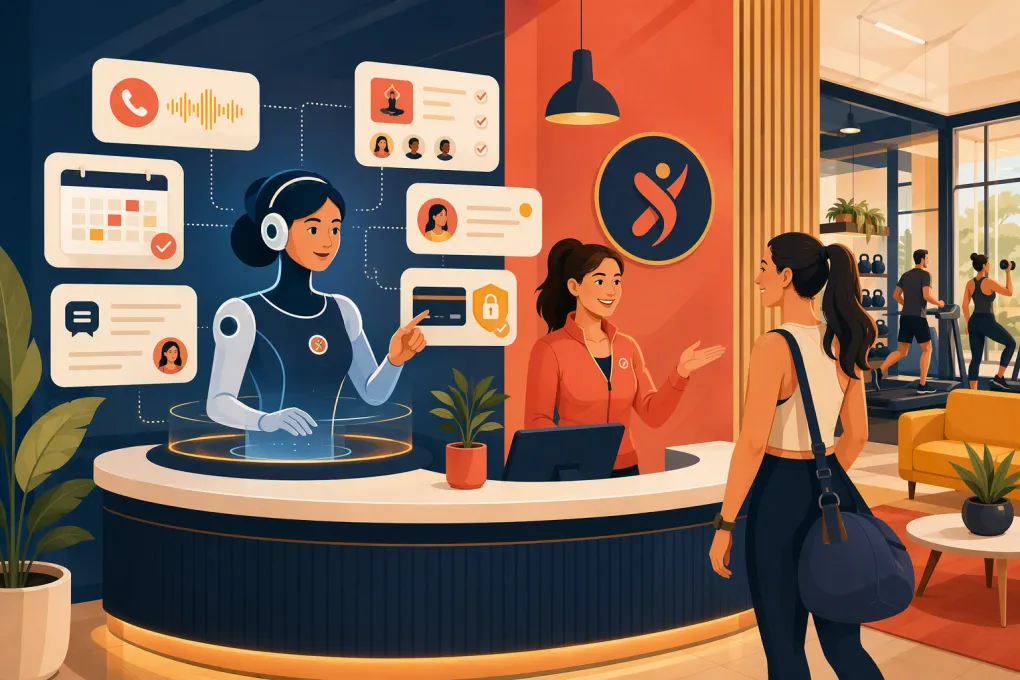
Fitty — your AI receptionist — answers calls and DMs, fills classes, follows up with every lead, and collects dues while you coach.