AI & Automation
AI Receptionist for Taekwondo Schools: A Practical Guide
Learn how an AI receptionist for taekwondo schools can answer leads, book trial classes, follow up, and collect dues without adding front-desk workload.
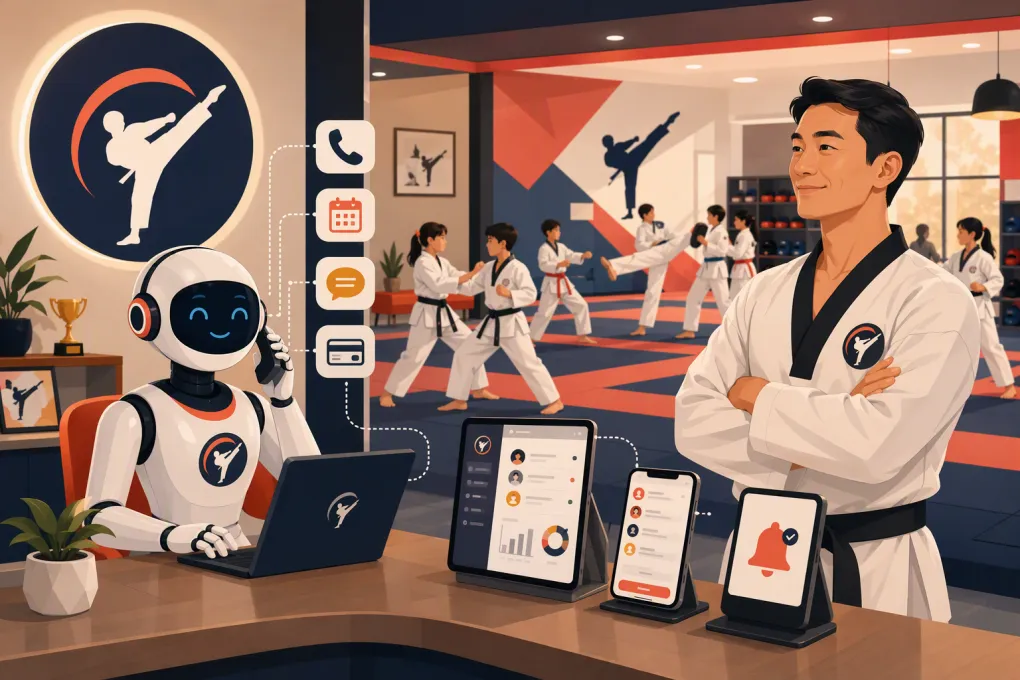 Watch · 20s
A parent sees your taekwondo school after dinner, calls with questions, and wants to book a trial. Nobody answers because the evening class is underway. By the time someone follows up tomorrow, the parent may have contacted two other schools.
That is the operational gap an AI receptionist is built to close. It can respond when instructors are teaching, collect the information needed to qualify a family, book an appropriate trial, and keep following up without asking a coach to live at the front desk.
For taekwondo schools, however, useful automation requires more than a generic chatbot. It needs to understand age groups, class levels, family decision-making, trial policies, schedules, locations, and the point at which a human should take over.
What an AI receptionist actually does
An AI receptionist is a software agent configured to handle defined front-desk conversations. Depending on the platform and enabled channels, it may respond to calls, messages, website inquiries, or existing leads in your database.
For a taekwondo school, its core jobs should include:
- Answering common questions about programs, schedules, location, and what to bring
- Capturing the parent or prospective student’s contact information
- Asking the student’s age, experience, goals, and scheduling preferences
- Matching the prospect with an eligible introductory class
- Booking, confirming, and reminding them about the trial
- Following up with leads who have not booked or attended
- Sending secure payment links for approved balances or dues
- Escalating sensitive or unusual requests to a staff member
The goal is not to make every conversation fully automated. The goal is to prevent ordinary inquiries from sitting unanswered while protecting staff time for teaching, enrollment conversations, and member service.
See how Fitty handles taekwondo leads while your team is on the mat →
Where taekwondo schools lose leads
Most schools do not have a lead problem in isolation. They have a response and follow-through problem.
Calls arrive during class
Peak inquiry times often overlap with after-school and evening programs. An owner teaching a children’s class cannot stop every few minutes to answer the phone. Voicemail captures a message, but it does not answer the parent’s immediate questions or secure the trial.
The inquiry lacks useful information
A website form that collects only a name and email creates another task. Staff still need to determine whether the inquiry is for a preschooler, school-age child, teenager, or adult before recommending a class.
Follow-up depends on memory
A lead may be called once and then disappear under attendance issues, belt testing, payroll, and parent questions. Consistent follow-up becomes difficult when it relies on an instructor remembering to check a spreadsheet.
Trial attendance is treated as the finish line
Booking is only one step. The school also needs confirmations, reminders, no-show recovery, and a clear post-trial enrollment process. Automating the wrong portion of the journey simply moves the bottleneck.
The ideal AI receptionist workflow
A strong workflow guides a prospect from inquiry to a useful next action without turning the conversation into an interrogation.
1. Respond and identify the request
The opening should determine whether the person is a new lead, current member, vendor, or another type of caller. Current-member issues should not be forced through a sales script.
For a new prospect, the agent can ask:
- Is the program for you or someone else?
- What is the student’s age?
- Has the student trained before?
- What would you like taekwondo to help with?
- Which days or times usually work?
- Which location are you interested in?
Only ask questions that affect routing, class eligibility, or follow-up. Long intake scripts create friction.
2. Recommend an eligible trial
The agent should book from rules established by the school, not improvise. Those rules may account for:
- Minimum and maximum ages for each program
- Beginner-only introductory sessions
- Class capacity
- Location and instructor availability
- Whether a parent must remain onsite
- Required arrival time and clothing
- Blackout dates, testing days, and school closures
If the prospect does not fit an available class, the agent should collect their preferences and create a staff follow-up rather than place them in the wrong session.
3. Confirm expectations
A confirmation should include the date, time, location, arrival instructions, clothing guidance, and anything the parent needs to complete beforehand. Clear expectations reduce preventable confusion at check-in.
This is also the right place to explain whether the trial is free or paid, without burying the prospect in membership options before they have visited.
4. Follow up based on behavior
Different outcomes need different messages:
- Booked: Send confirmation and reminders.
- Interested but not booked: Offer appropriate times and a simple booking path.
- No response: Continue a limited, respectful follow-up sequence.
- Canceled: Make rescheduling easy.
- No-showed: Acknowledge the missed visit and offer another eligible session.
- Attended: Trigger the school’s enrollment follow-up process.
The agent should stop sales messages when someone opts out, enrolls, or asks for a staff member.
See how Fitty books trials and follows up with unresponsive leads →
What should stay human
AI works best on structured, repeatable conversations. It should not make judgment calls that affect safety, trust, or contractual rights.
Route these situations to a person:
- Injury, medical, accessibility, or special-support questions
- Bullying, misconduct, or safeguarding concerns
- Refunds, cancellations, charge disputes, and contract disagreements
- Complex family billing arrangements
- Requests for individualized training advice
- Complaints involving an instructor or another student
- Questions the system cannot answer from approved information
Set explicit escalation rules. The agent should tell the person what happens next, collect a concise summary, and alert the correct employee. Pretending to know an answer is worse than making a clean handoff.
Using AI for dues without damaging relationships
Payment follow-up is repetitive, but it is also sensitive. An AI receptionist can notify members about an outstanding balance, answer basic process questions, and send an approved secure payment link.
It should not pressure a member, negotiate an arrangement without authorization, or request card details in an insecure message. Hardship requests, disputed charges, expired agreements, and repeated payment failures belong with staff.
Before automating dues outreach, define:
- Which balance statuses trigger a message
- Which channels may be used
- How often outreach occurs
- When messages stop
- How members can reach a person
- Where the secure payment link directs them
- How resolved balances sync back to the member record
Fitty is designed to combine lead response, booking, follow-up, and dues collection inside the same operating workflow rather than treating each task as a disconnected campaign.
Explore how Fitty can handle routine dues follow-up for your school →
How to set up an AI receptionist correctly
Automation exposes unclear policies. Clean up the underlying process before switching it on.
Build an approved knowledge base
Document the information staff already use to answer routine inquiries:
- Address, parking, and contact details
- Program names and age ranges
- Current class schedule
- Trial policy and eligibility
- What to wear and bring
- Arrival and pickup procedures
- Holiday and closure policies
- Membership options the agent is allowed to discuss
- Escalation contacts and response expectations
Assign someone to update this material whenever schedules, pricing, or policies change.
Connect booking rules
Do not give the agent unrestricted calendar access. Specify which sessions accept trials, how many trial spots are available, required buffers, and when same-day booking closes.
Test edge cases such as siblings in different age groups, prior martial arts experience, full classes, multiple locations, and families requesting a time that does not exist.
Write in your school’s voice
A taekwondo school can be disciplined and professional without sounding cold. Keep responses direct, respectful, and easy for a busy parent to understand. Avoid exaggerated promises about confidence, behavior, fitness, or competition outcomes.
Establish consent and communication controls
Follow applicable calling and messaging rules, maintain consent records where required, honor opt-outs, and work with qualified counsel on your specific obligations. Marketing follow-up should never continue after a clear request to stop.
Run a controlled launch
Start with a narrow set of workflows, such as new-lead FAQs and trial booking. Review transcripts, failed answers, booking errors, and escalations. Add no-show recovery or dues outreach only after the first workflow is reliable.
What to measure
Do not judge the system by how many messages it sends. Measure whether it improves the enrollment process and reduces preventable staff work.
Track:
- Time from inquiry to first response
- Percentage of qualified leads that book a trial
- Trial show rate
- No-show rescheduling rate
- Trial-to-enrollment progression
- Number and type of human escalations
- Booking errors or incorrect answers
- Opt-outs and complaints
- Staff time spent handling routine inquiries
- Outstanding balances resolved through approved workflows
Review the full funnel by location, program, and lead source. A high booking rate means little if prospects are being placed in unsuitable classes or arriving with the wrong expectations.
Choosing the right AI receptionist
Ask vendors to demonstrate your real workflow, not a generic restaurant or dental-office demo. Give them scenarios involving a six-year-old beginner, an adult prospect, two siblings, a full class, a missed trial, and a disputed payment.
Confirm how the system handles booking permissions, multiple locations, data access, opt-outs, human handoffs, conversation review, and updates to schedules or policies. You should also understand what happens when the AI is uncertain and how quickly staff can take control.
The best AI receptionist for a taekwondo school is not the one that talks the most. It is the one that responds reliably, follows your rules, creates clean records, and knows when an instructor or manager needs to step in.
With Fitty and WTF Go, those conversations can connect directly to the operating work behind them: lead management, trial booking, follow-up, and dues collection. That gives owners one process to manage instead of another standalone inbox.
Frequently asked questions
Can an AI receptionist book taekwondo trial classes?
Yes, if it is connected to an approved booking workflow with rules for age, program, capacity, location, and trial availability. It should escalate requests that do not fit those rules.
Will an AI receptionist replace my front-desk staff?
It can take over repetitive inquiries, booking, reminders, and follow-up, but staff should still handle sensitive member issues, complex enrollment decisions, disputes, and safety concerns.
Can an AI receptionist follow up with parents after a missed trial?
Yes. It can acknowledge the missed appointment, offer eligible times, and provide a rescheduling path while stopping outreach when the parent opts out or requests human help.
Can AI collect overdue taekwondo membership dues?
An AI agent can send approved reminders and secure payment links. Disputes, hardship requests, cancellations, and negotiated arrangements should be escalated to authorized staff.
What information does an AI receptionist need from my school?
It needs accurate schedules, program age ranges, trial rules, location details, booking limits, common policies, payment workflows, and clear instructions for human escalation.
Keep reading


Run your gym on autopilot with WTF Go
Fitty — your AI receptionist — answers calls and DMs, fills classes, follows up with every lead, and collects dues while you coach.