AI & Automation
AI Receptionist for Swim School Makeup Class Requests Guide
See how an AI receptionist for swim school makeup class requests can enforce policies, find eligible openings, book families, and reduce staff manual work.
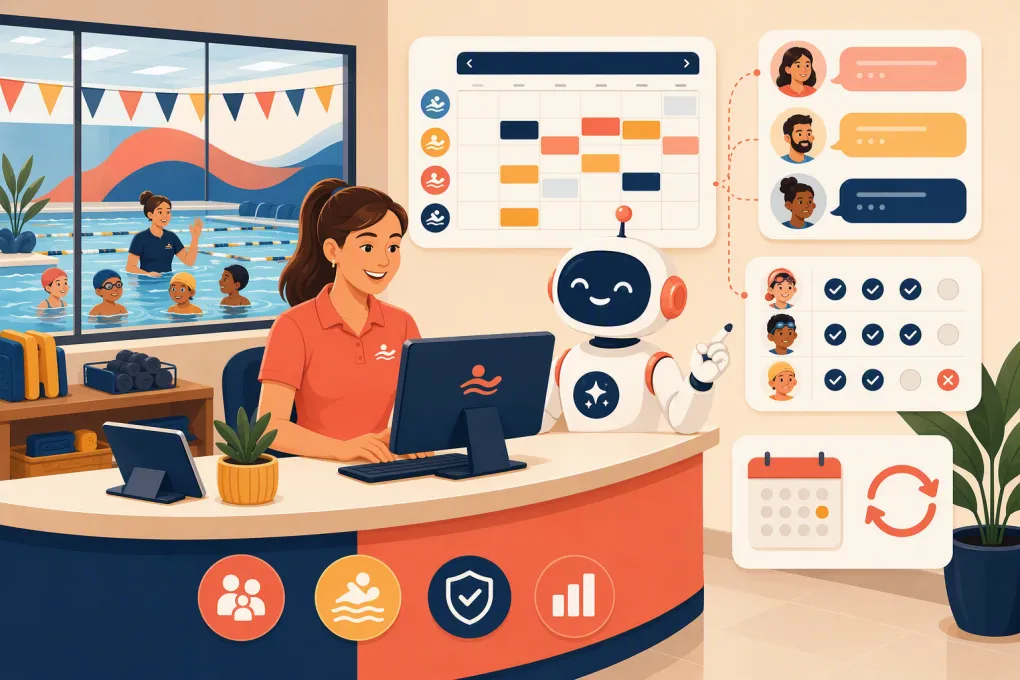 Watch · 20s
A missed swim lesson looks simple from a parent’s side: ask for a makeup class and choose another time. For the front desk, that request can trigger an eligibility check, attendance review, level match, capacity search, expiration check, booking update, and confirmation—all while the phone keeps ringing.
An AI receptionist can take much of that repetitive work off the desk. But it needs more than access to a calendar. It must follow the swim school’s actual makeup policy, protect class capacity, recognize exceptions, and know when a person should take over.
The goal is not to approve every request automatically. It is to resolve routine requests consistently while routing unusual cases to the right employee.
See how Fitty can handle swim school scheduling conversations around the clock →
Why makeup class requests create so much front-desk work
Makeup requests tend to arrive at inconvenient times: before morning lessons, during the after-school rush, after a weekend absence, or late at night when a parent remembers to send a message.
Each request may require staff to answer several questions:
- Is the swimmer currently enrolled?
- Was the missed lesson reported correctly?
- Does the absence qualify for a makeup?
- Has a makeup credit already been issued or used?
- When does the credit expire?
- Which classes match the swimmer’s level and age?
- Is there a real opening, not merely an empty-looking calendar slot?
- Will adding the swimmer affect instructor or pool capacity?
- Does the parent want a one-time makeup or a permanent transfer?
When these checks live in an employee’s memory, enforcement varies. One family receives an exception while another receives a strict reading of the policy. Staff then spend more time explaining decisions and correcting bookings.
An AI receptionist gives the school a consistent first line of response. It can gather the required information, apply approved rules, offer eligible options, and document the interaction.
What an AI receptionist should do with a makeup request
A useful workflow has five parts: identify, validate, match, book, and confirm.
1. Identify the swimmer and missed lesson
The receptionist should collect enough information to locate the correct enrollment without asking the parent to repeat the school’s entire intake process.
Useful fields include:
- Parent or guardian name
- Swimmer name
- Contact information associated with the account
- Missed class date and time
- Current class, level, or instructor
- Reason for the absence, if the policy requires it
The system should not guess when two swimmers have similar names or a family has multiple active enrollments. Ambiguous records should go to staff for verification.
2. Validate eligibility against the published policy
The AI should translate your policy into a clear decision tree. For example:
- Confirm that the swimmer had an active enrollment on the missed date.
- Check whether notice was required before the lesson.
- Confirm that the request falls within the allowed booking window.
- Check whether a credit already exists or has been redeemed.
- Apply any monthly, session-based, or enrollment-based limits.
- Route medical, emergency, billing, and closure-related exceptions to staff.
This prevents the AI from inventing exceptions or making judgment calls beyond its authority. It should explain the applicable rule in plain language and reference the next available action.
3. Match the swimmer to an appropriate class
A calendar opening is not automatically a valid makeup option. The class must fit the swimmer and the school’s operating constraints.
Matching criteria may include:
- Swim level or required skills
- Age range
- Instructor qualifications
- Pool or lane capacity
- Class format and duration
- Location
- Makeup booking window
- Restrictions on joining assessment or progression classes
The best workflow offers a short list of valid options rather than dumping the full schedule on the parent. If no class qualifies, the AI can offer to check again later, collect preferred times, or send the request to staff.
4. Complete the booking without creating conflicts
Before finalizing the reservation, the receptionist should recheck availability. That matters when multiple families are trying to claim the same opening.
The booking record should clearly distinguish a makeup visit from a permanent enrollment change. It should also consume or mark the appropriate credit so the same entitlement cannot be used twice.
If your booking platform cannot support those controls directly, use an approval workflow rather than pretending the process is fully automated. The AI can still gather the details and prepare the request for an employee.
5. Confirm the details and set expectations
A useful confirmation includes:
- Swimmer name
- Makeup class date and start time
- Location and pool, where applicable
- Class or level
- Arrival instructions
- What happens if the makeup is missed
- A clear way to cancel or contact the school
The receptionist should also send an internal record of the action. That gives the front desk context if the parent calls later.
Turn your makeup policy into automation-ready rules
AI cannot repair a vague policy. If staff regularly debate what the policy means, automation will only expose those gaps faster.
Before configuring an AI receptionist, write down the rules in a simple matrix:
| Policy area | Decision to define |
|---|---|
| Eligibility | Which absences qualify for a makeup? |
| Notice | Must the family report the absence before class? |
| Limits | How many active or redeemed makeups are allowed? |
| Validity | When does a credit become available and expire? |
| Class matching | Must age, level, location, and class format match? |
| Capacity | Can makeups use only open spots or also waitlist positions? |
| Cancellations | What happens when a booked makeup is missed? |
| Closures | How are school-canceled lessons handled? |
| Exceptions | Which situations always require manager approval? |
Then test the rules against real scenarios. Use anonymized examples from prior requests, including late notices, sibling accounts, expired credits, full classes, and uncertain skill levels.
Fitty, WTF Go’s AI receptionist, can answer incoming inquiries, support booking workflows, follow up, and keep conversations moving when staff are teaching or the facility is closed. The implementation should reflect your policy rather than replacing it with a generic script.
See how Fitty can turn your makeup policy into a consistent parent workflow →
Requests that should stay under human control
Not every interaction should end with an automated booking. Build explicit handoff triggers for cases involving:
- A swimmer whose level is uncertain
- Safety or supervision concerns
- Accessibility accommodations
- Instructor complaints
- Repeated no-shows or disputed attendance
- Requests to override class capacity
- Account ownership or identity uncertainty
- Billing disputes or refund requests
- Medical circumstances requiring judgment
- Permanent schedule changes disguised as makeup requests
A good handoff includes the collected details, the rule that blocked automation, and the parent’s preferred resolution. Staff should not have to restart the conversation.
The AI also needs boundaries. It should never promise an exception, assess a swimmer’s ability, provide medical advice, or place a child into an unsuitable class merely because a spot appears open.
A practical implementation plan
Audit the current request path
Track where requests arrive: phone, voicemail, email, website forms, social messages, or conversations at the desk. Document who checks eligibility, where credits are recorded, and how parents receive confirmation.
Look for duplicate entry and delays. If staff copy details from voicemail into one system and then manually send a confirmation elsewhere, that is a strong automation opportunity.
Clean up policy language
Create one staff-facing rule set and one parent-facing explanation. Remove phrases such as “subject to availability” unless you define what availability means operationally.
Give the AI approved responses for common outcomes:
- Eligible with available options
- Eligible but no current opening
- Ineligible due to notice requirements
- Expired credit
- Credit already used
- Wrong level or age group
- Manager review required
Connect booking and account information carefully
Decide what the receptionist may read and change. At minimum, it needs a reliable way to verify enrollment, determine eligibility, inspect appropriate openings, and record the outcome.
Use the narrowest permissions that support the workflow. Keep an activity history so managers can review bookings, denials, handoffs, and corrections.
Test before broad release
Run controlled scenarios before allowing automatic booking. Include routine requests and edge cases. Confirm that the system does not expose another family’s information, exceed capacity, reuse credits, or confuse a makeup with a transfer.
Start with a limited scope if necessary. For example, the AI can collect and validate requests while staff approve the final booking. Expand automation only after the rules and records are reliable.
Measure whether the workflow is actually helping
Do not evaluate the AI only by how many conversations it handles. Review operational outcomes such as:
- Time from request to resolution
- Number of requests completed without staff intervention
- Frequency and cause of human handoffs
- Booking corrections caused by level or capacity mismatches
- Duplicate or improperly redeemed credits
- Parent questions after confirmation
- Requests arriving outside staffed hours
Read conversation samples regularly. A high completion count means little if parents are confused or employees spend time repairing the results.
Managers should also review exception patterns. If many requests hit the same handoff rule, the policy may need clarification, the system may need better data, or the school may need a dedicated workflow for that scenario.
Where Fitty fits in the swim school front desk
Makeup scheduling is only one part of the parent journey. The same family may ask about beginner lessons, availability, pricing, enrollment, absences, and overdue payments across separate conversations.
Fitty is designed to act as an always-available receptionist and follow-up agent inside WTF Go. It can help answer leads, book classes, continue follow-up, and collect dues instead of letting requests sit until the next staffed shift.
For swim schools, the practical value is continuity. A parent can receive an immediate response, routine requests can move forward, and employees can focus on safety, instruction, assessments, and the exceptions that genuinely require experience.
Explore Fitty for swim school inquiries, bookings, and follow-up →
Frequently asked questions
Can an AI receptionist automatically book swim school makeup classes?
Yes, if it can verify eligibility, match the swimmer to an appropriate class, confirm capacity, and record the credit correctly. Requests involving exceptions or uncertain levels should be routed to staff.
How does AI know whether a swimmer qualifies for a makeup?
The swim school converts its published policy into defined rules covering notice, enrollment status, credit limits, expiration, and eligible classes. The AI applies those rules and escalates cases that require judgment.
Can an AI receptionist prevent overbooking?
It can help prevent overbooking when connected to reliable, current availability and configured to recheck capacity before confirmation. If live capacity is unavailable, staff approval is the safer workflow.
Should parents know they are speaking with AI?
The experience should be transparent and provide a straightforward way to reach a person. Clear identification and escalation options help set appropriate expectations.
What happens when no suitable makeup class is available?
The AI can collect preferred times, explain the applicable booking window, offer valid alternatives, or route the request to staff. It should not place a swimmer into an unsuitable level just to complete the booking.
Keep reading


Run your gym on autopilot with WTF Go
Fitty — your AI receptionist — answers calls and DMs, fills classes, follows up with every lead, and collects dues while you coach.