AI & Automation
AI Receptionist for Strength and Conditioning Gyms: Guide
Learn how an AI receptionist for strength and conditioning gyms captures leads, books consultations, follows up, and handles member questions fast, 24/7.
 Watch · 20s
A prospect finds your strength and conditioning gym at 9:40 p.m. They want to know whether you train beginners, what the schedule looks like, and how to book an assessment. Your coaches are off the clock. By morning, that prospect may have contacted three other facilities.
That is the practical case for an AI receptionist: not replacing coaches or front-desk staff, but covering the conversations that otherwise sit unanswered. For strength and conditioning gyms, the job is more complicated than sending class times. Leads may be parents, adult beginners, competitive athletes, teams, or people returning from an injury. Each needs a different next step.
A well-configured AI receptionist can respond immediately, ask a few useful questions, book the correct consultation or class, follow up with undecided leads, and handle routine member requests. A poorly configured one can create schedule conflicts, make promises your gym cannot keep, or give answers that should come from a coach.
See how Fitty handles after-hours strength gym inquiries and booking →
What an AI receptionist should actually do
An AI receptionist is a customer-facing agent connected to your gym’s approved information and operating rules. Depending on the system, it can manage inbound questions, lead qualification, scheduling, reminders, follow-up, payment prompts, and handoffs to staff.
For a strength and conditioning business, its core responsibilities should be narrow and operational:
- Respond to new inquiries when staff are coaching or unavailable.
- Identify the prospect’s training goal and experience level.
- Separate adult, youth, athlete, team, and return-to-training inquiries.
- Explain programs using language approved by the gym.
- Book the correct assessment, intro session, or consultation.
- Follow up when a prospect asks questions but does not book.
- Answer routine questions about location, parking, equipment, schedules, and policies.
- Escalate injuries, complaints, billing disputes, and unusual requests to a person.
It should not independently prescribe training, interpret symptoms, guarantee results, or decide whether an injured athlete is safe to participate.
Where strength and conditioning gyms lose leads
Most lead leakage occurs between interest and a clearly scheduled next step. Common failure points include:
Inquiries arriving during sessions
A coach running a small-group session cannot stop to answer a call or conduct a detailed text conversation. Waiting until the session ends may be operationally reasonable, but the prospect experiences silence.
Generic responses to specific goals
A parent asking about off-season development needs a different answer than an adult seeking supervised strength training. A generic message such as “Come try a class” can create uncertainty instead of momentum.
Too much friction before booking
Long forms and open-ended email exchanges make the prospect do the administrative work. The receptionist should gather only what is necessary to route and schedule the lead.
Follow-up that depends on memory
A lead asks about pricing, says they need to check their calendar, and disappears into a coach’s inbox. Without a defined follow-up sequence, warm opportunities are easily forgotten.
Incorrect scheduling
Not every prospect belongs in every session. Youth age bands, athlete groups, semi-private capacity, prerequisite assessments, and coach availability all have to be respected.
The best workflows to automate first
Do not automate every conversation on day one. Start with repetitive workflows where the correct next action is easy to define.
1. New-lead qualification
Keep qualification concise. Useful questions may include:
- Who is the training for: an adult, youth athlete, or team?
- What is the primary goal?
- Is the person currently training or new to structured strength work?
- What days or times generally work?
- Is there an injury or limitation a coach should discuss before booking?
The last question should trigger a staff handoff rather than medical guidance. You may also need a parent or guardian involved before confirming services for a minor.
The outcome should be a specific path, such as an adult consultation, athlete assessment, team inquiry, or coach callback—not a pile of information with no appointment.
2. Consultation and assessment booking
Define exactly what the receptionist is permitted to book. Your rules should cover:
- Appointment type and duration
- Eligible coaches
- Minimum booking notice
- Buffers between appointments
- Facility or room availability
- Capacity limits
- Cancellation and rescheduling windows
- Whether payment or a deposit is required
Avoid connecting an AI agent to an unrestricted calendar. It should expose only approved appointment types and available times.
3. Lead follow-up
Follow-up should reflect what the prospect already told you. A youth athlete lead should not receive an adult fitness message. Someone who completed an assessment should not continue receiving prompts to book one.
Build stop conditions into every sequence. Messages should stop when the lead books, declines, opts out, or requires staff attention. Automated marketing communications must also follow applicable consent, identification, and opt-out requirements.
4. Routine member support
An AI receptionist can take repetitive questions off the coaching floor, including:
- Today’s schedule
- Holiday hours
- How to reschedule
- What to bring to an assessment
- Where to park
- Membership freeze procedures
- How to update a payment method
- Who to contact about programming or an injury
The goal is not to block access to staff. It is to resolve simple requests quickly and route sensitive ones correctly.
5. Dues and payment follow-up
Payment collection is often a communication problem before it becomes a collections problem. An AI agent can notify a member that action is required, provide the approved route for updating payment details, and follow up based on your policy.
It should not expose sensitive payment information in conversation or improvise discounts. Disputes, hardship requests, chargebacks, and exceptions belong with an authorized staff member.
See how Fitty follows up with leads and handles dues without adding front-desk work →
How to configure the receptionist for your gym
The quality of the agent depends on the quality of its instructions. Before launch, document the following.
Build one source of truth
Create an approved knowledge base containing:
- Program names and accurate descriptions
- Age and eligibility requirements
- Current schedule information
- Pricing information you permit the agent to share
- Trial, assessment, and onboarding processes
- Cancellation, freeze, refund, and late-payment policies
- Address, parking, access, and holiday details
- Staff escalation contacts
Assign one person to maintain this information. If policies are scattered across old documents and staff messages, the AI will not fix the underlying inconsistency.
Map intent to the next action
For each common inquiry, specify the desired outcome. For example:
- Adult beginner: Answer basic questions and book a consultation.
- Youth athlete: Confirm age and sport, involve a guardian, and book the appropriate assessment.
- Team training: Collect organization, team size, age group, timeline, and decision-maker details for staff follow-up.
- Injury concern: Avoid advice and route to a qualified coach.
- Current member billing dispute: Escalate to an authorized person.
Define escalation triggers
The agent should hand off when a message involves safety, injury, legal threats, harassment, refunds, complex billing, media requests, facility incidents, or repeated confusion. Also give prospects a direct way to request a person.
Test realistic conversations
Do not test only easy questions. Try misspellings, vague requests, schedule changes, minors, expired offers, sold-out sessions, frustrated members, and prospects who change topics midway through a conversation.
Review whether the agent gives a correct answer, takes the right action, records useful context, and escalates when necessary.
Measure outcomes, not message volume
A high number of automated replies does not prove the system is helping. Review operational measures tied to the lead and member journey:
- Time from inquiry to first response
- Qualified leads reaching a booked next step
- Consultation and assessment attendance
- Leads requiring staff intervention
- Reasons conversations fail to book
- Repeated questions missing from the knowledge base
- Incorrect answers or scheduling attempts
- Payment issues resolved versus escalated
Read conversation samples regularly, especially during the first few weeks and after changing programs or policies. Look for friction: too many questions, unclear choices, weak handoffs, or follow-up that continues after the issue is resolved.
A practical rollout plan
Start with one location or one lead source and a limited set of workflows. A sensible sequence is:
- Document programs, policies, booking rules, and escalation paths.
- Launch answers for common questions and one appointment type.
- Test with staff before exposing the workflow to prospects.
- Add lead follow-up once booking logic is reliable.
- Add member support and payment workflows after reviewing early conversations.
- Audit results and update the knowledge base on a fixed schedule.
For multi-location operators, decide which information is universal and which varies by site. Hours, programs, coaches, prices, and appointment availability should be tied to the correct location. The agent should establish location early instead of making assumptions.
Why an all-in-one system matters
An AI receptionist is most useful when it can move beyond answering questions. If conversations, lead status, booking, follow-up, and payment tasks live in disconnected systems, staff still have to reconcile the journey manually.
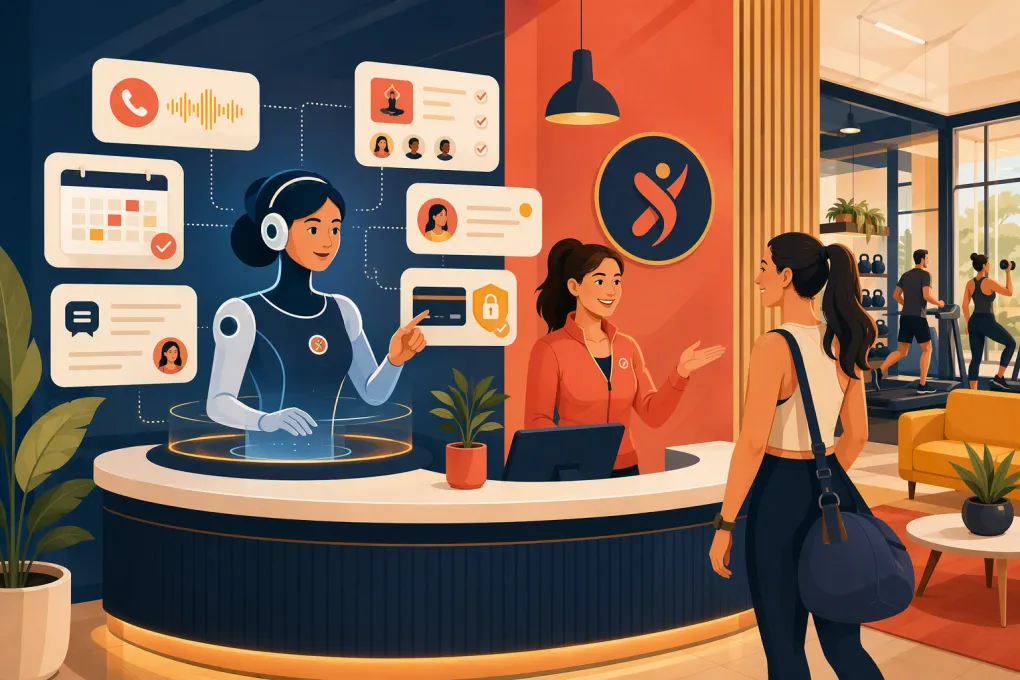
WTF Go combines gym operations with Fitty, its AI receptionist and agent. Fitty can answer leads, book classes, follow up, and collect dues around the clock. That gives owners a practical path from conversation to action without treating the receptionist as a standalone novelty.
The buying question is not simply whether an agent can generate a polished reply. Ask whether it can follow your actual booking rules, preserve the context of a lead, trigger the correct next step, and give staff a clear handoff when human judgment is required.
Explore WTF Go and put Fitty to work on your gym’s lead flow →
An AI receptionist will not compensate for unclear offers, outdated schedules, or inconsistent policies. But when your operating rules are solid, it can close the coverage gaps that cost staff time and leave prospects waiting. Start with one measurable workflow, supervise it closely, and expand only after it performs reliably.
Frequently asked questions
Can an AI receptionist book strength assessments and intro sessions?
Yes, if it has access to approved appointment types, coach availability, capacity limits, and booking rules. Keep its calendar permissions restricted to services it is authorized to schedule.
Can an AI receptionist answer questions about injuries?
It can acknowledge the concern and route the person to a qualified coach, but it should not diagnose an injury, interpret symptoms, or clear someone for training.
Will an AI receptionist replace gym staff?
It is better used to cover routine inquiries, scheduling, follow-up, and payment reminders. Coaches and staff remain essential for assessments, programming, sensitive issues, and relationship building.
What information is needed before launching an AI receptionist?
Prepare current program descriptions, schedules, pricing rules, booking requirements, policies, location details, escalation contacts, and clear instructions for handling minors and injury-related inquiries.
Can Fitty support leads outside normal gym hours?
Yes. Fitty is designed to answer leads, book classes, follow up, and assist with dues around the clock using the gym's configured workflows and information.
Keep reading


Run your gym on autopilot with WTF Go
Fitty — your AI receptionist — answers calls and DMs, fills classes, follows up with every lead, and collects dues while you coach.